
Treat the account, not the individual lead, as the unit of sale in enterprise prospecting: build each sequence around a specific organization's fit, buying signals, and timing. Pair a precise ideal customer profile with intent data and buying-committee mapping, then run outreach across LinkedIn, email, phone, and video in a coordinated cadence. The steps below turn that approach into a repeatable, testable motion, starting with how to define the accounts worth chasing.
TL;DR:
- Score accounts across firmographic fit, technology, and behavioral triggers; assign a named SDR to top tier matches, and nurture accounts lacking a timely signal.
- Exclude current customers, recently lost accounts, and active sequences; verify titles and contact details, then deduplicate at both account and contact levels.
- Use seven touches over 25 days across LinkedIn, email, phone, and video; leave longer gaps for senior leaders and change course when new intent appears.
- Hand off to an account executive only after confirming a named economic buyer, a stated timeline, and an internal champion willing to advocate.
- Test 30 to 50 accounts for eight weeks, review replies and meetings weekly, and revisit targeting or personalization if replies lag after week three.
Table of Contents
- How do you define an operational enterprise ICP?
- Building a prospecting list you can actually test
- Mapping the buying committee and enabling internal champions
- Designing multi-channel cadences that actually get replies
- What to capture before handing a deal to an account executive
- Scoring accounts on fit, intent, and timing
- Which tools and AI practices actually scale enterprise outreach?
- How an 8-week pilot proves the motion before you scale it
- Client playbook and proof: what SDR.ai's pilot data shows
- A head of sales checklist for the first 30 days
- How we help teams run this playbook faster
- FAQ
- Sources
How do you define an operational enterprise ICP?
Most teams write an ideal customer profile once, store it in a slide deck, and never touch it again. An operational ICP works differently: it is a living scoring model that tells reps exactly which accounts deserve five touches a week and which deserve none.
Three categories of data make an enterprise account worth pursuing.
- Firmographic fit: employee count, revenue band, industry vertical, and org structure (does the company have a dedicated function that would own your category?).
- Technographic fit: the tools already in the stack, especially adjacent or competing systems that signal budget and readiness to integrate something new.
- Behavioral triggers: a funding round, a new VP hire in the relevant department, a job posting for a role your product supports, or a public statement about a related initiative.
None of these signals alone justifies outreach. A company that matches your firmographic profile but shows no behavioral trigger is a long-term nurture account, not a this-week priority. Scoring thresholds should map directly to effort: accounts scoring in the top tier get multithreaded, multi-channel sequences with a named SDR; mid-tier accounts get lighter, single-channel touches; bottom-tier accounts go into a quarterly nurture list and nothing more.
In Sales Navigator, that scoring translates into layered boolean filters: company headcount range, industry, geography, and then a keyword layer on job titles to catch recent hires in target functions. A 50-filter sanity check on your list before you launch a sequence catches the accounts that technically match the firmographic filter but clearly are not real buyers, like a staffing agency that happens to share an industry code with your actual target vertical.
That ratio keeps reps from spreading thin across hundreds of mediocre-fit accounts instead of going deep on the thirty or forty that actually convert.
Poor targeting is the most common failure point in enterprise prospecting. A vague ICP does not just waste outreach volume, it inflates every downstream metric (open rates, reply rates, meeting-to-opportunity ratios) with noise that makes it impossible to tell whether your messaging or your targeting is the problem. Fixing the ICP before fixing the message is almost always the higher-leverage move.
Building a prospecting list you can actually test
A list is only as good as the sources feeding it and the hygiene applied before it ever reaches a sequence. Four sources, combined, give a more complete picture than any one alone: your CRM (for exclusion of existing customers and past opportunities), Sales Navigator (for firmographic and role-based targeting), an intent data provider (for in-market signals), and company-level trigger feeds like funding databases or news alerts.
- Pull the raw list from Sales Navigator using your scoring filters, then cross-reference against CRM to strip out current customers, recently closed-lost accounts within a suppression window, and anyone already in an active sequence.
- Enrich contact-level data (verified email, direct phone, current title) through an enrichment tool, and flag any record where the title or company does not match what Sales Navigator originally returned, since job changes happen constantly at this seniority level.
- Deduplicate at the account and contact level. Two SDRs hitting the same VP from two angles in the same week is the fastest way to burn a relationship before it starts.
- Scope the pilot cohort. For a first test, 30 to 50 accounts is enough to generate a meaningful reply-rate signal without overextending a small team.
Pro Tip: Run a 200-contact send-time test before committing a full sequence to a new segment. Varying the day and hour of the first touch across a controlled sample tells you more about real engagement windows than any generic "best time to email" chart, and the send-time testing method is straightforward to replicate internally.
Protecting sender reputation matters as much as list quality. Keep daily send volumes within platform-safe limits, warm up any new domain or LinkedIn account gradually, and route bounced or invalid emails out of future sends immediately rather than letting them accumulate.
Mapping the buying committee and enabling internal champions
Enterprise deals rarely die because one person said no. They die because someone in the room nobody mapped said no quietly, after the call ended. HubSpot's enterprise prospecting guidance points to buying-committee mapping and champion activation as the two moves that separate stalled enterprise deals from ones that close.
A typical enterprise buying committee includes an economic buyer who controls budget, a technical evaluator who stress-tests the solution, a day-to-day user who will live with the tool, and a procurement or legal reviewer who cares about contract terms more than features. Each role weighs a different decision criterion: the economic buyer wants ROI math, the technical evaluator wants integration proof, the end user wants a frictionless workflow.
The stakeholders who matter most are often the ones never listed in your CRM. A practitioner habit worth building into your process: after every discovery call, review the full list of meeting attendees and the email thread's CC line, not just the person who replied to your outreach. Names that show up in calendar invites but never speak on calls are frequently the ones who quietly veto a deal in procurement review weeks later.
Tactics for surfacing these hidden stakeholders include:
- Asking directly, early, "who else needs to sign off on something like this?"
- Scanning the prospect's tech stack for tools that would require integration approval from a security or IT reviewer.
- Watching for a sudden change in meeting attendee count, which often signals the deal has moved to a new internal stage.
Once you have identified a willing internal champion, give them tools to sell on your behalf. A one-page ROI summary with their own numbers plugged in, a short internal email template they can forward to their VP, and a plain-language comparison of the before-and-after workflow all travel further inside a company than another outbound email from you ever could.
Designing multi-channel cadences that actually get replies
Salesforce's 2026 prospecting guidance confirms what most enterprise teams have learned the hard way: single-channel outreach, no matter how polished, underperforms a coordinated sequence across LinkedIn, email, phone, and asynchronous video.
A LinkedIn-first pattern tends to outperform a cold-email-first one for enterprise targets, because a connection request or a comment on a post reads as research rather than interruption. The sequence below is a template, not a rulebook. Adjust the day spacing based on how senior the target is; the more senior the role, the longer the gaps should be between touches.
- Day 1, LinkedIn: view the profile, engage with a recent post if one exists, send a connection request with a short personalized note referencing a specific trigger event.
- Day 3, Email: a short, insight-led message that references the same trigger and poses a genuine question, not a pitch.
- Day 6, Phone: a warm call attempt, ideally timed around a known trigger window like a product launch or leadership change.
- Day 9, LinkedIn: a follow-up comment or direct message referencing something new, a piece of content, a mutual connection, or a company announcement.
- Day 13, Async video: a 60 to 90 second personalized video recapping the specific problem you believe the account faces, sent via email or LinkedIn.
- Day 18, Email: a value-exchange message, offering something concrete (a benchmark, a relevant case reference, a short audit) rather than asking for time.
- Day 25, Phone or LinkedIn: a breakup touch that leaves the door open without pressure.
Each touch carries a distinct intent. Early touches establish relevance and demonstrate research. Middle touches validate that the problem you identified is real for them. Later touches shift toward value exchange, giving the prospect a reason to respond that has nothing to do with your calendar availability.
Pro Tip: Alter the sequence the moment a new signal appears mid-cadence, a job change, a funding announcement, a competitor mention. A sequence built for a cold account should not keep running unchanged once the account turns hot; skip ahead to the value-exchange touch immediately.
For multithreading, run a parallel, lighter version of this same cadence against a second or third stakeholder identified during committee mapping, staggered by a few days so the account does not feel carpet-bombed. Teams running this kind of layered, multichannel approach report reaching 20 or more booked meetings a month once the cadence and targeting are tuned together.
What to capture before handing a deal to an account executive
An account executive who inherits an opportunity with no context re-does the discovery work from scratch, which wastes the goodwill the SDR built and often restarts the sales cycle clock. The fix is a short, consistent qualification checklist applied before handoff, every time.
- Economic buyer identified by name and title, not just a department guess.
- A rough budget or spend signal, even directional, that confirms the deal is financially plausible.
- A stated timeline or trigger event that explains why this account is evaluating now rather than next year.
- Procurement or legal constraints flagged early, especially for regulated industries or public sector accounts with long approval cycles.
- Political risk notes, meaning any sign of internal disagreement, a skeptical stakeholder, or a champion whose influence is uncertain.
HubSpot's guidance and most enterprise playbooks point toward MEDDPICC (Metrics, Economic Buyer, Decision Criteria, Decision Process, Paper Process, Identify Pain, Champion, Competition) as the fuller framework once a deal has multiple stakeholders and a longer cycle. For simpler, lower-ACV enterprise motions, a lighter framework like CHAMP (Challenges, Authority, Money, Prioritization) captures enough to qualify without the overhead. Mapping either framework's fields directly into CRM fields at handoff keeps the record consistent across reps.
The clearest handoff trigger is not a single checkbox but a convergence: a confirmed economic buyer conversation, a stated timeline, and at least one internal champion willing to advocate. When all three are present, the opportunity is ready for an AE. Missing any one of them, it stays in SDR-managed nurture a bit longer.

Scoring accounts on fit, intent, and timing
Fit tells you whether an account could ever be a customer. Intent tells you whether they are actively looking. Timing tells you whether now is the moment. Combining all three into a single prioritization score, rather than chasing whichever signal fired most recently, keeps reps focused on accounts that are genuinely ready rather than merely visible.
| Signal type | Example trigger | Priority action |
|---|---|---|
| Fit | Matches top-tier firmographic and technographic criteria | Add to active sequence at standard cadence |
| Intent | Repeated visits to pricing or comparison pages, research-tool activity | Accelerate to day-1 outreach, skip nurture queue |
| Timing | New VP hire, funding round, competitor churn event | Trigger immediate, personalized outreach referencing the event |
| Fit + Intent, no timing | Strong profile match, active research, no clear trigger | Standard cadence, monitor for trigger before escalating |
| Low fit, high intent | Poor firmographic match despite inbound interest | Light-touch response only, do not commit SDR cycles |
The practice of turning intent signals into booked meetings depends on this kind of layered scoring rather than treating any one signal as sufficient on its own.
Clear exit rules matter as much as entry rules. An account that has received a full cadence with zero engagement across three channels should move to a quarterly nurture list, not a second identical sequence. An account that explicitly says "not now, check back next year" gets a calendar reminder and nothing else until that date. Walking away from a cold account frees capacity for the next high-fit, high-intent one.
Which tools and AI practices actually scale enterprise outreach?
A lean, well-integrated stack beats a sprawling one. The core pieces most enterprise prospecting teams need are a list-building tool like Sales Navigator, a CRM as the single source of truth, an intent data provider, a contact enrichment tool, and a dialer that logs calls automatically.
- Sales Navigator for account and contact discovery using the layered filters described earlier.
- CRM as the one place every qualification field and interaction lives, no exceptions.
- Intent provider to flag in-market behavior before it shows up anywhere else.
- Enrichment tool to keep contact records current as people change roles.
- Dialer with automatic call logging, since manual call notes rarely survive a busy week. A 95% call-matching standard for dialer integration keeps the CRM record reliable enough for an AE to trust at handoff.
AI earns its place in research and first-draft writing, not in final judgment calls. Gartner's 2026 survey found that 69% of B2B buyers still turn to sales reps to validate AI-generated insights, which means a rep's judgment remains the last checkpoint before any AI-drafted message goes out.
Pro Tip: Use AI to draft the first version of a personalized opener based on a trigger event, then have a human rep edit it before sending. The research step is where AI saves the most time; the validation step is where a human still earns their seat.
Operational guardrails matter regardless of tool choice: throttle daily send volume to protect sender reputation, and enforce CRM logging discipline so no touch happens off the record.
How an 8-week pilot proves the motion before you scale it
Before committing a full team and budget to a new enterprise segment, run a bounded pilot. An 8-week window against 30 to 50 accounts is enough to generate a statistically meaningful reply pattern without overcommitting resources to an unproven approach.
- Weeks 1-2: finalize the ICP scoring model, build and enrich the list, and load the cadence into your outreach tool.
- Weeks 3-6: run the full multi-channel cadence, tracking reply rate, positive reply rate, and meetings booked weekly rather than waiting until the end.
- Weeks 7-8: analyze results, document what worked by segment and message variant, and decide whether to iterate the messaging, scale the motion to more accounts, or refocus the ICP entirely.
A pilot built on a 13-14% reply rate benchmark from LinkedIn-first, research-first outreach gives a useful comparison point when evaluating your own pilot's early weeks. If your reply rate lands well below that range after the first three weeks, the problem is more likely targeting or personalization than volume.
The decision at week 8 should be binary and specific: iterate the message and re-run against a fresh cohort, scale the proven cadence to the next tier of accounts, or conclude the segment is not a fit and redirect the budget elsewhere.
Client playbook and proof: what SDR.ai's pilot data shows
Our own 8-week, 30 to 50 account pilot structure gives teams a concrete template rather than a theoretical one, and our LinkedIn-first, research-first approach has produced 13 to 14% reply rates in targeted pilots.
- The LinkedIn-first sequencing and the layered Sales Navigator filtering are both directly replicable by an internal team with the right tooling.
- Matching intent-signal detection and AI-assisted drafting at scale is harder to build in-house without dedicated infrastructure.
- Any benchmark should be read against your own ICP and message quality, not copied as a guaranteed outcome.
A head of sales checklist for the first 30 days
The biggest mistake I see is teams trying to build the entire enterprise motion, full ICP model, full tech stack, full cadence library, before testing anything. Start smaller than feels comfortable.
Run a 30-day micro-pilot against your 10 highest-fit accounts only. Lock in one AE and SDR pairing responsible for that cohort, and assign a single owner for CRM hygiene so nothing falls through administrative cracks. Review reply rate and booked meetings every week, not every month, and adjust messaging based on what the data shows rather than what feels right. Thirty days of disciplined, narrow testing teaches more than ninety days of broad, unmeasured activity.
— Chad
How we help teams run this playbook faster
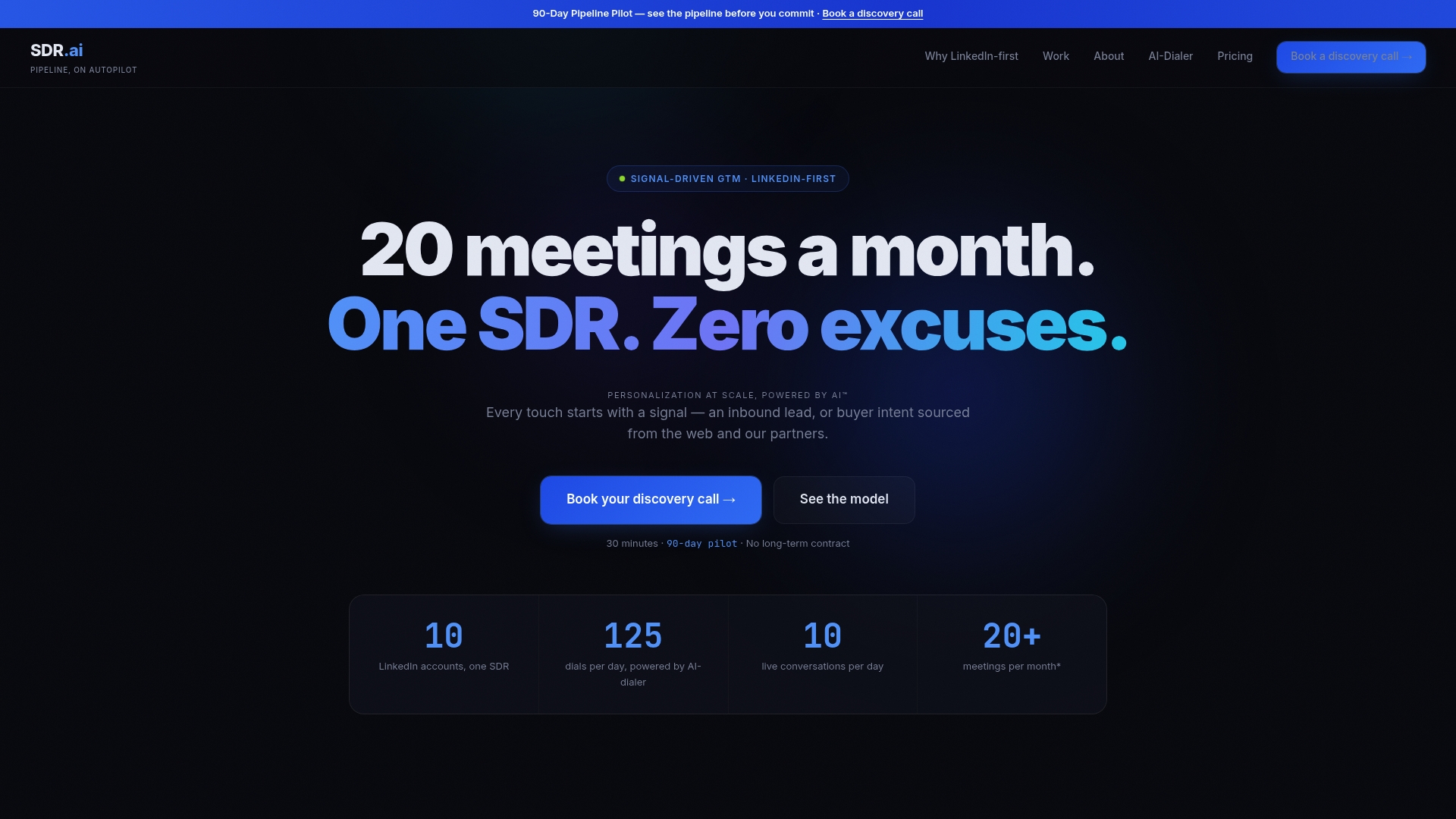
We built our AI-Powered Outbound service around exactly this account-first approach: LinkedIn-first targeting focused only on your ICP and intent signals, with a human SDR handling every reply so the personalization holds up under scrutiny. Instead of spending months hiring and ramping an internal SDR team, you get a working pilot structure, transparent pipeline math, and a system built to book qualified meetings from week one.
- AI-Powered Outbound pricing details are available on the company's official website.
- For teams that want the full method documented for internal use, The Blueprint packages a playbook and process, with pricing available on request.
- Teams that already run outbound internally but want better call logging and connect rates can add an AI-powered dialer tool, with pricing details available on request.
If you want to see the model and the pipeline math before committing, the Sdr covers both in detail, or you can go straight to booking a demo to discuss a pilot structured around your own ICP.
FAQ
What are the 5 P's of prospecting?
Definitions vary across sales organizations, but a common version covers Planning, Prioritization, Personalization, Persistence, and Performance tracking. In practice, this means defining your ICP and cadence in advance, ranking accounts by fit and intent, tailoring each message, following a structured multi-touch sequence, and reviewing reply and meeting metrics regularly.
What is the 3-3-3 rule in sales?
The 3-3-3 rule generally refers to spending roughly 3 minutes researching a prospect, making 3 personalized touchpoints before escalating effort, and allowing roughly 3 days between touches early in a cadence. Teams apply it differently depending on deal size and sales cycle length, so treat it as a starting framework rather than a fixed standard.
What is the 30-60-90 rule in sales?
The 30-60-90 rule typically describes a new rep's ramp plan: the first 30 days focus on learning the ICP, tools, and messaging, the next 30 on running live cadences and gathering early feedback, and the final 30 on hitting independent pipeline targets. For a prospecting motion rather than a new hire, the same structure maps well onto an 8-week pilot followed by a scaling decision, as described in our pilot template.
What is the most effective prospecting strategy for enterprise accounts?
No single channel outperforms a coordinated, multi-channel sequence that combines LinkedIn research, email, phone, and asynchronous video around a precise ICP and real intent signals, according to Salesforce's prospecting guidance. Mapping the full buying committee and activating an internal champion, as outlined in HubSpot's enterprise prospecting research, consistently outperforms single-threaded outreach to one contact.
How do you keep personalization quality high while scaling outreach?
Use AI to speed up research and draft early messaging, but keep a human reviewing every message before it sends, since Gartner's 2026 survey found 69% of B2B buyers still rely on reps to validate AI-generated insights. Pair that discipline with throttled send volumes and strict list hygiene so reputation does not degrade as volume grows.
Sources
- Gartner survey: 69% of B2B buyers turn to sales reps to validate AI-generated insights — Gartner
- B2B sales prospecting: Top strategies for 2026 — Salesforce
- Enterprise sales prospecting — HubSpot