
Account-based outreach means picking a finite list of named accounts, mapping the people who actually influence the buying decision, and running coordinated, personalized cadences prioritized by fit and live intent signals, rather than blasting a generic sequence at thousands of contacts. The recommended stance for most revenue teams: pilot a list of a moderate number of accounts, rank them by signal density, and run multithreaded cadences across email, LinkedIn, and calling. Teams that do this consistently see deeper engagement and shorter sales cycles than volume outbound produces.
TL;DR:
- Account-based outreach targets multiple stakeholders within high-fit, active accounts showing clustered signals, increasing engagement and deal velocity.
- The process involves selecting, researching, mapping stakeholders, building value hypotheses, sequencing multichannel cadences, and measuring account-level progress.
- Prioritization combines static fit signals with dynamic intent signals, focusing effort on accounts with high fit and recent urgency signals like funding or job postings.
- Successful outreach uses layered, personalized messaging for each stakeholder and escalates when multiple contacts engage within a short window.
- Metrics to track include stakeholder response depth, pipeline conversion, deal cycle speed, and win-rate uplift, rather than traditional contact-focused email metrics.
Table of Contents
- What Is Account-Based Outreach and Why Does It Beat Volume Outbound?
- The Step-by-Step Operational Workflow for Account-Based Prospecting
- How Do You Select and Prioritize Accounts for Outreach?
- Mapping the Buying Committee Without Guessing
- Which Intent Signals Actually Predict a Good Time to Reach Out?
- How to Write Value Hypotheses That Actually Land
- Building a Multichannel Cadence That Doesn't Burn the List
- What Metrics Actually Prove Account-Based Outreach Is Working?
- What Does Account-Based Outreach Look Like in Practice?
- Should Your Team Commit to Account-Based Outreach Right Now?
- How SDR.ai Runs Account-Based Outreach for You
- Sources
What Is Account-Based Outreach and Why Does It Beat Volume Outbound?
Volume outbound treats every contact as an isolated unit. Send 500 emails, book a few meetings, move on. Account-based outreach (often shortened to ABP, or account-based prospecting) flips the unit of work from the individual to the account itself. Instead of chasing one contact per company, you're coordinating outreach to three, four, or five people inside the same organization, each with a different job title, a different set of priorities, and a different reason to say yes.
That shift changes everything about how you resource and sequence the work. A rep researching one account for 45 minutes and then reaching four stakeholders with tailored messages produces a fundamentally different response pattern than a rep sending the same template to 200 strangers. The account-based prospecting model requires stakeholder mapping and coordinated multi-touch sequencing precisely because isolated, one-off touches rarely move a buying committee.
Multi-stakeholder coordination also does something volume outbound structurally can't: it creates internal referral pathways. When a champion mentions your outreach to their VP, or a technical evaluator forwards your case study to procurement, that's context volume outbound never generates. And accounts showing several signals at once, a new VP of sales plus a recent funding round plus job postings for the exact role you sell into, convert at a different rate than accounts with a single isolated trigger. That clustering, sometimes called signal density, is the single biggest lever separating high-performing ABP programs from spray-and-pray lists.
- Account becomes the unit of work, not the individual contact
- Multiple stakeholders reached in parallel, not sequentially
- Clustered signals get prioritized over single, isolated triggers
- Internal referral pathways emerge naturally from multi-threaded outreach
The Step-by-Step Operational Workflow for Account-Based Prospecting
Running account-based outreach without a repeatable process is how most pilots quietly die after three weeks. The workflow below breaks the motion into six steps, each with a specific deliverable, so a sales, marketing, or RevOps team can hand off work without losing context.
-
Select the account. Pull from your ICP filters (firmographic and technographic fit) plus current intent data, and produce a one-page account brief: company size, tech stack, recent news, and why this account made the list. Marketing or RevOps typically owns this step since it draws on data tooling like target account management platforms that match leads to accounts and surface named lists in one place.
-
Research the account. Go beyond the firmographics. Read the last two quarterly filings or press releases, scan the leadership team's recent LinkedIn activity, and note any product launches or org changes. The deliverable here is a short research doc, not a data dump, three to five bullet points a rep can read in ninety seconds before a call.
-
Map the stakeholders. Identify three to five people across the buying committee and document their likely priorities. The output is a stakeholder map, usually a simple grid: name, role, probable concern, and preferred channel.
-
Build value hypotheses. For each stakeholder, write one or two sentences on why your offering matters to their specific role. Sales owns this jointly with whoever holds messaging, often a sales enablement or marketing lead. The deliverable is a short list, typically five value hypotheses per account, one per key stakeholder plus a backup angle.
-
Sequence the cadence. Turn the research and hypotheses into an actual send schedule across email, LinkedIn, and calls. RevOps or sales ops usually builds the cadence template; reps customize the top two touches per account. The deliverable is a cadence playbook mapped to a calendar.
-
Measure and review. Track engagement and pipeline weekly, and review account-level progress in a standing meeting. The deliverable is a live dashboard, reviewed by sales leadership weekly and by cross-functional stakeholders monthly.
Target account selling methodology frames this same six-step arc as concentrating limited selling resources on high-fit accounts rather than spreading them thin, which is exactly the tradeoff a finite named list forces you to make. Skip the deliverables and you're just doing volume outbound with extra steps.
How Do You Select and Prioritize Accounts for Outreach?
A named list only works if every account on it earns its spot. Put too many accounts on the list and you're back to volume outbound with better branding. Put too few and you starve pipeline. The fix is separating what's static from what's dynamic in your account targeting.
Static fit signals answer "could this account ever be a good customer?" That includes firmographic data (headcount, revenue band, industry) and technographic data (what's already in their stack, whether a competing or complementary tool shows up in job postings). These signals barely change month to month, so they form your baseline ICP filter.
Dynamic intent signals answer a different question: "is this account showing urgency right now?" New leadership hires, funding announcements, website research surges, and job postings for roles tied to your solution all qualify. Modern account targeting increasingly leans on this intent layer as the real differentiator between programs that convert and programs that stall, because fit alone tells you who to watch, not who to call today.
Combine the two into a priority queue you can actually explain to a rep, not a black-box score nobody trusts. A simple tiering structure works well:
- Tier 1: High fit, high intent. One-to-one, deeply personalized outreach with custom research per stakeholder.
- Tier 2: High fit, moderate intent. One-to-few outreach, templated but segmented by persona.
- Tier 3: Moderate fit, unclear intent. Programmatic nurture until a signal promotes the account upward.
Pro Tip: Keep the scoring logic visible to the rep, even if it's just three bullet points on why an account moved up the queue. Reps ignore scores they can't explain, no matter how sophisticated the model behind them.
Mapping the Buying Committee Without Guessing
Most B2B deals over a few thousand dollars involve more than one decision-maker, and account-based outreach that only reaches a single contact is gambling on that person having both the authority and the motivation to champion your deal internally. Mapping the buying committee means identifying who plays which role before you send a single message.

Start with three archetypes: the champion or day-to-day user who feels the pain most directly, the technical evaluator who vets whether your solution actually works, and the economic buyer who signs off on budget. Larger accounts often add a fourth or fifth stakeholder, procurement or a security reviewer, but those three cover most mid-market deals.
For each stakeholder, record what actually matters for sequencing:
- Their likely priority (cost reduction, speed, risk mitigation, career impact)
- The metric they'll personally be judged on
- Preferred contact channel and typical response window
Sequencing rules follow naturally from the map. Reach the champion first since they're the easiest entry point and often the fastest reply. Bring in the technical evaluator once the champion engages, so the conversation has credibility behind it. Save the economic buyer for after you have internal validation, ideally referencing the champion's interest without disclosing anything confidential. A typical micro-plan: Monday, LinkedIn message to the champion. Thursday, email to the technical evaluator referencing "conversations with your team." The following Monday, a call attempt to the economic buyer once two internal touches have landed.
Which Intent Signals Actually Predict a Good Time to Reach Out?
Not every signal deserves the same weight, and treating them all equally is how teams end up chasing accounts that looked promising on paper and went cold in week two. The signals worth tracking operationally are the ones tied to a real, time-bound trigger:
- New executive hires in a relevant function (a new VP of sales, a new head of revenue operations)
- Funding announcements, especially Series A through C rounds
- Job postings for roles your product supports or replaces
- Site traffic surges on pricing or product pages
- Product launches or public roadmap announcements
The real edge isn't any single signal, it's clustering. An account with three or four signals firing in the same window deserves a same-week outreach push. An account with one isolated signal, say a single job posting, probably belongs in a nurture track instead of an immediate call. That layered approach, static ICP fit plus a live "what's happening today" queue, is what separates programs that consistently hit quota from ones that burn out reps chasing noise.
Because buyer experience and personalization now drive measurable commercial outcomes, the accounts you reach in that narrow window when signals cluster convert at meaningfully better rates than accounts reached cold. Keep the "why this account, why now" logic visible in your CRM notes so an AE can explain the prioritization in one sentence, not defend a mystery score.
How to Write Value Hypotheses That Actually Land
Generic messaging is the fastest way to waste a well-researched account list. A value hypothesis forces you to connect your product to something specific happening inside that company, for that specific stakeholder, before you write a single line of outreach copy.
Use a six-block structure for each hypothesis:
- Business imperative: What pressure is the company under right now (growth target, cost cutting, compliance deadline)?
- Initiative: What project or program is likely addressing that pressure?
- Our play: How does your product or service plug into that initiative?
- Benefit: What specific outcome does this stakeholder get (time saved, risk reduced, revenue unlocked)?
- Differentiator: Why you over the obvious alternative, including doing nothing?
- Evidence: A case study, statistic, or proof point that makes the claim credible.
A hypothesis for a VP of sales might read: "Given your recent headcount growth, you're likely under pressure to ramp new reps faster. Our AI-assisted outreach can compress ramp time without adding management overhead." A hypothesis for an economic buyer skews toward cost and risk instead of workflow.
Content mapping follows the same logic: send the champion a short, relevant case study early; hold the detailed ROI breakdown for the economic buyer once they're engaged. Personalization done well multiplies customer value rather than adding it incrementally, which is exactly why generic messaging underperforms even well-targeted lists.
Building a Multichannel Cadence That Doesn't Burn the List
A cadence is where research and stakeholder maps either turn into meetings or die in an inbox. The sequence matters as much as the message. Here's a sample 6 to 8 week pattern for a mid-market account with three mapped stakeholders:
- Week 1: LinkedIn connection request plus a short note to the champion referencing something specific from your research.
- Week 2: Follow-up email to the champion with a relevant asset (case study, short video, or benchmark).
- Week 3: First outreach to the technical evaluator, referencing the initiative rather than the champion by name.
- Week 4: Call attempt to the champion; voicemail referencing the earlier LinkedIn touch.
- Week 5: Email to the economic buyer, framed around business impact, mentioning that "your team has been exploring this area."
- Week 6: Second LinkedIn touch to the technical evaluator with a more technical asset.
- Week 7: Coordinated push: email plus call to whichever stakeholder has engaged most.
- Week 8: Final direct ask for a meeting, or a graceful pause if no engagement across all three contacts.
Referencing prior touches across stakeholders takes care. Say "your colleagues have found this useful" rather than naming a specific person's exact reply, that keeps the reference natural without breaching any implied privacy between coworkers.
Escalate when you see two or more stakeholders engage within the same week, that's a signal to bring in a manager or move faster on scheduling. Pause an account after eight weeks of zero response across all three contacts and all three channels; forcing a ninth touch rarely changes the outcome and it damages sender reputation for future cadences.
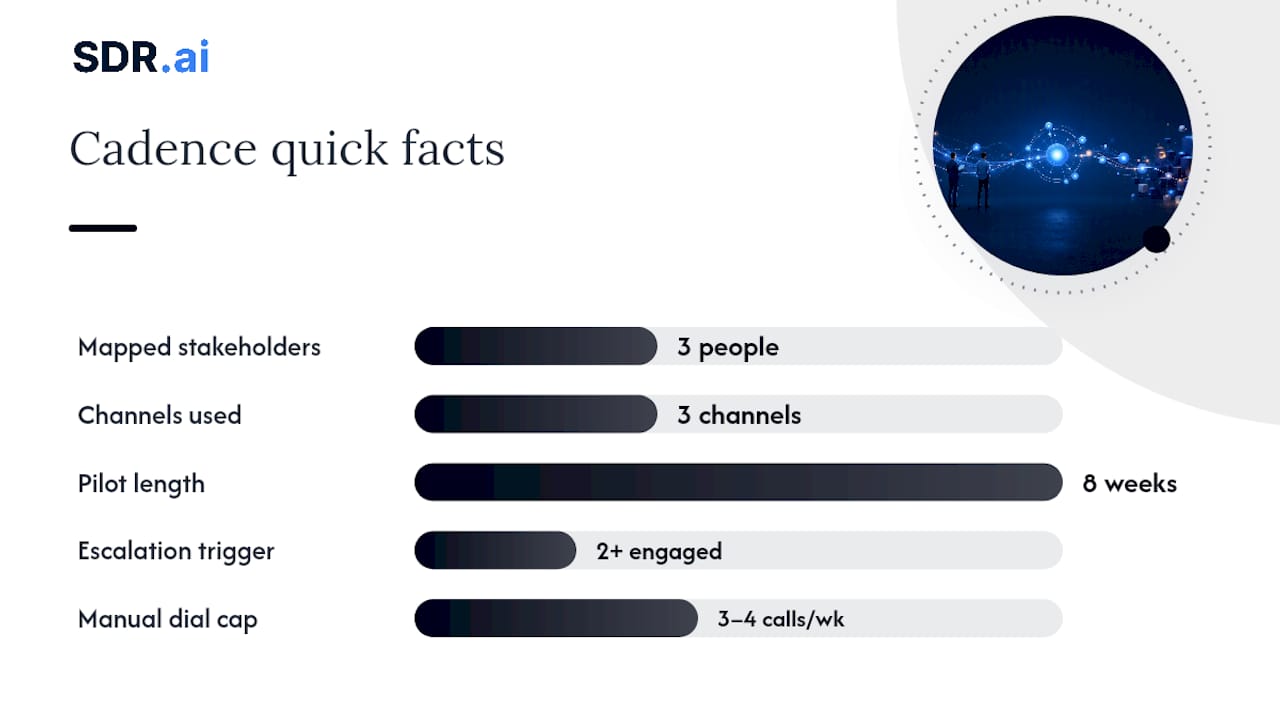
Pro Tip: Cap manual dial attempts at three to four per stakeholder per week. Beyond that, an AI-assisted dialer that runs parallel call attempts protects a rep's calendar without sacrificing call volume.
What Metrics Actually Prove Account-Based Outreach Is Working?
Standard outbound metrics like open rate and reply rate don't capture what account-based outreach is actually trying to accomplish. You need metrics that reflect account-level progress, not contact-level activity.
- Engagement depth: How many stakeholders per account have responded to at least one touch, not just whether one person replied.
- Pipeline-from-list: What percentage of your named accounts convert to a qualified opportunity, tracked against the full list, not just the accounts that responded.
- Cycle compression: Whether deals sourced from mapped, multithreaded accounts close faster than deals from single-threaded outbound.
- Win-rate uplift: Comparing close rates on accounts with three or more engaged stakeholders against accounts with only one.
- Expansion signals: Whether closed accounts show early signs of upsell or referral, a sign the initial multithreading paid off beyond the first deal.
Review engagement depth and pipeline-from-list weekly in an operational standup. Save win-rate uplift and expansion signals for a monthly strategy review, since those numbers need a larger sample to mean anything. Retire an account after eight to ten weeks of flat engagement across every mapped stakeholder; promote an account to Tier 1 the moment two or more people engage inside the same two-week window.
What Does Account-Based Outreach Look Like in Practice?
The workflow above isn't theoretical. It maps directly onto how AI-enabled sales development teams already operate. SDR.ai runs LinkedIn-first outreach paired with an AI dialer, which mirrors the multichannel cadence structure: LinkedIn touches build familiarity, then calls close the loop once a stakeholder has already seen a name in their notifications.
The intent-prioritization layer works the same way described above; instead of a rep guessing which of two hundred accounts deserves attention this week, an AI-driven signal layer flags accounts showing clustered activity and pushes them to the top of the queue.
The pattern that separates programs booking real meetings from programs that stall isn't more volume. It's fewer accounts, worked with more context, reached through more than one channel, by more than one message tailored to more than one person inside the company.
Clients running this model report booking many qualified meetings each month with fewer resources a traditional SDR team would require, largely because the signal layer removes the guesswork from account selection and the multichannel cadence removes the single-point-of-failure problem of reaching only one contact per company.
Should Your Team Commit to Account-Based Outreach Right Now?
Before committing, run an honest readiness check: do you have the bandwidth for research-heavy prospecting, a handful of tailored content assets per persona, clean enough data to build a real named list, and a cross-functional rhythm between sales and marketing? If any of those is missing, fix it first or you'll run a pilot destined to underdeliver.
Volume outbound still makes sense for low-price, high-velocity products where per-account research doesn't pay for itself. Account-based outreach earns its cost on deals large enough to justify the time.
A workable pilot: eight weeks, 30 to 50 accounts, one rep and one marketer, weekly standups, and a single success metric, meetings booked with at least two engaged stakeholders per account. Anything more ambitious for a first pilot usually collapses under its own complexity.
— Chad
How SDR.ai Runs Account-Based Outreach for You
Building the workflow above in-house means hiring for research, buying intent data tools, and training reps on stakeholder mapping before the first meeting ever gets booked. SDR.ai skips that ramp entirely: the signal-detection layer flags high-intent accounts automatically, LinkedIn-first messaging opens the door with each mapped stakeholder, and the AI Dialer handles the calling cadence in parallel so reps aren't stuck dialing one number at a time.
Whether you want the whole motion run for you on retainer or you'd rather license the dialing technology and run cadences with your own team, both paths start from the same signal-prioritized account list described in this playbook. If you're deciding between building this in-house or handing it to a team that already runs it daily, the honest comparison between an AI SDR and a traditional SDR agency lays out the tradeoffs plainly. For teams ready to see what a pilot looks like against their own account list, Sdr and get a straight answer on what a retainer or a dialer license would realistically produce for your pipeline.
Sources
- The value of getting personalization right — McKinsey
- Impact of personalization — Gartner
- Account-Based Prospecting Playbook: What Actually Works in 2026 | AFF Lab
- Monday
- What is target account marketing in 2026? B2B guide — Abmatic