
Multichannel outreach means reaching prospects through more than one channel, typically email and LinkedIn, in a coordinated sequence rather than isolated blasts. Done right, it lifts reply and meeting rates well above single-channel efforts. The move that actually works in 2026 isn't adding five channels at once. It's mastering two, email and LinkedIn, measuring reply rate and meetings booked, and only then scaling up.
TL;DR:
- True multichannel outreach requires native automation of email, LinkedIn, and phone sequences, not just having presence on multiple channels separately.
- Scalable, reliable sequences depend on conditional logic such as skip, trigger, and escalation rules, combined with strict governance and hygiene protocols.
- Combining email and LinkedIn with timing aligned to prospect signals can triple reply rates compared to single-channel efforts, but adding more channels too early often reduces efficiency.
- Data quality and real-time CRM integration are critical for behavior-reactive sequences, with tools and processes needing clear ownership to maintain performance and compliance.
- Outsourcing multichannel outreach through managed providers offers a faster, more proven path than building full in-house systems from scratch.
Table of Contents
- What Counts as Real Multichannel Outreach?
- Which Channels Actually Move the Needle in B2B?
- How Do You Design a Multichannel Sequence That Converts?
- What Data and Tools Does Reliable Sequencing Require?
- Which KPIs Actually Prove Multichannel Outreach Works?
- How Should You Roll Out Multichannel Outreach in Phases?
- How Does SDR.ai Apply This Playbook in Practice?
- What Should You Budget for a Multichannel Outreach Campaign?
- What Compliance Rules Apply to Multichannel Outreach?
- How Do You Keep Messaging Consistent Across Channels?
- What Multichannel Outreach Actually Gets Wrong in Practice
- Want a Managed Path Instead of Building It Yourself?
- Sources
- FAQ
What Counts as Real Multichannel Outreach?
Most teams claiming multichannel outreach are running email in one tab and LinkedIn in another, manually copying names between them. That's not a system. That's a person doing the job a system should do, and it falls apart the moment volume increases.
Genuine multichannel outreach requires native channel execution, meaning your sequencing tool actually sends the LinkedIn connection request, logs the phone call outcome, and triggers the next step, without a human alt-tabbing between five browser windows. WordStream draws a clear line here: multichannel is simply having a presence on several channels, while cross-channel coordination means those channels share audiences, creative logic, and triggers. A tool that can't pass data between channels automatically gives you multichannel presence without cross-channel coordination, which is a weaker version of the same idea.
The practical test is simple. Ask any vendor: "If a prospect opens my email three times but doesn't reply, does your system automatically delay the LinkedIn touch, or does it fire on schedule regardless?" If the answer is "it fires regardless," you're buying a scheduler, not a sequencing engine.
Unified sequencing also needs conditional logic baked in, not bolted on. That means:
- Skip rules: if a prospect replies on email, LinkedIn steps in that sequence pause automatically.
- Trigger rules: a website visit or LinkedIn profile view can bump a prospect into a faster cadence.
- Escalation rules: after two ignored touches, the sequence hands the lead to a live rep instead of continuing to blast messages into silence.
Governance matters just as much as logic. Set an impression frequency cap (no more than one touch per channel per 48 hours per prospect), assign a deliverability owner who watches email health metrics weekly, and stagger send times so an account doesn't get an email, a LinkedIn request, and a call all in the same hour. That last one feels like enthusiasm to your team and feels like harassment to the prospect.
Pro Tip: Before scaling any sequence past 50 accounts a week, run it manually on 10 accounts first. You'll catch broken skip logic and tone mismatches that a dashboard will never show you.
Which Channels Actually Move the Needle in B2B?
Email remains the foundation of B2B outreach because it's asynchronous, easy to personalize at scale, and doesn't require permission to send. Its weakness is fatigue. Deliverability drops fast when domains send high volumes without warmup, and generic templates get ignored or, worse, flagged.
LinkedIn adds a layer email can't: social proof. A connection request from someone who shares three mutual connections and comments intelligently on industry posts reads differently than a cold inbox message. Timing matters here more than most reps realize. Sending a LinkedIn request the same day as a cold email often reads as aggressive; waiting 2 to 3 days after an email open (if you can see it) or after a positive signal performs better.
Phone still closes gaps the written word can't, particularly for urgent, time-sensitive deals or when a prospect has engaged but gone quiet. Voicemail drop combined with a same-day follow-up email consistently outperforms either channel alone. One practical note: outbound calling and SMS carry consent and disclosure obligations that vary by jurisdiction, and the EU's GDPR framework sets the baseline most global teams design around even outside the EU.
Video and SMS are accelerants, not foundations. A 45-second personalized video dropped at step 3 or 4 of a sequence, Sendspark's data shows, works as a pattern interrupt precisely because almost nobody else is sending one. SMS works best for confirming a scheduled call, not for cold prospecting, where it can feel invasive.
| Channel | Best use | Typical limitation |
|---|---|---|
| Scalable first touch, asynchronous follow-up | Deliverability decay, template fatigue | |
| Building credibility, warming cold accounts | Connection request limits, slower cadence | |
| Phone | Urgent qualification, breaking through silence | Low answer rates without pre-warming |
| Video | Pattern interrupt at mid-sequence | Time-intensive to personalize at scale |
| SMS | Meeting confirmations, high-intent nudges | Feels intrusive as a cold-outreach channel |
The channel-selection rule that holds up across most outbound programs: two well-executed channels beat five mediocre ones. A sequence that nails email copy and LinkedIn timing will outperform a five-channel sprawl where nothing gets the attention it needs.
How Do You Design a Multichannel Sequence That Converts?
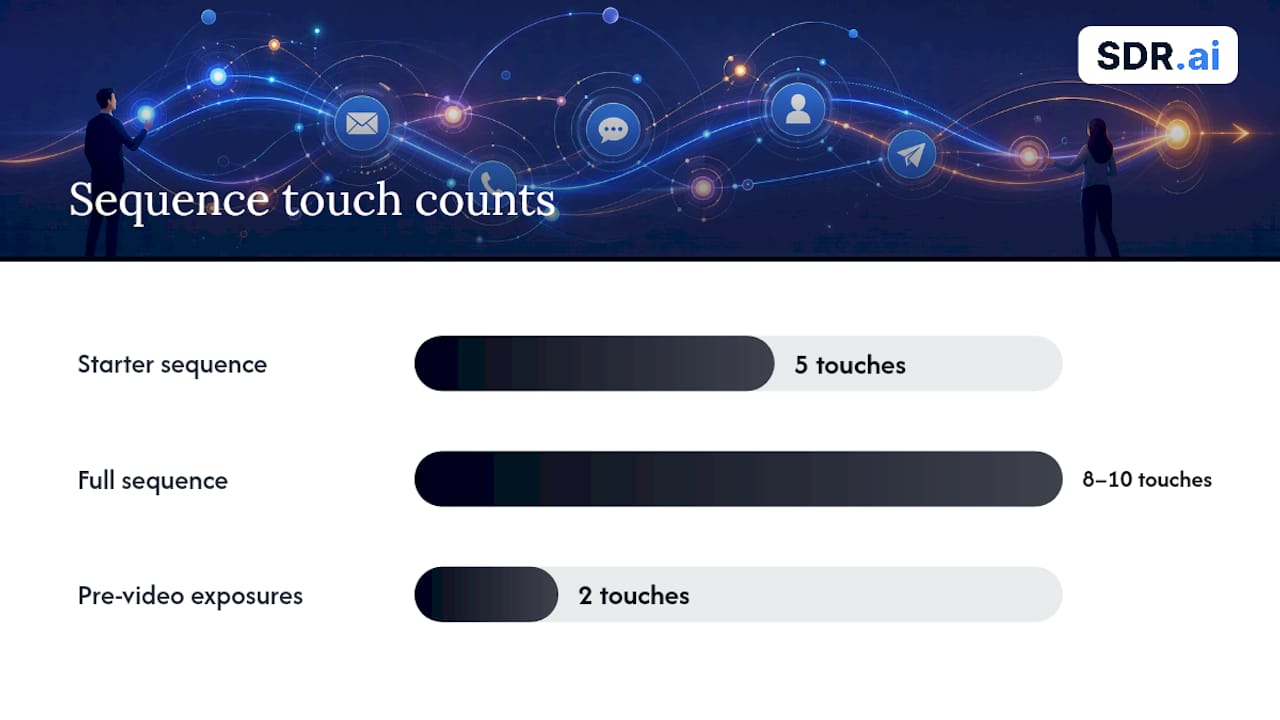
Start small. A two-channel starter sequence removes the temptation to overbuild before you know what's working.
- Day 1: Personalized email referencing a specific trigger (funding round, job change, product launch). Keep it under 100 words.
- Day 3: LinkedIn connection request with a one-line note tied to the same trigger, no pitch.
- Day 6: Follow-up email with a different angle, a case-relevant proof point, and a soft call-to-action.
- Day 9: LinkedIn message (post-connection) offering a specific resource or insight, not a meeting ask.
- Day 13: Breakup email: short, low-pressure, explicitly closing the loop.
That five-touch sequence, run consistently across a segment of 200 to 300 accounts, gives you a clean baseline: reply rate by channel and meetings booked per 100 sequences run.
Once that baseline is stable, expand into a fuller 8 to 10 touch sequence:
- Personalized email (trigger-based)
- LinkedIn connection request
- Phone call attempt with voicemail
- Email referencing the voicemail
- Short personalized video (Sendspark or similar) sent via email or LinkedIn message
- LinkedIn engagement (comment on their post, or a message reacting to shared content)
- Second phone attempt, different time of day
- Value-add email (industry stat, competitor move, relevant resource)
- LinkedIn message with direct meeting ask
- Breakup email
Video works best inserted at steps 5 or 6, mid-sequence, after the prospect has seen your name at least twice already. Sending it as touch one wastes the pattern-interrupt effect on someone who has no context for who you are.
Build in branching logic so the sequence reacts to behavior instead of running blind. If a prospect opens the same email three times without replying, that's high intent with hesitation. Escalate to a phone call within 24 hours rather than waiting for the next scheduled email. If a prospect replies with any objection, even a soft "not right now," pull them out of the automated sequence entirely and route to a human. Automated persistence after an explicit response reads as either a broken system or contempt for the prospect's time. Neither helps you close.
Pro Tip: Set a rule that pauses all further touches the moment a prospect clicks a link or replies. It sounds obvious, but a shocking number of sequences keep firing after engagement simply because nobody built the pause logic.
Hygiene rules protect the sequence's reputation over time. Always include a genuine breakup message, since SyncGTM's outreach data and most practitioner playbooks agree that breakup emails often generate replies at rates higher than several prior touches combined, simply because they remove pressure.
What Data and Tools Does Reliable Sequencing Require?
Sequencing logic is only as good as the data feeding it. Three fields are non-negotiable before you launch any multichannel sequence: a verified email address, a LinkedIn profile URL, and, where available, a direct phone number. Missing any one of these doesn't kill the sequence, it just forces a channel skip, which your system needs to handle gracefully rather than sending a broken step.
CRM writeback matters more than most teams budget for. Every touch, every reply, every call outcome needs to log back to the CRM automatically, not through a rep manually updating fields at the end of the week. Without that writeback, attribution breaks and handoff to an account executive becomes guesswork instead of a clean transfer of context.
Here's the honest technical decision most B2B teams face: do you need a full customer data platform, or will a lighter setup work?
- If you're running four or more paid channels at meaningful scale with real-time personalization needs, a CDP earns its cost.
- If you're running email, LinkedIn, and phone for outbound at SMB or mid-market volume, Amplitude's guidance suggests server-side tagging plus a lightweight audience sync to your email and sequencing tools delivers most of the same coordination value without the CDP price tag.
- Server-side sync becomes necessary specifically when timing matters, like triggering a LinkedIn touch within hours of a website visit, rather than a nightly batch update.
A practical stack maps cleanly to four jobs: an email service provider or marketing automation platform for deliverability and templates, a sequencing engine that owns the branching logic, a dialer for call attempts and logging, and a video tool for personalized recordings at scale. Trying to force one tool to do all four usually means it does at least two of them badly.
The uncomfortable industry reality: Braze's 2026 Global Customer Engagement Review found that only a little more than half of marketers actually update and leverage customer data in real time across channels. Real-time sync isn't a nice-to-have feature buried in a pricing tier. It's the difference between a sequence that reacts to behavior and one that just runs on a timer regardless of what the prospect does.
Which KPIs Actually Prove Multichannel Outreach Works?
Reply rate by channel is the first number to track, and it should be measured separately for email, LinkedIn, and phone, never blended into one vague "engagement" metric that hides which channel is actually working.
Meetings booked per 100 sequences run is the metric that matters most to anyone signing off on budget. It normalizes for volume and lets you compare a 50-account test against a 500-account rollout on equal footing.
Sendspark's research on multi-channel sequencing found that combining email, video, LinkedIn, and phone can generate 2 to 3 times more replies than single-channel outreach, with video placement in the middle of the sequence contributing meaningfully to that lift.
Track these secondary metrics alongside your primary KPIs:
- Connection acceptance rate on LinkedIn, which tells you whether your targeting and messaging are landing before a single word of pitch gets sent.
- Phone connect rate, separate from voicemail drops, since blending the two masks whether live conversations are actually happening.
- Video watch rate, which flags whether your subject lines and thumbnails are earning attention before the pitch even starts.
Run experiments deliberately rather than guessing. A channel holdout test, where one cohort gets email-only and a matched cohort gets email plus LinkedIn, isolates exactly how much lift the second channel adds. Cohort comparisons across different ICP segments show you where multichannel effort pays off and where it's wasted on a segment that only ever responds to one channel anyway.
For attribution, keep it simple: credit the sequence as a whole for a booked meeting rather than trying to assign fractional credit to each individual touch. Amplitude's recommended testing window runs holdout cohorts for 4 to 6 weeks, long enough to capture prospects who convert late after multiple touches rather than on the first message.
How Should You Roll Out Multichannel Outreach in Phases?
Phase one is a pilot, not a launch. Pick one segment, 200 to 300 accounts that closely match your ideal customer profile, and run the two-channel starter sequence against them for 2 to 4 weeks. Set baseline metrics before you start: current single-channel reply rate, current meetings booked per 100 outreach attempts. Without a baseline, you can't prove the multichannel version actually improved anything.
- Weeks 1 to 2: launch the pilot sequence, monitor deliverability daily, and fix any broken skip logic immediately.
- Weeks 3 to 4: compare reply rate and meetings booked against baseline; if lift is under 20%, diagnose before scaling rather than assuming more volume will fix it.
- Month 2: if the pilot beats baseline, expand to a second ICP segment and add one channel, typically phone or video, not both at once.
- Month 3 and beyond: scale to full account coverage, formalize governance, and set quarterly review checkpoints.
Phase two, scaling, should be criteria-driven rather than calendar-driven. Add a channel only after the current combination hits a stable meetings-booked rate for two consecutive weeks. Adding LinkedIn to email before email alone is performing is compounding weakness, not building strength.
Governance needs named owners, not shared responsibility that nobody actually holds:
- A cadence owner who approves any sequence change before it goes live.
- A deliverability owner who tracks email domain health weekly and flags spam-rate spikes immediately.
- Clear CRM rules dictating exactly which fields update automatically versus which require manual review.
Handoff between SDRs and account executives needs a defined trigger, not a vague "whenever it feels ready" moment. The cleanest rule: a lead moves to an AE the moment a meeting is booked and confirmed, with full sequence history attached so the AE isn't starting the conversation blind.
How Does SDR.ai Apply This Playbook in Practice?
Sdr runs LinkedIn-first outreach for B2B companies, layering personalized messaging with an AI dialer for warm calling and intent-based signals that flag which accounts are worth prioritizing right now, not just which accounts match a static ICP list.
The core problem with most outbound isn't lack of effort. It's that reps spend their limited hours guessing which prospects are ready to talk, instead of that time being spent on prospects already showing intent.
That's the operating principle behind Sdr's methodology: identify signals first, then sequence outreach across channels around that signal rather than blasting a flat list. In practice, that looks like the phased rollout described above, starting narrow on a defined segment, instrumenting reply rate and meetings booked from day one, and expanding channel coverage only once the baseline holds.
Clients often see over 20 qualified meetings booked a month with a fraction of the manpower a traditional SDR team would require, because AI handles the sequencing logic and intent scoring that would otherwise consume a rep's entire week. The case examples on Sdr's work page walk through specific engagements and outcomes for teams that took this approach rather than building it in-house from scratch.
None of this replaces human judgment on tone, timing, or when to step back and let a real conversation happen instead of another automated touch. It replaces the manual grunt work of tracking who opened what and when to send the next message, which is exactly where most DIY multichannel efforts quietly fall apart. If you're weighing whether to pilot this yourself, the fastest way to know is to run one segment and measure it against a real baseline, the same discipline this whole playbook is built on.
What Should You Budget for a Multichannel Outreach Campaign?
Costs break into three buckets: tools, data, and headcount, and headcount is almost always the largest line item, whether that's internal reps or an outsourced engagement.
On the tools side, expect to pay separately for an email/sequencing platform, a dialer, and a video personalization tool unless you find a bundled solution. Lightweight sequencing platforms tend to price per seat monthly, while dialers often add a per-minute or per-call cost on top. Video personalization tools usually scale with volume, since sending 500 personalized videos a month costs meaningfully more than 50.
Data costs are easy to underbudget. Verified email and phone data isn't free, and stale contact databases quietly waste spend on bounced emails and disconnected numbers. Budget for periodic data refreshes, not a one-time purchase treated as permanent.
Headcount is where the real budgeting decision lives. A single SDR, fully loaded with salary, benefits, and ramp time, typically costs far more monthly than most managed AI-driven outreach engagements, and that SDR still needs 60 to 90 days to become productive. That ramp time is the hidden cost most budgets miss entirely: you're paying full salary for months before seeing a single booked meeting.
The pragmatic budgeting approach: start with the two-channel pilot on a modest budget, measure meetings booked per 100 sequences, and only then scale spend proportionally to proven return, rather than committing to a full multichannel build before you know what's actually converting.
What Compliance Rules Apply to Multichannel Outreach?
Every channel in your sequence carries its own compliance obligations, and treating them as one blanket "outreach compliance" issue is how teams end up with gaps.
Email outreach in the US falls under the CAN-SPAM Act, which requires accurate sender information, a working unsubscribe mechanism, and honoring opt-outs within 10 business days. For any prospects in the EU or UK, GDPR sets a stricter bar, generally requiring a lawful basis for processing contact data and clear consent mechanisms, particularly for phone and SMS outreach where consent requirements tend to be tighter than for email.
Phone outreach carries additional regulatory layers depending on jurisdiction, including do-not-call registries and, in the US, restrictions under the Telephone Consumer Protection Act for certain automated dialing and texting. SMS specifically almost always requires explicit opt-in before a cold message goes out; treating SMS like email, where implied consent through a business relationship sometimes applies, is a common and costly mistake.
LinkedIn outreach sits in a gray area many teams underestimate. LinkedIn's own platform terms restrict automation tools that mimic human behavior at scale, and violating those terms can get accounts restricted regardless of what regional privacy law says.
The safest operating principle: build consent and opt-out handling into the sequencing logic itself, not as a manual afterthought a rep remembers to check. If a prospect opts out on one channel, that preference should propagate across all channels in the sequence automatically. A sequence that honors an email unsubscribe but keeps sending LinkedIn messages isn't technically compliant with the spirit of the request, even where it's technically legal.
How Do You Keep Messaging Consistent Across Channels?
Personalization tiers should scale with account value, not apply uniformly across every prospect. A high-value target account might warrant a fully custom video and hand-written email; a broader list might get templated messaging with dynamic fields for name, company, and one specific trigger event.
The consistency problem most multichannel programs hit isn't too little personalization, it's fragmented personalization, where the email references one angle and the LinkedIn message references a completely different one, making the outreach feel like two separate strangers rather than one coordinated effort. HubSpot's guidance on this is direct: define your audience segments first, then build smart content that adapts creative to the channel while keeping the underlying message and value proposition identical.
Practically, that means writing one core message thesis per account segment, then translating tone and format per channel rather than writing each channel's copy independently. Email can carry more detail and a longer case. LinkedIn needs to be shorter and more conversational, since it reads as a direct message rather than a formal pitch. Phone scripts should hit the same thesis in the first 15 seconds, since that's roughly how long you have before a prospect decides whether to keep listening.
Visual consistency matters too, particularly for video. A B2B video advertising approach that matches the tone of your email and LinkedIn copy performs better than a video that feels like it was made by an entirely different team with a different brand voice. Small mismatches, like a wildly different visual style or joke that doesn't land in the follow-up email, are what makes multichannel outreach feel disjointed instead of deliberate.
What Multichannel Outreach Actually Gets Wrong in Practice
The most expensive mistake in multichannel outreach isn't picking the wrong channel. It's launching all five at once before any single one is proven, which makes it impossible to diagnose why results are underwhelming when they inevitably are. Teams that succeed almost always start with two channels, get the timing and copy right, and only then add a third.
The second mistake is treating automation and human judgment as opposites instead of a handoff. Automation should own the repetitive mechanics: scheduling, logging, skip logic. The moment a prospect shows real signal, replies with a question, opens the same email five times, a human needs to take over the conversation. Programs that automate the entire funnel end up sounding robotic exactly when a real answer would have closed the deal.
The third mistake is underestimating deliverability decay. Teams scale email volume aggressively in month one, watch reply rates climb, then wonder why month three looks worse, without realizing their sending domain reputation eroded from careless scaling. Multichannel outreach doesn't fix a broken email foundation. It just spreads the same weak foundation across more channels, faster.
— Chad
Want a Managed Path Instead of Building It Yourself?
If reading the sequencing logic, data requirements, and governance rules above made the DIY path feel like a second full-time job, that reaction is fair. Building reliable multichannel outreach in-house means hiring, ramping, and managing a rep for months before the first meeting lands, and most companies don't have three months of runway to spare on a bet.
Sdr runs the entire playbook described in this guide on your behalf: LinkedIn-first outreach with personalized messaging, warm calling through an AI dialer, and intent signals that flag which accounts to prioritize instead of working a flat list in order. That's the core difference from doing it manually. You're not hiring a person and hoping the ramp period pays off. You're plugging into a system already tuned for the reply rates and meeting volume this article walks through.
- Personalized LinkedIn and email sequencing built around your ICP, not a generic template
- An AI dialer for warm calling that scales call volume without scaling headcount
- Intent-based lead identification so outreach targets accounts already showing signal
This fits best if you have limited internal sales headcount, need pipeline moving faster than a new hire's ramp time allows, or want to scale intent-based outreach without building the tech stack described above from scratch. See exactly Sdr and what a typical engagement looks like before deciding which path fits your team.
Sources
- Cross-channel engagement matters | Braze (2026)
- Cross-channel marketing: benefits, strategies & measurement tools | WordStream (2026)
- Multi-channel outreach strategy | Sendspark (2026)
- Cross-channel marketing guide | Amplitude (2025)
FAQ
What Is an Example of Multichannel Outreach?
A common example is a sequence combining a personalized email, a LinkedIn connection request three days later, a phone call attempt, and a short personalized video, all coordinated around the same trigger event, like a funding announcement or job change.
What Is Multichannel Communication?
Multichannel communication means reaching an audience through more than one channel, such as email, social media, and phone, though the channels don't necessarily share data or trigger logic between them.
What Does Multichannel Mean in Marketing?
In marketing, multichannel means running campaigns across several channels simultaneously, which WordStream distinguishes from cross-channel marketing, where those channels are actively coordinated around shared audiences and triggers.
What Is Multichannel vs Omnichannel?
Multichannel means presence across several separate channels; omnichannel means those channels are fully integrated so a customer's experience feels continuous no matter which one they use, with cross-channel coordination sitting between the two in practice.
How Do I Know if My Outreach Tool Truly Supports Multichannel Sequencing?
Ask whether the tool natively executes each channel, sends the LinkedIn request, logs the call, without a human manually switching between platforms; if any step requires manual copying, it's multichannel presence, not multichannel automation. Platforms like Sdr build that native execution and intent-based triggering directly into the sequencing methodology rather than requiring manual handoffs between tools.