
Buyer intent signals are the observable actions, like a pricing page visit, a demo request, or a burst of hiring on LinkedIn, that show an account is actively moving toward a purchase decision. They matter because they let revenue teams stop guessing and start prioritizing: reps who chase the right accounts at the right moment close faster and waste less time on cold names. The strongest programs never react to a single signal; they stack several and score them.
TL;DR:
- Prioritize account-level signals such as repeated pricing page visits, third-party research, or recent funding announcements, as they indicate higher buying intent.
- Use a scoring system that combines fit, intent recency, frequency, depth, and timing events to identify which accounts need immediate outreach.
- Assign clear ownership and SLAs to signals based on their strength, with high-intent signals triggering contact within 24 to 48 hours.
- Verify and enrich contact data before outreach to reduce misdirected efforts and ensure timely, relevant communication.
- Focus on continuous testing and disciplined execution, including stopping low-corroboration signals and refining thresholds based on actual conversion results.
Table of Contents
- What Are Buyer Intent Signals? A Working Taxonomy
- Where To Find Buyer Intent Signals By Channel
- Scoring Buyer Intent Signals: The Fit, Intent, and Timing Framework
- How To Operationalize Buyer Intent Signals, Step By Step
- Who Owns Which Signal: Role Ownership And SLAs
- Measuring Whether Your Intent Program Is Actually Working
- Data Quality And Privacy Pitfalls To Avoid
- How SDR.ai Turns Intent Signals Into Booked Meetings
- Start An Intent Program This Week: A Short Checklist
- What Most Teams Get Backwards About Intent Data
- Turn Intent Signals Into Booked Calendar Time
- Sources
What Are Buyer Intent Signals? A Working Taxonomy
Most teams use "intent data" and "buying signals" interchangeably, but they're not the same thing. Intent data is the raw feed, page visits, search behavior, content downloads, that a tool captures and aggregates. A buyer intent signal is the interpreted event: the specific action that tells you someone is closer to buying than they were yesterday. Buying signals is just the sales-floor term for the same concept, used more often by SDRs and AEs than by data teams.
The more useful split is by origin, because it determines how much you can trust the signal and how fast you can act on it.
- First-party signals come from your own properties: website visits, pricing page views, demo requests, product usage, and email engagement. You own this data outright, it's the most accurate, and it carries zero third-party ambiguity.
- Third-party signals come from outside your ecosystem: review-site research on platforms like G2, competitor comparison content, and industry publisher activity. These reveal buyers who aren't on your radar yet, but the data is modeled and probabilistic, so it needs corroboration before you act.
- Declared (zero-party) signals are things a buyer tells you directly, through a form field, a survey, or a chatbot conversation ("we're evaluating vendors this quarter"). They're rare but extremely high value because there's no inference involved.
- Firmographic and technographic triggers aren't behavioral at all. Funding rounds, executive hires, and tech-stack changes signal opportunity even without a single site visit.
The other axis that changes your tactics is account-level versus person-level. Account-level intent tells you a company is in-market; multiple people from the same domain hitting your site, or third-party research activity tied to that account. Person-level intent tells you which individual is doing the researching. A VP of Sales visiting your pricing page three times in a week is a very different signal than an anonymous account spike with no named contact. Account signals justify account-based marketing pushes and multi-threaded outreach. Person-level signals justify a direct, named outreach to that specific individual, often the same day.
A quick example: a mid-market SaaS company sees an account visit its pricing page twice, then a review comparison appears on a third-party site for the same domain, and a LinkedIn search shows the account just hired a VP of Revenue Operations. None of those three alone would trigger a call. Together, they're an account worth immediate attention.
Where To Find Buyer Intent Signals By Channel
Not every signal deserves the same response. The list below runs from weakest to strongest, with a note on where to actually monitor each one.
- Single blog or resource page view. This is noise more often than signal. Log it in your CRM for context, but never trigger outreach on this alone.
- Repeat website visits. Three or more sessions in a short window, especially hitting the same page, suggests real evaluation is underway. Track this through your marketing automation platform's page-level analytics.
- Pricing page visits. Pricing page activity is one of the strongest first-party indicators available, particularly when the same account revisits it more than once. Watch for repeat visits from multiple people at the same company; that's a buying committee forming.
- Content downloads tied to bottom-funnel topics. A case study or ROI calculator download ranks higher than a top-funnel ebook download. Segment your content library by funnel stage so this scoring is automatic.
- Product usage milestones (for freemium or trial models). Feature adoption, seat expansion, or hitting a usage cap are strong first-party signals that belong directly in your product analytics dashboard.
- Demo or trial request. This is close to the top of the tier list; it's an explicit, declared signal that requires almost no interpretation.
- Review-site research. Activity on G2 and similar platforms, comparison page views, category browsing, correlates with active vendor shortlisting. Most review platforms offer intent feeds or alerts you can pipe into your CRM.
- Competitor comparison searches. Someone typing "[your product] vs [competitor]" into a search engine, or visiting a comparison landing page, is deep in evaluation mode. Track this through search console data and comparison-page analytics.
- Industry publisher engagement. Downloading a report or attending a webinar hosted by a trade publication your ICP reads signals category awareness, not necessarily near-term intent. Weight this lower unless it repeats.
- Funding announcements. A recent raise, especially Series A or B, often means new budget and new headcount. Monitor this through funding databases and news alerts tied to your target account list.
- Executive or functional hires. A new VP of Sales or Head of RevOps frequently means an incoming tools review. LinkedIn job-change alerts are the easiest way to catch this.
- Tech-stack changes. A company adopting a new CRM or marketing platform often triggers a wave of adjacent tool evaluations. Technographic data providers surface this, though it's the noisiest trigger on this list and needs corroboration.
The pattern across all twelve: weak signals get logged and watched, strong signals get a person assigned to them within hours, not days.
Scoring Buyer Intent Signals: The Fit, Intent, and Timing Framework
The most reliable way to prioritize signals combines three variables: Fit, Intent, and Timing. Treat Fit as a static weight set once per account, Intent as a dynamic score that moves with behavior, and Timing as a boost layered on top when a trigger event fires.
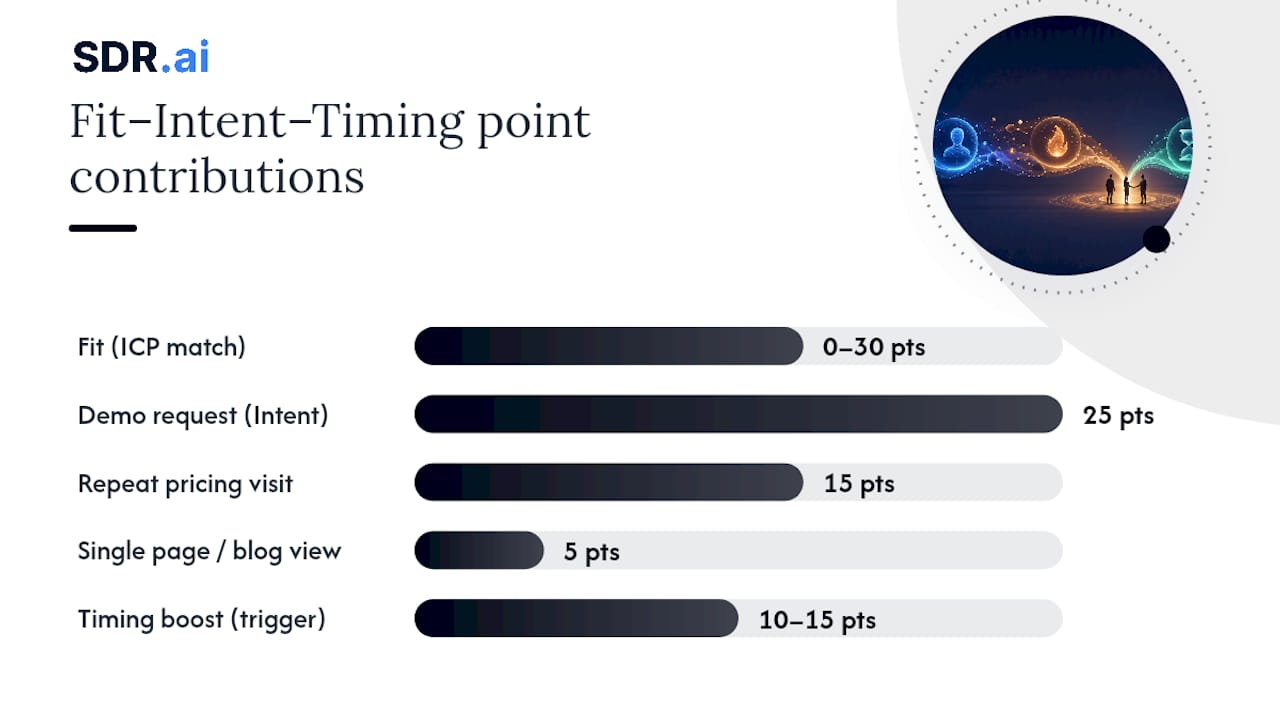
Fit is your ICP match, industry, company size, tech stack, and geography, scored once and rarely revisited. A common approach assigns 0 to 30 points based on how closely the account mirrors your best customers. An account that fails Fit almost never deserves urgent outreach, no matter how loud its behavioral signals get.
Intent is where recency, frequency, and depth do the work:
- Recency: a pricing page visit yesterday outweighs one from three weeks ago; many teams apply a decay multiplier that cuts a signal's point value roughly in half every seven to ten days.
- Frequency: three visits in a week beats three visits spread across a quarter. Repetition is the clearest evidence of active evaluation.
- Depth: a demo request or trial signup earns far more points than a single page view. A practical rubric might award 25 points for a demo request, 15 for a repeat pricing visit, and 5 for a single blog view.
- Seniority: a director-level or above visitor should carry a multiplier over an individual contributor, since buying-committee involvement usually starts at that level.
Timing layers trigger events on top. A funding round or executive hire can add a flat 10 to 15 point boost regardless of what the behavioral score already shows, because it changes the odds that budget exists right now.
Pro Tip: Don't build a scoring model from a vendor's default template and leave it untouched. Run small threshold experiments against your own conversion data for a full quarter before you trust the cutoffs.
Combine the three into tiers that map directly to action:
- 0 to 39 points: Monitor and nurture. Add to a marketing nurture stream; no rep time spent yet.
- 40 to 69 points: SDR review. An SDR checks the account, verifies the contact, and decides whether to enroll in a light-touch sequence.
- 70+ points: AE immediate outreach. Signal value decays fast, so Tier 1 accounts warrant contact within 24 to 48 hours, before the buying window closes or a competitor gets there first.
Stacked signals consistently outperform single ones: a funding round paired with a pricing-page spike is a far stronger indicator than either event alone, and your scoring model should reward that combination explicitly rather than just adding the two point values.
How To Operationalize Buyer Intent Signals, Step By Step
A scoring rubric is worthless if nobody acts on it consistently. Here's the operational sequence that turns a signal into a booked meeting.
- Capture the signal. Pull first-party data from your website and product analytics, and third-party data from review platforms and technographic providers, into one place, ideally your CRM or a dedicated intent platform, so nothing lives in a spreadsheet only one person checks.
- Verify and enrich the contact. Before anyone calls, confirm the person still works there, confirm their title, and pull firmographic details (headcount, industry, recent funding) to complete the Fit score. Skipping this step is the single most common reason outreach lands on the wrong person.
- Score automatically, review manually at the edges. Let your rules engine calculate Fit plus Intent plus Timing for every account. Route anything within a few points of a tier boundary to a human for a quick judgment call rather than letting the algorithm decide alone.
- Route based on tier, with an SLA attached. Low scores go to marketing nurture, mid scores go to an SDR queue, high scores go straight to an AE's calendar with a prompt response requirement.
- Message according to the specific signal, not a generic template. A pricing page visitor gets a message that references pricing and packaging. A funding-round trigger gets a message about scaling the function that just got budget. A competitor-comparison visitor gets a message that names the actual tradeoff, not a vague "saw you checking us out."
That last step matters more than most teams admit. Gartner's research shows 61% of B2B buyers actually prefer a rep-free buying experience, which means outreach only earns its place when it's relevant and timed to something the buyer just did. Generic speed without relevance tends to backfire, not build trust.
Who Owns Which Signal: Role Ownership And SLAs
Ambiguous ownership kills more intent programs than bad data does. A signal that sits in a shared inbox for four days because nobody was assigned to it is worse than no signal at all.
- Low-intent signals (Tier 3) belong to marketing. First action: enroll the contact in a nurture sequence, no rep involvement required.
- Medium-intent signals (Tier 2) belong to SDRs. First action: verify the contact, check Fit, and if it clears the bar, enroll in a targeted outbound sequence within three to five business days.
- High-intent signals (Tier 1) belong to AEs, sometimes with an SDR doing the initial contact verification. First action: direct outreach or a scheduled discovery call within 24 to 48 hours of the signal firing.
- Post-sale usage signals (expansion triggers, adoption drops) belong to customer success, since these often point to renewal risk or upsell opportunity rather than new-logo interest.
Write the SLA down and put it somewhere the whole team can see it. A verbal agreement about "we'll get to it quickly" evaporates the first time someone's out sick.
Measuring Whether Your Intent Program Is Actually Working
Intent signals only earn their keep if you can prove they shorten sales cycles or lift conversion. Track these:
- Time-to-contact: the gap between a signal firing and the first rep touch, benchmarked against your SLA targets.
- Conversion rate by tier: Tier 1 accounts should convert at a meaningfully higher rate than Tier 3; if they don't, your scoring weights are wrong.
- Pipeline influenced: the dollar value of opportunities that had an intent signal attached before the deal opened.
- Win rate: intent-sourced deals versus cold-outreach deals, measured separately so one doesn't mask the other.
- Deal velocity: days from first touch to close, compared across intent tiers.
Separate intent-driven wins from cold outreach in your reporting from day one, or you'll never isolate the lift the program actually produces. Running controlled experiments, testing different score thresholds or outreach cadences against your own conversion data, beats copying a vendor's default settings, since every ICP responds differently to timing and message angle.
Data Quality And Privacy Pitfalls To Avoid
A single-page view is not a buying signal, and treating it like one erodes rep trust in the whole system fast. Build in guardrails before you scale.
- Require at least two corroborating signals, or one clearly declared signal, before routing to a human for outreach.
- Set a decay window (commonly 7 to 14 days) so stale signals stop influencing scores and cluttering queues.
- Dedupe aggressively; the same account showing up three times under slightly different domain spellings inflates scores artificially.
- Verify contacts before outreach, since third-party intent data frequently attributes activity to someone who changed jobs months ago.
- Respect opt-outs and never imply you're tracking a named individual's personal browsing; document where each data source comes from so you can defend your methodology if a buyer asks.
How SDR.ai Turns Intent Signals Into Booked Meetings
The process is built around a simple idea: intent signals are only valuable if acted on fast, consistently, and without burning out a human team. The workflow runs on what Sdr calls Data, Digital, Dials, pulling firmographic and behavioral signals, layering targeted LinkedIn outreach on top, and closing the loop with AI-assisted warm calling once a signal clears the bar for direct contact. The Blueprint lays out that Data · Digital · Dials sequence in more detail.
Some clients report booking over 20 qualified meetings a month with a fraction of the manpower a traditional SDR team would require, driven by outreach that targets accounts already showing real buying signals rather than cold lists.
The About page walks through the methodology behind that outcome in more detail. A named editorial contributor bio for this analysis is pending final assignment.
Start An Intent Program This Week: A Short Checklist
Most teams overthink the launch. You don't need every signal source wired up before you start; you need three signals, a Fit rule, and an SLA.
Pick three signals you can already capture reliably, probably pricing page visits, demo requests, and one third-party trigger like a funding alert. Write a one-paragraph Fit rule (industry, size, geography) so everyone scores accounts the same way. Set a firm SLA: 24 to 48 hours for anything that clears your top tier, and stick to it for a full four to six week test window before changing anything.
Design exactly one experiment, maybe a threshold test comparing 70 points versus 80 as the AE handoff line, and one measurement to judge it, probably conversion rate by tier. Assign a named owner to each tier and write a short message template for each signal type before the first account ever clears the bar. Programs that launch messy and iterate weekly outperform programs stuck in six-month planning cycles almost every time.
What Most Teams Get Backwards About Intent Data
The biggest mistake I see in how companies talk about buyer intent signals isn't technical, it's philosophical. Teams treat intent data as a lead-generation source when it's actually a prioritization filter. Those are different jobs. A pricing page visit doesn't create a new opportunity; it tells you which opportunity already in your database deserves attention today instead of next month. Companies that buy an intent tool expecting it to fill the top of the funnel end up disappointed, then blame the data provider instead of the strategy.
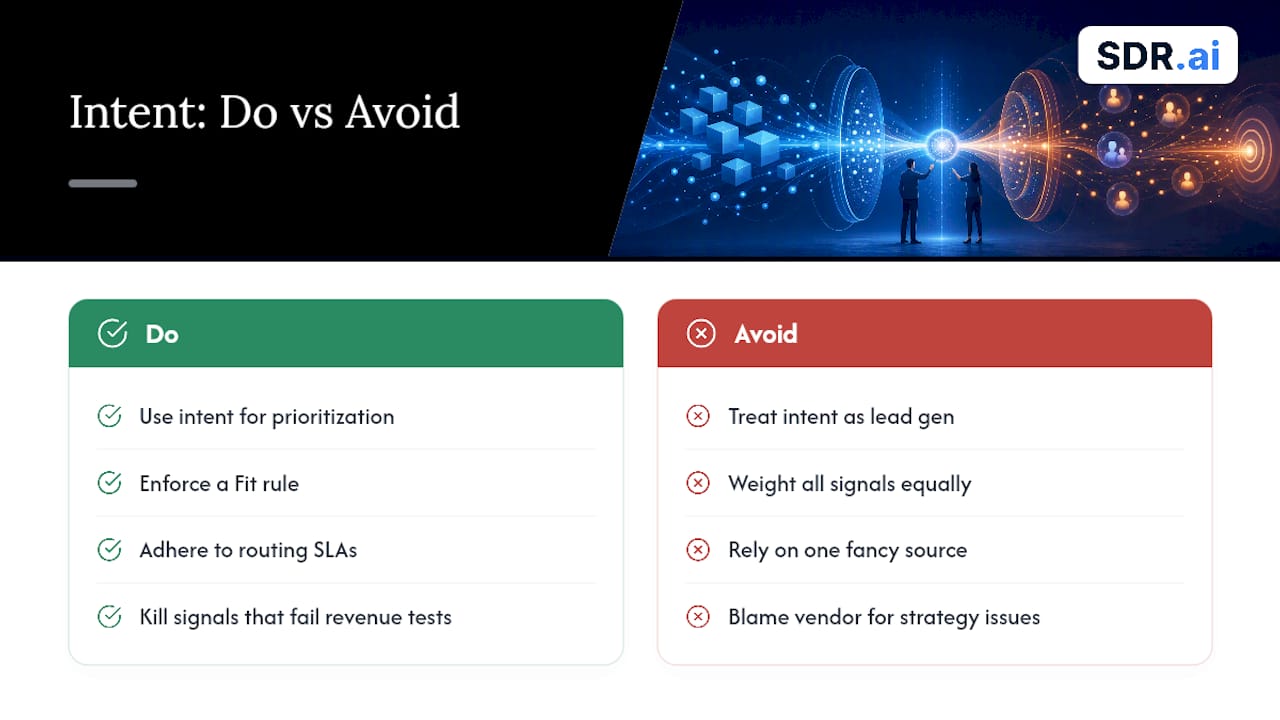
The second thing people get wrong is treating every signal as equally actionable just because it showed up in the same dashboard. A funding announcement and a single blog view are not the same species of event, but plenty of scoring models weight them close enough that reps stop trusting the queue entirely. Once trust in the score breaks, reps go back to gut instinct and the whole system quietly dies, even though the dashboard still looks active.
What actually separates programs that work from programs that stall isn't the sophistication of the data feed. It's discipline: a Fit rule nobody skips, an SLA nobody ignores, and a willingness to kill signals that don't correlate with closed revenue after a real test window. Most vendors won't tell you that because it undersells the platform. But the accounts stacking multiple corroborating signals, then routing them to a human fast, are the ones converting, not the accounts with the fanciest single data source.
— Chad
Turn Intent Signals Into Booked Calendar Time
Knowing which accounts are showing intent is only half the problem; most teams still lack the hours to act on every signal the same day. Sdr closes that gap by pairing AI-driven account monitoring with LinkedIn-first outreach and warm calling through its AI Dialer, so a pricing-page spike or a fresh executive hire turns into a real conversation instead of a note in a spreadsheet nobody checks.
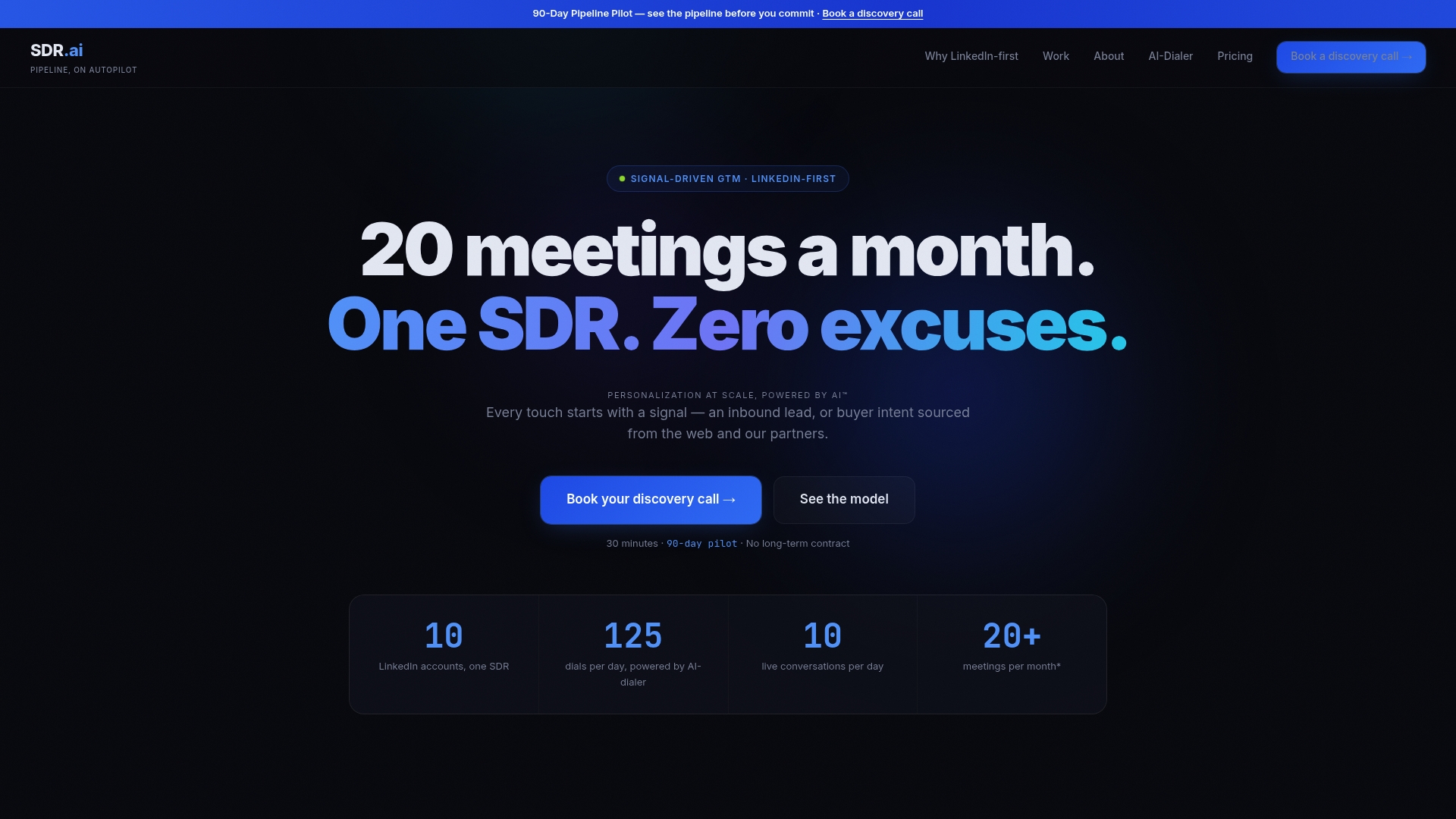
Some clients typically see over 20 qualified meetings booked per month, run on a lean setup that doesn't require scaling a full internal SDR team. The AI Dialer handles parallel calling once a signal clears your priority threshold, while the outreach engine keeps messaging tied to the specific signal that triggered it rather than a generic script. If you're weighing this against hiring an in-house SDR or an agency, the honest comparison breakdown is worth reading first. From there, the Sdr walks through what a pilot engagement looks like and how fast it can start turning your existing intent data into booked meetings.
Sources
- B2B Buying Signals: How to Spot, Score, and Convert Them — Leadfeeder
- How to Identify B2B Buying Signals and Intent | 2026 Guide — RevPartners
- What Is Intent Data? The Complete Guide to Turning Buyer Signals into Revenue — ZoomInfo