
Schedule your highest-value outreach for Tuesday through Thursday, in the prospect's local time, not yours. Cold emails perform best sent 9–11 AM; calls peak at 10–11 AM and again at 4–5 PM; LinkedIn touches land best between 9 AM and 2 PM. None of that outruns weak targeting or a lazy follow-up cadence. Send your first follow-up within two to three business days, and treat every window here as a starting hypothesis to test against your own list.
TL;DR:
- Tuesday and Wednesday account for 44% of all demo bookings, with Tuesday having the highest connect rate and Wednesday the highest volume.
- Sending emails at 9–11 AM and making calls at 10–11 AM or 4–5 PM optimizes outreach effectiveness across channels.
- Proper time zone adjustments are critical, as sending from the wrong zone can negate timing benefits and reduce response rates.
- Prioritizing midweek, mid-morning, and mid-afternoon windows for high-value prospects yields the best results, especially when combined with rapid follow-up.
- Testing your own outreach timing with at least 200 contacts over four weeks is essential, with speed-to-lead outperforming perfect timing once a signal is detected.
Table of Contents
- Best Days for Sales Outreach Send Times and Weekly Allocation
- Best Times to Send Sales Emails, Call Prospects, and Message on LinkedIn
- Time Zones and Execution: Where Good Timing Plans Fall Apart
- A Multi-Channel Sequence Template Built Around Send Timing
- Testing Your Own Sales Outreach Send Times: Sample Size and KPIs
- Adjusting Windows by Seniority and Industry
- What the Research Says and What SDR.ai Sees in Practice
- Three Priorities If You're Short on Bandwidth
- Sources
Best Days for Sales Outreach Send Times and Weekly Allocation
Tuesday and Wednesday together account for 44% of all demos booked across a 1.4 million call dataset analyzed by ZoomInfo. Tuesday wins on connect rate, Wednesday wins on raw volume, and both beat every other day by a wide margin.
That's not a coincidence of habit. By Tuesday, prospects have cleared their Monday inbox triage and haven't yet checked out for the week. HubSpot's survey work backs this up: Tuesday shows up repeatedly as the top day for successful cold calls, with late morning as the standout time-of-day window.
Monday and Friday aren't dead zones, but they need a different play. Monday mornings get eaten by internal meetings and inbox cleanup, so cold outreach underperforms. Warm leads are the exception. A prospect who already knows your name responds fine on Monday, especially if you're trying to convert a lukewarm lead before the week fills up. Friday works similarly in reverse. Light touches before noon (a check-in, a resource share) land fine. New cold dials on Friday afternoon are close to wasted effort. Most people are mentally clocked out.
For weekly planning, this breaks down into three simple rules:
- Reserve Tuesday, Wednesday, and Thursday for your highest-priority cold accounts and heaviest call volume.
- Use Monday for warm-to-hot conversion work: demo confirmations, contract follow-ups, anyone already in an active conversation.
- Stop initiating new cold dials after early Friday afternoon, and shift that time to internal prep, pipeline review, or light-touch nurture emails.
This isn't about avoiding Monday and Friday entirely. It's about matching the day to the type of touch, not treating every day of the week as interchangeable inventory.
Best Times to Send Sales Emails, Call Prospects, and Message on LinkedIn
Every channel has its own rhythm, and the mistake most sales teams make is applying one send-time rule across email, phone, and LinkedIn as if they behaved the same way. They don't.
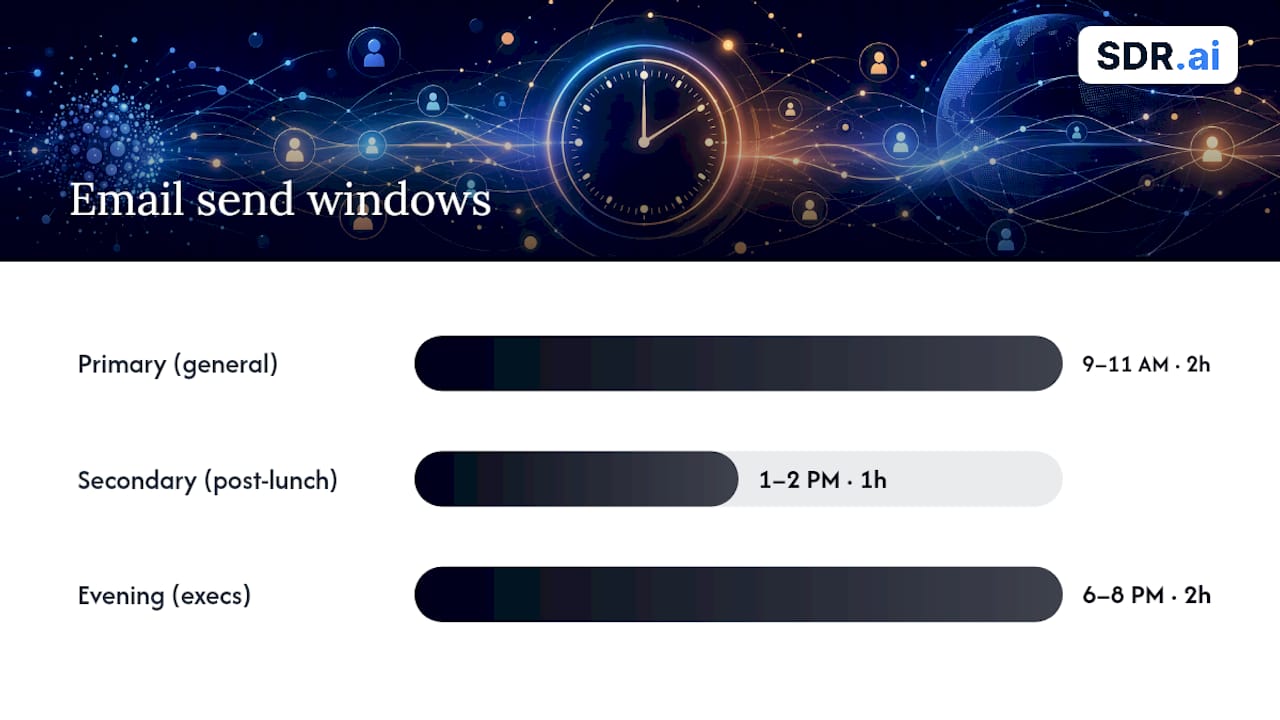
Email performs best in the 9–11 AM local window, when a prospect's inbox has cleared overnight backlog but hasn't yet filled with midday noise. A secondary window opens at 1–2 PM, right after lunch. For senior executives specifically, evening sends between 6–8 PM often outperform, according to multi-channel data from Emitree tracking email, call, and LinkedIn engagement together. Executives frequently clear personal email after the workday ends, when nobody else is competing for their attention.
Phone has the tightest evidence base of any channel. The consensus peak windows are 10–11 AM and 4–5 PM local time, and hour-by-hour benchmarking from SkipCall shows that simply shifting your calling window to these hours can lift connect rates 30–50% without touching your script or your list. Avoid the lunch hour (roughly 12–1 PM) and the first 30 minutes after typical start times, when prospects are still settling into their inbox.
LinkedIn rewards a wider window: 9 AM to 2 PM local generally works, since it's a platform people check in short bursts throughout the workday rather than at fixed times like email or calls.
| Channel | Primary window | Secondary window | Avoid |
|---|---|---|---|
| 9–11 AM local | 1–2 PM; 6–8 PM for executives | Late Friday, Monday before 9 AM | |
| Phone | 10–11 AM local | 4–5 PM local | 12–1 PM lunch, first 30 min of day |
| 9 AM–2 PM local | Early evening for passive scrolling | Late Friday afternoon |
A few persona-level tweaks matter more than the baseline windows themselves:
- C-suite contacts respond better to early morning (6–8 AM) or after 6 PM touches, before or after the gatekeeping starts.
- Middle managers and individual contributors fit the standard mid-morning and early-afternoon windows without adjustment.
- Operations and shift-based roles (retail, healthcare, manufacturing) need local research; their "mid-morning" might be 6 AM if the shift starts at 5.
Pro Tip: If your team all schedules sends for exactly 10:00 AM, you're competing with every other rep who read the same benchmark. Nudge your send to 10:15 or 10:20 to land just after the inbox spike clears.
Time Zones and Execution: Where Good Timing Plans Fall Apart
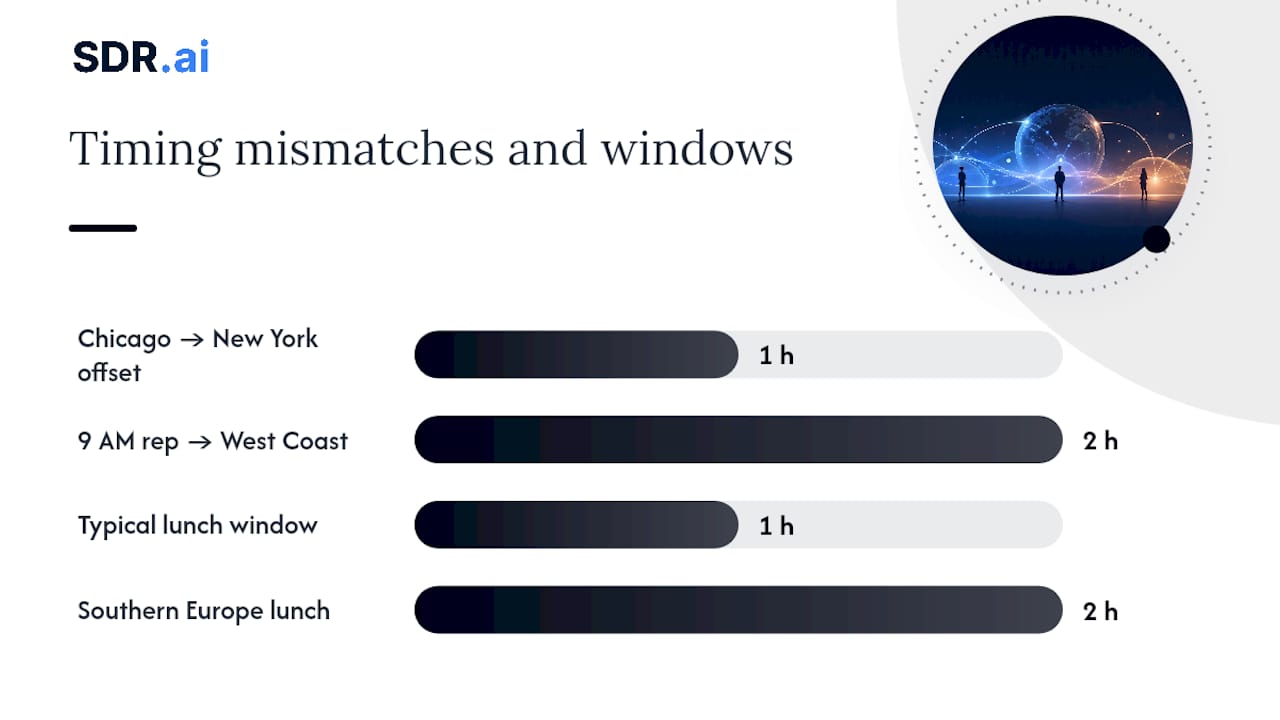
None of these windows matter if you're sending in your own time zone instead of the prospect's. This sounds obvious until you look at how many sequences are built on a single default time zone setting and never adjusted per contact. A sales rep in Chicago blasting a 9 AM send to a New York list is actually hitting inboxes at 10 AM Eastern, not the intended morning slot, and the same mismatch running the other direction turns a "9 AM" call attempt into a 7 AM wake-up call on the West Coast.
Getting the time zone wrong is one of the most common and costly execution errors in outbound. It quietly erases every benefit of good timing research because the prospect experiences the wrong hour regardless of what your dashboard says.
A few operational rules keep this from happening:
- Build no-send windows into every sequence: no calls or high-priority emails during local lunch hours (typically 12–1 PM, sometimes later in Southern Europe, where lunch runs closer to 1–3 PM).
- Respect regional business-hour norms. APAC markets often start earlier and wrap up outreach-friendly hours sooner than US teams expect.
- Route every contact record through timezone-aware scheduling before it enters a sequence, not after.
- Use dialers and sequencing tools that auto-convert send times based on the contact's detected or listed location, rather than a rep's personal calendar default.
An AI-Dialer built to enforce local-time calling windows removes this error at the point of dial, which matters more as call volume scales past what a human scheduler can manually track. On the automation side, tools like Cloud 9's CRM and marketing automation platform can help enforce these rules across a broader contact database once you're managing send times for hundreds of accounts.
A Multi-Channel Sequence Template Built Around Send Timing
Here's a ten-day sequence that stacks the timing research into a repeatable structure. Adjust spacing for seniority, but keep the channel order intact, since it's designed to hit a prospect through their most-checked channel at each stage.
- Day 1, morning: Send the first email between 9 and 10 AM local time.
- Day 1, midday: Send a LinkedIn connection request around lunch, referencing the email lightly if there's a mutual connection or shared context.
- Day 1, late afternoon: Attempt a call between 4 and 5 PM local, after the email and LinkedIn touch have had time to register.
- Day 3: Call again, and if you hit voicemail, leave one under 20 seconds that references the earlier email by name.
- Day 5: Send a value-add follow-up email, something concrete like a relevant case study, not a generic "just checking in."
- Day 7: Send a LinkedIn message, ideally referencing something specific from their profile or recent activity.
- Day 10: Send a break-up email that closes the loop without guilt-tripping, and offer a clear, low-effort next step if they're still interested.
Spacing should flex by persona. Most contacts do well with a follow-up every two to three business days. C-suite prospects need more room, closer to five to seven days between touches, since they're weighing more inputs and checking messages less frequently. Combining channels on the same day (email plus a call attempt) works fine for individual contributors, but for senior buyers it can read as pushy if both land within hours of each other.
Testing Your Own Sales Outreach Send Times: Sample Size and KPIs
Every window in this article is a starting point, not a guarantee for your list, your vertical, or your buyer. Testing against your own data is what turns a general benchmark into something you can trust.
Start with a minimum of 200 contacts per variant and run the test for at least four weeks, per testing guidance from SkipCall's hour-by-hour benchmarking work. Shorter runs get skewed by a single bad week, a holiday, or one rep having an off day. If your list is smaller than that, extend the duration rather than shrinking the sample, and expect noisier results either way.
Pick your KPIs carefully:
- Meeting-booked rate is your primary signal. It's the metric that actually maps to revenue.
- Reply rate is your secondary signal, useful for diagnosing message quality independent of timing.
- Open rate should be ignored. Apple's Mail Privacy Protection and similar features make open-rate data unreliable for measuring anything real about send timing.
Once a window wins, concentrate roughly 70% of your activity there while running small edge tests on the remaining 30% to avoid saturating your winning window and to catch shifts in prospect behavior over time.
That's a real number worth chasing, but it only shows up when the sample size and duration are respected.
Adjusting Windows by Seniority and Industry
The baseline windows in this article assume a fairly standard office worker. Real buyers don't all fit that mold, and the adjustments matter more the further a persona sits from a typical 9-to-5.
- C-suite executives respond best to early morning (6–8 AM) or evening (post-6 PM) touches, and they need longer spacing between follow-ups, five to seven business days rather than two to three.
- Individual contributors and middle managers fit the standard windows well: mid-morning for calls and email, early afternoon as backup.
- Healthcare buyers often work around shift patterns, meaning "morning" outreach might need to hit before 7 AM or after a shift change rather than a standard 9 AM slot.
- Finance sector contacts cluster activity around market hours, avoiding market open and close windows when they're heads-down.
- Manufacturing and operations roles frequently start earlier than office staff, so an 8 AM outreach attempt might already be their late morning.
The fix isn't guesswork. Pull a handful of calendar-confirmed meeting times from your own CRM for each persona and let that data, not a generic benchmark, set your real windows.
What the Research Says and What SDR.ai Sees in Practice
The datasets agree more than they disagree. ZoomInfo's 1.4 million call analysis points to Tuesday and Wednesday dominance with 10–11 AM and 4–5 PM peaks. SkipCall's hour-by-hour benchmarking confirms the same midday and midweek pattern. HubSpot's survey data adds late-morning booking rates to the picture.
- ZoomInfo: Tuesday/Wednesday drive 44% of demos booked
- SkipCall: 10–11 AM and 2–3 PM connect-rate peaks
- HubSpot: late-morning windows show the strongest booking rates
SDR.ai's LinkedIn-first outreach and AI-Dialer apply these windows automatically, layered on intent signals that flag which accounts to prioritize inside those windows, rather than treating every contact as equally worth a 10 AM slot.
Timing is a multiplier on relevance, not a substitute for it. The best day and time to contact a prospect means little if the message doesn't match a real buying signal.
Clients using this combined approach report booking 20 or more qualified meetings a month with a lean team, though results vary by list quality and ICP fit.
Three Priorities If You're Short on Bandwidth
If you can only change three things this week, start here. Protect two midweek, mid-morning blocks on your calendar and route your highest-value accounts exclusively into them. Everything else can flex around those two windows; they shouldn't.
Second, run the four-week test outlined above before you touch your broader cadence. It's tempting to react to one good day and declare a new best time. Don't. One week of data is noise, not a pattern.
Third, and this is the one most teams underweight: speed-to-lead beats perfect timing every time an intent signal fires. A prospect who just visited your pricing page and gets contacted within minutes will outconvert a perfectly-timed cold touch sent days later. Timing benchmarks help you optimize outreach you're initiating cold. They matter far less once a real signal tells you someone's already looking.
Get those three right before you obsess over whether 10:00 beats 10:15.
— Chad
Sources
- Best Days to Cold Call in 2026: Data From 1.4 Million Sales Calls
- Best Time to Cold Call B2B 2026: Hour-by-Hour Data
- Best time to make a sales call (HubSpot)
- Best Time to Send Cold Outreach: Email, Call & LinkedIn Data | Emitree Blog
- How to Determine the Best Day and Time to Contact Prospects | Apollo