
This page gives you ready-to-copy sales playbook templates plus a step-by-step process to customize and roll them out on your team. Start with the one-page ICP template below or follow the 9-step checklist to build a full playbook from scratch. If you run a small team, grab the lean version; if you manage multiple segments or territories, use the fuller structure and trim it down after your pilot.
TL;DR:
- A sales playbook should contain clear ownership, version control, and regular updates to ensure relevance and accuracy.
- Building a playbook requires mapping sales stages with specific entry and exit criteria before developing scripts and plays.
- Pilot testing the playbook with a small group and tracking usage data helps identify effective plays and areas needing adjustment.
- Integrating intent signals and AI-powered dialing enhances the playbook's effectiveness by prioritizing accounts and multiplying outreach volume.
- A lean, focused playbook under 10 pages works best for startups and small teams, while enterprise teams benefit from modular, segmented structures.
Table of Contents
- What Is a Sales Playbook, and How Is It Different From a Sales Process?
- What Should Be in a Sales Playbook? Core Components Explained
- How Do You Build a Sales Playbook Step by Step?
- Copyable Templates You Can Use Today
- How Do You Roll Out a Sales Playbook So Reps Actually Use It?
- What KPIs Prove a Sales Playbook Is Working?
- Who Owns Playbook Updates, and How Often Should It Change?
- How AI Signals and Parallel Dialing Change Play Execution
- When Should a Playbook Stay Lean vs. Go Deep?
- SDR.ai: Where DIY Playbooks Hit Their Limit
- Sources
- FAQ
What Is a Sales Playbook, and How Is It Different From a Sales Process?
A sales playbook is a living document of plays, scripts, and decision rules that tell a rep exactly what to say and do at each stage of a deal. It documents your ideal customer profile, messaging, objection responses, and close tactics so every rep sells the same way, at the same level of quality, regardless of tenure. The Elium sales playbook template frames this well: the playbook is the tactical layer that sits on top of your sales motion, not a replacement for it.
A sales process, by contrast, is the skeleton. It's the ordered list of stages a deal moves through, from first contact to close, each with a name and a purpose. The playbook is the muscle attached to that skeleton: the specific talk tracks, email templates, and objection rebuttals that get a deal from one stage to the next.
Think of it this way:
- The sales process says "move from Discovery to Demo."
- The playbook says "here's the exact question to ask in Discovery that earns the right to book the Demo, and here's what to say if the prospect claims they're happy with their current vendor."
Sales managers use playbooks primarily for three reasons: faster onboarding, consistent messaging across a growing team, and a documented reference for coaching. New reps ramp faster because they aren't reverse-engineering what works from silent observation. Managers get a shared vocabulary for coaching calls. And when a top performer leaves, their best plays don't leave with them.
Ownership typically sits with a sales enablement lead or the sales manager directly. On smaller teams, it's often the founder or head of sales, at least until the team justifies a dedicated role.
What Should Be in a Sales Playbook? Core Components Explained
A complete playbook has six working parts. Skip any one of them and reps end up guessing, which defeats the purpose of writing it down in the first place.
Metadata. Every playbook needs an owner name, a version number, and a last-updated date on the cover page. This sounds trivial until a rep is working from a six-month-old copy of the objection matrix during a live call.
Ideal customer profile (ICP). Document firmographics (company size, industry, tech stack), buying triggers (a funding round, a leadership change, an expiring contract), and the titles of people involved in the buying committee. Vague ICPs produce vague targeting; specific ones tell an SDR exactly who to prioritize this week.
Sales process stages with entry and exit criteria. Every stage needs a clear condition for entering it and a clear condition for leaving it. Without exit criteria, deals sit in "Discovery" for months because nobody defined what discovery actually needs to prove.
| Stage | Entry criteria | Exit criteria |
|---|---|---|
| Prospecting | Account matches ICP | Contact engaged (reply, call, or meeting accepted) |
| Discovery | Meeting booked | Pain, budget, and decision process confirmed |
| Demo/Evaluation | Discovery criteria met | Champion agrees solution fits stated pain |
| Close | Champion confirmed | Signed contract or documented loss reason |
Plays. A play is a specific sequence: which channel to use, what to say, and what triggers a rep to branch into a different message. Outbound plays, referral plays, and win-back plays for churned accounts are all common and each deserves its own short section rather than being crammed into one generic "outreach" chapter.
Objection handling matrix. List the five or six objections your team hears most, paired with a response and a proof point (a case study, a stat, a customer quote) that backs it up. An objection response without proof is just an opinion the prospect has no reason to trust.
Tools and enablement assets. Attach the actual templates: email sequences, call scripts, one-pagers, ROI calculators, and links to case studies. A playbook that describes a play but doesn't attach the asset just adds a step between the rep and the thing they actually need.
Together these six pieces form the checklist most sales training manual formats converge on, whether the team calls it a playbook, a runbook, or an enablement guide.
How Do You Build a Sales Playbook Step by Step?
Building a playbook is a sequencing problem before it's a writing problem. Do these steps out of order and you end up documenting plays for a process that hasn't been mapped yet, which is how most playbooks turn into 40-page documents nobody opens twice.
- Assign a single owner. One person drives the project, even if several people contribute content. Committees write playbooks that read like they were written by committees.
- Interview your top two or three performers. Record their actual talk tracks on live or recorded calls rather than asking them to describe what they do from memory. People are notoriously bad at narrating their own instincts.
- Map your sales stages and define exit criteria for each one. This is the scaffolding everything else attaches to. Salesforce's guide on building a playbook recommends nailing this map before writing a single script.
- Draft your ICP and a short list of discovery questions that qualify a prospect against it quickly.
- Turn your best performer's talk tracks into repeatable plays, then attach them directly to the relevant stage in your CRM so reps see them in context, not buried in a shared drive.
- Pilot the playbook with a small cohort (three to five reps) for two to four weeks before rolling it out company-wide.
- Collect usage and outcome data from the pilot. Which plays got used? Which ones correlated with meetings booked or deals advanced?
- Revise based on win/loss patterns, not just gut feel. If a play sounds good in the room but never converts, cut it.
- Version and publish. Lock a version number, log the changes, and distribute the final copy through your enablement tool or CRM, not a static PDF that goes stale the day it's shared.
Pro Tip: Decide how you'll credit a play for a meeting or a close before you run the pilot, not after. Tag each outreach sequence and call script with a unique identifier in your CRM so you can trace a booked meeting back to the exact play that produced it. Without that tagging step, every "which play worked" conversation after the pilot turns into guesswork dressed up as analysis.
This sequence mirrors what Zendesk's sales playbook framework recommends: map, draft, pilot, then expand. Skipping the pilot is the most common shortcut managers take, and it's the one that costs the most time later, because you end up debugging a company-wide rollout instead of a five-person test group.
Copyable Templates You Can Use Today
These are the fill-in-the-blank versions of the components above. Copy them directly into a doc or your CRM's notes field and adjust the bracketed details to match your product.
One-page ICP template
- Company size: [employee range]
- Industry: [target verticals]
- Tech stack signals: [tools that indicate fit]
- Buying trigger: [funding event, leadership change, contract renewal, compliance deadline]
- Buyer titles: [economic buyer, champion, technical evaluator]
- Disqualifiers: [conditions that mean walk away now]
Four-stage process table with sample activities
Outbound opener (talk track)
"Hi [name], I noticed [specific trigger, e.g., your team just posted three open sales roles]. Teams scaling that fast usually hit a wall around [specific pain]. Is that on your radar right now, or has it not come up yet?"
Discovery opener (talk track)
"Before we get into the demo, walk me through what's not working today. Where's the process breaking down, and what's that costing your team in hours or in missed pipeline?"
Objection response example
- Objection: "We already have a tool for this."
- Response: "Most teams we work with had a tool too. The gap usually isn't the tool, it's [specific gap]. Here's how [proof point/case study] closed that gap in about [timeframe]."
Starter 30-60-90 ramp template
- Days 1 to 30: Shadow calls, learn the ICP and objection matrix, complete two mock discovery calls with the manager.
- Days 31 to 60: Run live discovery calls solo, log every objection encountered, book first independent meetings.
- Days 61 to 90: Own a full pipeline segment, hit 80% of quota target, contribute one new objection response back to the playbook.
How Do You Roll Out a Sales Playbook So Reps Actually Use It?
A playbook nobody opens is just an expensive document. Rollout is where most of that risk lives, and it deserves as much planning as the content itself.
Start with a pilot group of three to five reps, ideally a mix of a strong performer and a newer hire, so you see how the playbook performs across skill levels. Expand to the full team only once the pilot shows the plays produce measurable lift, not just positive feelings in a debrief meeting.

Build onboarding around the 30-60-90 template above so new hires meet the playbook on day one instead of stumbling into it during week six. Managers should run a weekly call review using a short template: which play did the rep use, did they deviate from it, and what happened as a result. This turns coaching from vague feedback ("be more confident") into specific, playbook-anchored feedback ("you skipped the trigger question in step two, and the call drifted").
Track adoption with a short list of metrics:
- Percentage of reps who reference the playbook in CRM notes weekly
- Play-level usage rate (how often each specific play gets logged)
- Success rate per play (meetings booked or deals advanced per use)
Pro Tip: Change management fails most often when a playbook gets emailed as a PDF and never mentioned again. Attach the relevant play directly inside the CRM record at the stage where a rep needs it, so using the playbook takes less effort than ignoring it.
What KPIs Prove a Sales Playbook Is Working?
Split your metrics into leading and lagging indicators, and connect both back to specific plays rather than tracking team-wide averages alone. Leading metrics tell you whether reps are executing; lagging metrics tell you whether execution is producing revenue.
| Metric type | Examples | What it tells you |
|---|---|---|
| Leading | Reply rate, meeting conversion rate, sequence reply rate | Whether the play is getting attention early in the funnel |
| Lagging | Win rate, deal velocity, average contract value (ACV) | Whether the play ultimately drives revenue |
Salesforce's sales strategy guide recommends tracking conversion rate, customer acquisition cost, and customer lifetime value alongside win rate as the core set for evaluating any documented sales approach. To connect play usage to outcomes, tag each play with a unique identifier in your CRM at the moment a rep uses it, so a closed deal can be traced back to the specific sequence or script that opened it.
Two experiments are worth running in your first quarter with a playbook in place:
- Message A/B test: Run two versions of the same outbound opener against similar ICP segments and compare reply rates after two weeks.
- Cadence A/B test: Test a five-touch sequence against an eight-touch sequence on the same list and compare meeting-booked rate, not just replies.
Modern buyer-centric selling depends on connecting these leading indicators to revenue outcomes rather than treating reply rates as a vanity number, a point Apollo's research on effective sales strategies makes directly. Report on this monthly, with the playbook owner presenting play-level performance, not just team totals, in the sales leadership review.
Who Owns Playbook Updates, and How Often Should It Change?
A playbook without an owner rots within two quarters. Assign one person as the accountable owner, even if content contributions come from multiple reps and managers.
Keep a simple version log: version number, date, what changed, and who approved it. This matters more than it sounds. Six months from now, when a new VP asks why the objection matrix contradicts what a rep is saying on calls, you want an answer better than "someone edited it at some point."
Set a review cadence and stick to it:
- Quarterly reviews to refresh win/loss data, retire underperforming plays, and add new objections reps are hearing in the field.
- Ad hoc triggers for anything that breaks the playbook's assumptions immediately: a pricing change, a new competitor entering deals, a product launch, or a shift in your ICP after a market downturn.
Capture new top-performer plays as they emerge rather than waiting for the quarterly cycle. If a rep finds a discovery question that's converting unusually well, get it into the matrix within a week, not three months later. Archive plays that stop working instead of leaving them in the document to confuse newer reps.
Build a lightweight feedback loop: a shared channel or a recurring five-minute slot in the weekly sales meeting where reps flag what's not working. The reps running the plays daily will spot decay faster than any manager reviewing a spreadsheet.
How AI Signals and Parallel Dialing Change Play Execution
A playbook built entirely on assumptions about who to call is a playbook that wastes rep hours. The more useful version feeds real intent signals directly into play selection, so a rep or an SDR knows which account to prioritize today and which specific message fits that account's current buying stage.
One approach illustrates this concretely: instead of writing one generic outbound play, plays get triggered by detected intent signals, and outreach runs across LinkedIn and warm calling in parallel rather than sequentially. That's a meaningfully different play structure than "call the list top to bottom."
The core mechanism is straightforward: intent signals narrow the target list to accounts showing real buying behavior, personalized LinkedIn messaging opens the conversation, and parallel dialing through an AI-Dialer multiplies the number of live conversations one SDR can have in a day. SDR.ai reports this combination has helped clients book over 20 qualified meetings a month, with parallel dialing boosting meeting bookings 5 to 10 times over sequential calling, according to the company's own published results.
Operationally, this means tagging each play with the trigger that fired it (funding event, hiring signal, technology adoption) inside the CRM, so reporting can show which signal types produce the highest meeting-to-close rate over time. Teams evaluating this model in more depth can review the Sdr, which walks through how data signals, outreach channels, and dialing volume connect inside one operating system.
When Should a Playbook Stay Lean vs. Go Deep?
Most teams over-build their first playbook. A 40-page document with ten personas and six process variants sounds thorough, but reps don't read it, and a document nobody opens has zero effect on close rates.
If you're a startup or a team under 10 reps, write the lean version: one ICP, one process map, three or four plays, and a short objection matrix. Zendesk's own guidance backs this instinct directly. Shorter playbooks get used; long doctrinal manuals get skimmed once and forgotten.
Enterprise teams with multiple segments, territories, or stakeholder types genuinely need more structure. A team selling into healthcare and into financial services can't share one objection matrix; the compliance concerns alone are different enough to break a single generic response. In that case, build the full structure, but still ship it in modules by segment so a rep only opens the section relevant to their territory.
The practical rule either way: start smaller than feels comfortable, pilot it, and expand only where the data shows a gap. A playbook is a working document, not a monument.
— Chad
SDR.ai: Where DIY Playbooks Hit Their Limit
Writing the playbook is one project. Executing hundreds of outbound touches a month, consistently, without a rep burning out on dial after dial, is a different one entirely. SDR.ai exists for teams who've built the plays but don't have the headcount or the ramp time to run them at volume.
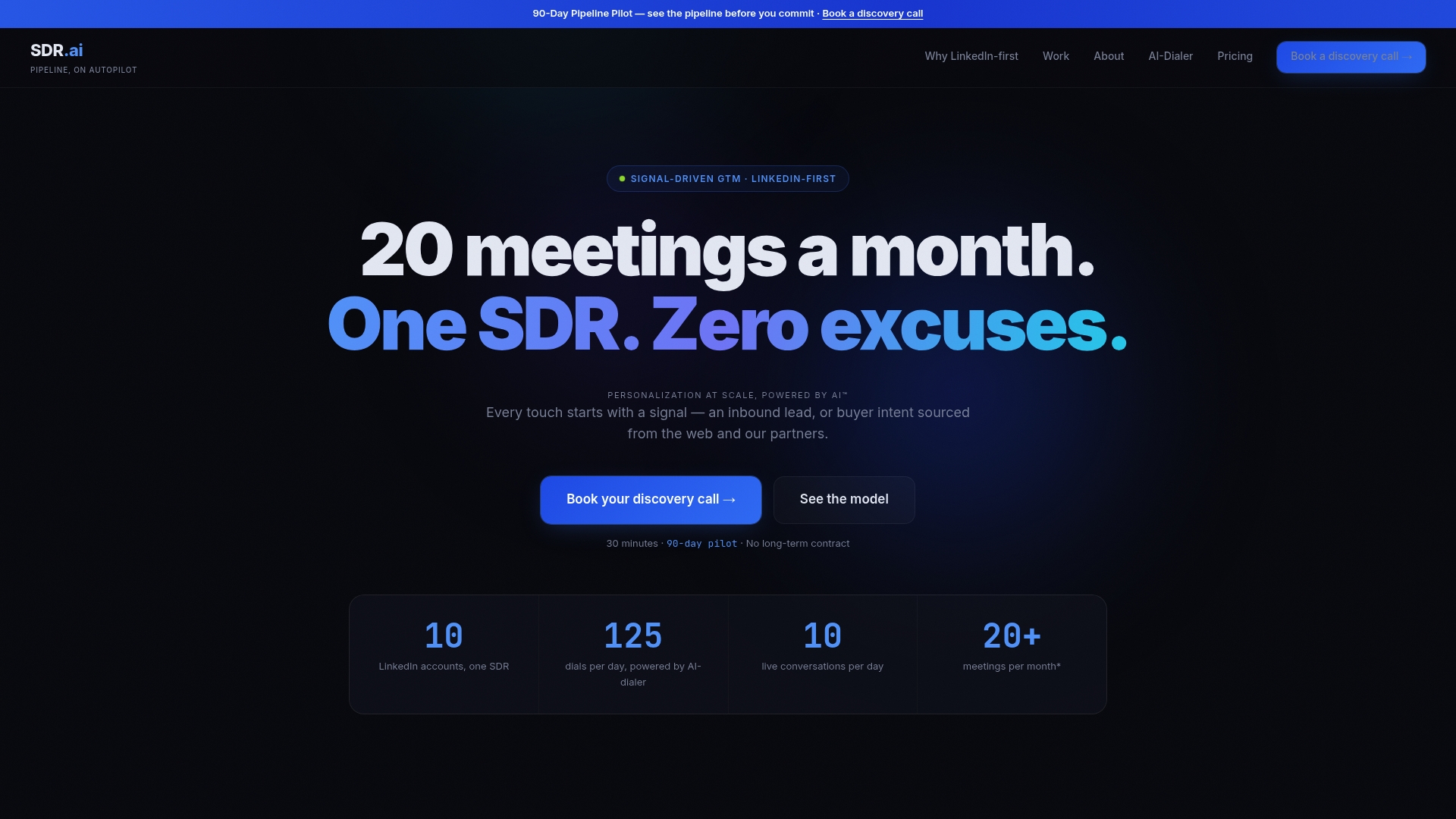
The core offering combines intent-based targeting with an AI-Dialer built for parallel calling, so a single SDR can have far more live conversations per day than manual dialing allows, plus personalized LinkedIn outreach layered on top. Clients report booking over 20 qualified meetings a month using this stack, with detailed methodology laid out on the Blueprint page.
Use a simple checklist to decide: if your team has the bandwidth to build plays, hire and train reps, and wait out a multi-month ramp, DIY works. If you need meetings booked in the next 30 days and don't have spare headcount to dedicate to outreach execution, a managed or tool-assisted option closes that gap faster. Compare the tradeoffs directly on the AI SDR vs. SDR agency breakdown, then book a demo to see how your own ICP and plays would map onto the system.
Sources
The sources below shaped the templates and framework above, each covering a different piece of building and running a playbook.
- Sales Playbook Template | Elium
- The Ultimate Sales Playbook: How to Create Your Own with Examples for Success
FAQ
What Should Be in a Sales Playbook?
A complete playbook needs metadata (owner, version), an ICP definition, sales process stages with entry and exit criteria, specific plays with talk tracks, an objection handling matrix, and attached tools like templates and case studies.
What Are the 5 P's of Sales?
Definitions vary across sales training programs, and there's no single canonical version referenced across major playbook guides. Rather than force-fit a mismatched framework, focus your playbook on the six components covered above: metadata, ICP, process stages, plays, objections, and tools.
What Is the 30-60-90 Rule in Sales?
It's a structured onboarding plan broken into three 30-day phases: days 1 to 30 focus on learning the playbook and shadowing calls, days 31 to 60 on running live discovery calls solo, and days 61 to 90 on owning a full pipeline segment and hitting a quota target.
What Four Elements Should Your Sales Playbook Include?
At minimum: an ideal customer profile, a mapped sales process with clear stage criteria, a set of plays with scripts or talk tracks, and an objection handling matrix backed by proof points.
How Is a Sales Playbook Template Different From a Full Sales Training Manual?
A sales playbook template is the tactical, fill-in-the-blank document focused on specific plays and messaging, while a full sales training manual usually covers broader onboarding topics like company history, product education, and internal tools alongside the playbook content.