
An ICP, or ideal customer profile, is the account-level description of companies most likely to buy, succeed, and expand with your product. It combines firmographics, technographics, behavioral signals, and fit indicators into a filter your team runs before any outreach. Use it to qualify accounts first, and your pipeline gets shorter, cleaner sales cycles almost immediately.
TL;DR:
- An effective ICP combines firmographics, technographics, behavioral signals, and fit indicators into a single score to accurately qualify target accounts.
- Building and maintaining an ICP requires integrating data into your CRM, regularly reviewing it, and involving sales and RevOps for ongoing accuracy.
- Pairing ICP fit with intent signals significantly improves qualification rates and shortens sales cycles because outreach becomes more targeted and timely.
- Failing to define negative criteria, overfitting the ICP, or neglecting data updates can quickly nullify the benefits of an ICP strategy.
- Properly operationalized ICP-driven outreach consistently delivers over 20 qualified meetings per month with minimal additional headcount.
Table of Contents
- What Does ICP Mean in Sales, Exactly?
- ICP vs Buyer Persona vs Target Market: What's the Real Difference?
- What Belongs in a Usable ICP Template?
- Why Does an ICP Actually Improve Sales Outcomes?
- How Do You Build and Operationalize an ICP?
- How Do You Use ICP in Sales Operations and ABM?
- What Mistakes Wreck an ICP Before It Ever Works?
- How Do You Measure Whether Your ICP Is Working?
- What Does ICP-Driven Outreach Look Like in Practice?
- Why ICPs Have to Stay Living Systems, Not Slides
- Turning an ICP Into Booked Meetings Without Building a Team
- Sources
- FAQ
What Does ICP Mean in Sales, Exactly?
An ICP operates at the company level, not the individual level. It describes the account: the business that has the budget, the problem, and the conditions to become a great customer, not the person who happens to answer the phone there.
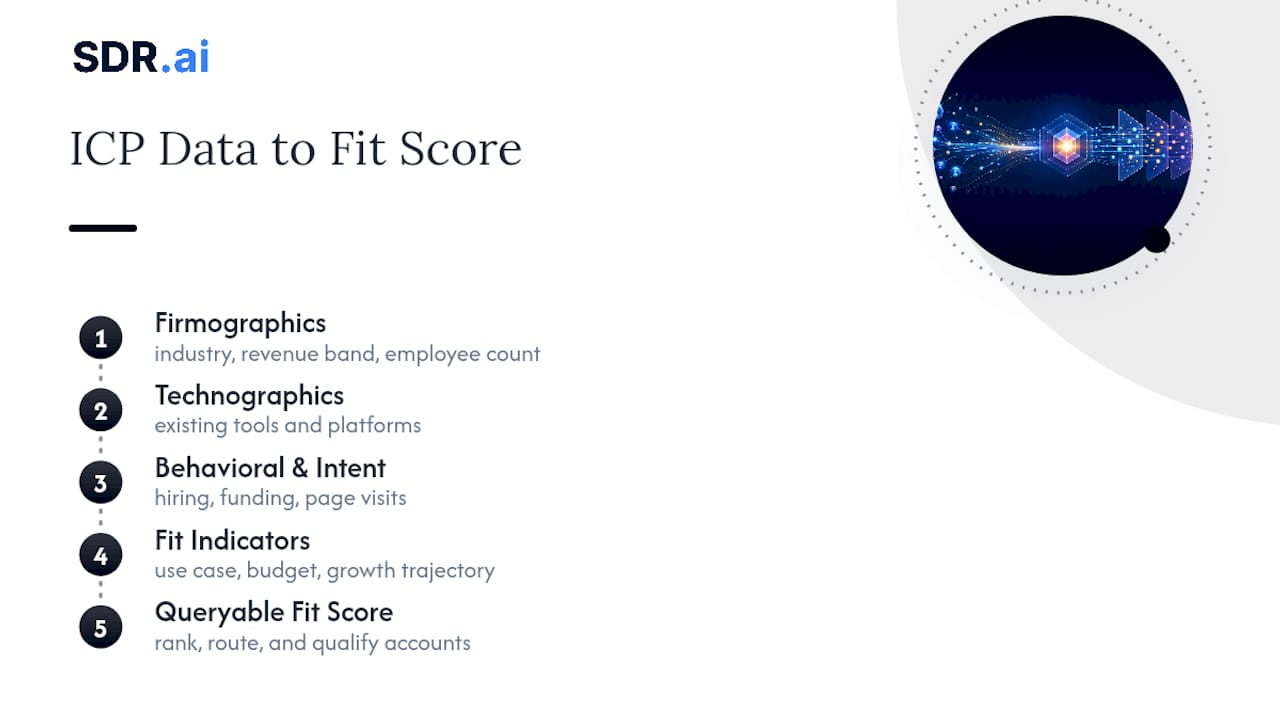
Modern ICPs run on four data layers. Firmographics cover industry, revenue band, employee count, and geography. Technographics capture the tools and platforms a company already runs, which often predict whether your product will fit their stack. Behavioral and intent signals track what accounts are actually doing right now, hiring surges, funding rounds, page visits on pricing or comparison content. Fit indicators measure whether the account's use case, budget, and growth trajectory line up with what your product actually solves.
That order matters. According to Gong's breakdown of ICP for sales, an ICP-first strategy qualifies accounts before persona-level outreach even starts. Skip that step, and your team ends up writing polished emails to companies that were never going to buy in the first place. The ICP decides who gets contacted. The persona decides how you talk to them once they're in.
Treating the ICP as four separate boxes to check misses the point, though. The real value shows up when those layers combine into a single fit score you can query, rank, and route, which is where the ZoomInfo pipeline model for ICP construction earns its keep.
ICP vs Buyer Persona vs Target Market: What's the Real Difference?
These three terms get used interchangeably in sales meetings, and that habit costs teams real pipeline. Each one answers a different question at a different altitude.
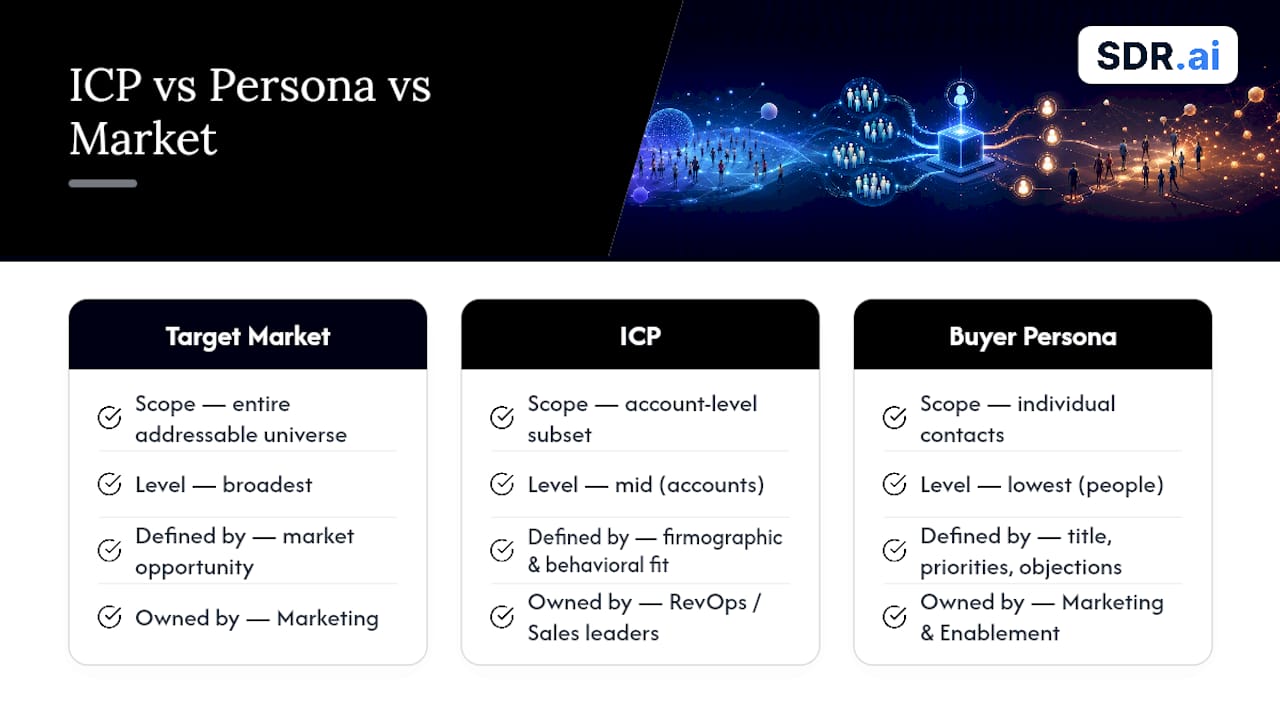
Target market is the broadest lens: the entire addressable universe of companies that could theoretically use your product. ICP narrows that down to the account-level subset that will actually succeed and expand, defined by firmographic and behavioral fit. Buyer persona operates one level below that: it describes the individual human inside an ICP-fit account, their title, priorities, and objections.
Ownership splits accordingly. RevOps or sales leadership typically owns the ICP definition and its data sources. Marketing and sales enablement usually own persona work, since personas drive messaging and content, not qualification.
The practical trigger is simple. If an account fails ICP criteria, an SDR should disqualify it and move on, regardless of how promising the individual contact sounds. If the account passes ICP criteria but the messaging isn't landing, that's a persona problem, not an ICP problem. Fix the message, not the target list.
What Belongs in a Usable ICP Template?
A working ICP template needs specific, checkable attributes, not vague adjectives like "innovative" or "growth minded." Here's what actually earns a place on the list.
- Firmographics: industry vertical, annual revenue band, employee headcount range, and geography or regulatory region.
- Technographics: the tech stack, platforms, or systems that signal compatibility (a company running a modern CRM behaves differently than one still on spreadsheets).
- Behavioral and intent signals: hiring sprees in relevant departments, recent funding events, and specific pages visited on your site, especially pricing or integration pages.
- Fit indicators: budget authority, direct use-case alignment, and expansion potential once the initial deal closes.
- Negative ICP criteria: the traits that should get an account excluded outright, chronically late-paying industries, company sizes too small to support your pricing, or geographies you can't legally service.
That last category gets skipped constantly, and it shouldn't. Prospeo's research on ICP scoring points out that negative ICP criteria protect SDR capacity by blocking accounts your team would otherwise chase for weeks with nothing to show for it.
Pro Tip: Build your negative ICP list before your positive one. It's easier to agree on who you don't want than to argue about the perfect version of who you do.
Why Does an ICP Actually Improve Sales Outcomes?
An ICP shortens sales cycles because reps stop chasing accounts that were never going to close. When outreach targets companies that already match your best customers on firmographics and intent, discovery calls take less convincing and objections shrink, since the account already has the underlying problem your product solves.
Win rates climb for the same reason. Salesforce's guidance on ideal customer profiles frames ICPs as foundational to sales and marketing alignment, since both teams stop arguing over lead quality once they're scoring against the same definition. That alignment shows up in campaign targeting too: marketing builds ABM lists from the same fit criteria sales uses to qualify, so nobody's working from a different spreadsheet.
Expansion revenue benefits as well. When an ICP explicitly includes expansion-fit attributes, like existing multi-department usage or upgrade history among similar accounts, sales can flag upsell-ready accounts months before a renewal conversation even starts.
How Do You Build and Operationalize an ICP?
Building an ICP on a whiteboard is easy. Wiring it into your CRM so it actually filters pipeline is the part most teams skip, and it's the part that determines whether the exercise was worth doing.
- Define success metrics first. Decide what "great customer" means in numbers: lifetime value, retention past 12 months, or time-to-value. Without a target metric, you're just guessing at patterns.
- Mine your closed-won accounts. Pull the last 12 to 24 months of closed deals and look for shared firmographic and behavioral traits. Which industries kept renewing? Which company sizes churned fastest?
- Interview real customers. Talk to five to ten of your best accounts directly. You're listening for the specific language they use to describe their problem and the event that triggered their search for a solution.
- Enrich and score. Layer in technographic and intent data, then build a tiered scoring model. This is where predictive data hygiene tools matter, since a scoring model built on stale CRM fields will misfire constantly, a point AI Management Agency's piece on predictive sales intelligence covers well.
- Implement routing rules and SLAs. Tier 1 accounts get immediate SDR contact within a defined window. Lower tiers get automated nurture. Build this directly into your CRM logic so it runs without a human checking a spreadsheet.
- Run quarterly drift checks. Markets shift, and so does your best-fit profile. Abmatic AI's ICP playbook recommends treating the whole model as a living system, tiering accounts, attaching a signal stack per tier, and revisiting the scoring rules every quarter rather than annually.
Pro Tip: Skip step three at your own risk. Closed-won data tells you who bought. Customer interviews tell you why, and that "why" is what your messaging actually needs.
How Do You Use ICP in Sales Operations and ABM?
An ICP only pays off once it's translated into rules your SDRs and account executives can follow without asking permission each time. That means building tiers with attached service levels, not just a static document nobody opens after the kickoff meeting.
A typical structure looks like this:
- Tier 1: perfect firmographic and technographic match plus active intent signal. Gets immediate SDR outreach and a highly personalized sequence within 24 hours.
- Tier 2: strong firmographic fit, weaker or absent intent signal. Gets standard cadence outreach with moderate personalization.
- Tier 3: partial fit or unclear signals. Gets nurture content and periodic re-scoring rather than direct outreach.
ICP attributes double as personalization variables. Industry and technographic data shape which pain points a sequence opens with. Intent signals, a recent funding round, a hiring surge in a relevant department, tell you exactly when to strike, not just who to target. Gartner's research on B2B buying journeys backs this timing approach: fit tells you who to pursue, intent tells you when the door is actually open.
Reported figures across vendors in the space suggest that pairing ICP fit with intent data materially lifts qualification rates compared to firmographic filtering alone, a pattern Apollo's research on ICP frameworks also documents.
What Mistakes Wreck an ICP Before It Ever Works?
The most common failure is conflating personas with ICPs, building a document full of job titles and pain points with no firmographic filter attached. That's a persona, not an ICP, and it will not tell your SDRs which companies to avoid.
Overfitting comes next. Teams build an ICP around three or four favorite customers and call it done, which produces a profile too narrow to generate real pipeline volume. A useful ICP needs pattern evidence from dozens of accounts, not anecdotes from your best logo.
Skipping negative ICP criteria is its own quiet killer, since without an exclusion list, SDRs waste weeks on accounts that were disqualified from the start. And letting fit data go stale, no owner, no refresh schedule, means your "ideal" account from eighteen months ago may no longer resemble your actual best customers today.
How Do You Measure Whether Your ICP Is Working?
Track win rate by tier first. If Tier 1 accounts aren't closing at a meaningfully higher rate than Tier 3, your scoring model needs recalibration, not just more outreach volume. Pair that with time-to-value, churn by cohort, and pipeline velocity segmented by ICP tier.
Fit scores decay. A company that matched your ICP six months ago may have changed leadership, tech stack, or budget since then. Many operational playbooks apply a rolling signal decay window, treating behavioral and intent signals as stale after roughly 30 days, so scores need refreshing on a set cadence rather than sitting frozen after the initial build.
Set a quarterly review checklist with a named owner, usually RevOps, pull closed-won and closed-lost data against ICP criteria, check for drift, and adjust the tiers. Skipping this turns your ICP into exactly the static slide it was never supposed to be.
What Does ICP-Driven Outreach Look Like in Practice?
Sdr operationalizes this exact model for B2B teams that don't want to build the scoring and routing infrastructure themselves. Its approach pairs AI-driven intent signals with LinkedIn-first outreach, targeting accounts that already match a client's ICP criteria before a single message goes out.
Instead of blasting generic sequences, the outreach adjusts based on where an account sits in the tier structure, high-fit accounts get more personalized messaging and faster follow-up through an AI dialer built for parallel calling. This approach is described as producing over 20 qualified meetings a month with a lean setup, presented as central to the methodology.
Why ICPs Have to Stay Living Systems, Not Slides
Most ICP documents die the moment the workshop ends. Somebody builds a slide, everyone nods, and six months later nobody remembers the exclusion criteria, let alone whether the fit scores still hold up against actual closed deals.
That's backwards. An ICP earns its value only when it's wired into CRM fields, routing logic, and a recurring review cadence with a named owner. Precision matters less than most teams assume in the first draft. Speed to a usable version, then quarterly refinement against real pipeline data, beats a perfect model that ships too late to matter. Cross-functional ownership between sales and RevOps keeps the thing alive long after the initial excitement fades.
— Chad
Turning an ICP Into Booked Meetings Without Building a Team
Defining an ICP is the easy half. Wiring it into consistent, personalized outreach at volume, that's where most in-house teams stall out, especially without dedicated RevOps headcount to maintain scoring and routing logic.
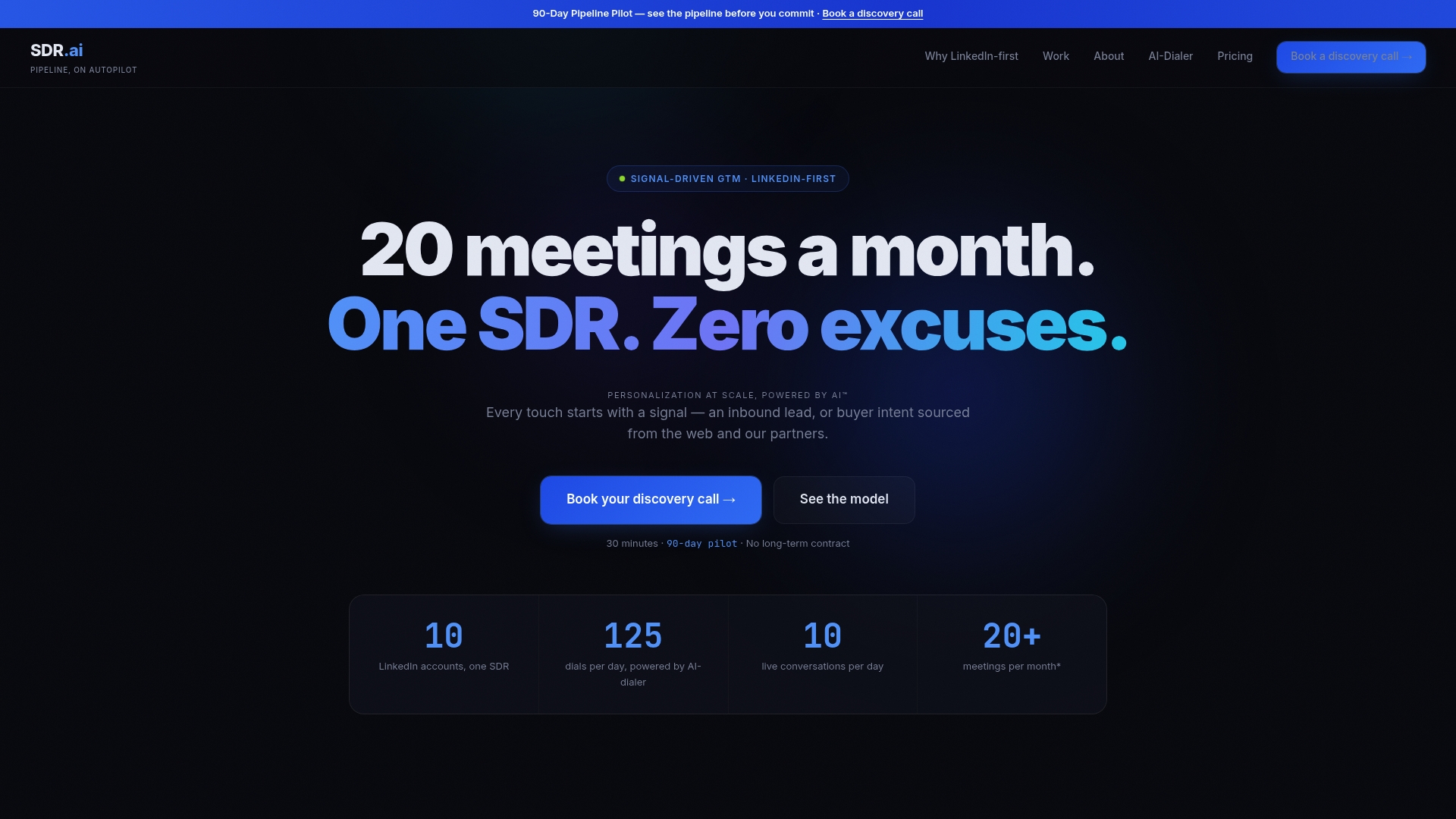
Sdr focuses specifically on that gap: LinkedIn-first outreach and an AI dialer built for parallel calling that targets accounts matching your ICP criteria, then personalizes messaging and timing based on intent signals rather than generic sequences. Sdr describes typical engagements producing over 20 qualified meetings a month with minimal added headcount, run against a transparent methodology rather than a black-box algorithm. If you're weighing whether to build this infrastructure internally or bring in a partner already running it, the comparison between an AI SDR and a traditional SDR agency walks through the tradeoffs. For teams that already have an ICP defined and just need it activated, booking a demo is the fastest way to see how it maps to your specific accounts.
Sources
- Ideal customer profile - ZoomInfo pipeline article
- What’s an Ideal Customer Profile (ICP)? How to Identify and Win Your Best Customers - Salesforce
FAQ
What Is a Good ICP?
A good ICP is specific enough to disqualify most companies while still leaving enough volume to fill a pipeline, built from pattern evidence across dozens of closed-won accounts rather than a handful of favorite customers.
How Do I Identify My ICP?
Start by mining your closed-won deals for shared firmographic and behavioral traits, then validate those patterns through direct customer interviews before layering in technographic and intent data.
What Does ICP Mean for Customers?
For a company being targeted, ICP means it matches the firmographic, technographic, and behavioral profile a vendor has identified as most likely to succeed with their product, which often translates into faster, more relevant outreach.
What Does ICP Mean in Finance?
Outside of sales, ICP can refer to unrelated finance and clinical terms depending on context, but within B2B sales and revenue operations, ICP exclusively means ideal customer profile, the account-level fit criteria used to qualify prospects.
What's the Difference Between ICP and Buyer Persona?
An ICP describes the ideal company at the account level using firmographic and fit data; a buyer persona describes the individual decision maker inside that account, including their role, priorities, and objections.