
Generative AI for sales works when you treat it as a disciplined pilot, not a company-wide mandate. Run one use case, usually lead research or outbound personalization, against a defined ICP for 30 to 90 days before scaling. B2B GTM teams, SDRs, and sales ops see the fastest gains. Start there, measure reply and meeting rates weekly, then expand only what the data supports.
TL;DR:
- Focus on proven use cases like lead research and outbound personalization within a controlled pilot period of 30 to 90 days.
- Implement guardrails such as sender warm-up, daily monitoring, and human approval gates to prevent reputation damage and control costs.
- Measure early success through reply and meeting rates, aiming for stability before scaling volume gradually over two to three months.
- Prioritize onboarding with clear workflows, starting with simple tasks like enrichment to build trust and adoption among sales teams.
- Expect future improvements to integrate deliverability checks into generation tools and stress the importance of regulation-aware human oversight.
Table of Contents
- What Generative AI for Sales Actually Does Well
- How Does Generative AI Work in a Real Sales Workflow?
- What Guardrails Prevent Generative AI Projects From Failing?
- How Do You Run a Generative AI Pilot in Sales?
- How Long Until Generative AI Shows Measurable ROI?
- Applied Example: How SDR.ai Operationalizes This Playbook
- Getting Your Sales Team to Actually Adopt These Tools
- Where Generative AI in Sales Is Headed Next
- What Sales Leaders Should Actually Prioritize
- How Sdr Turns This Playbook Into Booked Meetings
- Sources
What Generative AI for Sales Actually Does Well
Sales teams asking about generative AI usually want to know one thing: where does it move the needle without creating a mess? IBM's breakdown of generative AI in sales points to five areas: personalized customer interactions, better lead generation, automated outreach and follow-ups, faster content creation, and sharper forecasting. Each pulls a different lever, and each fits a different role on the team.
Prospecting and lead generation benefit most from pattern matching at scale. A model can scan firmographic and intent data across thousands of accounts and flag the 50 that match your ICP today, not the 500 that matched it a year ago. That's a research function, not a creative one, and it's usually the safest place to start.
Personalized outreach at scale sounds like a contradiction, but it isn't. AI drafts a first pass on messaging using account-specific signals (recent funding, job postings, tech stack changes), and a human still edits before anything sends. Content creation extends the same logic to case studies, one-pagers, and email sequences drafted from a brief instead of a blank page.
Forecasting, conversation intelligence, coaching, and RFP drafting round out the list, and they tend to help different people:
- Sales ops gets cleaner pipeline data and forecast models that flag deals with stalled momentum before they slip.
- Managers get coaching signals pulled from call transcripts, like talk-to-listen ratios or missed objection handling.
- AEs get RFP first drafts assembled from a knowledge base instead of starting from scratch.
- SDRs get research and enrichment done before the first touch, cutting prep time per account.
McKinsey's analysis of generative AI in B2B sales frames this as three separate pathways: productivity gains from automating grunt work, growth from better targeting and personalization, and eventually changes to how the sales operating model itself runs. Most teams are still on pathway one. That's fine. It's also where the ROI is easiest to prove.
How Does Generative AI Work in a Real Sales Workflow?
Two operating modes cover almost everything you'll deploy: copilot and agent. A copilot drafts, suggests, or summarizes, and a human approves before anything happens. An agent acts on its own within defined limits, sending an email or updating a CRM field without a person clicking "send" first.
Copilots are lower risk and faster to trust. The tradeoff is that they still need a human in the loop for every action, which caps the volume you can push through. Agents scale further but carry more exposure. If an agent misreads context and sends a poorly personalized message to 200 contacts overnight, you've damaged real relationships and possibly your domain's sender reputation before anyone notices.
Operational guidance on production AI for sales points to five patterns that consistently reach production instead of stalling in a pilot:
- Lead research and enrichment. Low risk, high volume, no customer-facing output. The natural starting point for most teams.
- Outbound personalization. Draft-then-approve messaging built on account signals, with deliverability guardrails from day one.
- SDR-assist copilot. Real-time suggestions during live calls or while drafting follow-ups, always with a human finger on the trigger.
- Pipeline hygiene and forecasting. Automated data cleanup and stall detection that feeds a more accurate forecast model.
- RFP drafting. First-draft responses pulled from an approved knowledge base, reviewed before submission.
Each pattern needs to plug into existing infrastructure: your CRM (Salesforce, HubSpot), your sales engagement platform, and any conversation intelligence tool already recording and transcribing calls. Skipping that integration step is the single fastest way to end up with a shadow system nobody trusts.
What Guardrails Prevent Generative AI Projects From Failing?
Gartner projects that more than 40% of agentic AI projects will be canceled by the end of 2027, largely because of rising costs and weak operational controls. Sales is especially exposed here because the downside isn't abstract. A bad outbound campaign burns your domain reputation, and rebuilding sender trust with mailbox providers takes months, not days.
Deliverability discipline has to be enforced in tooling, not left to good intentions:
- Warmed sender pools. Never route AI-generated volume through a fresh domain or a mailbox with no sending history.
- Per-domain throttles and send caps. Hard limits on daily volume per sender, enforced automatically, not by trusting someone to remember.
- Monitoring tripwires. Automated alerts when bounce rates, spam complaints, or reply rates move outside normal range.
- Human approval gates. Any net-new outbound message and anything containing commitment language (pricing, scope, contract terms) gets a human review before it sends.
- Cost and scope caps. Set a budget ceiling for inference and enrichment calls per month so a runaway agent doesn't rack up a bill nobody approved.
Pro Tip: Treat your sender reputation like a credit score. It's slow to build, fast to damage, and nearly impossible to explain to a prospect once it's gone.
Every one of these controls maps directly to the operational weaknesses Gartner flags as the reason agentic projects get canceled. Build the guardrails before you scale volume, not after something breaks.
How Do You Run a Generative AI Pilot in Sales?
A focused pilot beats a sprawling rollout every time, mostly because it's the only version you can actually measure. Pick one use case (outbound personalization is the most common starting point after lead enrichment), define your ICP tightly, and choose the channels you'll test on before writing a single message.
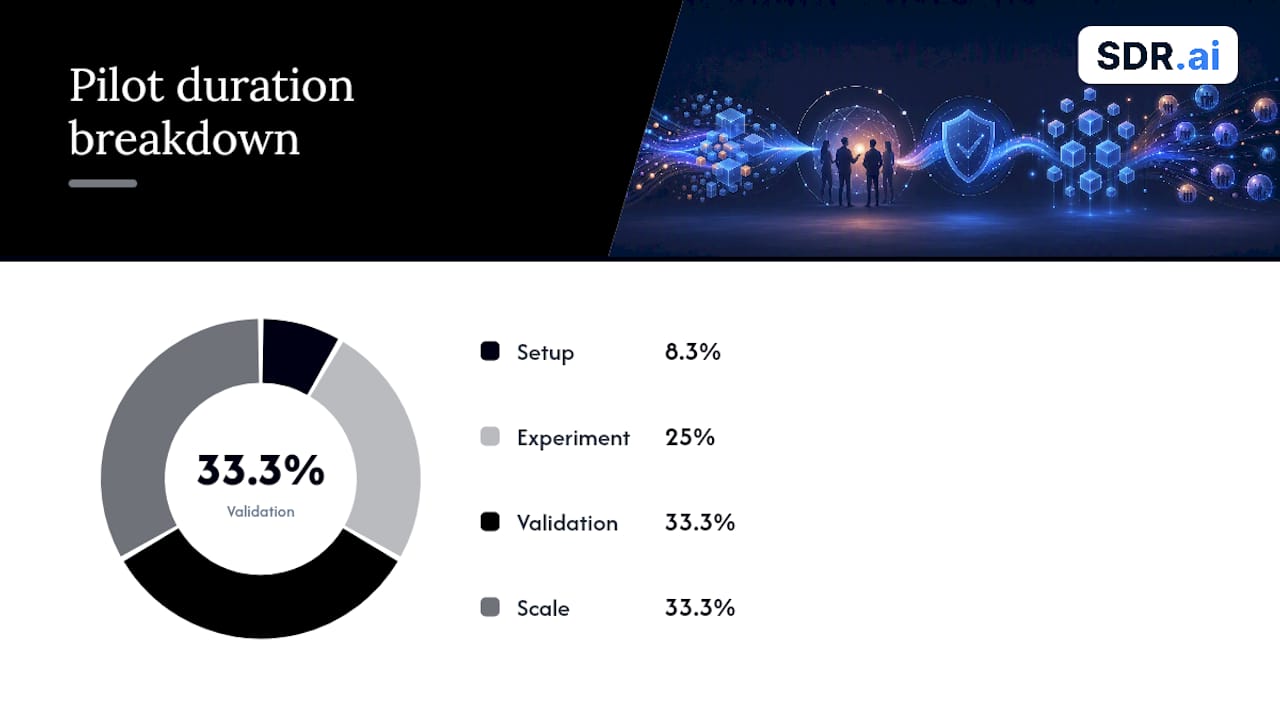
- Setup (week 1). Lock the ICP, connect your CRM and sales engagement platform, and confirm your sender pool is warmed and within safe volume limits.
- Experiment (weeks 2 to 4). Run the pilot at a deliberately capped volume. Watch open rates, reply rates, and any deliverability tripwires daily, not weekly.
- Validation (weeks 5 to 8). Compare meeting rate and qualified meeting count against your baseline. If reply rates are flat or bounce rates climb, pause and diagnose before adding volume.
- Scale (weeks 9 to 12). Expand sender volume gradually, add a second use case only after the first is stable, and formalize the approval workflow for the team.
LeadIQ's guidance on AI adoption in sales notes that pilots run with clear governance tend to show measurable lift within weeks rather than months, but only when the workflow is defined before launch, not improvised during it.
Watch four numbers throughout: open and reply rate, meeting rate, qualified meetings booked, and pipeline velocity. Early on, a reply rate holding steady while your rep spends less time per account is already a win. Don't wait for a revenue number to show up before you decide whether the pilot is working.
How Long Until Generative AI Shows Measurable ROI?
Most teams see directional lift in the 30 to 90 day range, assuming the pilot has a clear use case and a warmed sending infrastructure from day one. The leading indicators show up first: time saved per rep on research and drafting, and reply rate holding steady or improving compared to your baseline. Meeting rate and qualified pipeline typically lag those numbers by a few weeks.
Monday points to significant time savings when teams automate repetitive tasks like prospecting, drafting, and CRM updates. That time savings is usually the first metric to move, well before revenue impact becomes visible.
Define success criteria before you start, not after you see the numbers:
- A reply rate drop of more than a few points against baseline signals a personalization or targeting problem, not a volume problem.
- Rising bounce rates or spam complaints mean pause sending immediately and audit your sender pool.
- Meeting rate holding flat while volume increases is a real win. Don't mistake "flat" for "failure."
Scale only after two consecutive weeks of stable deliverability metrics. Expanding volume during a shaky week is how a promising pilot turns into a damaged domain.
Applied Example: How SDR.ai Operationalizes This Playbook
SDR's own approach mirrors the pilot-first pattern described above. Its method centers on LinkedIn-first outreach built around intent signals, layered with warm calling through its own AI-Dialer rather than blind cold-call volume. Some clients have reported booking over 20 qualified meetings a month with a lean team, the kind of outcome the deliverability and approval-gate guardrails above are designed to protect.
The Sdr Blueprint documents this as a repeatable data, digital, and dials engine rather than a one-off campaign. That structure maps directly onto the pilot-to-scale sequence: define the ICP, protect sender health, measure meeting rate before chasing volume. Teams evaluating whether to build this in-house or bring in an operator built around it can see the full comparison in Sdr's breakdown of AI SDR versus traditional agency models.
Getting Your Sales Team to Actually Adopt These Tools
Technology rollouts fail more often from resistance than from bad code. Reps who've spent years trusting their gut about which leads to chase won't automatically trust a model's enrichment score, and forcing adoption top-down usually backfires into shadow workflows where people quietly ignore the tool.
Start training with the narrowest possible use case, the one with the clearest, fastest payoff. Lead enrichment works well here because it removes a genuinely tedious task (manually researching 50 accounts) without asking a rep to change how they sell. Once that trust is built, layer in something more visible, like AI-assisted call coaching, where reps see their own transcripts and can validate the feedback against what they remember from the call.
HubSpot's research on generative AI adoption in sales notes that early adopters often see real productivity gains, but the outcome depends heavily on whether teams have defined workflows and active change management, not just access to a tool. A model sitting unused in a CRM sidebar delivers zero ROI regardless of how good it is.
Designate a champion on each pod, someone who's already comfortable with the tool, to answer day-to-day questions instead of routing everything to IT or a vendor's support line. Revisit training 30 days in. What confused reps in week one is rarely what confuses them in week four.
Where Generative AI in Sales Is Headed Next
The shift already underway is from copilot to agent, but slowly and unevenly. Most teams will keep humans in the approval loop for anything customer-facing well into this year and next, even as backend tasks like enrichment and pipeline hygiene move to fuller automation.
Conversation intelligence is getting sharper at predicting deal risk before a rep notices it themselves, flagging a stalled deal based on sentiment shifts across a call transcript rather than waiting for a stage to sit untouched for 30 days. Forecasting models are starting to incorporate that same signal, blending historical win rates with real-time conversation data instead of relying purely on stage-and-close-date math.
Expect tighter integration between generative drafting and deliverability infrastructure, too. Right now those are often separate systems bolted together. The next generation of tools will bake sender health checks directly into the drafting and sending pipeline, so a model can't generate a burst of outbound that a deliverability system would reject anyway.

Regulation around AI-generated outreach, particularly disclosure requirements in some jurisdictions, is also likely to tighten. Teams that build human approval gates now won't need to retrofit compliance later.
What Sales Leaders Should Actually Prioritize
Start with prospecting or enrichment, not outbound. Protect deliverability like it's your most valuable asset, because it is. Measure reply and meeting rate within weeks, not quarters, and kill what doesn't work fast. None of this succeeds without reps who trust the tool enough to actually use it.
— Chad
How Sdr Turns This Playbook Into Booked Meetings
Most of what this guide describes, warmed sender pools, human approval gates, pilot-to-scale sequencing, is exactly what Sdr runs day to day for B2B teams that don't want to build it themselves. Instead of hiring and ramping an SDR for months before seeing a single booked meeting, you get a managed pilot built on intent signals and LinkedIn-first outreach, backed by the same guardrails covered above.
If you're weighing whether to build this in-house or hand it to a team that's already operationalized it, Sdr's Blueprint walks through the exact data, digital, and dials sequence clients use to reach 20 or more qualified meetings a month. For teams that already have SDRs but need to multiply their call volume, the AI-Dialer handles parallel dialing without adding headcount. Either way, the next step is the same: book a demo and walk through your specific ICP before committing to a full rollout.
Sources
- Gartner press release on agentic AI project risk (2025)
- An unconstrained future: How generative AI could reshape B2B sales — McKinsey
- How to Use AI in Sales: Patterns & Guardrails | Resourcifi
- Monday
- Generative AI for sales — IBM