
To increase qualified meetings, stop counting booked calendar slots and start counting meetings that your closers accept as real opportunities. That means four moves: write the acceptance criteria before outreach starts, aim only at accounts that show fit and intent, qualify replies before offering a time, and hand each meeting to the salesperson with context. Teams that do this book fewer wasted calls and more pipeline from the same effort.
This guide walks through each move in order, with the numbers, questions and handoff fields we use when we run outbound for B2B technology companies.
TL;DR
- A qualified meeting is defined by written criteria agreed between SDRs and closers before the first message goes out, not by whether a prospect said yes.
- Prioritize accounts by fit, intent and timing. Spraying a large list is the most common reason meetings turn out unqualified.
- Qualify replies before you offer the calendar, and send the receiving rep evidence, not just an invite.
- Measure acceptance rate and meeting-to-opportunity rate, not only meetings booked. Diagnose weak results by stage.
Table of Contents
- Define "qualified" before you send a message
- Aim at the right accounts and signals
- Run outreach that earns real replies
- Qualify before you offer the calendar
- Prepare the prospect and hand off the context
- Measure what shows the meetings are working
- Our perspective: fewer meetings, better ones
- Get the system without building the team
- FAQ
- Sources
Define "qualified" before you send a message
Most disputes between SDRs and account executives come from one missing document: a shared definition of a qualified meeting. Without it, the SDR optimizes for volume and the closer judges on gut feel.
Peer-reviewed research on sales development points the same way. A 2022 academic study of inside sales practices finds that end qualification needs clearly defined criteria and a carefully coordinated, typically joint, handover. It also says the criteria should be customized to the company rather than assumed to be universal. In other words, copying a template from a blog post is not enough. Your sales motion, deal size and buyer set decide what counts.
Write an acceptance rubric
Sit down with the people who will take the meetings and agree on a one-page rubric. A workable version has three parts:
- Hard gates. Facts that must be true or the meeting is not booked: the company is in your ICP, the person has a role that touches the problem, and they are not a competitor, student or vendor.
- Soft signals. Things that raise priority but are not required: a recent funding round, a relevant hire, a technology change, a visible pain point on LinkedIn.
- Unknowns. Items the SDR does not need to resolve, such as full budget. Early in a complex deal, nobody has it yet.
That last point matters. The 2020 MEDDPICC guide from Inflexion Point calls literal BANT (budget, authority, need, timeframe) over-simplistic for complex B2B buying, where five to ten or more stakeholders may be involved and projects may not yet be formally funded. If your rubric rejects every prospect who cannot name a budget on the first call, it will starve your pipeline.
Agree on what happens to rejected meetings
The rubric only works if rejections come back with a reason. When an AE declines or holds a meeting, log one of a few coded reasons (wrong persona, no need, bad timing, duplicate). Review them together weekly. Patterns show up fast: if half your rejections say "wrong persona," the problem is list building, not messaging. Our guide to lead qualification frameworks by ACV, CRM fields and KPIs shows how to map those fields to deal size.
Aim at the right accounts and signals
A qualified meeting starts with a qualified target. Fit tells you who could buy. Intent and timing tell you who might buy now. You need both, and the second is where most teams under-invest.
Start with a narrow ICP
List the firmographics of your best existing customers: size, industry, stage, tech stack, buyer title. Then cut the list further until you could name the first fifty accounts from memory. A tighter list feels like fewer chances, but each message can be specific, and specificity is what earns a reply.
Add buying signals
Signals are observable events that raise the odds an account is in motion. Useful ones for B2B technology sellers include:
- A new executive in the function you sell to
- Job postings that describe the problem you solve
- A funding round or major product launch
- Engagement with content on LinkedIn about your category
- A competitor's customer posting about switching or frustration
AI can make this scoring practical. Salesforce's 2024 research, as highlighted in its India State of Sales report, describes Royal Enfield using AI-powered propensity scores to prioritize high-potential leads, which converted to sales at 23%. That is one company's result, not a benchmark, but it shows the principle: rank first, then spend human time on the top of the list. If you are a founder working out how to use AI and buyer signals for your first customers, this walkthrough on getting early customers with AI tools covers the early-stage angle.
You do not need perfect data to begin. McKinsey's 2024 analysis of next-gen B2B sales recommends a use-case approach: start with the most promising scenario instead of waiting for clean data. Pick one segment and one or two signals, run it for a month, and expand once you see what converts. For more on combining the three factors, see our posts on turning buyer intent signals into booked meetings and intent data, ICP fit and AI outreach.
Run outreach that earns real replies
The aim of outreach is not to extract a calendar click. It is to start a conversation with someone who has a reason to talk. That changes how you write.
Lead with the reason you picked them
One sentence that names the signal ("saw you are hiring your first RevOps lead") does more than three sentences about your product. Buyers can tell when a message was mail-merged. According to McKinsey's May 2026 survey on B2B growth, market leaders are four times more likely than peers to deploy one-to-one personalization (20% versus 5%). The same analysts say leaders treat personalization as a system capability built into the commercial workflow, not a one-off campaign tactic. Translate that to a small team: personalization has to be repeatable, which means signals and templates feed the message, and a person checks it.
Start where the buyer already is
For technology buyers, LinkedIn is often the best first touch because the profile gives you context before you write a word. Warm up with a profile view or relevant comment, send a short connection note, then follow up with a message that references something real. Our walkthrough of LinkedIn prospecting with AI in five steps lays out the sequence. Pair it with a call to people who have already seen your name; the difference between cold and warm calling is often the difference between a hang-up and a conversation.
Give time back to selling
When reps are buried in admin, outreach quality drops. Salesforce's 2024 State of Sales report finds that reps spend only 30% of their time selling, with 70% going to administrative work, planning and other non-selling tasks. Automating research, list hygiene and dialing frees hours for the conversations that matter. The same company's 2024 AI findings report that 80% of reps on teams using AI say getting customer insights is easy, compared with 54% on teams without AI. For tools that take on repetitive work so reps can focus on qualified prospects, this overview of sales automation for small businesses is a starting point.

Qualify before you offer the calendar
The cheapest way to raise your qualified rate is to stop booking meetings with everyone who replies. A reply is not a meeting. Treat replies as a triage queue.
Sort every reply
A simple sort works for most teams:
| Reply type | Example | Action |
|---|---|---|
| Clear interest | "Yes, let's talk this week" | Confirm fit against hard gates, then book |
| Curious, vague | "What does this cost?" | Ask one qualifying question before booking |
| Referral | "Talk to our VP of Sales" | Reach out to the referral with context, then book |
| Not now | "Try me next quarter" | Set a dated follow-up and a signal to watch |
| Wrong fit | "We do not do that" | Close politely and log the reason |
Having a human read every reply is what keeps automation honest. It is also how we run our service: AI finds and warms the account, and a human SDR handles the response. Our piece on AI meeting booking in four B2B stages explains where the human sits.
Ask better questions than BANT
Buyers notice when you do not understand them. Salesforce's 2024 report shows that 86% of business buyers are more likely to purchase when companies understand their goals, yet 59% feel reps do not take time to understand their challenges. A scripted budget interrogation makes that worse.
Gartner's March 2024 qualification research suggests moving from BANT toward FONE: Fit, Openness, Need and Engagement, especially in complex technology sales. A practical set of pre-meeting questions under that model:
- Fit: Does the company match the ICP and the use case?
- Openness: Are they willing to change how they do this today? What have they tried?
- Need: What is the problem, and what happens if it stays unsolved?
- Engagement: Who else will join, and are they willing to invite them?
Keep it to one or two questions in the thread. Anything more feels like a form. And treat qualification as continuing: one contributor in a Gartner peer discussion calls this "Always Be Qualifying," meaning you keep learning after the meeting is booked, not only before it.
Prepare the prospect and hand off the context
A good meeting can still fail if the prospect arrives confused or the closer arrives blind. Both are fixable in a few minutes.
Prepare the prospect
When you confirm the meeting, send a short note with the purpose, the two or three topics you will cover, who from your side will attend, and how long it will take. Ask them to bring anyone else who cares about the problem. Prospects who know what the call is for show up more often and engage more.
Hand off evidence, not just an invite
The receiving salesperson should see, in the CRM and in the calendar invite, the following:
- The signal or trigger that led to outreach
- The prospect's own words about their problem, quoted from the thread
- Which rubric gates were confirmed and which remain unknown
- Other stakeholders mentioned or invited
- Any objection raised, and the answer given
- Links to the LinkedIn thread and the account record
This is the coordination problem the academic research describes. The SDR's job is to prepare the customer for a meaningful conversation with field sales, so the handoff has to be designed by both sides. Our lead handoff process guide offers a field-by-field template.
Measure what shows the meetings are working
Meetings booked is a vanity number if half of them go nowhere. Track the chain instead.
| Metric | What it tells you |
|---|---|
| Reply rate | Whether targeting and message land |
| Positive reply rate | Whether the offer matches the audience |
| Reply-to-meeting rate | Whether triage and scheduling work |
| Acceptance rate | Whether meetings meet the rubric |
| Meeting-to-opportunity rate | Whether qualification predicts pipeline |
| Pipeline per meeting | Whether you are reaching the right deal size |
Use the right denominator. Measure acceptance against meetings held, and opportunity creation against accepted meetings, so a few no-shows do not hide a healthy process.
Diagnose by stage
- Low reply rate: The list or the opening line is wrong. Tighten the ICP or add a stronger signal.
- Good replies, few meetings: Friction in scheduling or a vague ask. Offer two times and state the purpose.
- Meetings held but rejected: The rubric is not being applied, or it is not the right rubric. Review rejected meetings with the AEs.
- Accepted but no opportunities: The qualification questions do not surface real need. Revisit the Need and Openness questions.
Visibility itself pays off. Salesforce's State of Marketing report finds that 93% of high-performing marketers have a clear view of their impact on the sales pipeline, versus 71% of underperformers. The same logic applies to outbound. And teams using AI are 1.3 times more likely to report revenue growth than those that do not, according to Salesforce's 2024 research, though that is a correlation, not a guarantee for any single team.
If you want a broader look at how to structure the outbound motion behind these numbers, our guide to appointment setting strategies covers cadence and channel mix.
Our perspective: fewer meetings, better ones
We run outbound for Series A and B technology companies, and the same mistake shows up again and again: founders ask for more meetings when what they need is more meetings their closer wants to take. Volume is easy to buy and hard to use.

We focus on the ICP and on intent signals, and we start on LinkedIn because that is where a buyer's context is visible. A human SDR reads and answers every reply, because a reply is where qualification really happens. We would rather decline a polite "send me info" than add it to a number that looks good in a weekly report.
The pipeline math should be on the table from day one: reply rate, acceptance rate, opportunity rate. When the numbers are visible, the conversation with the sales team changes from "are these leads any good?" to "which stage do we fix?" That is a far better conversation, and it is how a small team gets to a steady flow of qualified meetings without building a whole SDR department first.
— Chad
Get the system without building the team
If you want this machinery running without hiring and ramping an in-house SDR team, our AI-Powered Outbound service is $2,500 per month plus a $500 one-time setup fee. It is built around signal-driven targeting, LinkedIn-first outreach and a human SDR who handles every reply.
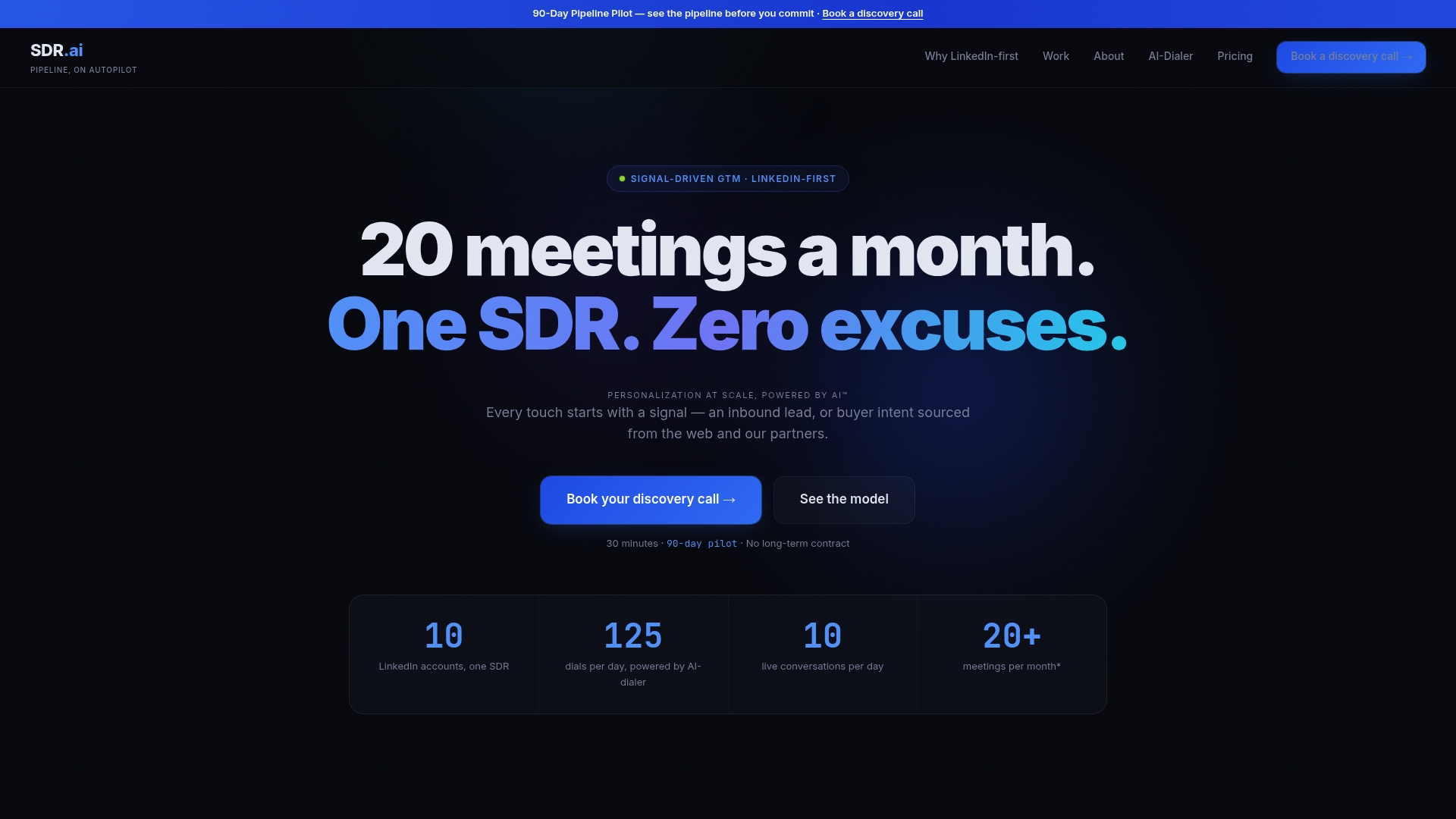
If your reps already have their own lists and you mainly need to warm up and speed up calling, the AI-Dialer is $2,400 per year with a $500 one-time onboarding fee.
FAQ
What is a qualified meeting?
A qualified meeting is one with a person who matches your ICP, has a relevant problem and has agreed to a conversation about it, judged against criteria that your sales team wrote down in advance. The standard should be set jointly by SDRs and closers. If the closer would not have taken the meeting knowing what the SDR knew, it was not qualified.
How many qualified meetings should an SDR book?
There is no universal number, because it depends on deal size, market and channel. Set a target from your own funnel math: work backward from the pipeline you need, using your acceptance and opportunity rates. Then adjust after a month of data rather than borrowing a benchmark from another company.
Is BANT still worth using?
It is a useful checklist, but a poor gate for complex technology deals, where budgets and stakeholders are often unsettled early on. Gartner suggests Fit, Openness, Need and Engagement as a better early-stage frame. Use BANT items as soft signals, not as automatic disqualifiers.
How long does it take to see more qualified meetings?
You can usually see reply and acceptance data within the first few weeks of a focused campaign, since those metrics need only a few hundred touches. Meeting-to-opportunity data takes longer, because it depends on your sales cycle. Review the stage ratios every week and change one variable at a time.
Sources
- Toward a contextualized understanding of inside sales (2022)
- McKinsey: Key tactics for successful next-gen B2B sales
- McKinsey: B2B buyers reset the bar
- Salesforce State of Sales report, 6th edition
- Salesforce: Sales teams using AI statistics (2024)
- Gartner: Improve Lead Qualification to Win More Sales
- Inflexion Point: MEDDPICC+RR Opportunity Qualification
- Gartner Peer Community: qualifying outbound leads
- Salesforce State of Marketing, 9th edition
- Getting early customers with AI tools
- Sales automation for small businesses