
Intent data for sales is the practice of tracking digital research behavior, like content consumption, product searches, and hiring patterns, to flag accounts that are actively investigating a problem your company solves. The core benefit is prioritization: instead of cold-calling a flat list, reps chase the accounts already showing motion. The caveat matters just as much as the promise. Intent is a signal of activity, not a confirmed sale, and treating it as a guarantee is where most teams waste their budget.
TL;DR:
- Intent signals alone do not predict which vendor a buyer will choose, but they reveal that an account is actively researching relevant solutions.
- Effective use of intent data requires building scoring models that combine intent spikes, ideal customer profile fit, and prior engagement, filtering out low-quality signals.
- Proper integration into CRM and clear response SLAs are essential for maintaining trust and measuring the true impact of intent-based outreach.
- Privacy considerations mean first-party data with consent is safest, while third-party feeds must be scrutinized for compliance and methodology transparency.
- Combining AI-driven intent analysis with human-led outreach helps turn signals into booked meetings, avoiding automated, impersonal communication.
Table of Contents
- What Intent Data Looks Like in Practice for Sales Teams
- How Sales Teams Should Use Intent Data Day to Day
- Integrating Intent Signals Into Your CRM and Lead Scoring
- Measurement, Limits, and Common Pitfalls
- Privacy and Compliance Considerations When Using Intent Data in Sales
- Best Practices for Data Validation and Quality Assurance
- How to Map Intent Data to Internal Segmentation and Campaign Assignment
- Emerging Trends and Technologies in Intent Data
- Practitioner Perspective: Acting on Intent Without Losing the Human Touch
- Turn Intent Signals Into Booked Meetings, Not Spreadsheets
- Sources
- FAQ
What Intent Data Looks Like in Practice for Sales Teams
Intent signals get picked up through a mix of observable digital footprints. A prospect reads three articles about your category on an industry publisher's site. A company posts two new job listings for "revenue operations." A firm closes a funding round and suddenly has budget to spend. Each of these events, tracked at scale, becomes a data point that a sales team can act on.
There's a meaningful difference between account-level and contact-level signals. Account-level intent tells you that "somebody at Acme Corp" is researching CRM alternatives, which is useful for account-based targeting but doesn't tell you who to call. Contact-level intent, often pulled from first-party sources like your own website or gated content, tells you a named person engaged. Freshness matters enormously here: a signal from 30 days ago is a lukewarm lead at best, while a spike from the last 48 hours is worth an immediate call.
Signal indicators worth tracking on a rep's dashboard:
- Repeated visits to pricing or comparison pages on your own site
- Content downloads or webinar attendance tied to your specific category
- Job postings that signal new budget or a new buying team
- Funding announcements or leadership changes at target accounts
- Third-party research spikes on competitor or category keywords
How Sales Teams Should Use Intent Data Day to Day
The teams that get real return from intent data don't buy a feed and hope. They build a scoring model first, then layer intent on top of it.
Scoring approach: Combine three inputs, an intent spike (a sudden increase in topic engagement), ICP fit (does this account match your ideal customer profile on size, industry, and tech stack), and existing engagement (has this account already talked to a rep or opened emails). An account that scores high on all three jumps the queue. An account with intent but poor fit gets filtered out entirely, no matter how loud the signal.
Action rules should be simple enough that a rep can apply them without checking a manual:
- High intent + strong ICP fit + no prior contact → call within 24 hours
- Moderate intent + strong fit → add to a nurture sequence, not a cold call
- High intent + weak fit → hand to marketing for a lighter-touch campaign, not sales
- Any intent spike on an existing open opportunity → notify the rep immediately, this often signals a stalled deal is moving again
A practical multi-channel sequence triggered by an intent spike might look like this: a LinkedIn connection request with a note referencing the specific topic the account researched, followed 48 hours later by an email that offers a resource on that exact subject, followed by a call attempt on day five if there's no response. Track response rate, meeting-set rate, and time-to-first-touch as your core metrics.
Pro Tip: Before you buy any intent feed, pull your last 20 closed-won deals and map what those accounts were doing in the 90 days before they signed. Build your monitors around those specific behaviors instead of a generic topic list. You'll cut noise dramatically and your reps will trust the alerts more.
Coordination between sales and marketing matters here too. Marketing should own the nurture-tier accounts, sales should own the call-ready tier, and both teams need a shared definition of what "intent" means before either side touches a lead. Gartner's own guidance on scoring leads with intent data makes the same point: intent only improves prioritization when it's combined with fit and lifecycle stage, not used on its own.
Integrating Intent Signals Into Your CRM and Lead Scoring
Getting intent data into a rep's daily workflow, without drowning them in noise, is mostly an ingestion and mapping problem.
- Ingest and normalize first. Whether you're pulling data through a CDP or a direct ETL pipeline into your CRM, standardize topic taxonomy before anything hits a rep's screen. A signal labeled "cloud migration" from one source and "infrastructure modernization" from another needs to map to the same internal field, or your scoring model breaks silently.
- Set explicit thresholds. A reasonable starting rule might be three or more topic-relevant page views within a seven-day window before a signal counts as "high intent." Adjust the window and count based on your sales cycle length, a 90-day enterprise cycle tolerates a wider window than a two-week transactional one.
- Route with an SLA, not a firehose. Every qualifying signal should route to a specific rep with a response-time expectation attached, typically 24 to 48 hours. Without an SLA, alerts pile up and reps start ignoring them, which defeats the entire system.
- Log every signal against the account record. Attribution only works if you can later trace a closed deal back to the intent signal that triggered the first outreach. Most teams skip this step and then can't prove the program's ROI six months later.
Forrester's research on intent data adoption found that while usage has grown, most organizations still underuse the data they've already paid for, largely because of exactly these integration and measurement gaps.
Measurement, Limits, and Common Pitfalls
The single biggest misconception about intent data is that it predicts who will buy from you specifically. It doesn't. Forrester's buyer journey research found that 68% of B2B buyers begin the purchase process with a preferred vendor already in mind, and that preferred vendor wins the deal 55% of the time. Intent shows that an account is moving. It says nothing about which vendor they're moving toward.
Many B2B buyers start their purchase process with a preferred vendor already in mind, and that vendor often closes the deal.
Common errors that sink intent programs:
- Buying a feed before building a playbook or scoring model to act on it
- Mapping topic taxonomy poorly, so signals land on the wrong segment
- Chasing every low-quality signal instead of filtering for fit first
- Never measuring response or meeting rate, so nobody can prove the program works
Set a realistic measurement plan from day one: track response rate and meeting-set rate as leading indicators, run A/B tests comparing intent-triggered outreach against your standard cadence, and only after a full sales cycle, attribute win-rate changes to the program. Budget-wise, expect a ramp period of one to two full sales cycles before the signal-to-pipeline math becomes reliable.
Privacy and Compliance Considerations When Using Intent Data in Sales
Intent data sits closer to regulated territory than most sales teams realize, especially once contact-level signals enter the picture. First-party data collected through your own site with proper consent banners is generally the safest category to work with. Third-party aggregated feeds carry more risk, because the data was often collected by a publisher or ad network under a privacy policy the end account never saw applied to your outreach.
Before activating any third-party intent source, confirm how the vendor sourced consent and whether that consent covers resale to sales and marketing teams. Regulations like the EU's GDPR and various US state privacy laws treat behavioral tracking differently depending on jurisdiction, so a feed that's compliant for a UK account may not clear the bar for a California one. When in doubt, route the question to legal rather than assuming the vendor has already handled it.
A few practical habits reduce exposure:
- Prefer vendors who publish a clear methodology for how consent was captured
- Avoid using intent data to infer or store sensitive personal characteristics, stick to firmographic and behavioral signals tied to the account, not the individual
- Build a data retention policy so stale intent records get purged rather than piling up indefinitely
- Train reps to use intent as context for relevance, not as a script that reveals exactly what a prospect read, which can feel invasive rather than helpful
Compliance isn't just a legal checkbox here. Outreach that references a signal too precisely can spook a buyer instead of impressing them. The best use of intent data reads as relevant timing, not surveillance.
Best Practices for Data Validation and Quality Assurance
An intent feed is only as good as its worst signal, and bad signals erode rep trust faster than almost anything else in a sales tech stack. Validation starts with sampling: pull a batch of flagged accounts each month and manually check whether the underlying behavior actually happened the way the vendor claims.

Cross-reference signals against outcomes you already know. If an account shows "high intent" on your category but your CRM shows they signed with a competitor three weeks earlier, that's a data quality flag worth investigating, not an isolated miss. Track a false-positive rate over time and hold vendors accountable to it.
A few quality-assurance habits worth building into a quarterly review:
- Audit taxonomy mapping every quarter, categories drift as vendors update their topic models
- Compare signal freshness against actual close-to-signal timing on won deals
- Flag any source with a false-positive rate that climbs past what your reps will tolerate before they stop trusting alerts entirely
- Require vendors to disclose sample size and refresh frequency, not just topic coverage
Reps disengage from a scoring system the moment it cries wolf too often. Protecting signal quality is less about the sophistication of the algorithm and more about the discipline of checking it against reality on a fixed schedule.
How to Map Intent Data to Internal Segmentation and Campaign Assignment
Raw intent signals mean nothing until they're mapped onto the segmentation model your sales and marketing teams already use. If your ICP segments accounts by industry, employee count, and tech stack, every incoming intent signal needs to resolve to one of those existing buckets before a rep or a campaign ever sees it.
Start by auditing your current segmentation model and confirming it's specific enough to receive intent data usefully. A segmentation model with only three broad tiers will bury the nuance a good intent signal provides. A model with defined micro-segments, say, mid-market SaaS companies with 50 to 200 employees evaluating a category switch, gives intent data somewhere precise to land.
Once mapped, assign each segment a default campaign path. A high-fit segment showing intent might route straight to an SDR for a call. A borderline-fit segment might route to a lighter-touch nurture campaign in marketing automation instead. This is where buyer persona work pays off. Personas that are specific about role, pain point, and buying trigger make it far easier to decide which campaign an intent-flagged account should enter, rather than dumping every signal into the same generic sequence.

Gartner's guidance on intent purchasing reinforces this directly: mapping intent taxonomy to internal segmentation before activating any campaign is one of the clearest ways to avoid targeting irrelevant accounts and to keep the handoff between marketing and sales clean. Skip this step and even accurate intent data ends up misapplied.
Emerging Trends and Technologies in Intent Data
AI-driven intent analysis is changing how signals get interpreted, not just how they get collected. Instead of a rep manually reviewing a list of topic spikes, machine learning models now cluster related behaviors, a job post, a pricing page visit, and a competitor comparison search, into a single composite intent score that accounts for how those signals typically combine before a real deal happens.
Natural language processing is also improving how third-party feeds classify content, reducing the taxonomy drift that used to require constant manual correction. That matters directly for signal quality, since inconsistent topic labeling has been one of the biggest sources of wasted outreach.
Another shift worth watching is the move toward real-time activation. Older intent workflows batched signals overnight or weekly. Newer platforms push qualifying signals to a rep's queue within minutes of the behavior occurring, which matters because freshness is one of the strongest predictors of whether an intent-triggered call actually lands a conversation.
Predictive scoring models are also starting to weigh historical win patterns more heavily, essentially automating the "reverse-engineer your closed-won deals" approach that experienced sales ops teams have used manually for years. As these models mature, expect intent platforms to increasingly resemble lead-scoring engines with intent built in as one input among several, rather than a standalone tool bolted on top of a CRM.
Practitioner Perspective: Acting on Intent Without Losing the Human Touch
Most intent programs fail at the handoff between signal and outreach. Sdr pairs signal-driven targeting with LinkedIn-first messaging, but the reply always goes to a human, not a bot script. That distinction is worth sitting with, because the industry's obsession with automation has quietly created a generation of outreach that feels mechanical the moment a prospect actually responds.
Sdr tracks something it calls Humanity per Hour™, a way of measuring how much genuinely human attention survives as outreach scales through AI. The bet here is that intent data should reduce the volume of wasted contacts, not the quality of the ones that land. Teams experimenting in-house with raw feeds often get the targeting right and the follow-through wrong. A managed AI-powered SDR model is worth considering the moment your in-house team has more qualified signals than reps to act on them.
— Chad
Turn Intent Signals Into Booked Meetings, Not Spreadsheets
Reading this far probably confirmed something you already suspected: the hard part of intent data isn't finding signals, it's building the machine that turns a spike into a booked call before the window closes. That's the exact gap Sdr's AI-powered outbound service was built to close. Instead of your team manually triaging feeds and hoping reps follow up in time, Sdr combines signal-driven account targeting with LinkedIn-first outreach and a human SDR who handles every single reply.
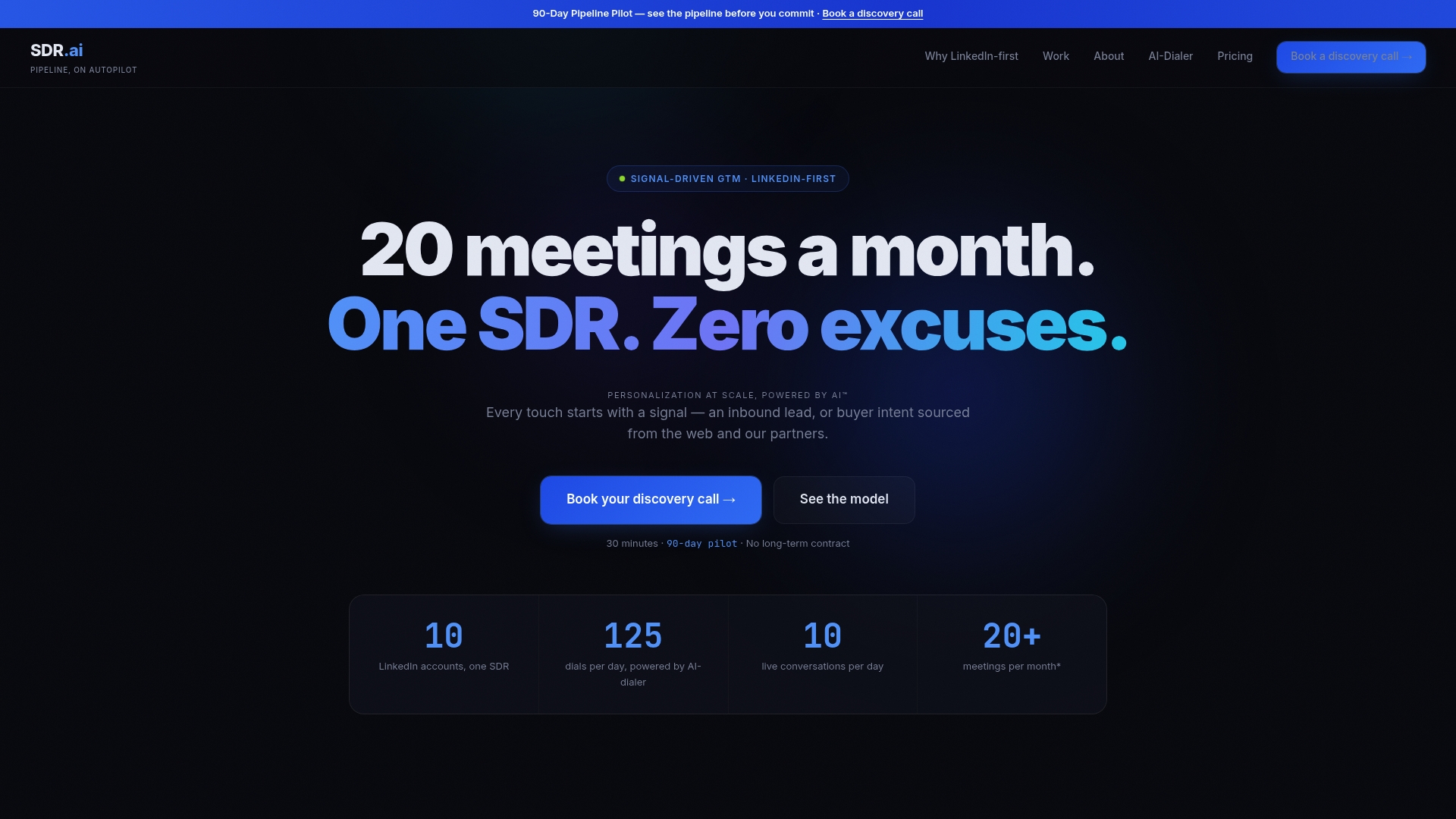
A pilot typically starts with a review of your ICP and current pipeline math, then moves into live outreach within weeks. If you're weighing that build-versus-buy decision, Sdr walks through the exact playbook. Teams that want to keep dialing in-house can license the AI-Dialer directly. For current pricing details, please visit the client's website. Either way, the next step is the same: book a demo and see what your intent data could actually be producing.
Sources
Forrester's buyer preference research and Gartner's intent purchasing guide both offer primary-source depth beyond what any single article can cover.
- B2B intent data is ubiquitous, increasing, and consistently underutilized
- How to purchase intent data
FAQ
What Is Intent Data in a Sales Context?
Intent data is behavioral evidence, like content consumption, product research, or hiring activity, that shows an account is actively investigating a problem your company solves. It helps reps prioritize outreach toward accounts already in motion rather than cold-calling a flat list.
How Do You Use Intent Data in Sales?
Combine an intent spike with ICP fit and existing engagement to score accounts, then route high scorers to immediate outreach and lower scorers to nurture campaigns. The most reliable starting point is reverse-engineering your last 20 closed-won deals to find the behaviors that preceded them, rather than buying a generic feed first.
What Is the Rule of Seven in B2B Sales?
The Rule of Seven is a planning heuristic suggesting buyers need roughly seven meaningful touches before they act, adapted for B2B to mean staged, relevant exposures across channels and stakeholders rather than raw repetition. It works well alongside intent data, since a signal can tell you when to time one of those seven touches for maximum relevance.
Who Provides B2B Intent Data?
Intent data comes from a mix of first-party sources (your own CRM and website), second-party partner co-ops, and third-party aggregated feeds from publishers and ad networks. Rather than picking a single named provider, most sales teams blend first-party signals with a vetted third-party feed, checking taxonomy alignment and refresh cadence before committing budget, as outlined in Gartner's purchasing framework.
Does Sdr Use Intent Data for Outreach?
Yes. Sdr's AI-powered outbound service applies signal-driven targeting to identify accounts showing intent, then pairs that with LinkedIn-first messaging and human-managed replies rather than fully automated scripts.