
AI for meeting booking uses signal-driven outreach and a human-in-loop SDR model to scale targeted, qualified B2B meetings. It works by pairing AI-powered targeting and messaging with a human rep who validates intent and handles every reply, so growth-stage B2B teams get a steady flow of qualified conversations without building an SDR team from scratch.
TL;DR:
- Define qualified meetings in writing using firmographic fit, timing, and a named decision influence; route every reply to a human SDR before scheduling.
- Prepare clean CRM data, permitted intent signals, an ideal customer profile, two to three message templates, and human review rules before launching outreach.
- Allow one to three weeks for setup, then run a 30 to 60 day focused pilot; expand only after KPI thresholds hold consistently.
- Track qualified meeting rates, opportunity conversion, and cost per booked meeting; research led LinkedIn outreach reports reply rates of 13% to 14%.
- Choose a managed service when hiring bandwidth is limited and pipeline targets are near; build internally only with mature data systems and time to experiment.
Table of Contents
- Why leaders are adopting AI for meeting booking
- How an AI-for-meeting-booking workflow actually operates
- Practical checklist: what to prepare, how to launch, and a realistic ramp timeline
- What to measure and the ROI math for meeting-booking programs
- Why SDR.ai: documented outcomes and how our model maps to the checklist
- Executive perspective: when to pick a managed AI SDR service vs building in-house
- How SDR.ai can help you get started
- FAQ
- Sources
Why leaders are adopting AI for meeting booking
Buyer behavior has shifted in a way that makes a hybrid model necessary, not optional. 67% of B2B buyers now prefer a rep-free experience when they are doing early research, which means cold, generic outreach lands worse than ever. Yet the same buyers still want a person involved before they commit. 69% of B2B buyers turn to sales reps to validate AI-generated insights once they have narrowed their options, which is exactly the moment a human SDR needs to show up.
Sales organizations are already leaning into this split:
- Most sales teams now report using AI in their daily workflow, according to Salesforce's State of Sales report, largely to automate routine tasks and reclaim selling time.
- McKinsey's analysis of gen AI in B2B sales points to next-best-action automation and multi-step prospect nurturing as the areas where AI adds the most value before a human needs to step in.
- Buyers actively tune out outreach that misses the mark, which raises the cost of generic prospecting and rewards signal-driven targeting.
AI scales discovery, and a human closes the gap at the moment buyers actually want to talk to someone. That division of labor is the core of what "AI for meeting booking" means in practice.
How an AI-for-meeting-booking workflow actually operates
A working program moves through four stages, each with a clear owner and output.
- Signal-driven targeting: AI models score accounts using firmographics, web intent data, and engagement signals to flag who is actively in-market, rather than blasting a static list.
- LinkedIn-first outreach and warm calling: Personalized messaging goes out first, sequenced across LinkedIn and email, with an AI-dialer handling warm calls at the right moment in the cadence.
- Human-in-loop reply handling: Every reply routes to a human SDR, who applies qualification criteria (budget signal, timing, technical fit) before anything is called a meeting.
- Handoff and scheduling: Once a prospect clears the qualification bar, the SDR books the meeting directly onto the account executive's calendar with context notes attached.
The targeting layer matters more than most teams expect. Pulling from intent data and ICP fit rather than a generic contact list is what keeps reply rates workable instead of collapsing under spam filters. The dialer layer works the same way: modern AI dialer integrations can match and route calls at high accuracy, which keeps warm calling efficient instead of becoming another untracked activity.
Pro Tip: Define "qualified meeting" in writing before launch, including firmographic fit, a timing signal, and a named decision influence, so your sales team and your outreach engine are judging the same bar.
The handoff step is where most self-built programs break down. Without a documented definition of what counts as qualified, AI-sourced meetings pile up on an account executive's calendar with no consistent fit, which erodes trust in the whole program within weeks.
Practical checklist: what to prepare, how to launch, and a realistic ramp timeline
Before any outreach goes out, a few foundational pieces need to be in place.
- Data readiness: clean CRM records, enriched firmographic data, and a documented list of which intent signals you are permitted to use.
- ICP and messaging: a written ideal customer profile, two to three message templates, and a sequenced cadence ready to test against real replies.
- Channel and governance rules: which channels you will use first (LinkedIn is typically the lead channel), sender domain alignment, and a rule requiring human review of AI-drafted messages before they scale. Governance around sender reputation often determines whether a program survives past month one.
A realistic rollout follows three phases:
- Setup (1 to 3 weeks): connect CRM, finalize ICP and messaging, configure the dialer and sequencing.
- Pilot (30 to 60 days): run a focused account cohort, track reply and qualification rates weekly, and adjust messaging based on what is landing.
- Scale (months two and beyond): expand account volume and channels once KPI thresholds from the pilot are consistently met.
Internally, this requires a CRM owner, someone who can approve messaging copy, and an account executive ready to take handoffs on short notice. Teams piloting this model for the first time often reference a 90-day pilot framework to set expectations before the first meeting is even booked.
What to measure and the ROI math for meeting-booking programs
A pilot is only as good as the numbers you track against it. The core KPIs to watch are:
- Meetings booked per month against your target volume.
- Qualified meeting rate, the share of booked meetings that meet your written qualification bar.
- Reply rate, benchmarked against outreach built on research-first LinkedIn messaging, which reports reply rates in the 13% to 14% range.
- Meetings-to-opportunity conversion, the percentage of qualified meetings that turn into a real sales opportunity.
- Cost per booked meeting, weighed against the fully loaded cost of an in-house SDR hire.
Say a program books 20 qualified meetings in a month and a quarter of those convert to opportunities: that is 5 new opportunities a month without adding a full-time hire. The math gets more compelling once you factor in time reclaimed. Salesforce's research ties AI adoption to measurable time savings on routine tasks, time that account executives can redirect to closing instead of prospecting.
Why SDR.ai: documented outcomes and how our model maps to the checklist
We built our service around the exact workflow described above, because we think the gap between what AI can promise and what it actually delivers comes down to execution discipline, not the model itself. Our offerings map directly onto each stage:
- AI-Powered Outbound handles signal-driven targeting, LinkedIn-first messaging, and sequenced follow-up end-to-end.
- AI-Dialer runs warm calling in parallel, and we also sell it as a standalone tool for teams that want to run their own dialing.
- Every reply gets routed to a human SDR on our side, so qualification happens before a meeting ever lands on your calendar.
- We document client engagements on our Work examples page, where we describe booking qualified meetings a month for clients with minimal added manpower, a claim we stand behind but that reflects our own reporting, not an independent audit.
Our Blueprint lays out the full methodology if you want the detail before talking to us.
Executive perspective: when to pick a managed AI SDR service vs building in-house

Building an SDR motion internally means owning data infrastructure, hiring and ramping reps, and absorbing months of trial and error before messaging converges on something that works. Buying a managed program trades some control for speed: you get a tested playbook and a live pilot within weeks instead of a quarter.
If you are a founder or sales leader with limited hiring bandwidth and a near-term pipeline target, a managed service is the faster, lower-risk path. Building in-house only makes sense when your data infrastructure is already mature and you have the time to experiment without a revenue clock running.
— Chad
How SDR.ai can help you get started
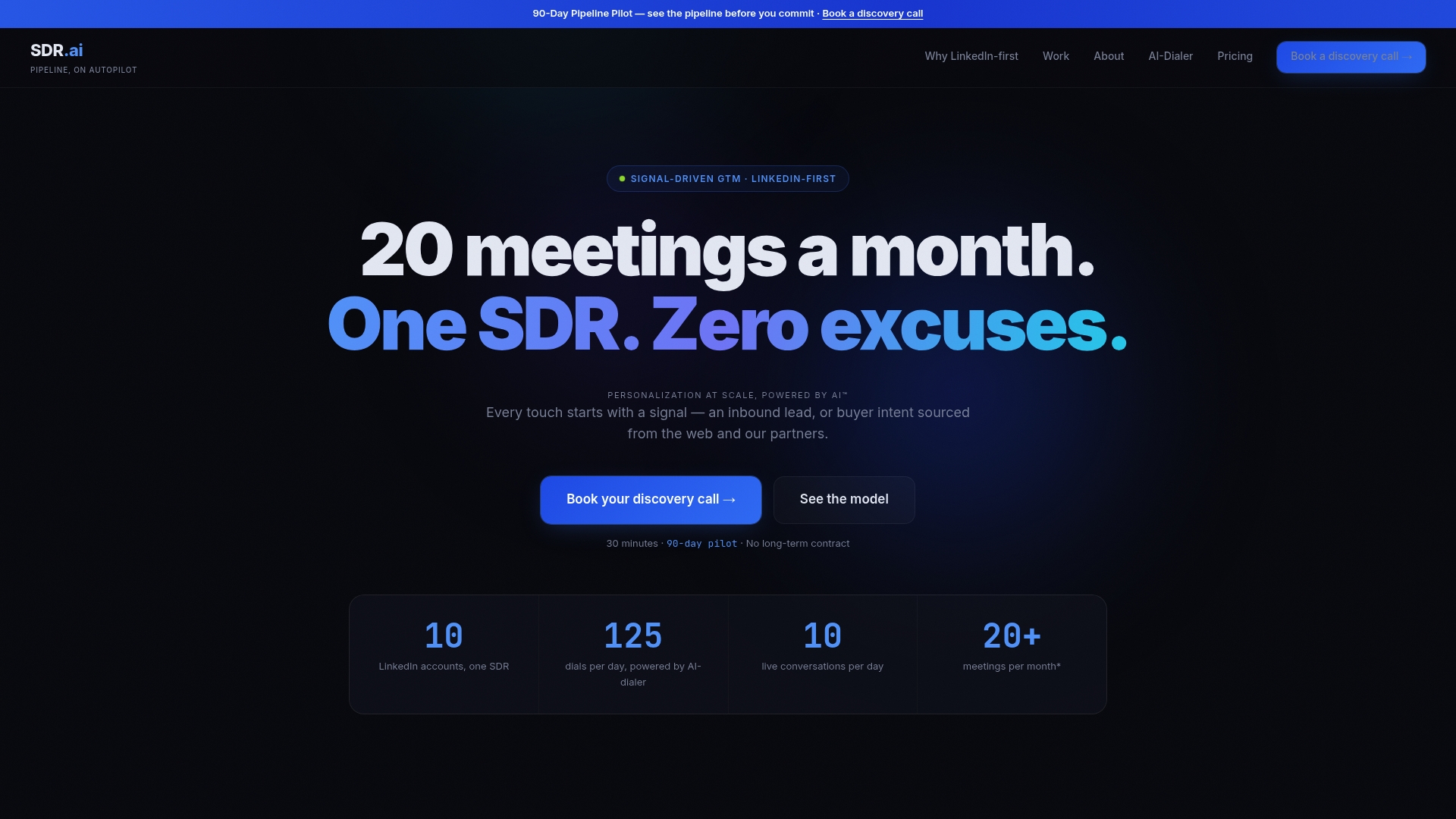
If you want qualified meetings on your calendar without hiring and ramping an SDR team, we built our AI-Powered Outbound service to get there fast. A typical pilot runs through our setup phase, a committed KPI target, and the ramp timeline described above.
- Review the Blueprint methodology before your first call.
- Watch the model walkthrough for the pipeline math behind our approach.
- Explore the AI-Dialer product page if you want warm calling as a standalone tool.
| What you get | Detail |
|---|---|
| AI-Powered Outbound | $2,500 per month |
| Setup fee | $500 one-off |
| AI-Dialer | $2,400 per year |
| AI-Dialer onboarding | $500 one-off |
Book a demo to see how our pilot maps to your targets.
FAQ
What does "AI for meeting booking" actually mean?
It refers to AI-powered outbound sales development: software that handles targeting, messaging, and sequencing to generate qualified B2B meetings, typically paired with a human SDR who validates and books the final meeting.
How long does it take to see results from an AI SDR pilot?
Most pilots follow a setup phase of 1 to 3 weeks, followed by a 30 to 60 day pilot window to generate enough replies and meetings to judge performance before scaling.
What reply rates should I expect from AI-driven outreach?
Research-first, LinkedIn-led outreach has reported reply rates in the 13% to 14% range, though actual results depend heavily on ICP fit and message quality.
How does AI for meeting booking integrate with my CRM?
A working program syncs account and contact data from your CRM for targeting, then writes qualified meetings and context notes back into the same system so account executives have full visibility at handoff.
What does SDR.ai's service cost?
Our AI-Powered Outbound service runs $2,500 per month with a $500 one-time setup fee, and our standalone AI-Dialer is $2,400 per year with a $500 onboarding fee.
Sources
- Gartner press release: 67% of B2B buyers prefer a rep-free experience
- Salesforce State of Sales report — AI adoption and productivity findings
- McKinsey: Unlocking profitable B2B growth through gen AI