
Start with 8 to 12 touches spread across 10 to 21 days, mixing email, LinkedIn, and phone, with an optional video touch near the end. Front-load the first three touches inside 72 hours, then widen the spacing so you don't look desperate or trip a spam filter. Adjust from there based on how warm the lead is and how big the deal size is.
TL;DR:
- Most effective cold outbound cadences involve 8 to 10 touches over 21 days, with a focus on front-loading the first three within 72 hours.
- Cadence strategy dictates the number, timing, and channels of outreach, while sequence implementation automates the plan; misaligning these causes poor results.
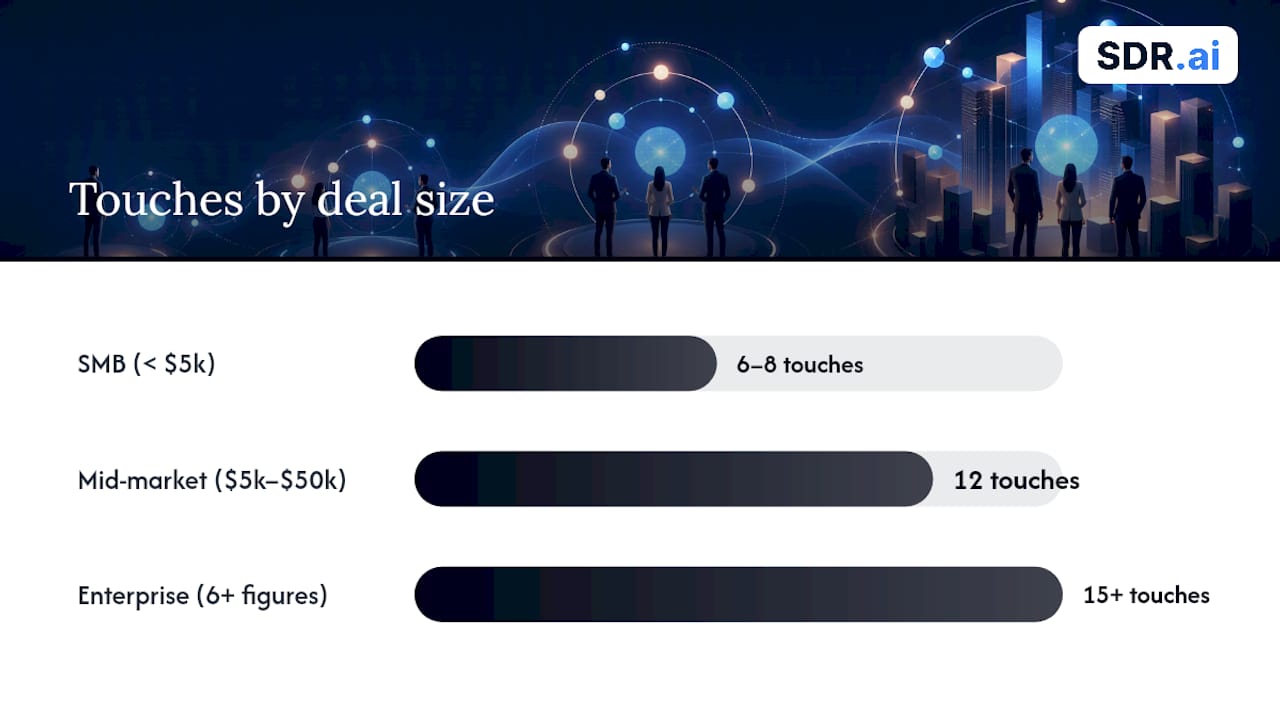
- Deal size influences cadence length: SMBs need 6 to 8 touches over 10 to 14 days, mid-market about 12 over 10 to 14 days, and enterprise deals over 15 touches across 21 to 30+ days.
- Response rates and meeting bookings are key metrics for cadence effectiveness; always test variables separately and watch for spam complaints or unsubscriptions.
- Use signal-driven, personalized cadences anchored on real buying signals and intent data to accelerate outreach and improve conversion, especially for high-value or informed prospects.
Table of Contents
- What Is a Sales Cadence (and How Is It Different From a Sequence)?
- Why Bother With a Cadence at All?
- Timing Rules: How Many Touches, How Fast, and in What Order
- Six Ready-to-Copy Sales Cadence Examples
- Adjusting Cadences for Buyer Stage, Intent Signals, and Deal Size
- Measuring and Optimizing Your Cadence Over Time
- The SDR.ai Approach: Signal-Driven Cadences Built on LinkedIn and AI Dialing
- A Practical Way to Roll This Out
- Sources
- FAQ
What Is a Sales Cadence (and How Is It Different From a Sequence)?
A sales cadence is the rhythm of your outreach: how many touches, how far apart, and across which channels. A sequence is the mechanical layer underneath it, the actual templates, tasks, and automation rules loaded into a tool like Outreach, Salesloft, or HubSpot Sales Hub that execute that rhythm. People use the two terms interchangeably, and that's where teams get into trouble.
Cadence is strategy. Sequence is implementation. If you build the sequence first, you end up automating a bad plan faster. Design the cadence, decide the number of touches, the spacing, and the channel order, and only then translate it into sequence steps. Teams that separate these two decisions avoid the trap of noisy, over-automated outreach that annoys prospects instead of converting them.
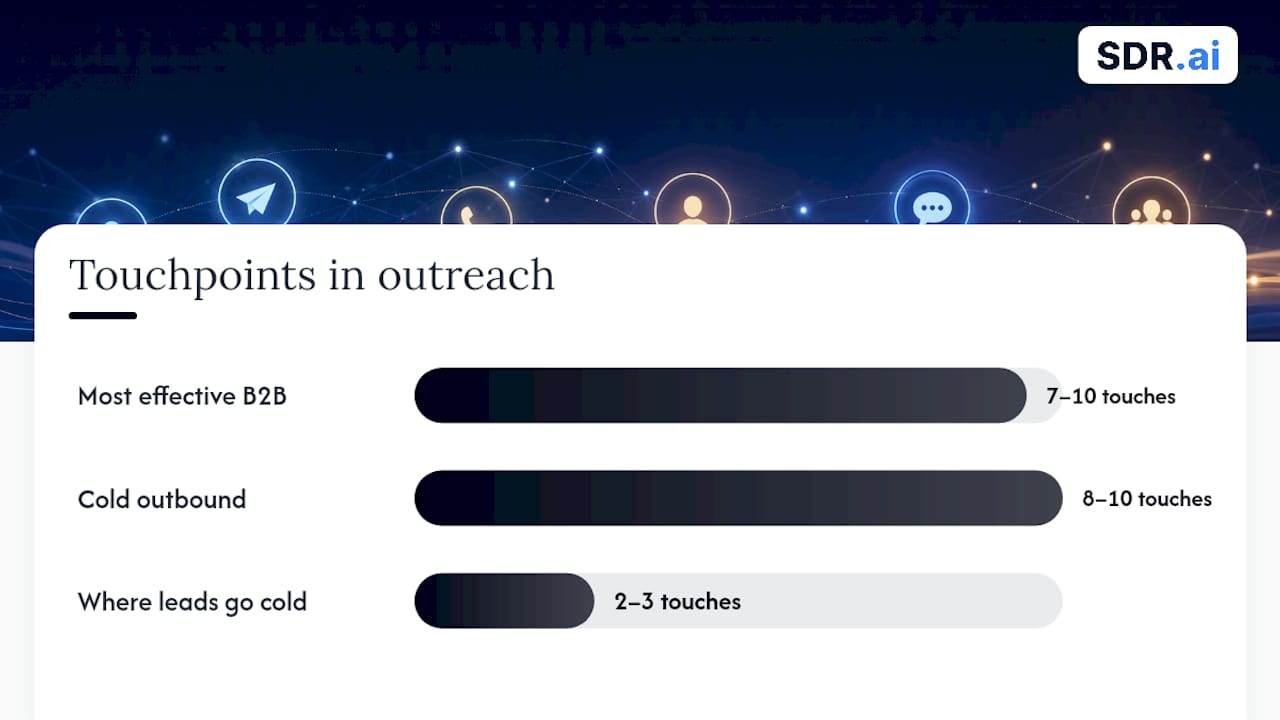
Most effective B2B sequences run seven to ten touchpoints over 10 to 14 days, though cold outbound specifically often stretches to 8 to 10 touches across two to three weeks. That range isn't arbitrary. It reflects how long it takes a busy buyer to notice you exist, then decide you're worth a reply.
Before you build a single template, audit what you're already doing. Run through this checklist:
- Count your current average touches per lead. Most teams guess low.
- List every channel you actually use, not the ones you intend to use.
- Measure the average gap in days between touch one and touch two.
- Identify where leads go cold. Usually it's after touch two or three.
- Check whether your messaging changes tone or just repeats the same pitch.
- Confirm you have a defined exit point (a breakup email, a CRM status change) instead of letting dead leads linger forever.
That audit alone will surface why your current outreach underperforms before you write a single new line of copy.
Why Bother With a Cadence at All?
An ad-hoc outreach habit, a few emails here, a call there, whenever a rep remembers, loses leads to sheer forgetfulness. A defined cadence forces repeatability. You can test one variable at a time, measure it, and scale whatever wins instead of guessing.
Diversifying channels instead of relying on a single one tends to lift meeting-booked rates by a real margin, since some prospects simply never check email but respond fast on LinkedIn or the phone. That's the core case for a multichannel plan rather than an inbox-only push.
Cadence length should track the situation, not a company-wide template:
- Short, high-velocity cadences fit inbound leads, demo requests, and anyone who just showed active intent. Speed beats polish here.
- Long, research-heavy cadences fit enterprise accounts where multiple stakeholders need convincing over weeks, not days.
- Medium cadences (10 to 14 days) fit most mid-market cold outbound and referral follow-up.
Match the cadence to how the prospect showed up in your pipeline, a lead who requested a demo yesterday should never wait in the same 21-day queue as a cold list import.
One more thing worth flagging: aggressive front-loading without spacing discipline is the fastest way to land in spam or get reported. Keep total weekly touches per prospect reasonable, and always give an easy way to opt out. A cadence that books meetings but burns your domain reputation is a net loss.
Timing Rules: How Many Touches, How Fast, and in What Order
Deal size changes the math substantially:
- SMB deals (sub $5,000 annual value): 6 to 8 touches over 10 to 14 days. Buyers decide fast or not at all.
- Mid-market deals ($5,000 to $50,000 annual value): a proven 12-touch structure works well here, front-loaded early, escalating value in the middle touches, and closing with a breakup email.
- Enterprise deals (six figures and up): 15+ touches across 21 to 30+ days, since multiple stakeholders need to coordinate internally before anyone commits to a call.
Channel order matters as much as touch count. Open with email or LinkedIn, both are low-friction and let the prospect engage on their own time. Escalate to phone calls and voicemail once you've established some visibility, usually around touch three or four. Save video messages and direct mail for mid-to-late touches, where they work best precisely because they stand out against a backdrop of routine text.
A data-driven cadence follows a repeatable build order: identify the audience, define the goal, map every touchpoint and its timing, personalize the messaging, automate only the low-value steps, and track performance so you can adjust. Skip any one of those steps, and the cadence degrades into noise.
Keep the copy itself tight. First emails should run 50 to 125 words, voicemails should stay under 20 seconds, and your breakup email should explicitly give the prospect permission to ignore you, that permission-to-close-the-file email routinely generates replies from people who went quiet for weeks.
Pro Tip: Write your breakup email before you write touch one. Knowing exactly how the cadence ends forces you to keep every earlier touch shorter and more purposeful, instead of cramming your whole pitch into every message out of fear you won't get another chance.
Six Ready-to-Copy Sales Cadence Examples
Each of these templates is a starting structure, not a rulebook. Swap in your own product language, but keep the day spacing and channel order intact unless you have a specific reason to change it.
1. Cold Outbound: 10 Touches Over 21 Days
Cold outbound needs the most patience because the prospect has zero context on who you are.
- Day 1, Email: Short intro tied to a specific trigger (funding, hiring, tech stack). CTA: "Worth a 15-minute conversation?"
- Day 2, LinkedIn: Connection request with a one-line personalized note, no pitch.
- Day 3, Phone: Cold call attempt. Leave a voicemail under 20 seconds if no answer.
- Day 6, Email: Share a relevant case detail or statistic. CTA: propose two specific time slots.
- Day 9, LinkedIn: Comment or react on a recent post, then send a soft message referencing it.
- Day 12, Phone: Second call attempt at a different time of day.
- Day 15, Email: Reframe the value prop around a different pain point.
- Day 17, Video: A 60-second personalized video recapping why you're reaching out.
- Day 19, Phone: Third and final call attempt.
- Day 21, Email (breakup): "Closing the file, permission to reach back out later?"
2. Inbound Speed-to-Lead: 5 to 7 Touches Over 8 Days
This one runs on urgency. A demo request or content download signals active buying intent, and that intent decays fast if you wait even a day.
- Within 1 hour, Phone: Immediate call attempt. This single step often determines whether the lead converts at all.
- Day 1, Email: Short confirmation email if the call goes to voicemail, referencing exactly what they requested.
- Day 2, Phone: Second call attempt.
- Day 3, LinkedIn: Connection request plus a brief note.
- Day 5, Email: Share a relevant resource tied to their specific request.
- Day 7, Phone: Third call attempt.
- Day 8, Email (breakup): Offer a self-serve resource and an open door.
3. Event Follow-Up: 5 to 7 Touches Over 14 Days
Prospects met at a conference or webinar already have context, so this cadence can move faster and skip the cold introduction entirely.
- Day 1, Email: Reference the specific conversation or session. CTA: schedule a follow-up call.
- Day 3, LinkedIn: Connection request mentioning where you met.
- Day 5, Phone: Call attempt referencing the event.
- Day 8, Email: Share a resource discussed at the event or booth.
- Day 11, Phone: Second call attempt.
- Day 14, Email (breakup): Close the loop, offer to reconnect at the next relevant event.
4. Trial Nurture: 8 Touches Over 30 Days
Trial users need activation nudges, not sales pressure, until they've actually used the product.
- Day 1, Email: Welcome message with one clear first action to take.
- Day 3, Email: Check-in tied to whether they completed that first action.
- Day 7, Phone: Light-touch call offering onboarding help.
- Day 10, Email: Highlight a feature relevant to their stated use case.
- Day 15, Email: Share a quick win or case example from a similar customer.
- Day 20, Phone: Second check-in call, focused on removing blockers.
- Day 25, Email: Trial-ending reminder with a clear next step.
- Day 30, Email: Final conversion push or graceful downgrade offer.
5. Re-Engagement: 6 Touches Over 12 Days
Old, cold, or previously unresponsive leads need low-commitment asks. Nobody wants to jump back into a full sales conversation after months of silence.
- Day 1, Email: "Still relevant?" style message, low pressure, easy to ignore or reply to.
- Day 3, LinkedIn: Light engagement, a comment or reaction, no direct pitch.
- Day 5, Email: Share something new since the last contact (product update, market shift).
- Day 8, Phone: Brief call attempt, framed as a check-in rather than a pitch.
- Day 10, Email: One specific, easy-to-answer question.
- Day 12, Email (breakup): Final low-pressure close, invite them to reach out whenever ready.
6. Executive Outreach: 6 Touches Over 18 Days
Senior buyers get pitched constantly, so brevity and outcome-focus matter more here than anywhere else in this list.
- Day 1, Email: Two or three sentences maximum. Lead with the business outcome, not the product.
- Day 4, LinkedIn: Personalized connection note referencing a company-level event, not a product feature.
- Day 8, Phone: Call attempt, brief voicemail if no answer.
- Day 12, Email: Share a relevant peer result or industry data point.
- Day 15, Phone: Second call attempt.
- Day 18, Email (breakup): Short, respectful close, leave the door open.
Adjusting Cadences for Buyer Stage, Intent Signals, and Deal Size
A warm lead and a cold list import should never sit in the same cadence. Warm leads (referrals, inbound requests, anyone who engaged with your content recently) justify fewer, faster touches because you're confirming interest, not creating it. Cold leads need the full build-up: more touches, longer spacing, more proof points before you ask for time.
Intent signals should override your default timing entirely. When you spot funding news, a tech stack change, or a relevant job move, shorten the cadence and prioritize a direct phone call or LinkedIn message within 24 to 48 hours. That kind of signal has a short shelf life. Wait a week and a competitor gets there first.
Personalization doesn't need to be uniform across every touch either. Spread your effort strategically:
- Touch one deserves genuine, specific personalization tied to something true about that account.
- Middle touches can lean on scaled personalization, merge fields, segment-based messaging, light customization.
- The breakup email should feel personal again, since it's often the highest-reply touch in the entire cadence.
- Enterprise accounts justify hyper-personalizing almost every touch, since the deal size covers the time investment.
- High-volume SMB cadences should scale personalization aggressively to keep rep time sustainable.
The general rule: personalize where the payoff justifies the time, and automate everywhere else without apology.
Measuring and Optimizing Your Cadence Over Time
Four numbers tell you almost everything about whether a cadence is working:
- Reply rate per touch and per cadence overall.
- Meetings booked per sequence enrolled, your real conversion metric.
- Connect rate on phone touches specifically.
- Unsubscribe and spam complaint rate, your early warning system.
Run A/B tests one variable at a time. Change the subject line, or the touch count, or the channel order, never all three simultaneously, or you won't know what actually moved the needle. Give each test enough volume to mean something (a few dozen enrollments minimum per variant) and let it run a full cadence cycle before calling a winner.
Set a hard threshold for spam complaints and unsubscribes. If either spikes above your platform's flagged rate, whatever your email provider considers a warning sign, pause the cadence immediately and revisit the copy and spacing before resuming. A cadence that books meetings while quietly torching your sender reputation is not a win, it's a slow-motion problem you'll pay for later.
Pro Tip: Track reply rate by touch number, not just cadence-wide. If touch four consistently underperforms touches three and five, that's not noise, it's a broken message you can fix in ten minutes.
The SDR.ai Approach: Signal-Driven Cadences Built on LinkedIn and AI Dialing
Everything above assumes you're guessing at intent from public signals. SDR.ai builds cadences around actual buying signals instead, LinkedIn-first outreach targeted at a defined Ideal Customer Profile, backed by intent data that tells you who's actually in-market right now.
That changes the cadence math in a few concrete ways:
- When intent signals are strong, touch count can shrink and spacing can tighten, you're not warming up a stranger, you're following up with someone already showing interest.
- The AI-Dialer enables parallel dialing, which means the phone touches in a cadence like the ones above happen faster and at higher volume without adding headcount.
- The Sdr, built around Data, Digital, and Dials, gives teams a structured way to sequence signal discovery, digital touches, and calling into one coordinated cadence rather than three disconnected efforts.
Having every reply handled personally allows signal-driven targeting to speed up the top of the cadence without turning the middle and end into a robotic scripted grind. The method behind this approach is built specifically to shorten ramp-up time for teams that don't want to hire and train an in-house SDR bench from scratch.
A Practical Way to Roll This Out
Don't try to launch six cadences at once. Pick one Ideal Customer Profile, build one cadence for it using the timing rules above, and run it for four to six weeks before you touch anything else. That window gives you enough volume to trust your reply rate and meeting numbers instead of reacting to a good or bad week.
Once you have real data, iterate on one variable, not five. Maybe the breakup email is your best performer and you should test moving it earlier. Maybe touch three is dead weight. You won't know until you've actually run the cadence long enough to measure it honestly.
Share what you find with the rest of the team, and expect to rebuild the cadence again in another quarter. The best sales teams treat cadence design as a living document, not a launch-and-forget project.
— Chad
Sources
A few sources back most of the benchmarks in this guide, and they're worth reading in full if you're building cadences at scale.
- Sales sequences: 12 best practices for B2B teams in 2026
- How to Build an Email Sales Cadence That Converts: Examples and Best Practices
- Sales Cadence Best Practices: Build One That Converts — QUOTA Training
- Sales Cadences: Best Practices, Templates, and Tools — Reevo
FAQ
What Is a Good Sales Cadence?
A good sales cadence for most mid-market B2B outreach runs 8 to 12 touches over 10 to 21 days, mixing email, phone, and LinkedIn. Front-load the first three touches within 72 hours, then widen spacing to avoid fatiguing the prospect or triggering spam filters.
What Are the Four Types of Cadences?
Most teams organize cadences by scenario: cold outbound, inbound speed-to-lead, event or referral follow-up, and enterprise or executive outreach. Each type varies in touch count and speed because prospect intent and deal size differ so much between them.
What Are Some Examples of a Sales Cadence?
A cold outbound cadence might run 10 touches across email, LinkedIn, and phone over 21 days, while an inbound speed-to-lead cadence compresses to 5 to 7 touches over just 8 days. Trial nurture, re-engagement, and executive outreach each follow their own structure, all detailed with day-by-day steps above.
How Long Should a Sales Cadence Run?
Cadence length should match deal size and intent: SMB deals typically run 10 to 14 days, mid-market deals often extend to a 12-touch structure, and enterprise cadences can stretch past 21 to 30 days to allow multiple stakeholders time to coordinate internally.
Should I Use the Same Cadence for Every Lead?
No. Warm, high-intent leads need shorter, faster cadences, while cold or enterprise leads need more touches and wider spacing. Signals like funding news or a job change should shorten your response window to 24 to 48 hours regardless of which cadence template you started from.