
Warm calling wins on meetings-per-dial, often producing 3 to 5 times the conversion of pure cold outreach, but it costs more time per contact. Cold calling wins on volume and market discovery. The real answer is neither replaces the other one. This article breaks down the metrics, timing windows, scripts, and a weeklong experiment to figure out your own mix.
TL;DR:
- Warm calling consistently achieves three to five times higher meetings-per-dial rate than cold calling, with connection rates of 15 to 25% versus 5 to 10%.
- Cold calling requires minimal research and can handle higher daily dial volumes but results in lower meeting conversion and higher burnout risk.
- Trigger-based warm calling, supported by AI automation, can now match cold call volume while delivering significantly better conversion rates.
- Optimal calling days are Tuesday and Wednesday, with peak times between 10 and 11 AM and 4 and 5 PM local time, improving connection and booking rates.
- For contracts under $25,000, combine cold and warm outreach; for enterprise deals, prioritize warm calling using AI to scale trigger detection and reduce research costs.
Table of Contents
- Cold Calling vs Warm Calling: What Actually Separates Them?
- Cold Calling vs Warm Calling: Comparing the Numbers
- When Should You Use Cold Calling vs Warm Calling?
- What Are the Best Days and Times to Call?
- How Do You Run an Effective Cold Calling Playbook?
- How Do You Warm Call Without Slowing Down Your Team?
- How Do You Run Cold and Warm Calling Together?
- How Is AI Changing the Economics of Warm Calling?
- So Which Motion Should You Actually Run?
- The Gap Between What Teams Believe and What the Numbers Show
- Scale Warm Calling Without Scaling Headcount
- Sources
Cold Calling vs Warm Calling: What Actually Separates Them?
The difference isn't intensity or tone. It's information. Cold calling means dialing a list with no prior signal that the person on the other end has any interest in what you sell. Warm calling means you're dialing because something already happened: they filled out a form, your company got a mutual introduction, or their business just raised a funding round. Hot calling is the tightest version of warm: the prospect requested a demo or asked a rep to call them back today.
Here's how that plays out on the phone:
- Cold calling: You're calling a VP of Ops from a purchased list. She's never heard of your company. Your first ten seconds decide whether she hangs up.
- Warm calling: You're calling a director whose company just posted three open engineering roles on LinkedIn. You open with, "Saw you're scaling the platform team, that usually means X problem shows up around month three."
- Hot calling: The prospect booked a 15-minute call through your website an hour ago. You're just confirming details and answering questions.
Treat these as a spectrum, not three separate playbooks. A cold contact who opens three emails and visits your pricing page has quietly warmed up, even if nobody manually tagged them. The best outbound teams track that drift and re-route contacts accordingly with effective revenue operations, rather than locking every account into whichever bucket it started in.
Cold Calling vs Warm Calling: Comparing the Numbers
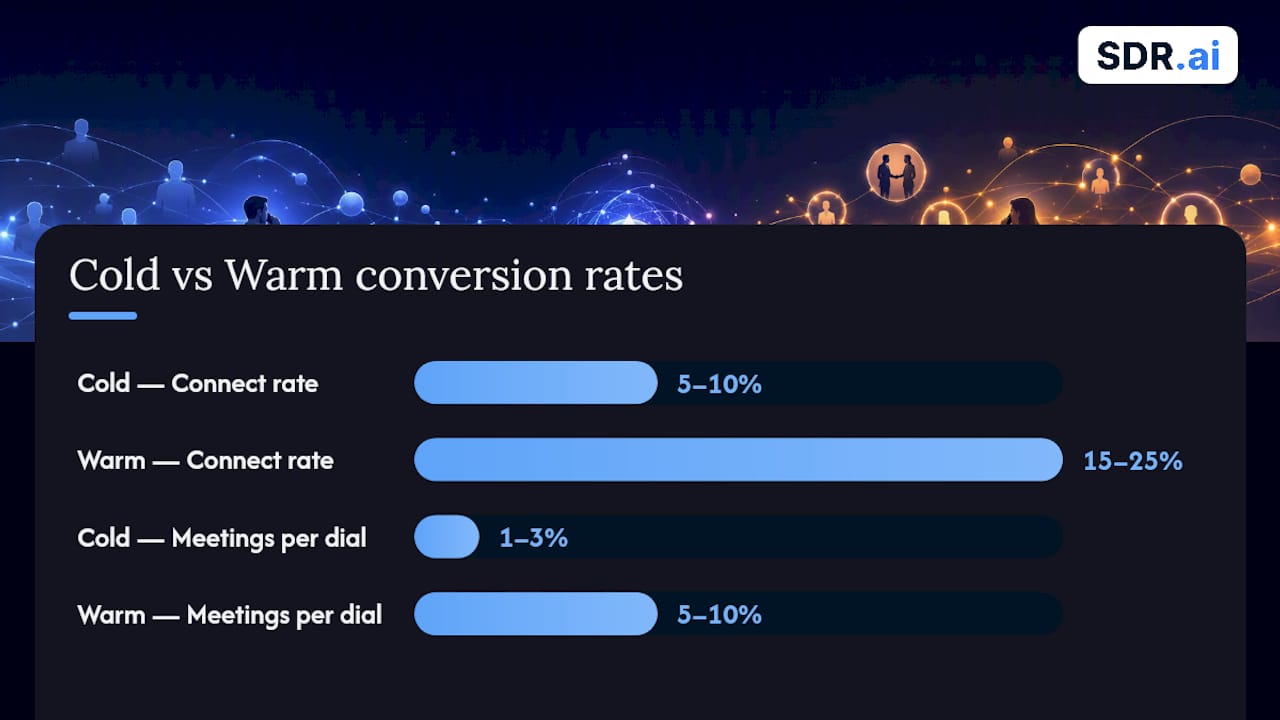
The gap between these two motions shows up most clearly in what happens after the phone gets picked up.
Cold calls open with zero context, so the first job is earning ten seconds of attention before pitching anything. Warm calls open with a reference point, which cuts resistance immediately and shifts the conversation from "why are you calling me" to "how does this apply to me."
By the numbers: Cold calling typically converts at a 5 to 10% connect rate with roughly 1 to 3% of dials becoming a meeting. Warm calling connects at 15 to 25% and turns 5 to 10% of dials into meetings, a 3 to 5x lift in meetings-per-dial.
That math changes how you resource a team:
- Research time per contact: Cold requires almost none; warm typically needs 1 to 3 minutes of prep per contact to find the trigger and personalize the open.
- Daily dial capacity: An SDR working a cold list can usually push 80 to 120 dials a day; the research overhead on warm lists drops that to 40 to 60.
- Cost-per-meeting: Warm calling's higher conversion usually offsets its lower volume, so cost-per-meeting often lands lower than cold despite the extra prep time.
- Burnout risk: Cold calling's rejection rate is brutal on morale over months, and it's a leading driver of SDR attrition on teams that never vary the motion.
- Funnel role: Cold calling is a top-of-funnel discovery tool. Warm calling is a mid-funnel acceleration tool that pushes engaged accounts toward a meeting faster.
Neither number tells you which motion to run. They tell you what each one costs and what it buys, which is the actual decision.
When Should You Use Cold Calling vs Warm Calling?
Deal size, vertical, and geography all push the decision in different directions. Here's how to think about each:
- Cold calling fits transactional B2B under roughly $25,000 in annual contract value, local services, and anything where you're still figuring out who your ideal customer actually is. Low per-contact value means you can't justify heavy research time, and you need volume to find pattern in the noise.
- Warm calling fits account-based motions and enterprise deals where a single closed account is worth the research investment many times over, and where a trigger (a new hire, a funding round, a product launch) gives you a real reason to call.
- Geography changes pickup behavior. US prospects tend to answer more readily during business hours than counterparts in much of EMEA and APAC, where cold outbound calling carries more cultural friction and stricter consent norms in several markets. Confirm local Do Not Call and consent requirements before scaling any list internationally.
- Run small experiments before committing. Split a list 50/50 between a warm-triggered segment and a pure-cold segment, run it for two weeks, and compare meetings-per-dial. That single test tells you more about your market than any industry benchmark.
The mistake most teams make is picking one motion permanently instead of matching the motion to the segment in front of them.
What Are the Best Days and Times to Call?
Timing moves the needle more than most reps assume, and the data on this is remarkably consistent across sources.
Tuesday and Wednesday together account for 44% of demos booked in ZoomInfo's analysis of over 1.4 million outbound calls, with peak connect windows between 10 and 11 AM and again between 4 and 5 PM in the prospect's local time zone. Separate practitioner polling from HubSpot confirms Tuesday as the single best day for cold-call success, with Wednesday close behind and Fridays trailing well behind both. Shifting your call block by 15 to 30 minutes off the "textbook" hour can actually outperform hitting the exact recommended minute, since it avoids the pile-up of other reps dialing the same slot.
Benchmark snapshot: Cold connect rates run 5 to 10%, warm connect rates run 15 to 25%, and the gap compounds further downstream in meetings booked.
| Metric | Cold calling | Warm calling |
|---|---|---|
| Connect rate | 5–10% | 15–25% |
| Conversion on connect | 15–25% | 30–50% |
| Typical daily dials per SDR | 80–120 | 40–60 |
| Meetings per dial (approx.) | 1–3 | 6 to 8 |
Run a short measurement sprint before you trust any of these ranges for your own pipeline. Track connect rate, conversation-to-meeting rate, and cost-per-meeting over a single week, split by motion, and let your own numbers override the benchmarks above.
How Do You Run an Effective Cold Calling Playbook?
Cold calling rewards structure more than charisma. Here's the sequence that keeps a cold list productive instead of burning through contacts for nothing:
- Open with one of two frameworks. For gatekeeper-screened lines: "Hi, I'm trying to reach whoever owns [specific function] — can you point me the right way?" For direct dials: skip the pitch and lead with a specific, researched observation about their business, then ask a single question.
- Protect two call blocks a week, ideally Tuesday and Wednesday mornings and late afternoons, and treat that time as non-negotiable on the SDR calendar.
- Set a daily dial target between 40 and 120, depending on list quality and whether reps are also handling warm accounts that same day.
- Cap attempts at 6 to 8 touches across two to three weeks, leaving a voicemail on attempts two and five, never every time.
- Layer email and LinkedIn around the calls. Multi-channel sequencing lifts meeting outcomes by roughly 30 to 50% versus dialing alone.
- Validate numbers before loading a list and confirm your calling hours respect local Do Not Call rules and time-zone restrictions, since TCPA requirements apply regardless of whether a human or an AI system places the call.
Pro Tip: Rotate your opening line every two weeks and track which version gets past the first ten seconds most often. Most reps never test their open, and it's the single highest-leverage line in the whole call.
How Do You Warm Call Without Slowing Down Your Team?
Warm calling scales only when trigger detection stops being manual. Here's the workflow that keeps it fast without losing the relevance that makes it work.
Build a trigger taxonomy first: funding announcements, executive hires, job postings signaling a new initiative, product launches, event attendance, and inbound form fills all qualify. Each one gives you a legitimate, specific reason to call that a cold list never provides.
Before dialing, spend two minutes reading the trigger source, the prospect's LinkedIn activity, and their company's recent news. That's enough to build one sentence that proves you did the homework: "Saw your team just closed a Series B, that usually means headcount doubles inside six months, which is exactly when the process you're using today starts breaking."
- Pair the call with an email sent within the hour and a LinkedIn connection request referencing the same trigger.
- Sequence three touches across five business days rather than stretching them over weeks; warm signals decay fast.
- Track meetings booked per research-minute spent, not just meetings per dial, since that's the number that tells you whether the prep time is paying for itself.
- Re-route any warm contact that goes cold for two weeks back into a standard cold cadence instead of letting it sit untouched.
Pro Tip: If a trigger is more than three weeks old, treat the contact as cold again. Warm signals have a shelf life, and calling on stale context reads worse than calling with none at all.
How Do You Run Cold and Warm Calling Together?
Most teams don't fail because they picked the wrong motion. They fail because they run both motions on the same list with the same reps and the same expectations, and neither one gets resourced properly.
Segment accounts before anyone dials. Target accounts with a real trigger, an ABM tier assignment, or an enterprise deal size get routed to warm treatment. Everything else stays on the cold list for volume and discovery.
- Assign a fixed SDR mix, for example 70% cold capacity and 30% warm capacity, and revisit that ratio monthly based on measured cost-per-meeting.
- Protect warm call blocks the same way you protect Tuesday and Wednesday cold blocks, so trigger-based leads don't sit stale while reps grind a cold list.
- Build an escalation path: any cold contact that opens three emails, visits pricing, or engages on LinkedIn gets automatically bumped into the warm queue.
- Track balanced KPIs across both motions: pipeline velocity, meetings per dial, and cost-per-meeting, rather than judging cold and warm against each other's raw meeting counts.
The teams that get this right treat the warm list as a moving target that cold outreach constantly feeds, not two permanently separate lanes.
How Is AI Changing the Economics of Warm Calling?
The biggest constraint on warm calling has never been the script; it's the research time. Reading LinkedIn activity, checking funding databases, and scanning job boards for every contact on a list used to take minutes per prospect, which is exactly why warm calling stayed a boutique, low-volume motion for most teams.
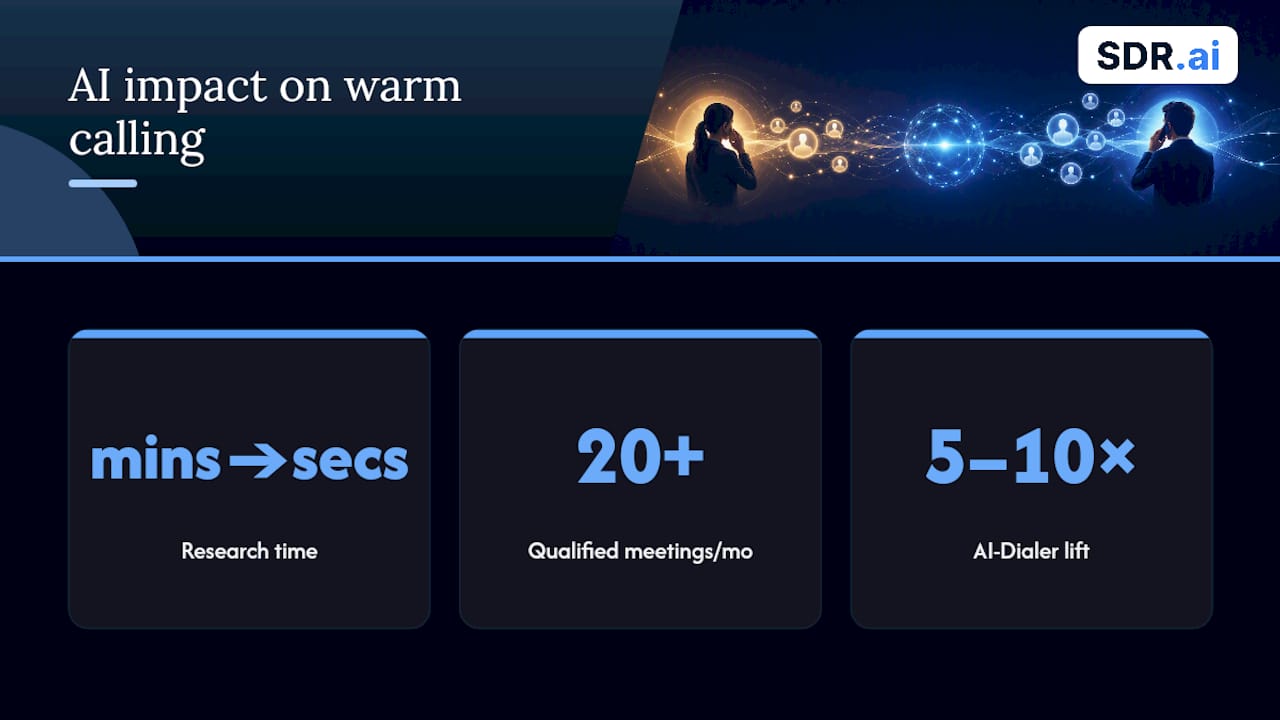
That constraint is disappearing. AI systems built to surface intent signals can now compress that research window from minutes to seconds, scanning hundreds of contacts for triggers simultaneously rather than one rep working through a list by hand.
Warm calling stops being a luxury reserved for enterprise deals once trigger surfacing is automated. The motion that used to require a dedicated researcher becomes something a single SDR can run at cold-calling volume, with warm-calling conversion.
Sdr applies this directly to LinkedIn-first outbound, using AI to identify intent signals and route personalized outreach to the right contacts at the right moment. The claimed result is over 20 qualified meetings booked a month with a fraction of the manpower a traditional SDR team would need, and the AI-Dialer is built to push that further with parallel dialing technology designed to book 5 to 10 times more meetings than a single-line setup.
One caveat worth flagging: the FCC has confirmed that TCPA rules apply to AI-generated voices the same way they apply to human ones. Automating outreach doesn't exempt a team from consent and timing rules.
So Which Motion Should You Actually Run?
If your average contract value sits under $25,000, keep cold calling in the mix for discovery and testing messaging; don't abandon it just because warm converts better on paper. If you're selling into enterprise or ABM accounts, put your research budget into warm calling, since the conversion math clearly favors it there.
Run this experiment next week: protect Tuesday and Wednesday call blocks, split your list 50/50 between a warm-triggered segment and a pure-cold segment, and measure only three things: connect rate, meetings booked, and cost-per-meeting. Two weeks of real numbers will tell you more than any industry benchmark.
The Gap Between What Teams Believe and What the Numbers Show
Most sales leaders treat cold calling and warm calling as a philosophical choice, almost a matter of team culture, when it's really a resourcing math problem. The data is blunt: warm calling converts several times better per dial, and the only reason teams don't run more of it is that manual research doesn't scale past a handful of reps.
That's the part conventional advice gets wrong. Sales blogs love to tell you "warm calling is better," as if that settles anything. It doesn't. Warm calling was always better on a per-dial basis. The real constraint was throughput, and throughput is exactly what AI-driven trigger surfacing solves. Teams that keep debating cold versus warm in the abstract are missing the actual shift: the constraint that made cold calling a volume necessity is loosening.
If you manage SDR capacity, the priority isn't picking a side. It's auditing how much of your team's time goes to manual research that a system could now do in seconds, and redirecting that freed capacity toward the motion that was converting better all along.
— Chad
Scale Warm Calling Without Scaling Headcount
Every option in this comparison runs into the same wall eventually: warm calling converts better, but manual research caps how many contacts a team can actually reach. Sdr removes that ceiling by automating trigger detection across LinkedIn and routing personalized outreach the moment a real signal appears, so a single rep works at cold-calling volume with warm-calling conversion.
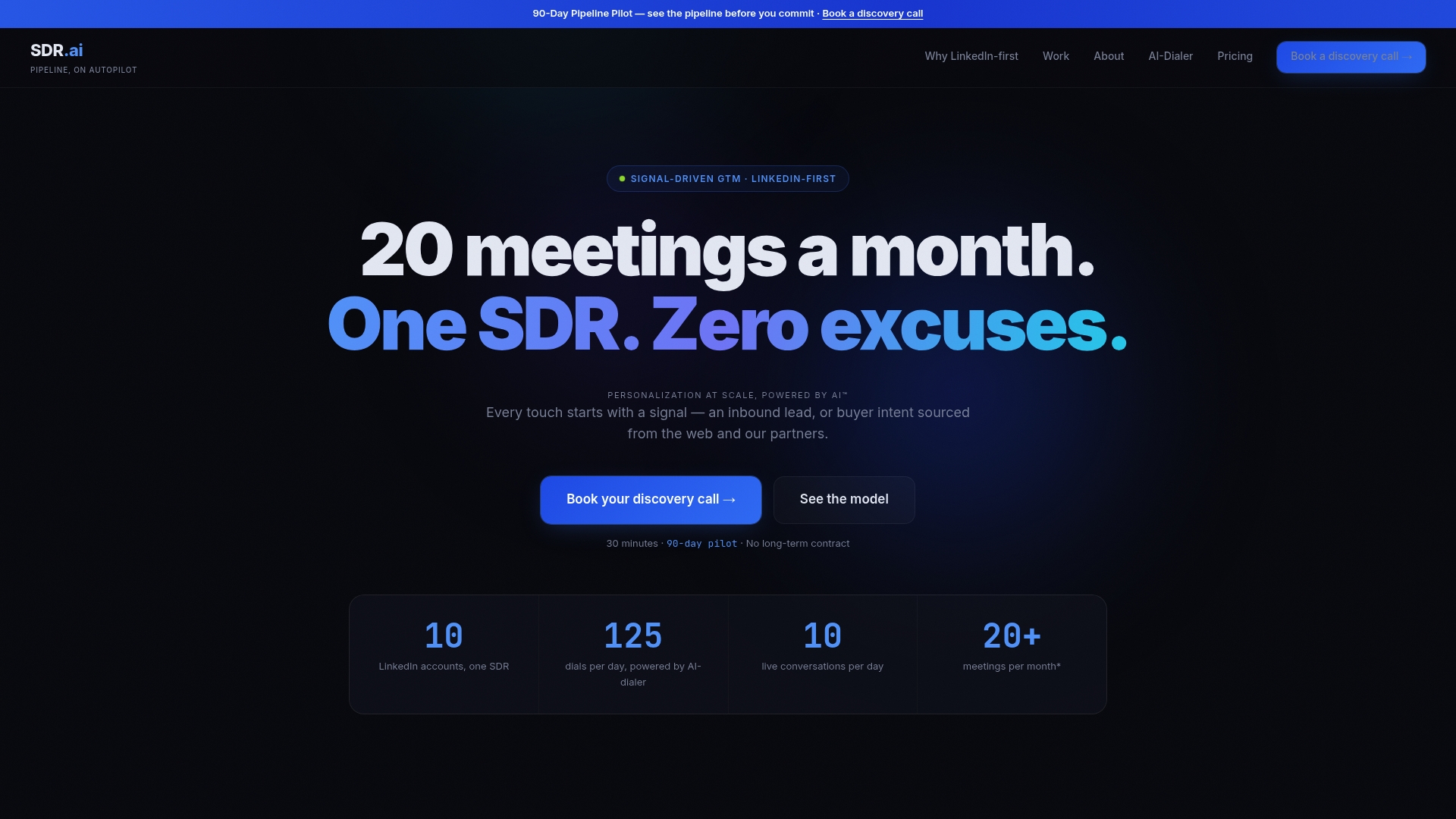
Clients working with Sdr typically see:
- Over 20 qualified meetings booked per month with minimal manpower
- Parallel dialing through the AI-Dialer built to produce 5 to 10 times more meetings than single-line dialing
- Intent-based targeting that replaces cold lists with contacts already showing buying signals
If your team is still measuring cost-per-meeting against manual research time, that math has changed. Book a demo and see what your pipeline looks like when trigger surfacing runs on autopilot.
Sources
- best-days-to-cold-call
- The best time to make a sales call
- Cold Calling vs Warm Calling: The Real Differences, Conversion Rates & When to Use Each
- FCC confirms TCPA applies AI technologies generate human voices