
Clean B2B contact data means every record is standardized, deduplicated, verified, and traceable to its source, so your outreach reaches real people instead of bouncing or landing on suppressed contacts. The short version of the fix: standardize, dedupe, validate, enrich, reconcile, and monitor, in that order, on a repeating cycle. If you do nothing else today, run a quick email validation pass on your active outreach list or suppress known opt-outs before your next send.
TL;DR:
- Validate active outreach lists weekly or before major sends, and review evergreen databases monthly to quarterly, adjusting cadence to list activity.
- Standardize records before deduplication, then enrich only segments you plan to work; fuzzy matching can merge different people with common names at one company.
- Store each contact’s source, collection date, and consent basis, then check internal and relevant external suppression lists before every campaign or channel change.
Table of Contents
- Why Clean Contact Data Matters for B2B Pipeline
- When and How Often to Clean B2B Contact Data
- The Step-by-Step B2B Contact Data Cleansing Workflow
- Vendor-Neutral Tools and Methods for Each Cleansing Step
- How to Choose a Cleansing Workflow or Vendor
- How SDR.ai Applies Clean Contact Data to Drive Booked Meetings
- A Few Rules of Thumb for Teams Managing This in House
- Get Validated Contact Data Working for You, Not Against You
- FAQ
- Sources
Why Clean Contact Data Matters for B2B Pipeline
Bad contact data does not just waste time. It actively damages the infrastructure you depend on for every future campaign. Each hard bounce signals to mailbox providers that your list hygiene is poor, and enough of them will get your sending domain throttled or blacklisted, which hurts every rep on your team, not just the one who sent the bad email.
Pipeline math breaks down fast when inputs are dirty. A list with a high bounce rate does not just produce fewer meetings. It produces fewer meetings per dollar spent on tools, reps, and ad spend that feed your top of funnel, because every stage downstream (replies, meetings, opportunities) is a percentage of a smaller, worse starting pool.
Industry coverage of the shift toward data-driven B2B outreach points to the same pattern: outbound performance increasingly depends on pairing accurate contact records with real intent signals rather than blasting generic lists. Without clean data, intent signals are wasted because you cannot tell if the account record you are scoring is even current.
The dimensions worth tracking mirror the structure in ISO/IEC 25012, which frames data quality as multi-dimensional rather than a single accuracy score. For B2B contact lists specifically, timeliness (is this person still at this company) and traceability (where did this record come from) tend to fail before raw accuracy does. A title or email can be technically correct at the moment of capture and still be useless six months later if nobody tracked when it was collected.
Before and after metrics to track:
- Bounce rate (total) and hard bounce rate, separately, since hard bounces carry more reputation risk.
- Reply rate as a percentage of delivered (not sent) emails, so you are not comparing against a denominator inflated by bad addresses.
- Meetings booked per 1,000 contacts, which normalizes performance across campaigns of different sizes.
- Sender reputation or domain health score, pulled from your email platform or a dedicated monitoring tool.
Run these numbers before a cleansing pass and again thirty to sixty days after. The gap is usually the clearest internal argument for treating data hygiene as a recurring budget line rather than a one-time cleanup.
When and How Often to Clean B2B Contact Data
Cleaning cadence should match how fast a list decays, and B2B contact data decays constantly: people change jobs, get promoted, switch phone systems, or leave a company entirely. An active outreach list needs tighter monitoring than a cold, evergreen database you touch once a quarter.
Recommended cleaning cadence and triggers:
- Run validation on active outreach lists weekly or before every major send, since these lists get the most exposure to bounces and complaints.
- Clean evergreen or nurture databases monthly to quarterly, depending on list size and how often records get touched by any team.
- Trigger an immediate re-validation after a bulk import, a new data vendor delivery, or a merger or acquisition announcement affecting target accounts.
- Treat a sudden spike in bounce rate or spam complaints as a forced, same-day suppression and validation run rather than waiting for the next scheduled pass.
- Re-check consent and suppression status whenever a contact moves between campaigns or channels, since consent captured for one purpose does not automatically cover another.
Automate the routine cadence where you can, but keep a human in the loop for noisy triggers. A validation tool flagging twenty records a day is a normal background hum. A tool flagging two thousand records overnight usually means an integration broke, not that your list suddenly decayed.
The Step-by-Step B2B Contact Data Cleansing Workflow
This is the operational sequence, in order. Each step builds on the one before it, so skipping ahead (enriching before you deduplicate, for instance) multiplies the enrichment spend on records you were about to merge or delete anyway.
- Inventory and tag provenance. Map every source feeding your contact database (forms, list purchases, enrichment vendors, manual entry) and add a source field and a collected-at timestamp to every record. Without this, you cannot answer the first question any compliance review or sales leader will ask: where did this contact come from, and when.
- Standardize formats. Canonicalize name casing, company name variants (Inc., Inc, Incorporated), phone formats to a single pattern (E.164 is the common default), and domain names stripped of protocol and trailing slashes. Standardization has to happen before deduplication, because matching logic fails silently when "Acme Inc." and "ACME INC" are treated as different companies.
- Deduplicate and resolve identity. Decide upfront whether you want conservative merging (only merge on exact email match) or aggressive merging (fuzzy match on name plus company plus phone). Conservative rules miss some duplicates; aggressive rules risk merging two different people who share an employer and a common name. Also decide how you handle role-based addresses like sales@ or info@ separately from named individuals, since merging a role inbox with a person record corrupts both.
- Validate. Run email verification at the level the campaign warrants: syntax and domain checks are the minimum, MX record lookups confirm the domain can receive mail, and mailbox-level pings (where available) confirm the specific address is active. Phone validation should check line type (mobile versus landline versus VOIP) since that changes how a number should be worked into a cadence. Flag low-confidence matches for manual review rather than auto-accepting or auto-rejecting them.
- Enrich. Add fields that change how a rep prioritizes or personalizes outreach: title granularity (not just "Manager" but "Manager, Demand Generation"), company size band, tech stack signals, and intent data where available. Enrichment is worth the per-record cost mainly on segments you are actually going to work hard, not your entire historical database. For a deeper look at timing enrichment against campaign launches, see how real-time enrichment speeds up outbound ROI.
- Screen for suppression and consent. Check every record against your internal do-not-contact list and any relevant external suppression registry, such as the UK's Telephone Preference Service, before a call or recorded message goes out. The ICO's guidance on marketing lists is explicit that bought-in lists need their own recent, specific consent, and that screening against suppression lists is an organization's responsibility even when a vendor claims the list is already compliant. Store the consent type and date alongside the record, not in a separate spreadsheet nobody checks before a campaign.
- Reconcile and verify. Before a full send, run a small sample through your actual sending infrastructure and watch deliverability in real time. Log the outcome (delivered, bounced, complained) against each record so the next cleansing pass has real signal to work from instead of guessing. Syncing this log back into your CRM consistently is its own discipline. These CRM integration patterns for reconciling outbound data cover common ways teams keep that loop closed without manual exports.
Pro Tip: Run your sample-send reconciliation on a rotating 2% slice of each list rather than the same test segment every time, so you catch decay across the whole database instead of just validating the same healthy corner repeatedly.
The ICO's broader direct marketing guidance reinforces why step 1 and step 6 matter as much as the technical steps: transparency about how contact data was collected is a requirement, not a nice-to-have, and vague policy language buried in a footer does not count as informed consent.
Vendor-Neutral Tools and Methods for Each Cleansing Step
Rather than naming specific products, it helps to think in categories, because the right category depends on your list size, budget, and how sensitive your market is to compliance risk.
- Field validators check email and phone format and deliverability at different depths. A basic "level" confirms syntax and domain; a deeper level pings the mailbox or checks phone line type, and deeper checks generally cost more per record, so reserve them for your highest-priority segments.
- Identity resolution and dedupe engines apply matching logic ranging from strict exact-match rules to fuzzy, probabilistic scoring that outputs a confidence percentage per match. Low-confidence matches should route to human review instead of auto-merging, especially for named enterprise accounts where merging the wrong two people damages a relationship, not just a database field.
- Enrichment APIs and data warehouses differ mainly in latency and cost. In-line enrichment (called at the moment a lead hits your system) keeps data current but costs more per lookup; batch enrichment overnight is cheaper but means your freshest leads sit unenriched for hours. Match the pattern to how time-sensitive your intent signals actually are, a point covered in more depth in this breakdown of intent data paired with ICP fit.
- ETL, automation, and customer data platform (CDP) patterns handle the ongoing sync between your cleansed source of truth and the CRM or engagement platform your reps actually work in. For organizations running multiple systems (CRM, ERP, marketing automation), the sync logic gets more complex, and resources like this CRM-ERP integration overview are a useful reference for how enterprise teams structure that plumbing.
- Human verification still beats automation for high-annual-contract-value accounts, GDPR-sensitive markets, or ambiguous role titles that an algorithm will misclassify. A $200,000 deal is worth a five-minute manual LinkedIn check before your best rep sends the first message.
For teams building or exporting lists manually before any of this automation kicks in, practical workflows for pulling and enriching contact sets exist outside dedicated platforms too, such as this approach to finding and enriching LinkedIn-sourced emails in bulk.
How to Choose a Cleansing Workflow or Vendor
Whether you are building this in-house or evaluating an outside vendor, the same checklist applies. Treat it as a demo script.
- Ask for sample test set results, not marketing claims. A vendor should be able to show match and verification accuracy on a sample set with a stated confidence methodology, not a single blended "accuracy" percentage with no breakdown.
- Ask how provenance is documented. Good vendors can tell you where a record came from and when it was last refreshed. The NPL data quality good practice guide frames this kind of lifecycle traceability as central to data quality management, not an afterthought bolted on for compliance.
- Ask how consent and suppression are handled. You need a clear answer on how opt-outs propagate, how deletion requests are honored, and whether suppression checks run automatically before every send or only on request.
- Check operational fit against your actual scale. API throughput limits, SLA terms, and the pricing model should match your campaign volume, not a theoretical enterprise tier you will never use.
- Watch for red flags. A vendor that cannot show any test results, cannot explain their matching logic in plain language, or treats provenance as irrelevant is a vendor you will eventually have to clean up after.
Pro Tip: Request a small paid pilot batch before committing to a full contract. A vendor confident in their accuracy will not object to proving it on a few hundred of your actual records first.
How SDR.ai Applies Clean Contact Data to Drive Booked Meetings

Clean data only matters if it gets used well downstream, and that is the part most teams underestimate. We built our outbound process around the same sequence described above: list records get standardized and deduplicated before they ever reach a human or an AI-driven message, validated for deliverability, enriched with the title and company signals that actually change how a message gets written, and screened for suppression before a single call or message goes out.
The difference in our process is what happens after validation. Intent signals are layered on top of a clean record to decide who gets contacted first and what the message says, rather than enriching every record equally and hoping volume makes up for relevance. That sequencing (clean first, score second, personalize third) can lead to a significant number of qualified meetings booked per month without needing to staff an internal SDR team.
Clean data without prioritization is just a tidier spreadsheet. The value shows up when validated, enriched records feed directly into who gets contacted first and what the message says.
For readers who want to see this applied at the channel level, our breakdown of multichannel outreach built around clean, enriched data and this walkthrough of matching call lists at a 95% rate through dialer integration go deeper into the mechanics.
A Few Rules of Thumb for Teams Managing This in House
Fix deliverability and verify your highest-value accounts before you spend a cent on broad enrichment. A perfectly enriched record that bounces is worthless, while a thinly enriched record that reaches a real inbox still has a chance.

Keep audit trails. Every record should show where it came from, when it was last validated, and what consent basis you are relying on to contact it. This is tedious until the day a suppression complaint or a compliance review lands on your desk, at which point it is the only thing that matters.
Treat data quality as a recurring KPI on the same dashboard as pipeline and bookings, not a cleanup project you schedule once a year and then forget. Lists decay continuously, so the monitoring has to be continuous too.
*— Chad
Get Validated Contact Data Working for You, Not Against You
Building the workflow above in-house takes real engineering time: provenance tagging, dedupe rules, validation tiers, suppression logic, and the ongoing maintenance to keep it all running. We run that entire pipeline as part of AI-Powered Outbound, pairing validated, enriched contact data with LinkedIn-first messaging and warm calling through our AI dialer, so your outreach only ever touches real, consented, ICP-matched contacts.
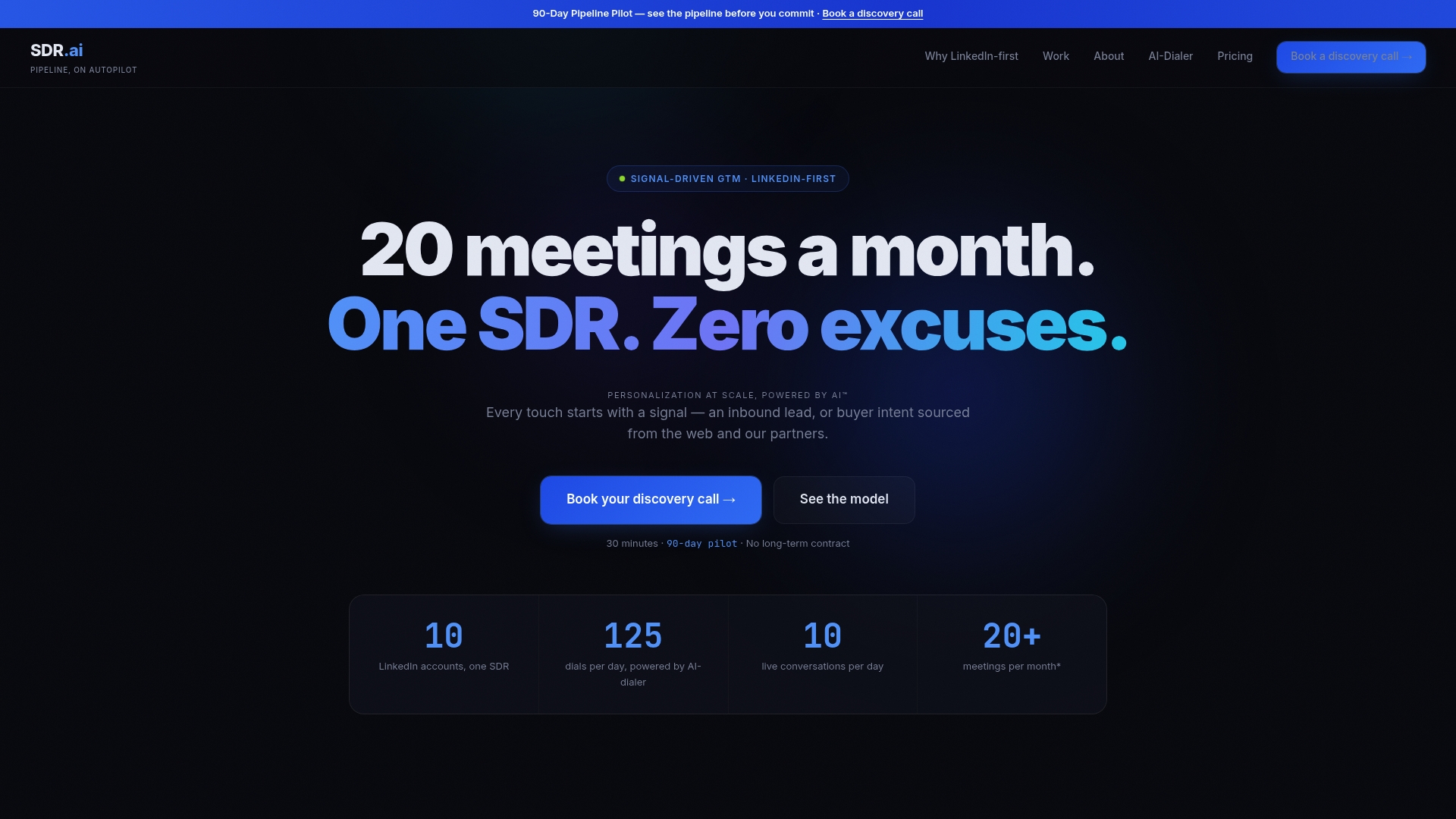
If you want to see the math and process before committing, Sdr walks through our methodology in detail, and AI-Dialer is available as a standalone tool if phone validation and call matching are your immediate bottleneck. For teams who want to try the workflow themselves first, our guides on enrichment ROI timelines and building sanity-checked Sales Navigator lists are a solid starting point.
| What you get | Detail |
|---|---|
| AI-Powered Outbound | $2,500 per month, plus a $500 one-off setup fee |
| AI-Dialer (standalone) | $2,400 per year, plus a $500 one-off onboarding fee |
| Sdr | Methodology walkthrough, price available on request |
Ready to see what a clean, validated list could do for your pipeline? Book a demo and we will show you the math on your own numbers.
FAQ
What is the best B2B contact database right now?
There is no single "best" database for every use case since accuracy depends on industry, region, and how recently a given provider refreshed its records. Instead of chasing a universal answer, request a sample accuracy test from any provider you consider and compare it against your own validation pass before committing.
What is the rule of 7 in B2B?
The "rule of 7" is a marketing heuristic suggesting a prospect typically needs around seven touches or exposures before they take action, though the specific number varies by source and is not a formally established standard. It is used loosely to argue for persistent, multi-touch outreach rather than a single email or call.
What is B2B contact data?
B2B contact data is the set of identifying and firmographic details tied to a business contact, typically a name, title, email, phone number, company, and company attributes like size or industry. Clean B2B contact data adds standardization, deduplication, and verification on top of that raw information so it is usable for outreach without bouncing or violating consent rules.
Where can I find free B2B contact information?
Public company websites, LinkedIn profiles, and press releases are common free sources for basic B2B contact details, though they require manual verification and typically lack enrichment like validated phone numbers or intent signals. Free sources also rarely include documented consent or provenance records, which ICO guidance treats as a requirement before using that data for direct marketing.
Sources
- ISO/IEC 25012 (data quality) — arc42 extract
- Using marketing lists | ICO
- Data quality good practice guide — NPL