"AI for sales calls" means an AI SDR paired with an AI dialer running LinkedIn-first, intent-triggered outreach that books qualified meetings for your sales team. For most Series A/B B2B companies, it beats hiring a full SDR bench on speed and short-term cost. Skip it only if your average deal size demands months of relationship building before a signature.
TL;DR:
- AI sales development representatives are most effective for high-volume, short-cycle deals under 60 days, but less suitable for long-term, relationship-driven enterprise transactions.
- Success heavily depends on clear ICP targeting, clean contact data, and swift human handoffs, with response rates increasing when outreach is timely and signals are well defined.
- A 90-day pilot should focus on precise data setup, signal configuration, and weekly performance tracking, starting small to reduce risks and facilitate quick iteration.
- Vendors must demonstrate actual booked meetings, trigger signals, and call summaries within minutes, avoiding vague scoring or manual note-taking that hampers transparency.
- Outsourcing AI SDRs offers faster payback and lower cost per meeting than traditional hires, but only if targeting, data hygiene, and handoff processes are tightly managed.
Table of Contents
- What does 'AI for sales calls' actually mean?
- Does AI for sales calls actually deliver ROI?
- When should you use AI SDRs instead of hiring humans?
- How do you evaluate an outsourced AI-for-sales-calls partner?
- What does a 90-day AI SDR pilot look like?
- What most founders get wrong about AI SDRs
- Book Qualified Meetings Without the SDR Hiring Cycle
- Sources
What does 'AI for sales calls' actually mean?
Strip away the buzzwords and the mechanics are simple. An AI SDR watches for buying signals, funding rounds, new executive hires, technographic shifts, job postings, and fires personalized outreach within hours of detecting one. That timing matters more than most founders assume: a prospect who just raised a Series B and posted three sales-hire listings is a different conversation than a cold name on a list.
The system also multi-threads the buying committee. Instead of one message to one VP, it sends role-specific messages to the VP of Sales, the RevOps lead, and the CFO simultaneously, each framed around what that person actually cares about, an approach Abmatic's breakdown of AI SDR mechanics ties directly to higher response rates.
The AI dialer picks up where messaging leaves off:
- Parallel dialing multiple numbers at once instead of waiting on a single ring
- Automatic voicemail detection so reps skip dead air
- Live transcription and real-time talk-track prompts during the call
- Instant post-call summaries written straight into the CRM
When a prospect shows real interest, the workflow hands off to a human. That handoff, done well, includes a structured disposition, a call summary, and a clear next step, not just a "warm lead, good luck" note dropped in Slack.
Does AI for sales calls actually deliver ROI?
The honest answer: it depends heavily on execution, but the upside case is well documented. Case studies compiled by Prestyj's ROI framework comparing AI sales automation to hiring SDRs report cost-per-meeting can be significantly lower for AI-driven programs compared to human SDR costs.
The payback gap is the real story. The same research shows AI programs reaching payback in 1 to 12 weeks, while human SDR hires typically take 6 to 12 months to become net-positive once ramp and turnover are factored in.
For a Series A company burning runway on every hire, that difference between a six-week payback and a nine-month one isn't a rounding error. It's the gap between proving pipeline before the next board meeting and explaining a miss.
Three things drive the variance between a strong result and a mediocre one:
- ICP clarity. A fuzzy ideal customer profile means the AI targets the wrong accounts at scale, which is worse than targeting them slowly.
- Data hygiene. Bad contact data or stale firmographics kills personalization before it starts.
- Handoff speed. A qualified lead that sits for three days loses momentum, AI-sourced or not.
Timing itself is a lever. Abmatic's data on signal-triggered outreach points to response rates multiple times higher than static, calendar-based campaigns, simply because the message lands when the buyer is already thinking about the problem.
When should you use AI SDRs instead of hiring humans?
Volume and deal complexity decide this, not preference. Here's a rubric that holds up across most B2B tech companies:
- High-volume, mid-complexity deals favor AI. If your outbound motion needs to touch hundreds of accounts a month and your sales cycle runs under 60 days, AI SDR and dialer combinations outperform a headcount-limited human team almost every time.
- High ACV, long-cycle, multi-year contracts favor humans. Enterprise deals north of $100,000 ACV, especially in regulated industries like healthcare or financial services, still need a human building trust across a 6 to 18 month cycle.
- Relationship-driven verticals lean human. Legal services, government contracting, and anything requiring in-person trust building still moves through people, not sequences.
- Everything else runs hybrid. Most Series A/B tech companies land here: AI handles a majority of top-of-funnel prospecting and qualification, while human account executives own complex discovery, objection handling, and closing.
Pro Tip: Don't assign AI and humans to the same accounts at the same funnel stage. Overlap creates duplicate outreach and prospects who get two conflicting messages in one week, the fastest way to burn a good account.
How do you evaluate an outsourced AI-for-sales-calls partner?
Most vendor pitches sound identical. The differences show up in the details a demo won't volunteer.
Run through this checklist before signing anything:
- Can they show you exactly which signals trigger outreach, or is targeting a black box?
- Does the dialer live inside the same sequence as email and LinkedIn steps, so a call has context from prior touches? Smartlead's guide to AI dialers flags sequence-native design as the difference between a call that feels relevant and one that feels random.
- Do call summaries and dispositions write directly into your CRM, or does someone re-key notes by hand?
- Who owns the data when the engagement ends?
- What's the SLA on meeting quality, not just meeting volume?
Ask every vendor the same blunt question: "Show me three booked meetings from the last 30 days, the signal that triggered outreach, and the call summary that led to the booking." A vendor with a real system answers in minutes. A vendor selling a script reads you a case study instead.
Watch for a few red flags. Vague "AI-powered scoring" with no explanation of inputs. No native CRM writes, meaning your team manually reconciles activity. And any pitch that leads with dial volume instead of meeting quality, because 500 dials a day means nothing if none of them convert. Nooks' guide to AI dialer capabilities and LeadIQ's dialer market overview are both useful reference points for what a serious feature set actually includes.
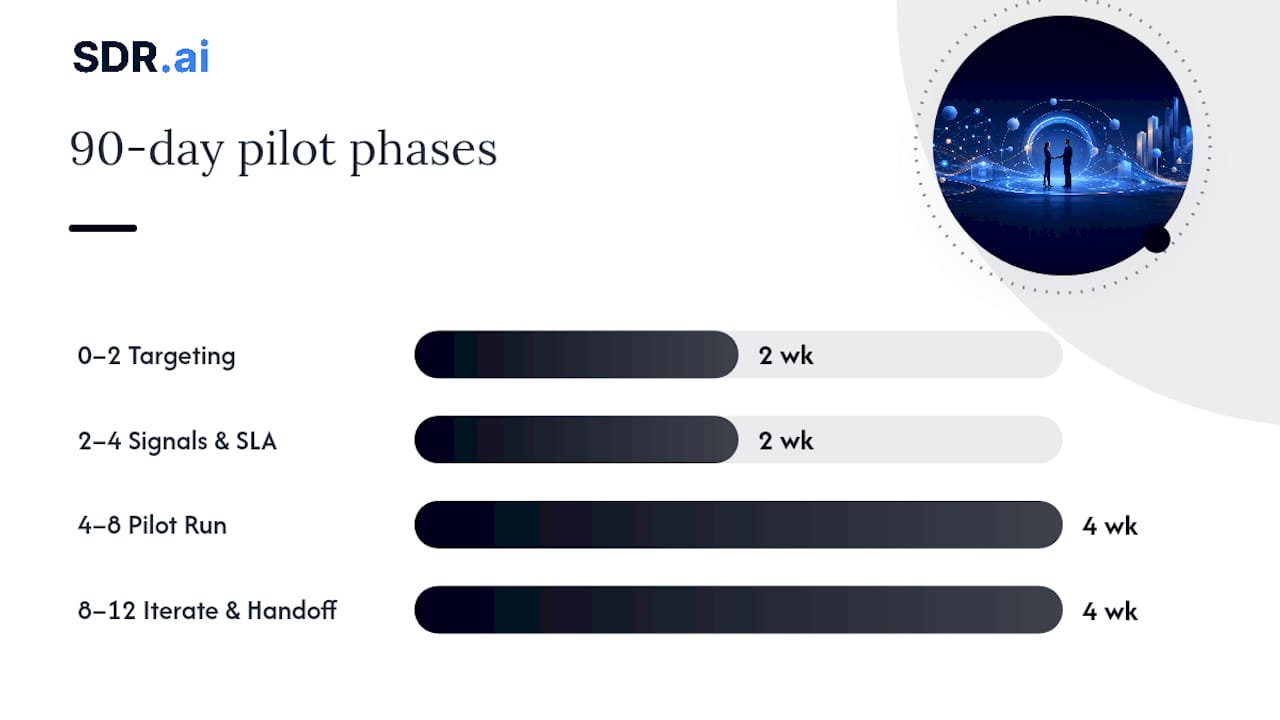
What does a 90-day AI SDR pilot look like?
A pilot succeeds or fails based on structure, not enthusiasm. Here's the sequence that keeps risk low while still proving real value fast:
- Weeks 0 to 2: Lock the ICP, clean your contact data, and build a defined target account list. Skipping this step is the single most common reason pilots underperform, since AI amplifies bad targeting just as efficiently as good targeting.
- Weeks 2 to 4: Configure the signals that matter for your business (funding events, hiring surges, tech-stack changes) and set qualification criteria plus a handoff SLA with your AE team.
- Weeks 4 to 8: Run the bounded pilot. Track meetings booked, show rate, cost per lead, and SQL rate weekly, not monthly.
- Weeks 8 to 12: Iterate the signals and messaging that underperformed, ramp parallel dialing volume, and formalize the AE handoff process with real pipeline reporting.
Pro Tip: Start smaller than feels comfortable. HubSpot's own guidance on rolling out AI prospecting tools recommends testing with human review before scaling autonomous sequences, and a tight 90-day pilot with a short target list beats a sprawling launch that nobody can debug.
Build governance in from day one: privacy checks on data sourcing, clean CRM field mapping, and explicit rules for when a human reviews AI-drafted messages before they send.
What most founders get wrong about AI SDRs
The biggest mistake isn't choosing AI SDRs. It's expecting them to work without an ICP anyone could defend in a room. Companies that skip that step get outreach at scale, aimed at the wrong accounts at scale, which is a worse outcome than doing nothing.

The second mistake is treating the AI/human handoff as an afterthought. Meetings die in the gap between "AI flagged interest" and "human actually calls back." A structured disposition and same-day follow-up protocol fixes most of that.
What good looks like: clear signal configuration, a lean target list, and a handoff SLA measured in hours. Clients running that model consistently report booked meetings increasing meaningfully each month, with none of the multi-month ramp a new SDR hire requires. The AI runs continuous prospecting and qualification. Humans keep the discovery and closing work that still requires a real conversation.
— Chad
Book Qualified Meetings Without the SDR Hiring Cycle
SDR runs the exact model this article describes: LinkedIn-first outreach mapped to your ICP, intent signals that trigger messaging within hours, and an AI dialer that handles parallel dialing, voicemail detection, live transcription, and CRM-ready call summaries. No six-month ramp, no SDR salary while you wait to find out if the hire works out.
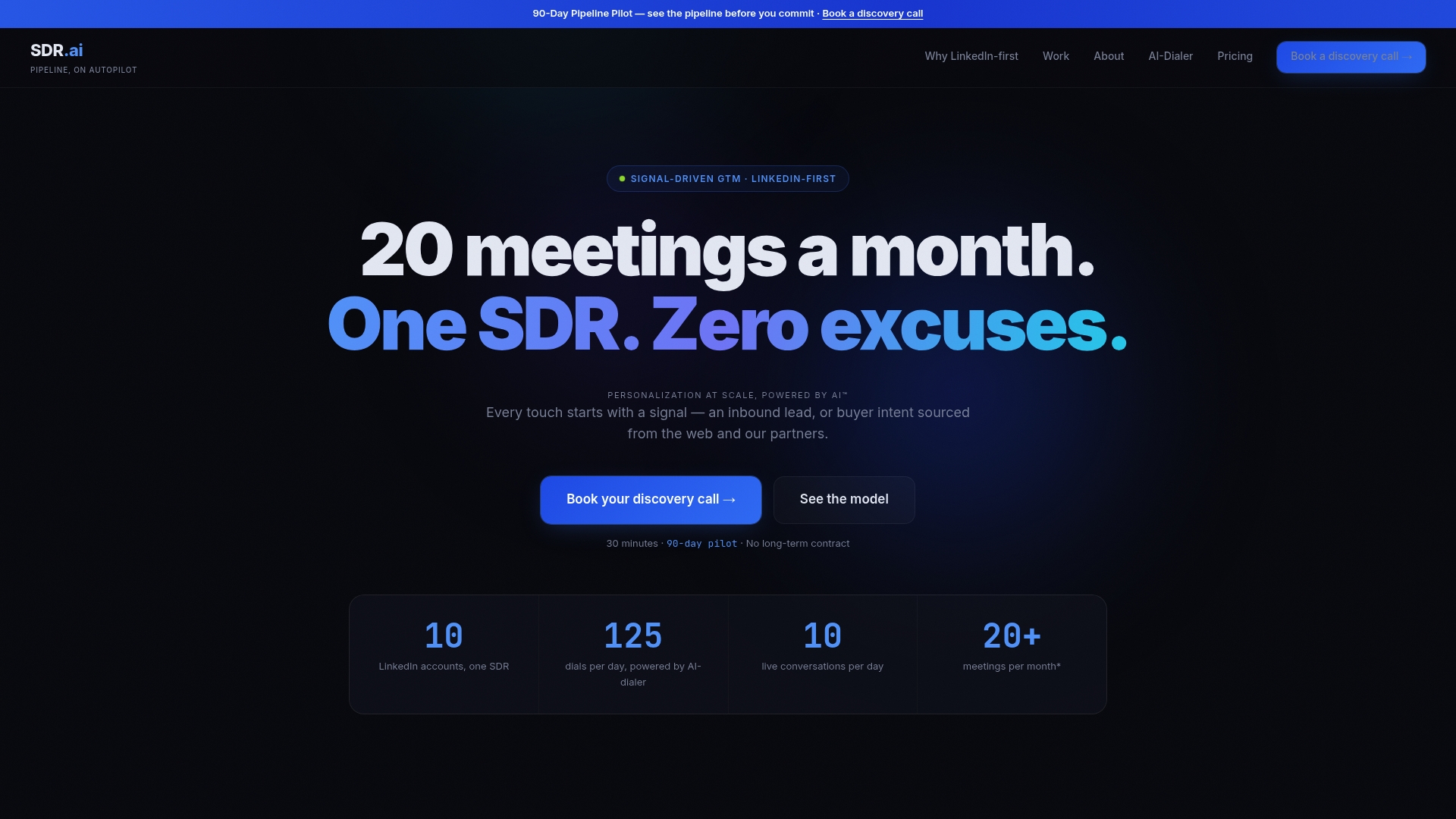
Pilot engagements are structured around the same 90-day framework outlined above, with weekly tracking on meetings booked, show rate, and cost per meeting from week one. Clients typically see booked meetings increasing meaningfully each month once signals and messaging are tuned, with the AI-Dialer handling the calling volume a growing pipeline demands. If you want the mechanics explained without the sales pitch, the plain-English AI SDR guide is a good place to start. When you're ready to see it against your own target account list, book a demo and bring your ICP.