
An AI SDR is an autonomous agent that qualifies leads, personalizes outreach, and books meetings without a human writing every message. It works best for B2B teams with a defined ideal customer profile and repeatable qualification rules, where speed to first response and consistent follow-up matter more than nuanced negotiation. Providers like SDR.ai have shown this model can produce many qualified meetings a month with a fraction of the headcount a traditional team requires.
TL;DR:
- AI SDRs respond instantly to inbound inquiries, increasing the chances of engagement and reducing missed opportunities across time zones.
- They automate CRM updates, maintain high coverage across thousands of leads, and typically cost significantly less than fully loaded human SDRs.
- Successful pilots require clear qualification criteria, strict guardrails, and a dedicated measurement plan focusing on meetings booked and conversion rates.
- AI SDRs excel with inbound leads, repeatable qualification rules, and high-volume scenarios, but still need human involvement for complex negotiations.
- Designing handoff rules and escalation protocols before launching a pilot is critical to ensure human trust and overall success.
Table of Contents
- What Is an AI SDR and How Does It Actually Work?
- What Benefits and ROI Should You Expect From an AI SDR?
- Should AI SDRs Replace Human SDRs Entirely?
- Which Businesses See the Fastest Results From AI SDRs?
- How Do You Pilot and Scale an AI SDR Program?
- What Does an AI SDR Cost Compared to Hiring an SDR?
- What Are the Real Risks and Compliance Concerns With AI SDRs?
- How Does SDR.ai Apply This Model in Practice?
- Should You Pilot an AI SDR Now or Wait?
- What the Data Actually Tells Decision-Makers
- Get Started With an AI SDR Built for B2B Outreach
- Sources
What Is an AI SDR and How Does It Actually Work?
The term "agentic AI" gets thrown around loosely, but it means something specific here, as explained in agentic AI marketing services. Older sales automation followed rigid if-this-then-that rules: a lead fills out a form, gets tagged, receives email three. An AI SDR built on agentic principles instead assesses buying readiness in real time and decides its next move on its own, the way a junior rep would size up a prospect before choosing an angle, according to IBM's framing of agentic AI SDRs.
That autonomy runs on a stack of data and models working together, not one clever chatbot.
- CRM data feeds the agent context on account history, past touches, and deal stage.
- Intent signals (website visits, content downloads, job changes, hiring surges) tell it who is worth prioritizing today.
- Enrichment and firmographic data fill in company size, tech stack, and role, so messaging isn't generic.
- LLMs and NLP models generate and interpret language, drafting replies and reading tone in incoming messages.
- Decisioning layers with guardrails decide whether to keep nurturing, escalate, or drop a lead, while staying inside rules a sales ops team sets.
In practice, a typical workflow looks like this: a prospect fills out a demo request form at 11 p.m., and the agent replies within minutes, asks two qualifying questions, checks the answers against ICP criteria, and offers calendar slots if it clears the bar. If the prospect goes quiet, the AI follows up on a set cadence across channels, usually email, LinkedIn, and chat, with SMS increasingly common in the mix. Voice is the newest frontier. AI-powered dialers can now support warm calling, but fully autonomous voice conversations for complex objection handling still lags behind text-based channels.
Handoff is where the design matters most Good AI SDR systems don't try to close everything themselves. They're built to recognize when a deal needs a human, whether that's a pricing objection, a multi-stakeholder buying committee, or simply a prospect who asks a question outside the agent's confidence threshold, and route it accordingly. Salesforce notes that AI SDRs also update CRM records automatically as they work, which keeps pipeline data current without a rep manually logging every touch.

What Benefits and ROI Should You Expect From an AI SDR?
The single biggest lever is speed to lead. Human SDRs sleep, take lunch, and juggle a dozen leads at once. An AI agent responds to an inbound inquiry the moment it lands, at 2 a.m. or during a Tuesday lunch rush, and that responsiveness compounds because faster replies correlate with higher engagement rates across the board.
The numbers that matter: AI SDR agents are built specifically to deliver always-on engagement, automated qualification, and meeting booking at scale, and one direct benefit vendors highlight is improved CRM hygiene, since every interaction gets logged automatically instead of depending on a rep's memory at the end of a long day, per monday.com's analysis of AI SDR agents.
Coverage improves too. A five-person SDR team can realistically work a few hundred accounts with real attention. An AI agent can maintain simultaneous conversations across thousands of leads without dropping the ones that don't reply on the first try, which is where most pipeline quietly leaks away today. IBM points out that this always-on coverage directly reduces missed inbound opportunities, particularly for companies with global audiences hitting their site outside a single time zone's business hours.
On cost, the comparison usually breaks down like this:
- A fully loaded human SDR (salary, benefits, tools, management overhead, ramp time) often runs well into six figures annually before they've booked a single qualified meeting.
- An AI SDR engagement typically costs a fraction of that when priced per meeting or per agent, though exact figures vary widely by vendor and volume.
- Ramp time for an AI agent is measured in days or weeks, not the three to six months a new human hire typically needs to hit quota.
Secondary gains matter more than they sound. Consistent qualification criteria mean every lead gets scored the same way, no rep having a slow Monday or skipping steps under quota pressure. Automated call and chat notes also mean managers stop relying on a rep's memory of what a prospect actually said three weeks ago.
Should AI SDRs Replace Human SDRs Entirely?
They shouldn't, and treating this as an either/or choice is the most common strategic mistake companies make. Gartner has projected that a substantial share of seller tasks will be executed by generative AI within the next several years, which signals momentum, not full replacement, according to Gartner's press release on generative AI in sales. The realistic model is division of labor, not headcount elimination.
Here's how the split typically works in practice:
- AI handles volume and pattern-matching work: initial qualification, form and chat responses, follow-up sequences, meeting scheduling, and CRM data entry.
- Humans handle judgment and relationship work: multi-stakeholder negotiations, objection handling that requires reading emotional cues, and enterprise deals where a prospect expects to talk to a person before signing anything.
- Handoff rules bridge the two, with clear SLAs, such as escalating to a human rep within one business hour of a qualified lead requesting a call, or immediately when a prospect asks a pricing question the agent isn't authorized to answer.
A hybrid team often looks like one senior rep overseeing an AI agent's output for a book of accounts, stepping in only when the agent flags a deal as ready or stuck. That rep spends far less time on cold outreach and far more time on live conversations that actually move deals forward.
The measurement that matters here isn't outreach volume, it's what happens after handoff. Salesforce recommends tracking qualified meetings and post-handoff conversion rate rather than opens or clicks, since those vanity metrics say little about whether a B2B buyer is actually moving toward a purchase.
Which Businesses See the Fastest Results From AI SDRs?
Not every company gets equal value from this technology, and the businesses that see quick wins tend to share a specific shape: high lead volume, repeatable qualification logic, and a sales cycle that doesn't hinge on months of relationship-building before the first real conversation.
- Inbound-heavy businesses with demo requests, content downloads, or event sign-ups get immediate leverage since AI SDRs excel at fast, consistent triage of anyone who raises their hand first.
- Mid-market SaaS, developer tools, and marketplace companies tend to have clean, repeatable ICP criteria (company size, tech stack, role) that translate well into rules an agent can apply consistently.
- Teams facing demand surges, like a product launch or a conference that generates a spike of leads in 48 hours, can lean on AI coverage instead of scrambling to staff up temporarily.
- Account re-engagement plays work well too, since an AI agent can systematically work through a list of dormant leads that a human team simply never got back to.
Where this model hits real limits is cold outbound prospecting into accounts with no prior signal. Salesforce's own research notes that AI SDRs perform best on inbound triage and predictable qualification, while fully autonomous cold outbound into unfamiliar enterprise accounts still benefits from human research and a warmer point of entry. If your growth model depends on breaking into accounts that have never heard of you, expect to pair AI execution with human-led account research rather than handing the whole motion to an agent.
How Do You Pilot and Scale an AI SDR Program?
Skipping the planning phase is the single fastest way to waste a pilot budget. Before any tool gets turned on, nail down three things: your ICP definition in specific, checkable terms, the exact criteria that make a lead "qualified," and the metrics you'll use to call the pilot a win or a loss.
Pro Tip: Write your qualification rules down as a checklist before your first integration call. Vendors will ask for this, and teams that show up without it lose two to three weeks just defining it mid-pilot.
From there, a realistic rollout looks like this:
- Weeks 0 to 2: Connect the CRM, map fields, grant calendar access, and set up consent tracking for outreach channels. CRM-native AI SDR tools can go live in minutes to days, while standalone platforms that need custom integrations typically take several weeks.
- Weeks 2 to 4: Approve message templates, set escalation rules, and run the agent on a limited segment, not your full lead pool, while you watch tone and accuracy closely.
- Weeks 4 to 8: Expand to full volume, review a sample of conversations weekly, and adjust qualification logic based on what's actually converting.
- Weeks 8 to 12: Compare results against your baseline and decide whether to scale, adjust the ICP targeting, or pull back.
Guardrails deserve real attention here, not a rubber stamp. That means defined escalation triggers, a human reviewing a sample of AI-generated messages every week rather than trusting it blind, and a formal approval step before any new template goes live. Track response rate, meetings booked, and qualified-to-meeting conversion as your primary KPIs. Everything else is noise during a pilot.
What Does an AI SDR Cost Compared to Hiring an SDR?
Pricing shapes vary more than most buyers expect walking in. Vendors commonly structure fees around per-agent subscriptions, per-meeting-booked pricing, volume-based tiers, or a flat setup fee plus a monthly retainer. None of these is inherently better; the right fit depends on whether your priority is predictable spend or paying only for outcomes.
- Per-agent pricing works like a software seat, predictable but not tied to results.
- Per-meeting pricing ties cost directly to booked meetings, which appeals to teams that want spend to scale with output.
- Volume tiers reward higher usage with lower unit costs, useful once you've validated the model works.
- Setup fees cover initial CRM integration, template building, and ICP configuration.
Vendor pricing data suggests AI SDR costs often land at a fraction of what a fully loaded human SDR costs annually, though the exact multiple depends heavily on your volume and vendor structure. When building your model, don't forget enrichment data fees, integration costs, and any legal review needed for outreach compliance in your target markets. Budget separately for a three-month experimentation phase versus your eventual production spend; the two rarely cost the same per meeting.
What Are the Real Risks and Compliance Concerns With AI SDRs?
The technical ceiling is real. Complex, multi-stakeholder deals with competing priorities inside a buying committee still ask for judgment an autonomous agent doesn't reliably have yet. Treat those as human territory from day one rather than testing the limits on your biggest accounts.
Brand risk is the concern that keeps sales leaders up at night, and it's a fair one. An agent operating without oversight can drift in tone, make a claim about your product that isn't accurate, or repeat a mistake across hundreds of conversations before anyone notices. The fix isn't complicated, but it does require discipline:
- Review a random sample of AI-generated conversations weekly, not just when something goes wrong.
- Lock approved claims and template language before launch, and require sign-off for any new messaging.
- Build in a human-in-the-loop checkpoint for any conversation that touches pricing, contracts, or competitive claims.
Privacy and consent deserve equal weight. Track opt-in and opt-out status per channel, minimize the personal data an agent stores beyond what's needed for qualification, and log every interaction for audit purposes. Regulations differ by region, so confirm your outreach practices align with the rules governing wherever your prospects live before scaling volume.
How Does SDR.ai Apply This Model in Practice?
Sdr built its approach around a framework it calls Data, Digital, and Dials: intent data identifies who's ready to buy, digital outreach on LinkedIn opens the conversation with personalized messaging, and warm calling through its AI-Dialer closes the loop with a live voice touch. Clients typically see over 20 qualified meetings booked per month using a lean team structure, not a stacked one.
A few specifics worth knowing:
- LinkedIn-first outreach targets a defined ICP rather than blasting generic lists, which is why response quality tends to stay high.
- Intent signals drive prioritization, so outreach goes to accounts actually showing buying behavior, not a cold list bought off a data broker.
- The AI-Dialer supports parallel warm calling, letting one rep's effective calling capacity multiply without adding headcount.
- Guardrails and quality tracking, internally framed around what Sdr calls Humanity per Hour, keep messaging grounded in genuine, useful conversation rather than volume for its own sake.
The Data, Digital, Dials framework is documented in detail for teams that want to see the mechanics before committing to a pilot.
Should You Pilot an AI SDR Now or Wait?
If your team has a defined ICP, real inbound volume, and qualification rules you could hand to a new hire on day one, an AI SDR pilot will likely pay for itself faster than another quarter of hiring and ramping human reps. If your sales motion depends on long relationship-building with a handful of enterprise accounts, expect a smaller, more surgical role for AI, focused on triage and follow-up rather than the whole cycle.
Run this as a three-step decision, not a leap of faith. First, define your pilot: pick one segment, one clear qualification standard, and one success metric. Second, run it for eight to twelve weeks without changing the rules midstream. Third, measure meeting quality, cost per meeting, and conversion uplift, then decide whether to expand, adjust, or stop.
What the Data Actually Tells Decision-Makers
Most of the coverage on AI SDRs treats "agentic" as a marketing buzzword rather than a real technical distinction, and that's a mistake. The difference between rule-based automation and genuine agentic decisioning determines whether your pilot succeeds or quietly fails. A system that just fires sequences on a timer will burn through your lead list and generate the same complaints as bad outbound always has: generic messaging, poor timing, and prospects who feel spammed.
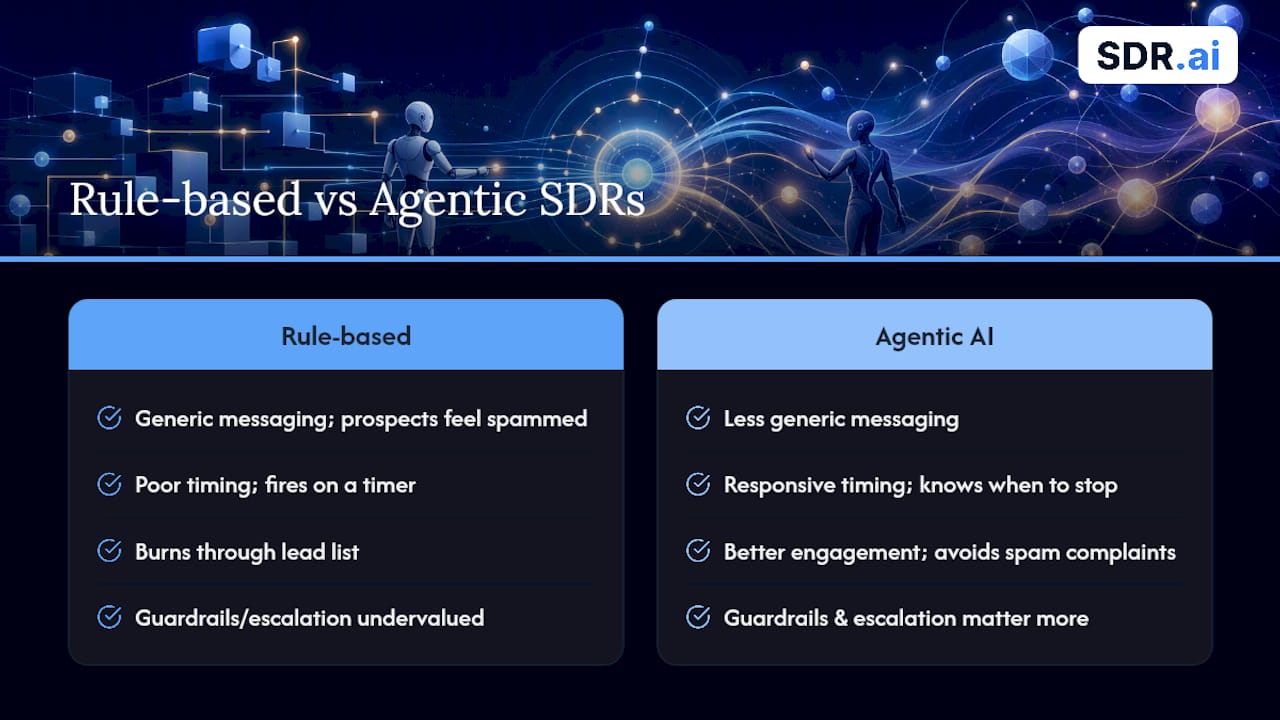
The conventional advice tells you to "test a few vendors and see what sticks." That's backwards. The teams getting real results define their qualification logic and success metrics before they ever touch a platform, then judge vendors against that standard rather than being sold on features. Guardrails and escalation rules matter more than message-writing quality, because a smart agent that knows when to stop beats a smooth talker that doesn't.
If you take one thing from this, prioritize designing your handoff rules before you pilot anything. That single decision determines whether your human reps trust the system enough to actually use it.
— Chad
Get Started With an AI SDR Built for B2B Outreach
Sdr gives you a working AI SDR program without the six-month ramp time or six-figure salary a traditional hire requires. Instead of stitching together a generic automation tool and hoping it learns your ICP, you get LinkedIn-first outreach, intent-based lead prioritization, and warm calling through the AI-Dialer, all built around the qualification rules your team already trusts.
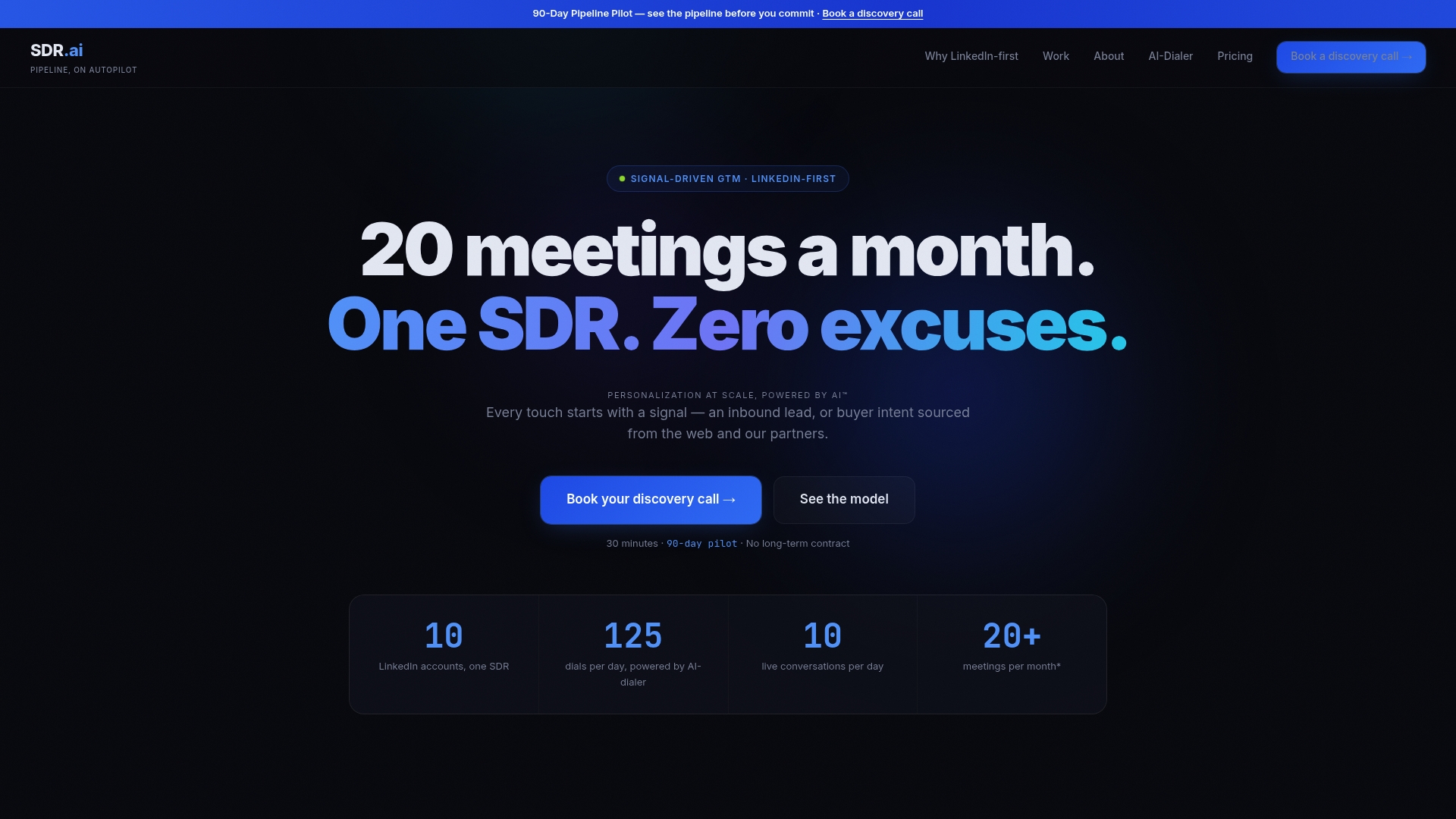
That combination is why clients see over 20 qualified meetings booked a month with a fraction of the manpower a full SDR team demands. If you're evaluating whether to hire another rep or run a pilot instead, the honest comparison between an AI SDR and a traditional SDR agency lays out the tradeoffs plainly. When you're ready to see the model applied to your own pipeline, book a demo and walk through what a pilot would look like for your ICP.
Sources
- Beyond Automation: How AI SDRs are Redefining Sales | IBM
- What is an AI SDR? How They Work + Best Practices | Salesforce
- Monday
- Gartner press release: generative AI in sales