
Yes, AI can scale and often improve outbound sales, but only when you match the approach to the job. Automation helpers speed up copywriting and sequencing for lean teams. Managed AI SDR services like Sdr run the whole pipeline, often booking 20+ qualified meetings a month with minimal headcount. Autonomous agents handle end-to-end prospecting for larger orgs ready to cede more control. The trade-off across all three is more scale and personalization, but real risk around deliverability and governance if nobody’s watching the machine.
AI-Powered SDRs
Managed AI SDR services like SDR.ai can book over 20 qualified meetings per month with minimal staff, suitable for companies needing rapid pipeline growth.
Automation helpers mainly assist with content creation and sequencing but rarely handle dialing or booking, limiting their scope for full-funnel outreach.
Autonomous AI agents automate the entire prospecting workflow but require strict governance to manage deliverability risks and oversight.
Successful AI-driven outbound relies on deliberate pilot programs focusing on a narrow ICP, specific channels, and measurable KPIs over at least four to six weeks.
Choosing the right approach depends heavily on team size, target volume, channel focus, governance capacity, and integration with existing CRM systems.
Table of Contents
What “AI for Outbound Sales” Actually Means
The phrase gets used as a catchall, and that’s the first problem. “AI for outbound sales” covers three genuinely different product categories, and confusing them is why so many teams buy the wrong tool and blame AI for the failure.
Automation helpers are the entry point. These are assistants bolted onto your existing stack. Think copy generation, sequence building, and basic list enrichment. A rep still owns the strategy and the send button; the AI just removes the blank-page problem and speeds up the mechanical parts. AI sales automation platforms in this category typically automate outreach across email, LinkedIn, SMS, WhatsApp, and phone, building conditional sequences and personalizing messages at scale.
Managed AI SDR services sit a level up. Instead of handing a rep a better tool, you’re handing the whole top-of-funnel motion to a team that runs AI-augmented outreach, dialing, and qualification on your behalf. Sdr operates in this category, running LinkedIn-first outreach with personalized messaging and warm calling through an AI dialer, targeting a defined ideal customer profile rather than blasting a generic list. The buyer here isn’t looking for a tool to learn. They’re looking for a pipeline that shows up.
Autonomous outbound agents are the newest and riskiest tier. These systems run the full prospect-to-booking workflow with minimal human intervention. That includes finding leads, sequencing outreach, handling replies, and scheduling meetings. They demand the most trust and the least oversight, which makes them powerful in the right hands and dangerous in the wrong ones.
Here’s how the three map to buyer reality:
-
Small team, tight budget, need speed on copy: automation helpers fit. You keep control, but you’re still the bottleneck on strategy and volume.
-
Series A/B company or overwhelmed sales team with no time to build an SDR function from scratch: a managed AI SDR service fits. You get the outcome without hiring, training, or managing a rep.
-
Enterprise with mature data infrastructure and appetite for autonomy: autonomous agents fit, provided someone owns governance full time.
-
Any team relying only on a single channel: none of the three will outperform a multichannel approach, because prospects respond differently across email, LinkedIn, and phone depending on where they actually pay attention.
Workflow coverage differs sharply, too. Automation helpers usually stop at content generation and sequencing. They rarely touch dialing or booking. Managed services typically cover the full funnel: list building, personalization, multichannel sequencing, warm calling, and meeting booking, all under one accountable relationship. Autonomous agents aim for the same full-funnel coverage but automate the human judgment calls in between, which is exactly where the risk concentrates.
How AI Changes Outbound Workflows and What It Actually Delivers
The honest answer is that AI doesn’t replace outbound strategy. It removes the friction that kills volume before strategy even matters.
Five use cases show up again and again in outbound motions that have actually adopted AI well:
-
Prospect discovery: AI tools scan intent signals, job changes, funding events, and technographic data to surface accounts that are more likely to respond right now, not just accounts that fit a firmographic filter.
-
Multichannel outreach: instead of a rep manually juggling email, LinkedIn, and phone, AI sales automation platforms orchestrate sequences across all three channels, adjusting timing and messaging based on engagement.
-
AI-assisted personalization: generative models draft outreach that references a prospect’s actual role, recent activity, or company news rather than a mail-merge token, which is the difference between a message that gets read and one that gets reported as spam.
-
Warm calling with parallel dialers: parallel dialing technology lets a single rep or AI system work through far more live conversations per hour than manual dialing allows, directly increasing contact rates.
-
Qualification and booking: conversation intelligence tools convert call and email signals into next-step recommendations automatically, so reps spend time talking to qualified prospects instead of guessing who to call next.
Pro Tip: Don’t judge an AI outbound tool by how good its demo email sounds. Judge it by how it handles a prospect who replies with a one-word objection. That’s where the personalization either holds up or falls apart.
On the numbers side, expectations should stay realistic. Revenue AI platforms that surface signals from calls and emails and automate follow-ups report saving reps meaningful hours per week and improving win rates by helping teams prioritize the right accounts instead of working a flat list. The exact lift varies by industry, list quality, and how disciplined the team already was before adding AI. A team with a messy CRM and no ICP definition won’t see the same gains as one with clean data and a tight target list, no matter which AI layer you bolt on.
Integration matters more than most buyers expect going in. If your AI outreach tool doesn’t sync cleanly with your CRM, you end up with two versions of the truth: one in the AI platform, one in Salesforce or HubSpot, and reps guessing which is current. Enterprise platforms that build generative AI directly into the CRM workflow avoid this by keeping lead scoring, outreach drafts, and predictive analytics in one place. Deliverability is the other silent killer. Sending AI-personalized volume through a domain with no warm-up plan, no sending limits, and no consent hygiene will tank your sender reputation faster than any tool’s personalization can compensate for.
How to Choose the Right AI Approach for Your Outbound Team
Pick the wrong category and you’ll blame the tool for a mismatch that was never the tool’s fault. Work through these decision axes before you take a single demo call.
-
Team size and operating model. A five-person startup sales team has different needs than a 40-rep enterprise floor. Small teams generally get more value from a managed service that removes the burden entirely; larger teams with existing SDR infrastructure may prefer an automation layer bolted onto what they already run.
-
Outbound volume you actually need. If your target is 20 to 30 qualified meetings a month, you don’t need an autonomous agent system built for thousands of touches a week. Match the tool’s scale to your pipeline goal, not to what sounds impressive in a sales deck.
-
Channel mix. If your buyers live on LinkedIn and rarely answer cold calls, a phone-first tool is the wrong investment regardless of how good its dialer is.
-
Autonomy versus human-in-the-loop. Decide upfront how much you’re willing to let AI decide without a human checkpoint. This is a governance question, not a technology question, and it should be answered before you buy, not discovered during a pilot gone wrong.
-
CRM and tech-stack fit. A tool that can’t sync bidirectionally with your CRM creates data debt you’ll be cleaning up for months.
-
Compliance and deliverability posture. Ask specifically how the vendor handles consent, data sourcing, and email/LinkedIn account warm-up. Vague answers here are a red flag, not a formality.
-
Budget model. Retainer, per-seat SaaS license, or outcome-based pricing all carry different risk profiles. Outcome-based and managed-retainer models shift more execution risk onto the vendor, which matters if your internal team is already stretched.
When you get on a vendor call, ask direct questions: How many qualified meetings has this exact setup produced for a company your size? What happens to deliverability if reply rates drop? How much human review touches each message before it sends? Vague answers to any of these, especially the last one, should worry you more than a slick product demo.
Pro Tip: Ask every vendor what their churn rate looks like after the first 90 days. A tool or service that can’t retain clients past the honeymoon period usually has a personalization problem that only shows up at scale.
Before you sign anything, get internal alignment on three things: who owns the relationship day to day, what the two or three success metrics actually are (not five, not “more pipeline” as a vague goal), and what your realistic timeline is before you expect to see booked meetings. Skipping this step is the single most common reason internal AI outbound pilots quietly die three months in.
Building the Pilot: From First Test to Full Scale
Running AI outbound without a structured pilot is how teams end up with a burned domain and no data to show for it. Here’s a sequence that actually protects you.
-
Define a narrow ICP slice. Don’t test against your whole addressable market. Pick one segment, ideally 200 to 500 accounts, tight enough that a failed test doesn’t cost you your best prospects.
-
Select your channels deliberately. Start with one or two, not five. Pilot design should define ICP segments, sample sizes, and measurable KPIs before you scale, and adding channels mid-pilot muddies which lever actually moved the numbers.
-
Set your primary metrics upfront. Meetings booked, reply rate, and pipeline value generated are the three that matter. Vanity metrics like open rate tell you almost nothing about whether the pilot is working.
-
Run it for at least four to six weeks. Shorter windows don’t give deliverability warm-up or messaging iteration enough time to show real signal.
On the operational side, a handful of tasks separate a pilot that produces clean data from one that produces noise:
-
Enrich your contact data before launch, not during. Stale or wrong job titles will sink personalization no matter how good the AI copy is.
-
Map how leads and activities flow into your CRM before the first message sends, so you’re not reconciling spreadsheets three weeks in.
-
Set explicit human-in-the-loop checkpoints, especially for the first two weeks, so a bad message pattern gets caught before it burns 200 contacts.
-
Warm up any new sending domain or dialer number gradually. Skipping this step is the fastest way to land in spam folders.
-
Confirm consent and data-sourcing practices match the regulations in every region you’re prospecting into, since rules differ meaningfully across markets.
Scale triggers should be numeric, not vibes-based. If your pilot segment is producing a reply rate and meeting-booked rate that beats your historical outbound baseline, and pipeline value from those meetings holds up after a full sales cycle, that’s your green light. Most teams see initial signal within four to six weeks and a fuller ramp to steady-state performance by month three, though this varies with list quality and how quickly messaging gets iterated. The teams that stall out are almost always the ones that never touched their messaging after week one. Segmentation and copy need at least one meaningful revision cycle based on real reply data before you can judge the channel fairly.
Real-World Evidence: How Sdr Runs This in Practice
Sdr’s method starts where most AI outbound tools stop: identifying intent before the first message goes out. Rather than blasting a static list, the approach targets an ideal customer profile using intent signals, job changes, and engagement data to prioritize who gets contacted first and how.

The outreach itself runs LinkedIn-first, since that’s where most B2B buyers now do their research before a phone call ever happens. Personalized messaging built around a prospect’s actual context feeds into warm calling through Sdr’s AI Dialer, which uses parallel dialing to push contact rates well beyond what a single rep working a manual list could manage. The AI Dialer has been documented to help teams book five to ten times more meetings than traditional single-line dialing.
Clients working with Sdr often see a substantial number of qualified meetings booked each month, run with a fraction of the manpower a traditional in-house SDR hire or agency retainer would require. That outcome depends heavily on ICP tightness and market responsiveness, which is why every engagement starts with a defined pilot segment rather than an open-ended blast.
None of this runs on autopilot without oversight. Sdr layers governance into the pipeline: message review checkpoints, deliverability monitoring, and consent practices that keep sending domains and dialer lines healthy over time. That’s the difference between an outreach motion that compounds and one that burns out after a hot first month.
-
LinkedIn-first outreach mapped to a defined ICP, not a generic list
-
Intent-signal identification to prioritize who gets contacted and when
-
AI Dialer parallel calling documented at five to ten times traditional booking rates
-
Human oversight on message quality and deliverability health throughout the engagement
Case-specific outcomes vary by industry and starting pipeline maturity, and results from any individual client engagement will differ based on ICP fit and market conditions.
Build, Buy, or Hire: What Actually Fits Your Situation
The build-versus-buy debate misses the real question, which is speed-to-results versus long-term ownership. Building an in-house AI outbound function gives you control and, eventually, lower cost per meeting once it’s mature. It also takes months to get right, and most teams underestimate how much of that time goes to fixing deliverability problems nobody warned them about.
A managed AI SDR service compresses that timeline dramatically. You’re paying more per meeting early on, but you skip the trial-and-error phase entirely, which matters most for a Series A company that needs pipeline this quarter, not a system that’s optimized by next year.
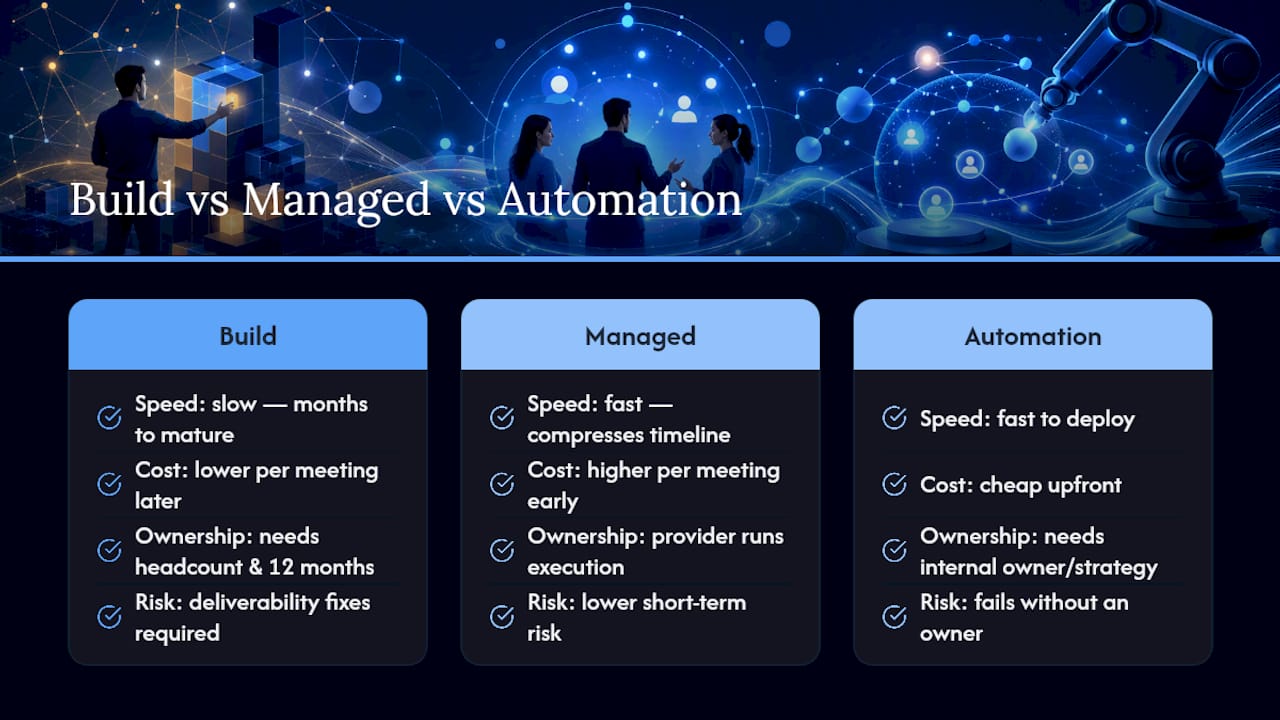
Automation helpers sit in between: cheap and fast to deploy, but they still require someone internally who owns strategy, list quality, and iteration. If that person doesn’t exist on your team yet, the tool won’t fix that gap on its own.
The honest framework: if you have the headcount and twelve months of patience, build. If you need booked meetings in the next quarter and don’t want to manage the machine yourself, a managed service like Sdr is the faster, lower-risk path. Whichever path you pick, insist on the same governance questions. Autonomy without oversight breaks things quietly, long before anyone notices the damage.
— Chad
Getting Started With an AI-Driven Outbound Engine
If you’ve read this far, you’re probably past the question of whether AI belongs in outbound and into the harder question of who should run it. Sdr exists for exactly the buyer stuck there: a Series A or B company, or a sales team that’s stretched thin and can’t afford another six months of trial-and-error hiring.
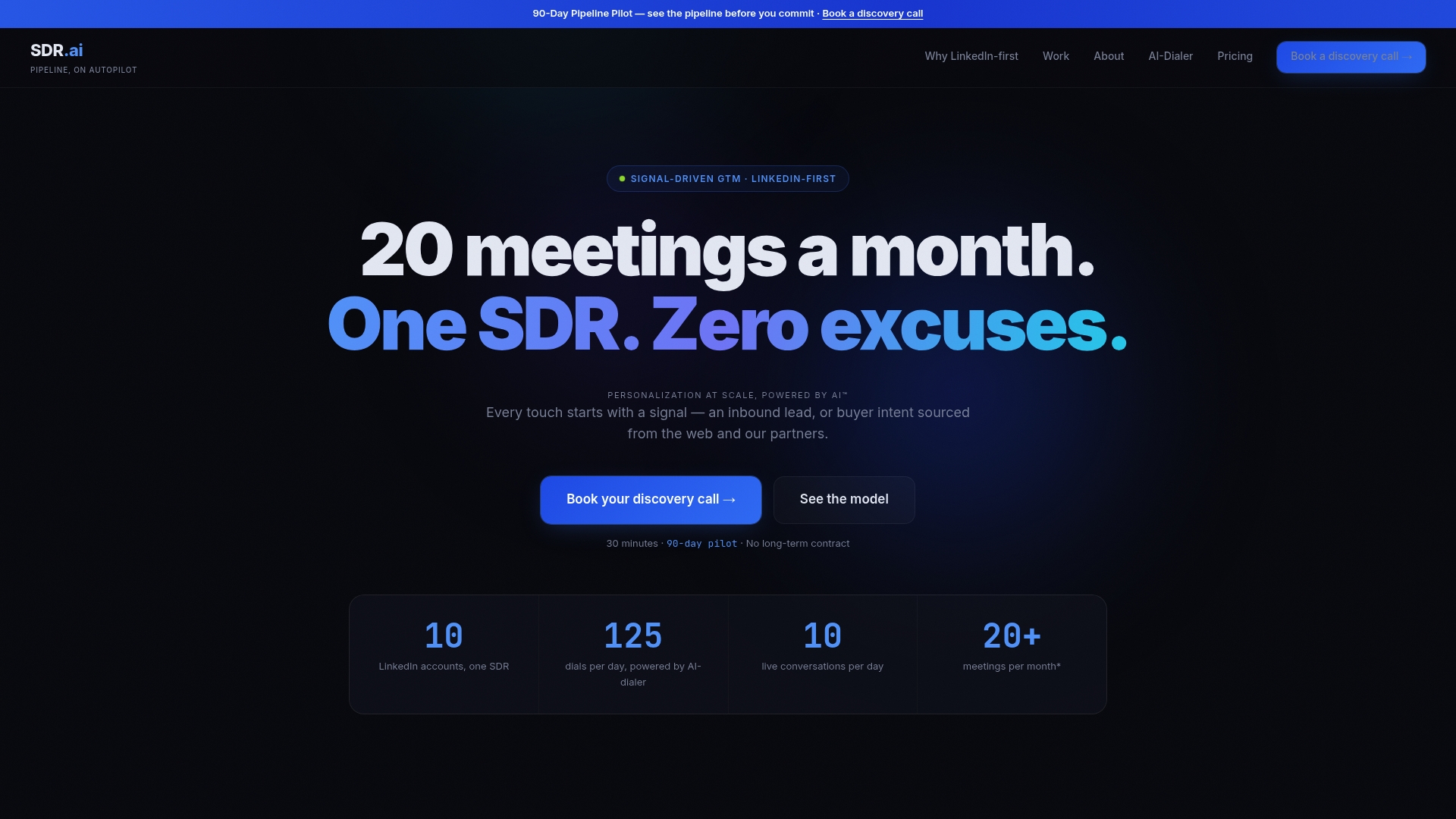
Sdr runs LinkedIn-first outreach against your defined ICP, layers in intent signals to prioritize who gets contacted, and backs it with an AI Dialer built for parallel calling instead of one line at a time. Clients typically see setup and ramp happen within the first few weeks, with meeting volume building as messaging gets tuned against real reply data. Success gets measured the way it should be: qualified meetings booked, reply rate, and pipeline value, not vanity metrics that look good in a slide deck. Compared to hiring and training an in-house SDR or signing a traditional agency retainer, you get a working pipeline without the ramp-up cost or the management overhead. If you want to see exactly what that looks like for your ICP, book a demo and walk through your pipeline goals directly.