
A sales follow up cadence is the rhythm that governs how often, how long and on which channels you contact a prospect, while a sequence is the list of steps that carries it out. Plan roughly 8 to 12 touches across 2 to 4 weeks, answer inbound leads within minutes, and make every touch add something new while you rotate channels.
TL;DR:
- Plan 8 to 12 touches over 2 to 4 weeks, with 2 to 3 day gaps early and 4 to 5 day gaps later.
- Answer inbound leads within minutes; contact warm, event, or post demo prospects daily or every other day during the first week.
- A cold cadence can mix three emails, three calls, and two LinkedIn touches, with voicemail on two calls; favor calls for warm leads.
- Pause outreach after a reply, a booked meeting, or an unsubscribe; send a courteous closing note, then schedule reengagement in 90 days with a fresh reason.
- Test one variable at a time; adopt changes only when meetings booked per contact improve across two batches, rather than relying on email opens.
Table of Contents
- What a sales cadence is and why it matters
- How many touchpoints you need and when to send them
- Channel mix: how to combine email, phone, LinkedIn and voicemail
- Copyable sample cadences you can drop into a sequences tool
- How to personalize with intent signals and quick prospect research
- How to test and measure cadences: KPIs, experiments and optimization rules
- Short templates: subject lines, voicemail and the break-up email
- Why speed, persistence and measurement matter most when you build a cadence
- How we help teams run and scale follow-up cadences
- FAQ
- Sources
What a sales cadence is and why it matters
People mix up two terms, so let's separate them. A cadence is the tempo: how many touches, how far apart, across which channels, and when you stop. A sequence is the tactical step list that runs inside that tempo, usually automated in a sales engagement tool. HubSpot describes a sales sequence as a timed series of touchpoints across email, phone and social, with the cadence setting the spacing between them.
Why bother defining it? Without a written cadence, follow-up depends on mood and memory. Reps send two emails, hear nothing, and quietly move on. A defined rhythm removes that decision. Everyone knows what touch comes next, who owns it, and when the lead is closed out.
Here is what a good cadence does for a team:
- It keeps reps persistent after the first silence, which is where most deals are abandoned.
- It removes decision fatigue, because the next action is already scheduled.
- It makes results comparable across reps, so you can see what works.
- It gives managers a clear point to step in, since every lead sits at a known stage.
- It pauses automatically when a prospect replies, so nobody gets a canned email after a real conversation has started.
The evidence for persistence is plain. Prospects rarely answer the first message, and HubSpot's prospecting guidance calls around eight touches a practical benchmark for B2B outreach. Follow-ups also change outcomes. HubSpot's follow-up research reports reply rates moving from 16% to 27% when reps send at least one follow-up. The first email is rarely the one that works.
A cadence is not permission to nag. The goal is steady, relevant contact that respects the prospect's time. If every touch repeats "just checking in," you have a schedule but no cadence worth running.
How many touchpoints you need and when to send them
Start with the benchmark, then adjust it to your market. Gartner's sales development guidance recommends touching prospects 8 to 12 times over 2 to 4 weeks. Many teams treat 8 touches as a practical default and extend toward 12 for high-value accounts. Stopping after only a few touches may mean you gave up before the prospect noticed you.
Speed to lead for inbound. Someone who just filled out a form is the warmest prospect you will ever have, and that warmth fades quickly. Gartner stresses that inbound leads need very fast follow-up, measured in minutes, to reach best-in-class response rates. If your team cannot cover every form fill in real time, automation can close the gap. This speed-to-lead automation guide shows how smaller teams get a first response out in under five minutes without a dedicated RevOps hire.
Gartner: 8 to 12 touches over 2 to 4 weeks is the best-practice window for outreach, with inbound leads needing a response in minutes. Treat this as your baseline, then test your way off it.
Spacing rules that hold up in practice:
- For cold outreach, HubSpot suggests 2 to 3 days between touches in week one, then stretching to 4 to 5 days later in the cadence.
- After an email with no reply, wait 48 to 72 hours before the first follow-up, which is the window HubSpot's follow-up research recommends in many situations.
- For warm leads, event contacts and post-demo deals, tighten the spacing. Interest decays fast, so one touch every day or two is reasonable in the first week.
- For cold lists, widen the gaps after week one. Frequent contact with strangers who have shown no interest mostly builds annoyance.
- Pause the sequence the moment someone replies, books a meeting or unsubscribes.
Time of day and day of week. Early-week inboxes are crowded, so some practitioners avoid sending email first thing Monday. For calls, HubSpot's prospecting guidance suggests trying around 3 p.m. local time or later, and it also advises testing email send windows five minutes before or after the hour. Test different days and times to learn when buyers are more likely to respond. Treat all of this as a hypothesis for your own data, not a law. Our own write-up of send time tests shows how to set up that kind of experiment.
When should you stop? After the final touch in your cadence, send a polite break-up message and move the contact to a long-term nurture list with a re-engage reminder. Silence after 8 to 12 well-spaced, valuable touches is an answer, and your time is better spent elsewhere.
Channel mix: how to combine email, phone, LinkedIn and voicemail
Repeating one channel is the weakest way to follow up. A prospect who ignores your emails may answer a call, and one who never picks up may accept a LinkedIn request. Gartner recommends mixing voice, email and social, and HubSpot's prospecting guidance suggests splits such as three calls and two emails, or three emails and two calls, then committing to a testable number of attempts.
Use each channel for what it does best:
- Email carries detail. Use it for the first message, proof points, links and anything the prospect may want to forward to a colleague.
- Phone carries urgency and tone. It works best when you have a reason to call, such as a signal or an earlier open, and it suits warm leads and later touches.
- LinkedIn carries context. A connection request, a comment on a recent post or a short message shows you are a real person with a reason to be in their feed.
- Voicemail carries a short, clear reason to respond. Keep it brief and give one idea, not a pitch.
A simple ratio to start testing: for a cold 8-touch cadence, run 3 emails, 3 calls (two with voicemail), and 2 LinkedIn touches. For warm leads, lean toward the phone, since they already know who you are. For senior buyers who rarely answer unknown numbers, shift weight toward email and LinkedIn.
Rotate channels rather than stacking them. Two emails in a row feel like repetition. An email, then a call, then a LinkedIn note feels like three different reasons to respond. Our write-up on LinkedIn-first, research-first outreach shows how a social touch can open the door before the first call.
Social touches and voicemails earn their place only when they add something. A LinkedIn "just following up" note is noise. A comment on the prospect's post, or a one-line observation about their hiring, is value. The same holds for voicemail: mention the specific reason you called, not "I wanted to touch base."

Copyable sample cadences you can drop into a sequences tool
Below is a cold 8-touch cadence. It follows the day, channel, message type and goal structure that ZoomInfo's follow-up guide uses for its own 8-touch example, with spacing that follows HubSpot's 2 to 3 days early, then 4 to 5 days later.
| Day | Channel | Message type | Goal |
|---|---|---|---|
| 1 | Signal-based intro | Earn attention with one relevant observation | |
| 3 | Connection request with short note | Create a second point of recognition | |
| 5 | Phone | Call plus voicemail | Reach the prospect, or leave a clear reason to reply |
| 8 | Value add (insight or case example) | Give something useful, no ask beyond a reply | |
| 12 | Phone | Call, no voicemail | Try a live conversation at a different time of day |
| 16 | Comment or short message on recent activity | Stay visible without pitching | |
| 21 | Direct meeting request | Ask for 15 minutes with a specific agenda | |
| 26 | Break-up | Close politely and invite a reply |
Warm lead or event follow-up (several touches):
- First, send a personal email promptly, referencing the specific session, booth chat or content they engaged with.
- Connect on LinkedIn with a note about the conversation.
- Call and leave a voicemail that repeats the reason you reached out.
- Email a short resource tied to what they said they care about.
- Call again at a different time of day.
- Send a meeting request with proposed times.
- Send the break-up email and schedule a re-engage reminder.
Post-demo or contract stage: keep the cadence short and tied to their decision timeline.
- After the demo, send a recap email with the agreed next step and any promised materials.
- Share a proof point aimed at the concern they raised.
- Call to ask what questions have come up internally.
- Offer to join a call with other stakeholders, rather than waiting on one champion.
- Send a clear next-step email with a mutual timeline.
- If there is still no response, consider involving a manager or executive sponsor.
Where the break-up and tickler go. Put the break-up email last, after the final value touch, not in the middle. It closes the loop politely, and it often draws replies because it lowers the pressure. Right after sending it, create a reminder in your CRM to re-engage with something new, such as a trigger event or fresh content. For more templates, see our six copyable cadence examples and the two-week targeted outbound playbook, which shows a shorter, more aggressive format for tightly targeted lists.
How to personalize with intent signals and quick prospect research
Personalization is what keeps a long cadence from feeling like a mail merge. ZoomInfo's guidance tells reps to drop "just checking in" and instead use the SCQA structure (Situation, Complication, Question, Answer) and reference intent signals. Each follow-up should earn the next reply by being worth reading.
High-value intent signals to watch:
- A recent funding round or a new budget cycle.
- A new executive hire in the function you sell to.
- Changes in their tech stack, such as adopting or dropping a tool you integrate with.
- Content activity: a post, webinar appearance, job listing or pricing page visit.
- Expansion news, such as a new office, market or product launch.
How to mention a signal without sounding like surveillance: state the fact once, connect it to a problem, then ask a small question. For example: "Saw you brought on a new VP of Sales last month. Teams in that spot often rebuild follow-up before the next quarter. Is that on your list?" Skip phrases like "I noticed you visited our site three times."
A quick pre-touch checklist:
- Check their LinkedIn profile for recent posts, role changes or shared connections.
- Scan the company's news page or a quick search for funding, hires or launches.
- Review your CRM history so you do not repeat a point or contradict an earlier message.
Pro Tip: Save one specific detail per prospect in your CRM notes at the first touch, then reference a different detail at each later touch, so the cadence feels like a conversation instead of a loop.
How to test and measure cadences: KPIs, experiments and optimization rules
A cadence is a hypothesis. Treat it that way and it will improve every quarter.
Core KPIs to track:
- Reply rate: replies divided by prospects contacted, split by positive and negative.
- Meetings booked per contact: the metric that ties activity to pipeline.
- Conversion per touch: which step in the cadence produces the reply, so you can cut weak steps.
- Time to first response: for inbound, how many minutes pass before a human reaches the lead.
- Connect rate on calls: useful for judging time-of-day tests.
Experiments worth running, one at a time:
- Touch count: 6 versus 8 versus 10.
- Spacing: 2-day gaps versus 4-day gaps after week one.
- Channel order: phone first versus email first.
- Message angle: signal-based versus value-add content.
- Voicemail versus no voicemail on the first call.
Change a single variable per test, or you will not know what caused the result. Split contacts randomly between the control and the variant, using the same list quality and the same reps where possible. Run each test until every variant has a meaningful number of contacts and has completed the full cadence, since late touches produce replies too. A few dozen contacts per variant is too thin to trust.
A simple decision rule: adopt a variant only if it beats the control on meetings booked per contact, not just opens, and the lead holds up across two consecutive batches. Then promote it to your standard cadence and start the next test. Opens alone mislead, because many people open an email and never reply.
Short templates: subject lines, voicemail and the break-up email
Adapt these to your voice and add one real detail before sending.
Subject lines:
- Cold: "Quick question about [their initiative]"
- Cold: "Idea for [Company]'s outbound after the new hire"
- Warm: "Following up on our chat at [event]"
- Warm: "The resource I mentioned, plus one thought"
- Post-demo: "Next steps for [Company]"
Voicemail script: "Hi [Name], this is [Your name] from [Company]. I'm calling because [specific reason or signal]. I sent a short note about it earlier today. My number is [number], and I'll try you again later this week."
LinkedIn opener: "Hi [Name], I follow [topic] and liked your post on [subject]. Would be glad to connect."
Break-up email, in order:
- Open with a short, friendly line: "I've reached out a few times and don't want to clutter your inbox."
- State the one-line value you offered, so they remember why you wrote.
- Leave the door open: "If this becomes a priority, reply any time and I'll pick it back up."
- Set a 90-day CRM reminder to re-engage with a new reason to talk.
Why speed, persistence and measurement matter most when you build a cadence
Most teams over-engineer the message and under-engineer the habit. If I had to rank priorities, I would put speed on inbound first, because no clever sequence rescues a lead who waited a day. Second is consistent multichannel persistence on outbound, since the real failure is stopping at touch three. Third is signal-driven relevance, because a prospect forgives a long cadence far sooner than a pointless one.
Automate the mechanics, meaning the scheduling, pausing and logging, but keep the message human and tied to something real about the buyer. Then treat the cadence as a live experiment, changing one variable at a time. A cadence that never changes quietly stops working.
— Chad
How we help teams run and scale follow-up cadences
If you want these cadences running without building an SDR team first, here is what we offer:
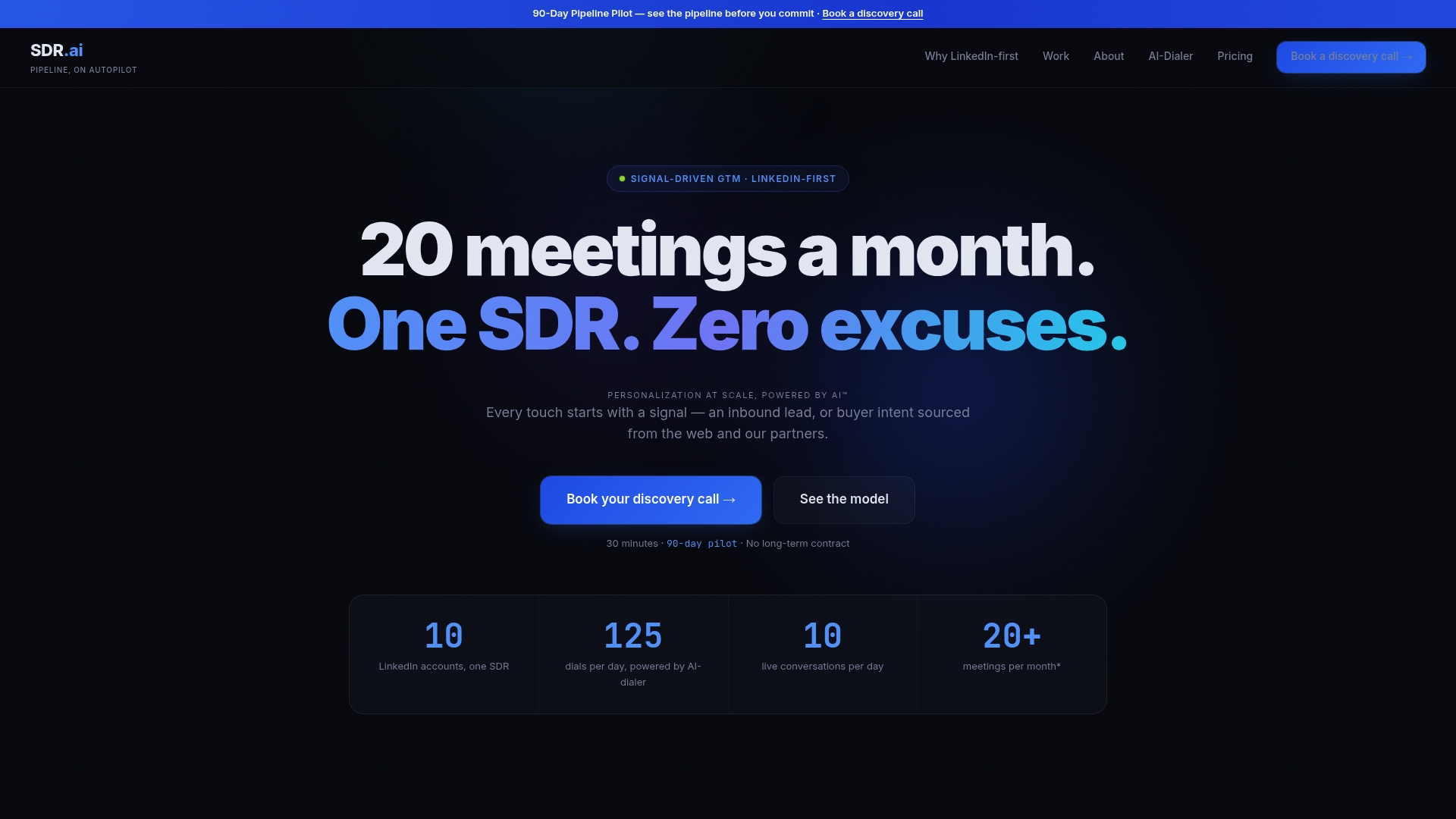
Most teams stall at the same place: the cadence is written, but nobody has time to research every prospect, rotate channels and keep the rhythm going. We built our services around that gap, so more of your effort lands on real conversations with people who fit your ICP.
- AI-Powered Outbound: LinkedIn-first outreach aimed at your ICP and intent signals, with a human SDR handling every reply. It is $2,500 per month plus a one-time $500 setup fee, and the details are on our main site.
- The SDR.ai Blueprint: our playbook for building your own outbound engine, with the model, cadences and pipeline math laid out. Current pricing details are on the Blueprint page.
- AI-Dialer: warm calling for your touches that need a voice, at $2,400 per year with a one-time $500 onboarding fee.
Together they cover the touches that stall most cadences: targeting, personalized messages and live calls. If you want to see the model first, watch our walkthrough, or request a demo and we will map your cadence to your own pipeline.
FAQ
What does follow-up cadence mean?
A follow-up cadence is the planned rhythm of contact with a prospect: how many touches, how far apart, and on which channels. It is the tempo, while the sequence is the list of steps that carries it out. A good one keeps you persistent without repeating yourself.
What is a good sales cadence?
A good sales follow up cadence mixes channels and gives each touch a new reason to reply. Gartner suggests 8 to 12 touches over 2 to 4 weeks, and many teams use 8 as a starting point. Tighten the spacing for warm leads and widen it for cold ones.
What is the 30-60-90 rule in sales?
It is not a follow-up timing rule. It usually refers to a longer-term plan for a new rep's ramp or a deal's progress, and definitions vary by team. For follow-up, use spacing based on the lead's temperature instead, such as HubSpot's suggested cadence of 2 to 3 days early and 4 to 5 days later for cold outreach.
What is the 10-3-1 rule in sales?
Definitions vary, and no single source we cite defines it, so treat it as a team's own funnel shorthand rather than a standard. A common reading is a ratio of many contacts to fewer conversations to one deal, which is why a consistent number of touches matters. Define your own ratios from tracked meetings per contact.
When should I stop following up?
Stop after your final planned touch, which is usually a break-up email. Move the contact to a nurture list and set a 90-day reminder to re-engage with something new. Stop immediately if the prospect asks you to.
Sources
- 11 Sales Development Strategies for High-Growth Companies
- Sales sequences: 12 best practices for B2B teams in 2026
- 9 Sales Follow-Up Strategies to Stop Wasting Leads