
An outbound sales playbook is the documented system that turns prospecting into repeatable, qualified meetings tied directly to revenue math. The single best first step is not to write the whole thing: it's to run a narrow, targeted one to two week proof test against a defined ideal customer profile before you build anything else.
TL;DR:
- Running a short, targeted proof test against a narrow ideal customer profile is critical before scaling outbound sales efforts.
- Defining and validating detailed firmographics, technographics, and trigger events ensures message-market fit and improves reply rates during testing.
- Combining personalized touches across LinkedIn, email, and calls increases reply and meeting rates, especially when sequencing rules are followed carefully.
- Using metrics like positive reply rate and meeting set rate provides clearer insights into message effectiveness than raw reply counts.
- Regular review, feedback collection, and playbook refinement prevent stagnation and optimize outbound strategies over time.
Table of Contents
- What belongs in an outbound sales playbook
- Define and validate your ICP and buyer personas before you write a single script
- Multi-channel cadences and outreach templates that actually get replies
- Test, measure, and scale: the proof phase and Credibility Readiness
- Key metrics: what matters versus what's noise
- Operations and tech: avoiding click overload while keeping replies fast
- Sample plays SDRs can copy today
- How the SDR.ai Blueprint implements the playbook
- Common objections and how to script your rebuttals
- Legal and compliance considerations for outbound communications
- Continuous improvement: closing the feedback loop on your playbook
- Author perspective: what good outbound leadership looks like today
- How SDR.ai can help you run this playbook faster
- FAQ
- Sources
What belongs in an outbound sales playbook
A playbook earns its name when a new rep can read it and run a play without asking five people for context. That means documenting the system, not just the pitch.
According to Salesforce's playbook guidance, a working playbook should cover:
- Your ICP and buyer personas, with the firmographic and trigger criteria that qualify a lead
- Named plays for prospecting, qualification, follow-up, and closing, each with a clear goal
- Cadence templates and scripts for email, call, and LinkedIn touches
- Qualification criteria and lead routing rules so handoffs don't stall
- KPIs for each play and escalation paths for stuck deals
Each section exists to remove ambiguity. A rep without a scripted qualification path will improvise, and improvisation is what makes ramp time unpredictable and results inconsistent across a team. We'd recommend keeping each play to a one-page summary with linked templates and scripts underneath, so reps can scan the plan in under a minute and go deeper only when they need to.
Define and validate your ICP and buyer personas before you write a single script
Targeting is the whole game. An outbound playbook built on a vague persona wastes every other investment you make in it.
Start with operational criteria you can actually filter on:
- Firmographics: company size, industry, revenue band, and geography
- Technographics: the tools or platforms a prospect already uses that signal fit
- Trigger events: funding rounds, leadership changes, or product launches that create urgency
- Outcome and budget window: the problem your product solves and when they're likely to have budget for it
Build personas quickly using LinkedIn profiles, job postings (they reveal internal pain points and priorities), and public filings for larger accounts. Then validate before you scale: run a one to two week test against a narrow segment and watch for message-market fit signals, meaning prospects engaging with your specific value proposition rather than generic politeness replies.
Pro Tip: If your test segment isn't generating any positive replies by day 10, the problem is almost always the ICP definition, not the script.
Multi-channel cadences and outreach templates that actually get replies
A cadence is the sequence and timing of touches across channels, and it's where most playbooks either prove their worth or fall apart — here is how to automate multichannel follow-ups effectively.
For a targeted proof phase, a typical cadence runs 2 to 3 personalized touches over 14 to 21 days, mixing LinkedIn connection and comment, a personalized email, and a phone call. Each touch should reference something specific to the prospect, not a template filled with a merge field.
Combining channels works better than any single one. Practitioner data cited by HubSpot shows that pairing phone calls with email tends to multiply reply rates compared to either channel alone, and calls also give you faster feedback on whether your messaging is landing.
Once you've proven the segment converts, a scaled cadence can add volume, but only after that proof, since higher email volume without deliverability safeguards is what damages domain reputation.
A few sequencing rules worth documenting:
- Lead with LinkedIn engagement before the first email, so your name looks familiar when the email lands
- Call within a day or two of a LinkedIn view or email open, while you're top of mind
- Avoid stacking every touch on a Monday or Friday, when inboxes are either flooded or ignored
The widely referenced 3-3-3 pattern, three touches across three channels over three days, works well as a compressed version of this cadence for high-urgency triggers like a funding announcement.
Test, measure, and scale: the proof phase and Credibility Readiness
Scaling outbound before you've proven it works is the single most common way teams burn a market segment. The fix is a decision framework: start targeted, prove it, then scale.
Start by calculating meeting demand (M) from your revenue goal and funnel conversion rates, rather than picking an arbitrary number of calls or emails per day. Work backward from the pipeline you need.
Before adding volume, run your plan through a Credibility Readiness Score, a checklist that scores your readiness across five dimensions:
| CRS dimension | What it measures |
|---|---|
| Executive narrative proof | Whether your pitch has credible social proof or case evidence |
| Authority assets | Content or materials that back up your claims |
| Message-market fit | Whether your targeted test produced consistent positive replies |
| Reply-handling ops | Whether your team can respond fast enough to not lose momentum |
| Deliverability and compliance | Whether your sending infrastructure and consent practices are sound |
The same framework recommends a CRS of 7 or higher before you move from a targeted test (typically 5 to 10 meetings a month) into high-volume outreach. Below that threshold, pause and fix the weakest dimension instead of adding more contacts to a leaky process.
Key metrics: what matters versus what's noise
Raw reply rate is the easiest number to track and the least useful one, since it counts "unsubscribe" and "not interested" the same as genuine interest.
Track these instead:
- Positive reply rate: replies that show real interest, the number the targeted outreach framework treats as the real signal of message-market fit
- Meeting set rate: positive replies that convert into a booked meeting
- Show rate: booked meetings that actually happen
- Meeting to SQL rate: booked meetings that turn into a qualified opportunity
During your proof phase, watch positive reply rate and meeting set rate weekly, since that's where you'll see message-market fit emerge or fail. Once you're scaling, shift more attention to show rate and meeting to SQL, which tell you whether volume is diluting lead quality. A minimal weekly dashboard tracking those four numbers beats a dozen vanity metrics nobody reviews.
Operations and tech: avoiding click overload while keeping replies fast
Reply speed decides whether a positive response turns into a meeting or goes cold. Set an SLA (same business day, ideally within a couple of hours) and assign clear ownership: a sequence owner who runs the cadence, an ops lead who manages routing and tooling, and a deliverability owner who monitors sending reputation.
Research from Salesforce found that many sales organizations underuse their CRM despite having one, a pattern often described as click overload from too many disconnected point tools. Consolidating around a CRM core, with suppression lists and deliverability monitoring built in rather than bolted on, tends to beat adding another niche tool.
Pro Tip: Script the small CRM habits, logging outcomes, updating stage, triggering the next task, directly into your play documentation so they aren't optional.
Sample plays SDRs can copy today
A play is only useful if someone can run it without you in the room. Two worth documenting first:
- Targeted prospecting play: Goal is a booked meeting from a cold ICP match. Sequence: LinkedIn engagement, personalized email referencing a trigger event, call within 48 hours. Qualification outcome: a positive reply rate above your proof-phase baseline and a clear next step offered on every call.
- Demo-request follow-up play: Goal is converting inbound interest into a held meeting. Sequence: immediate email confirming details, a call same day if no response within an hour, a LinkedIn touch if the call goes to voicemail. Qualification outcome: meeting set rate near 100% given the lead already raised a hand.
Adapt either play by deal size: larger accounts warrant a slower cadence with more personalization per touch, while smaller deals can run a faster, more templated version of the same structure.
How the SDR.ai Blueprint implements the playbook
We built Sdr around the same targeted-first logic: a Data · Digital · Dials engine that maps intent signals to your ICP, then runs personalized outreach through LinkedIn and parallel calling rather than guesswork.
Our starter checklist for a two-week pilot:
- Define your ICP and pull a list of 50 to 100 matching accounts
- Launch a targeted cadence across LinkedIn, email, and call
- Track positive reply rate and meeting set rate daily
- Review and adjust messaging weekly, not monthly
We often book a significant number of qualified meetings per SDR, and our AI-Dialer is designed to help teams book meetings faster through parallel dialing.
Common objections and how to script your rebuttals
Objections repeat across almost every outbound motion, which means they're scriptable. Document the rebuttal once and every rep benefits.
"We already have a vendor for this." Don't argue the point immediately. Ask what's working well and what isn't, since most "we have a vendor" objections are really "we haven't evaluated alternatives recently." A good rebuttal opens a comparison conversation rather than a confrontation.
"Not a priority right now." This usually means the trigger event you targeted hasn't translated into urgency yet. Acknowledge the timing, then ask what would need to be true for it to become a priority, and log the answer for a scheduled follow-up rather than pushing harder immediately.
"Send me some information." Treat this as a soft no unless paired with a specific question. A strong response offers a short, relevant asset and proposes a specific time to discuss it, rather than sending generic material into a void.
"How is this different from [competitor]?" This is a buying signal disguised as a deflection. Answer with one or two concrete differentiators tied to the prospect's stated problem, not a feature list.
Script these as if-then branches inside your play documentation, with the exact phrasing reps should use, not just a bullet describing the objection. A rep improvising a rebuttal live tends to get defensive; a rep reading from a tested script tends to stay curious, and curiosity converts more often than defensiveness.

Legal and compliance considerations for outbound communications
Outbound compliance rules vary significantly by country and by channel, so your playbook should state which rules apply to your specific markets rather than assuming one standard covers everyone.
Email outreach in many jurisdictions requires a working unsubscribe mechanism and accurate sender identification. Cold calling rules differ widely: some countries maintain do-not-call registries that carry real penalties for violations, while others regulate calling hours or require specific disclosures at the start of a call. Treat any claim about what's "legal" in your market as a question for your legal counsel or your market's regulator, not a default assumption carried over from another country's rules.
Deliverability and compliance also overlap in practice. The targeted outreach framework cited above treats deliverability and compliance monitoring as one of the five dimensions of Credibility Readiness, which means a sending domain with poor list hygiene or weak consent practices risks both legal exposure and a damaged sender reputation at the same time.
Document consent sources for every list you build (where the contact came from and why outreach is appropriate), maintain a suppression list for opt-outs, and review your scripts and templates against your market's current rules before scaling volume. Compliance review belongs in the playbook as a named step, not an afterthought handled once a year.

Continuous improvement: closing the feedback loop on your playbook
A playbook that doesn't change is already out of date. Buyer behavior shifts, channels saturate, and scripts that worked last quarter start sounding stale.
Build a weekly review cadence where the sequence owner and ops lead look at positive reply rate and meeting set rate by play, not just in aggregate. A play that's quietly underperforming for one segment can drag down your overall numbers while looking fine on average.
Capture rep feedback directly into the playbook. The people running the cadence every day notice which lines get ignored and which openers get replies long before the dashboard shows it. Give them a simple way to flag a script line for review rather than relying on quarterly retrospectives alone.
Retire and replace, don't just add. A playbook that accumulates every play anyone ever tried becomes unusable. When a play stops earning its KPI threshold for a few consecutive weeks, archive it and document why, so the team doesn't rediscover the same dead end later.
Author perspective: what good outbound leadership looks like today
Good leaders enforce the targeted-first mindset as culture, not just process. Review cadences for deliverability risk and coach plays weekly, not quarterly.
— Chad
How SDR.ai can help you run this playbook faster
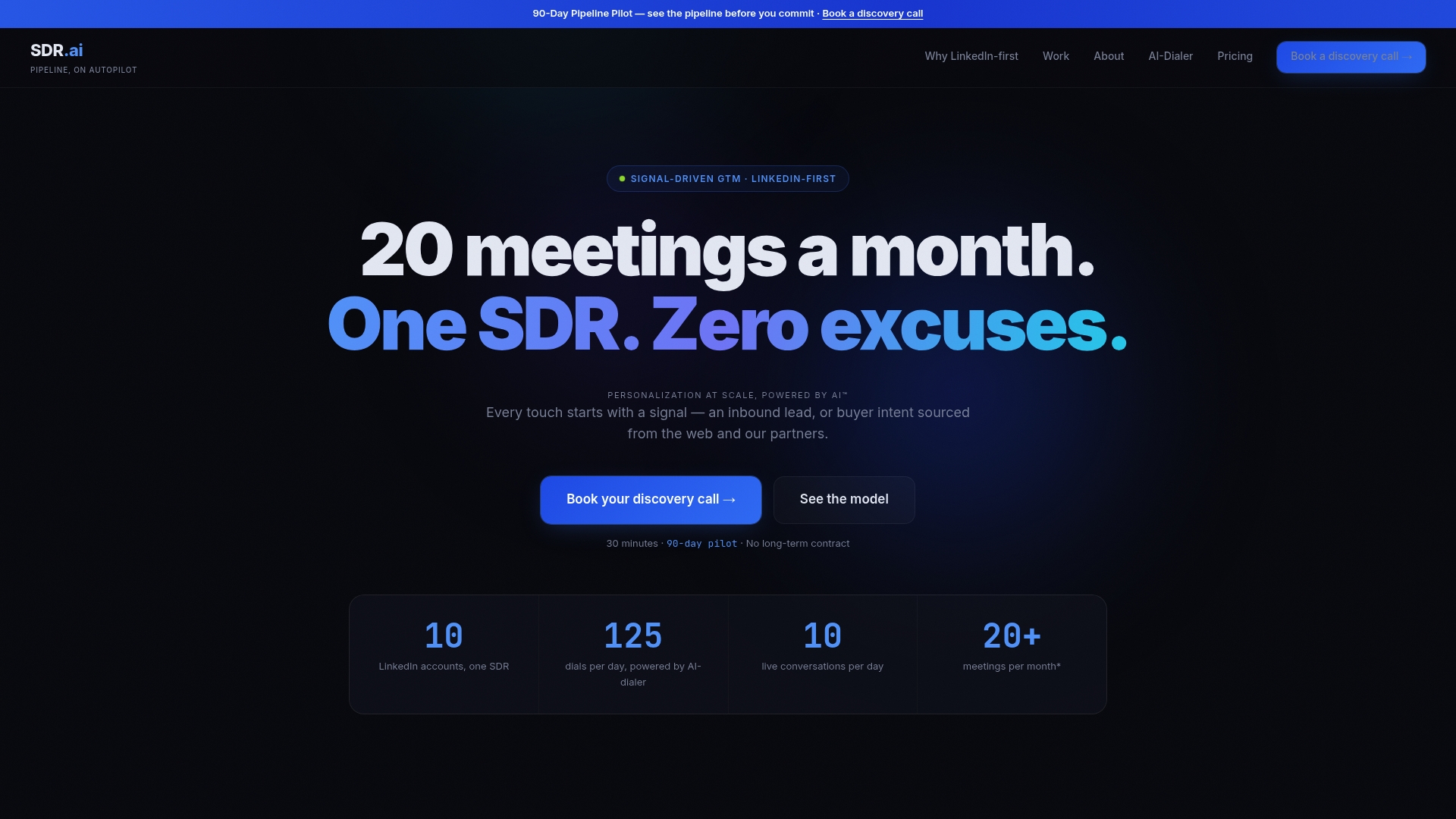
We built our AI-Powered Outbound service and AI-Dialer around the exact targeted-first logic this playbook describes, so you don't have to build the proof-and-scale system from scratch. If you'd rather run it yourself first, download Sdr for a runnable template, or book a demo to see how our Data · Digital · Dials engine handles the ICP validation step for you.
FAQ
What is the 3-3-3 rule in sales?
The 3-3-3 rule is a compressed outbound cadence: three touches across three channels (commonly LinkedIn, email, and phone) over three days. It is best suited for high-urgency triggers, like a funding announcement, where speed matters more than a slower, drawn-out sequence.
What should be in a sales playbook?
A sales playbook should document your ICP and personas, named plays for prospecting, qualification, follow-up, and closing, plus cadence templates, scripts, KPIs, and routing rules, according to Salesforce's playbook guidance. The goal is letting any rep execute consistently without improvising.
What are outbound sales strategies?
Outbound sales strategies are proactive outreach tactics, cold calling, cold email, and LinkedIn prospecting, aimed at prospects who haven't already engaged with you. The most reliable approach starts with a narrow, targeted test against a defined ICP before scaling volume, per the targeted versus high-volume outreach framework.
What is the 70/30 rule in sales?
There's no single authoritative source that fixes this exact split for every sales organization, so treat it as a rough guideline rather than a hard rule.
Sources
- High-Volume vs. Targeted Outreach for B2B Tech Founders
- Ultimate Sales Playbook: How to Create Your Own | Salesforce