
The single best move is a research-first opener built on one specific prospect signal, a one-line statement of relevance, and a single low-friction call to action. Skip the generic flattery and the multi-question close. A research-first opener gives sales teams a way to make outreach feel more relevant than a templated, name-only message.
TL;DR:
- Use one public professional signal, connect it to an outcome relevant to the prospect’s role, and make one ask instead of combining requests.
- Begin with a low friction question, offer a useful resource if the prospect stays silent, and reserve a meeting request for the second or third touch.
- Track acceptance, replies, booked meetings, and qualified meeting conversion separately; high acceptance paired with few replies points to a weak first direct message.
- A person should verify every factual claim in a message drafted with AI against current public information, especially before contacting enterprise accounts or senior executives.
- Test one variable at a time with comparable, sufficiently large groups, then scale the winner and move on rather than running parallel tests indefinitely.
Table of Contents
- What Hyper-Personalized LinkedIn Outreach Actually Means
- Why Personalization Drives Better B2B Reply Rates
- The Anatomy of a Message That Actually Converts
- Templates You Can Adapt Today
- Scaling Personalization with AI Without Losing Authenticity
- Measuring Results and Running Your First A/B Tests
- Mistakes That Signal "Automated" Instead of "Personal"
- Real Results and a Starter Experiment to Run Yourself
- Ethics and Compliance When Using AI for Outreach
- Human Review Versus Full Automation: Where the Line Should Sit
- How We Help You Scale Personalized LinkedIn Outreach
- FAQ
- Sources
What Hyper-Personalized LinkedIn Outreach Actually Means
Hyper-personalization goes beyond swapping in a first name or company. It means building the entire opening line around one specific, verifiable detail about the prospect: a recent post, a role change, a funding announcement, or a shared connection. Name-only personalization signals a mail-merge the moment a prospect reads it; hyper-personalization reads like a message from someone who actually looked at their profile.
This guide covers the three message formats where personalization carries the most weight on LinkedIn:
- Connection request notes, where space is limited
- First direct messages after a connection accepts
- InMail messages sent to prospects outside your network
LinkedIn-first outreach tends to outperform cold email when the prospect is active on the platform, posts regularly, or belongs to a tight professional community where mutual connections carry weight. Email still wins for high-volume, low-touch sequences, but LinkedIn's visible profile data makes genuine personalization far easier to execute at the individual level.
Why Personalization Drives Better B2B Reply Rates
Relevance builds credibility faster than any opening line about your product ever will. When a message references something true and current about the prospect's world, it signals research, not volume. LinkedIn's own guidance on personalized sales outreach states that effective personalization focuses on the recipient's needs, interests, and current situation rather than the sender's pitch, and that this focus increases engagement and replies.
Social proof compounds the effect. A message that mentions a shared connection, a mutual group, or a peer company you have worked with gives the prospect a reason to trust the outreach before they trust the offer. Teams building this kind of trust signal into outreach at scale often lean on tools like the ones Clareefai's guide to social selling describes for surfacing and showcasing customer proof points.
Three metrics tell you whether personalization is working: connection acceptance rate, reply rate, and meeting booking rate. LinkedIn's content on personalized outreach campaigns recommends anchoring openers and subject lines to recent news, achievements, or shared pain points specifically because curiosity drives the open and the reply. Track all three metrics separately. A high acceptance rate paired with a low reply rate usually means your connection note works but your first DM does not follow through on the signal you used to get in.
The Anatomy of a Message That Actually Converts
A high-converting LinkedIn message is built from five parts, each doing one job. Skipping any of them, or stacking too many asks into one message, is where most outreach falls apart.
- A specific signal. Pull from a recent post, a job change, a company funding round, a shared group, or a mutual connection. Public intent signals, such as a prospect engaging with content about a problem your offering solves, work especially well because they double as a reason the message is timely.
- A humanizing opener. Reference the signal in one sentence, written the way you would mention it in a real conversation, not the way a template would phrase it.
- A one-line value statement. Tie your reason for reaching out directly to an outcome this specific prospect's role or company would care about, not a generic feature list.
- A single call to action. Pick one: a question, a resource offer, or a meeting request. Never combine two.
- The right length and timing. Keep connection notes and first DMs concise. Timing messages for when the recipient is likely to be active may help them get noticed.
Useful sources for openers include recent posts and comments, role or company news, engagement with relevant content, and shared connections or groups. Mapping these signals to your Ideal Customer Profile before you start writing saves far more time than personalizing message by message; our guide to mapping ICP filters in Sales Navigator walks through building that filter set once and reusing it across a campaign.
CTA sequencing matters as much as CTA wording. Start with the lowest-friction ask (a question that invites a short reply), move to a resource offer if the first message gets silence, and save the direct meeting request for the second or third touch once some rapport exists.
Pro Tip: Write your opener as if you are leaving a voice note for a colleague, then cut it down. If it sounds stiff read aloud, it will read as templated on screen.
Templates You Can Adapt Today
These templates are starting points, not scripts. Swap in the real signal every time; the structure stays constant but the details should never repeat word for word across prospects.
- Connection note (engagement-based signal): "Saw your comment on [topic] in the [group/post] thread. I work with [role type] on exactly that problem and would like to connect."
- First DM (company event or role change): "Congrats on the move to [new role] at [company]. Teams in that seat usually hit [specific challenge] in the first few months. We've helped similar teams fix that without adding headcount. Worth a quick look?"
- Follow-up (later, resource CTA): "No pressure to reply. If it's useful, here's a short breakdown of how [peer company type] approached [challenge]. Happy to send it over."
- Follow-up 2 (one week later, direct CTA): "Circling back once more. If [challenge] is on your radar this quarter, open to a 15-minute call to compare notes?"
- Executive variant: Lead with the business outcome (revenue, retention, market position) rather than the operational detail. Executives respond to strategic framing, not feature depth.
- Practitioner variant: Lead with the specific operational pain point and reference a concrete workflow detail. Practitioners respond to proof that you understand their day-to-day.
Our case study on personalized LinkedIn messaging is available to read. Treat the results as specific to that case study, not a general guarantee.
Scaling Personalization with AI Without Losing Authenticity
Personalization agents are the current answer to the volume problem. Outreach's documentation on personalization agents describes tools that guide AI with prompts to automatically tailor emails, LinkedIn messages, and call talking points, then slot that tailored copy into existing templates and sequences.
The workflow that keeps this from feeling robotic has four steps:
- Signal capture: pull recent posts, role changes, funding news, and engagement data into one record per prospect.
- Templated prompt: feed that signal into a structured prompt that generates a draft opener, not a full message.
- Human review: a real person edits the draft for tone, accuracy, and anything that reads slightly off before it sends.
- Send and log: the message goes out through your sequencing tool, and the result feeds back into your signal data for the next round.
Guardrails matter more than the AI model you choose. Never let an agent reference a signal it cannot verify as current and public. Never let it fabricate a shared connection or a false sense of familiarity. And never let volume targets override the human review step entirely, since that is exactly where robotic phrasing slips through.
When evaluating a platform for this workflow, prioritize CRM sync so signals update automatically, enrichment data that refreshes on a schedule, and sequence controls that let a human pause or edit any message before it sends.
Pro Tip: Run every AI-drafted opener through a simple test: would you be comfortable if the prospect asked you directly how you knew that detail? If the honest answer is awkward, rewrite it.
Measuring Results and Running Your First A/B Tests
Track four numbers from the start: connection acceptance rate, reply rate, meeting booking rate, and qualified meeting conversion (the share of booked meetings that match your ICP criteria). These four together tell you whether personalization is working at each stage of the funnel, not just at the top.
- Test one variable at a time. Start with the opener (signal type A versus signal type B), then the CTA (question versus resource offer), then send timing (morning versus afternoon).
- Use a sufficiently large, comparable group for each variant before drawing conclusions. Small samples can swing substantially based on a few replies.
- Scale the winner, then retire the test. Once one variant clearly outperforms across acceptance and reply rate, roll it out fully and move to the next variable rather than running parallel tests indefinitely.
- Space follow-ups and limit the number of total touches after the initial message. Repeated follow-ups can become counterproductive.
Mistakes That Signal "Automated" Instead of "Personal"
A few habits reliably tank reply rates, and all of them are easy to fix once you know to look for them.
- Referencing private or inferred details (guessing at personal circumstances) instead of publicly available, verifiable signals.
- Using first-name-only personalization and calling it done; it reads as templated the moment the rest of the message is generic.
- Packing three asks into one message (a question, a resource offer, and a meeting request together) instead of picking one clear CTA.
- Over-personalizing to the point of sounding like surveillance, such as referencing a prospect's vacation photos or personal posts unrelated to their professional context.
- Sending the same opener structure to every prospect in a list, which defeats the purpose of hyper-personalization even when each detail is technically unique.
The fix in every case is the same: pick one professional, public, timely signal, write one clear value line, and ask for one thing.
Real Results and a Starter Experiment to Run Yourself
LinkedIn-first, research-first outreach has produced measurable reply gains in practice. Our benchmarking post on AI sales outreach and our five-step process for Series A and B startups are available to read.
A simple pilot to validate the approach yourself:
- Select prospects matching your ICP and split them evenly into two groups.
- Send Group A generic, name-only personalized messages and Group B hyper-personalized, signal-based openers.
- Track acceptance rate, reply rate, and meeting booking rate separately for each group over a suitable period.
- Compare results before scaling whichever approach wins to your full outreach list.
Ethics and Compliance When Using AI for Outreach
AI-assisted personalization raises real questions about what is fair game and what crosses a line. The core principle is simple: use only information the prospect has made public, either on their LinkedIn profile, in posts, or in company announcements. Scraping private data, inferring sensitive personal details, or purchasing enriched data of unclear origin creates both an ethical problem and a compliance risk depending on your jurisdiction's data protection rules.
Transparency matters too. A message should never imply a relationship or familiarity that does not exist, such as suggesting a referral that never happened. If AI drafted part of a message, a human should still verify every factual claim in it before it sends, since an AI model can occasionally misstate a detail (the wrong company, an outdated role) that damages credibility the moment the prospect notices.
Respect LinkedIn's own platform rules on connection request volume and automation, since violating them risks account restrictions that undermine the entire outreach effort. When in doubt about whether a data source or automation method is appropriate, the safer path is to default to publicly visible, directly sourced information and keep a human in the loop on anything sent at scale.

Human Review Versus Full Automation: Where the Line Should Sit
Full automation works for high-volume, lower-stakes prospecting where a wrong detail costs little. It stops working the moment the target is an enterprise account or a senior executive, where one inaccurate reference can end the relationship before it starts. Those messages deserve a human's eyes before they send, every time.
Managed AI-enabled outreach earns its cost when a team cannot reliably staff that human review step at the volume their pipeline needs. For teams weighing in-house automation against a managed service, the deciding factor is usually whether they have someone with the bandwidth to review drafts daily. If not, a managed approach protects the authenticity that makes personalization work in the first place.
— Chad
How We Help You Scale Personalized LinkedIn Outreach
We built our AI-Powered Outbound service for Series A and B startups and sales teams stretched too thin to personalize every message by hand. We combine signal-driven targeting with LinkedIn-first outreach, and a human SDR on our side reviews and handles every reply, so the research-first approach in this guide runs at full volume without losing the authenticity that makes it work.
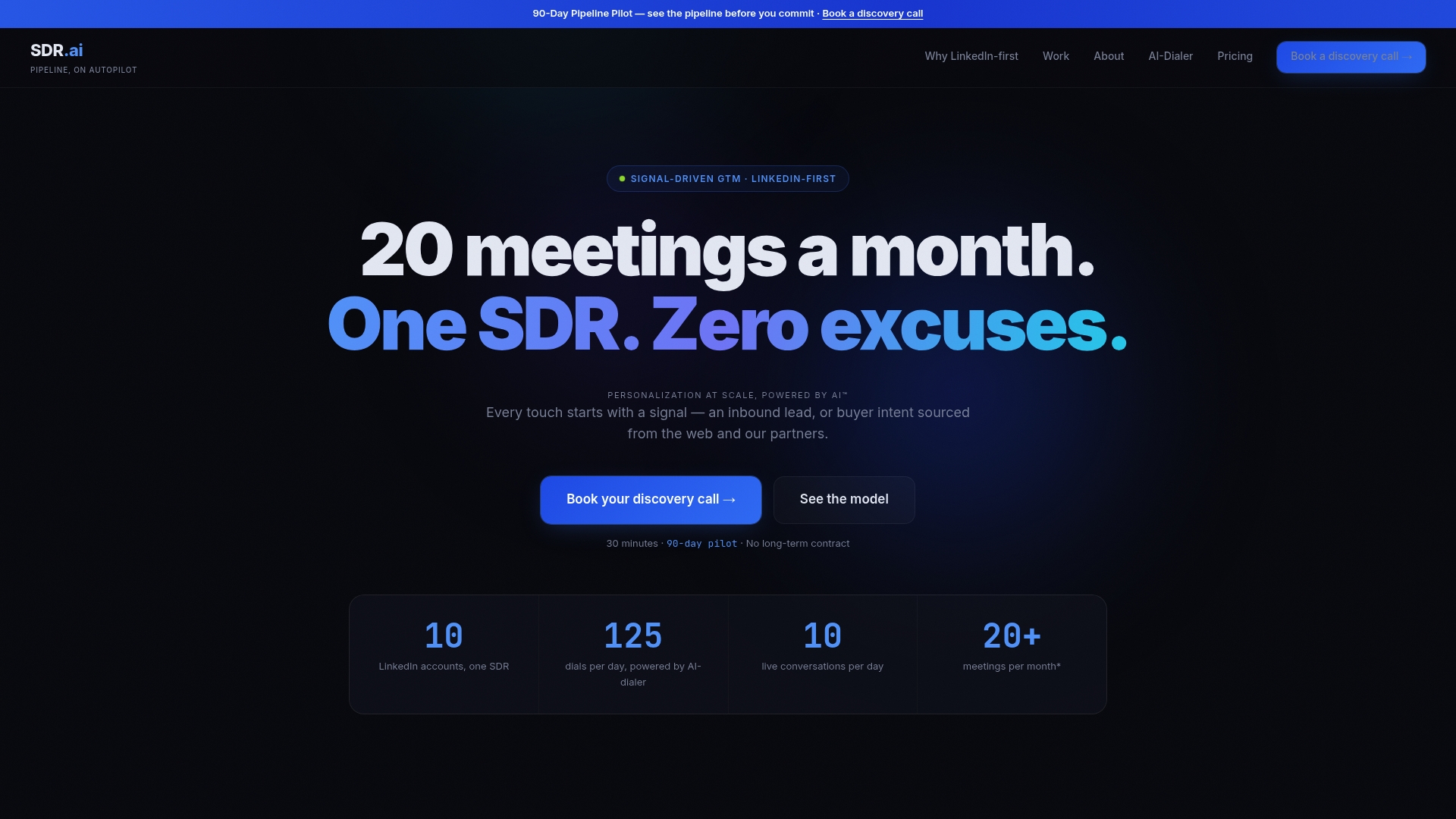
If you want to see the methodology before committing, our Sdr walks through the playbook in full. When you are ready to see it running on your own ICP, book a demo and we will show you the math.
FAQ
What is the 3/2/1 rule on LinkedIn?
The 3/2/1 rule is a content posting guideline suggesting three engagement actions (likes or comments on others' posts), two original posts, and one piece of outreach per day to build visibility before prospects receive a direct message. It is a social selling habit, not a strict outreach script, and definitions of the exact ratio vary by source.
What is the best way to do LinkedIn outreach?
The most effective approach combines a research-first opener built on one specific, verifiable signal with a single clear call to action, rather than a generic or multi-ask message. LinkedIn's own guidance recommends focusing on the recipient's current situation and needs to drive stronger engagement and reply rates.
What happens when you reach 1,000 connections on LinkedIn?
Reaching a large number of connections does not change your account's functionality, but LinkedIn stops displaying your exact connection count and shows "500+" instead well before that point. It is primarily a visibility and credibility signal to prospects viewing your profile rather than a functional milestone.
What is the 95/5 rule on LinkedIn?
The ratio is a widely cited social selling heuristic rather than an officially documented LinkedIn policy, so treat the exact ratio as directional.