
Firmographics tell you which companies could buy from you. Intent data tells you which of them may be ready to buy now. Firmographics are the filter, intent is the sorting layer on top, and the teams that book the most meetings use both, in that order. The rest of this guide shows what each one is, where each one fails, and how to put them together in a workflow a small sales team can run.
TL;DR
- Firmographics describe what a company is: industry, size, revenue, location. They define your market and your ideal customer profile (ICP).
- Intent data describes what a company is doing: researching a topic, comparing vendors, visiting your pricing page. It points to timing.
- Firmographics change over quarters or years. Intent changes over days or weeks, so it goes stale fast.
- Use firmographics first to build the list, then intent to decide who gets contacted this week.
- Neither tells you who to talk to. You also need accurate contact data for the buyer inside the account.
Table of Contents
- What firmographic data is
- What intent data is
- Intent data vs. firmographics at a glance
- Where each one breaks down on its own
- How to combine them: a four-step workflow
- Choosing an intent data source
- A worked example
- Our perspective
- Put fit and intent to work with us
- Common mistakes to avoid
- FAQ
- Sources
What firmographic data is
Firmographic data is the company-level version of demographics. Firmographic data classifies organizations the way demographic data classifies people, using attributes such as industry, size, revenue, location and ownership structure. Its job is to answer one question: does this account fit our ICP?
Typical firmographic fields:
- Industry or vertical (often coded to a standard system such as NAICS, which has 20 broad sectors in the US)
- Employee count and headcount growth
- Annual revenue or funding stage
- Headquarters and office locations
- Ownership structure: public, private, venture-backed, subsidiary
Because these are mostly recorded facts, they are stable. Firmographics change slowly, over quarters to years, which makes them reliable and cheap to keep current. It also means they say nothing about whether a company is shopping this month.
Firmographic data usually comes from public filings, state registries and third-party databases. In practice, most teams pull it through a LinkedIn filter set or a data provider and refresh it on a schedule.
What intent data is
Intent data is behavioral evidence. It shows that a company is researching a topic, a product category or a competitor, based on content consumption, searches, review-site activity and visits to your own website.
It comes in two kinds:
- First-party intent is behavior on properties you own: a pricing-page visit, a demo request, a repeat visit to a comparison page, a reply to an email.
- Third-party intent is behavior across the wider web, usually gathered by publisher co-ops and review sites and resolved to a company.
There is a third family that many outbound teams under-use: social and professional signals. A new VP of Sales hire, a funding round, a job posting for an SDR, or a founder commenting on a post about outbound problems all say something about timing. If you want a concrete picture of what software-buying signals look like in the wild, this example of first-party and third-party intent signals shows how one team read interest from content behavior aimed at a single job title.
Intent data vs. firmographics at a glance
| Firmographics | Intent data | |
|---|---|---|
| Question answered | Does this company fit our ICP? | Is this company in a buying window? |
| What it describes | What a company is | What a company is doing |
| Typical fields | Industry, size, revenue, location | Topic research, site visits, review-site activity |
| Speed of change | Quarters to years | Days to weeks |
| Main strength | Stable, verifiable, easy to filter | Shows timing and priority |
| Main weakness | No signal of timing | Noisy, decays quickly, often account-level only |
| Best used for | Building the target universe | Ranking and sequencing accounts |
The split is simple enough to repeat in a meeting: firmographics draw the outer edge of a market, and intent indicates whether an account sits in a buying window.
Where each one breaks down on its own
Firmographics alone: right company, wrong moment
If you sell only on firmographics, every account in your ICP looks equally good all the time. A list of 3,000 Series A software companies is a market, not a pipeline. Reps work it top to bottom, send the same message to everyone, and most of those accounts are not looking. You end up with low reply rates and a team that blames the list.
The upside is that firmographic errors are easy to spot and fix. An employee count is off, or a company was acquired. These are quick corrections.
Intent alone: a surge with nobody behind it
The opposite mistake is chasing every spike. Third-party signals are noisy, and a surge may have no real buyer behind it. One figure worth knowing: in a 2024 audit of 47 deployments, topic-based third-party intent had a median precision of 0.51, while first-party intent carries high confidence. In plain terms, roughly half of the flagged accounts were not true positives.

Intent without firmographics has a second problem: you may chase interested companies that can never become good customers. A five-person agency researching enterprise sales tooling is showing intent, but not buying intent you can serve. One practitioner write-up puts it well: poor firmographic data means intent signals get applied to the wrong organizations, and the signal is wasted.
Both together, and still missing a layer
Even a perfect fit-plus-timing list does not tell you whom to message. Intent often lacks the person-level detail needed for outreach, so you need a third layer of accurate contact data to reach decision-makers. A target stack without that third layer tends to look functional on a spreadsheet but fail during CRM execution.
How to combine them: a four-step workflow
1. Define the ICP in firmographic terms
Write the ICP as filters, not adjectives. For example: US-based B2B software companies, 20 to 200 employees, Series A or B, with a sales leader already hired. Then translate each filter into something your data source can actually apply. We cover the translation for LinkedIn in our guide to mapping your ICP to Sales Navigator filters.
2. Pick two or three intent signals you can verify
Start narrow. Good first signals for outbound teams:
- A visit to your pricing or comparison page (first-party)
- A leadership hire in the function you sell to
- A funding announcement that makes budget likely
- Engagement with content on the exact problem you solve
- Research on your category or a competitor via a third-party feed
More signals are not better. Each one needs a rule for what it means and how long it stays valid. A pricing-page visit might be worth a same-day touch. A funding round might stay relevant for a few weeks.
3. Score accounts in tiers
A simple three-tier model beats a complex scoring formula that nobody trusts:
- Tier 1: fits the ICP and shows a strong, recent signal. Personal outreach this week.
- Tier 2: fits the ICP and shows a weak or older signal. Light-touch sequence.
- Tier 3: fits the ICP, no signal. Stay in the nurture pool and check again on a schedule.
Accounts that do not fit the ICP leave the list, however loud their signals. Our post on fit, intent and timing goes deeper on how to turn those tiers into booked meetings.
4. Test contact coverage before you commit
This is the step most teams skip. Take 100 ICP accounts that your intent source flagged and check how many have a verified, reachable decision-maker. Testing providers on target accounts and measuring contact return rate tells you more than any demo. If you can only reach a third of the flagged accounts, your effective intent coverage is a third.
Then protect the list. Bounces and stale titles quietly erode results, so track them after every send, as we explain in our piece on keeping B2B contact data clean. Once contacts are right, the message matters: a clear, specific opener beats a long pitch, and these email templates that get responses show how short and direct a good first touch can be.
Choosing an intent data source
Not all intent data is built the same way, and how a vendor makes money shapes what you get. Forrester groups intent providers into four models:
- Traditional providers selling standalone feeds
- ABM platform providers with intent inside a larger software suite
- Campaign execution firms that bundle data with services
- Walled gardens with exclusive data from sites they own
A practical consequence: a standalone feed gives you flexibility but needs your team to act on it. A bundled service acts for you but ties the data to that vendor's campaigns. Walled-garden data can be high quality but covers only one audience.
If you already use one source and want another, Forrester suggests looking for datasets that are at least 30 to 40% unique compared with what you have. Otherwise you are paying twice for the same signals.
Forrester also argues that using intent analytics only for early-stage discovery leaves revenue on the table. Signals matter in open deals too: a stalled opportunity whose champion suddenly researches a competitor deserves attention.
A worked example
Imagine a founder selling a developer-security tool to US software companies.
- Firmographic filter: software companies, 50 to 300 employees, Series A or B, US-based. This yields roughly 1,800 accounts.
- Intent layer: the team watches three signals: a new head of security or engineering hire, visits to its comparison page, and public posts about a compliance deadline. About 90 accounts show at least one signal this month.
- Tiering: 15 accounts show two or more signals and become Tier 1. The rest go to a lighter sequence.
- Contact check: the team finds a verified decision-maker at 12 of the 15 and handles the other three manually.
The founder is now working 12 well-timed conversations instead of mailing 1,800 strangers. The numbers are illustrative, not a benchmark, but the shape of the funnel is the point: wide filter, narrow signal, verified person.
Our perspective
We run outbound for B2B tech companies every day, and the pattern we see is consistent: teams that treat firmographics and intent as rivals waste one or the other.
Firmographics are your ICP. We never contact an account that fails that test. Intent is how we decide who goes first, and a human SDR then handles every reply, because a signal only becomes a meeting when a real conversation follows.
That is why our approach is LinkedIn-first and signal-driven. We focus only on the ICP and the intent signals around it, which keeps outreach relevant and keeps the pipeline math simple enough for a founder to check. We built it so a startup can get a working outbound motion without hiring and ramping an in-house SDR team.
If you want the longer version of how fit, signals and AI outreach fit together, read our guide to booking more meetings with intent data, ICP fit and AI outreach.
Chad
Put fit and intent to work with us
If you are a founder or sales leader who wants this workflow running without building the team first, our AI-Powered Outbound service is built around it: ICP filtering, intent-based prioritization, personalized LinkedIn-first messaging and multichannel follow-up, with a human SDR handling every reply. It costs $2,500 per month plus a one-time $500 setup fee.
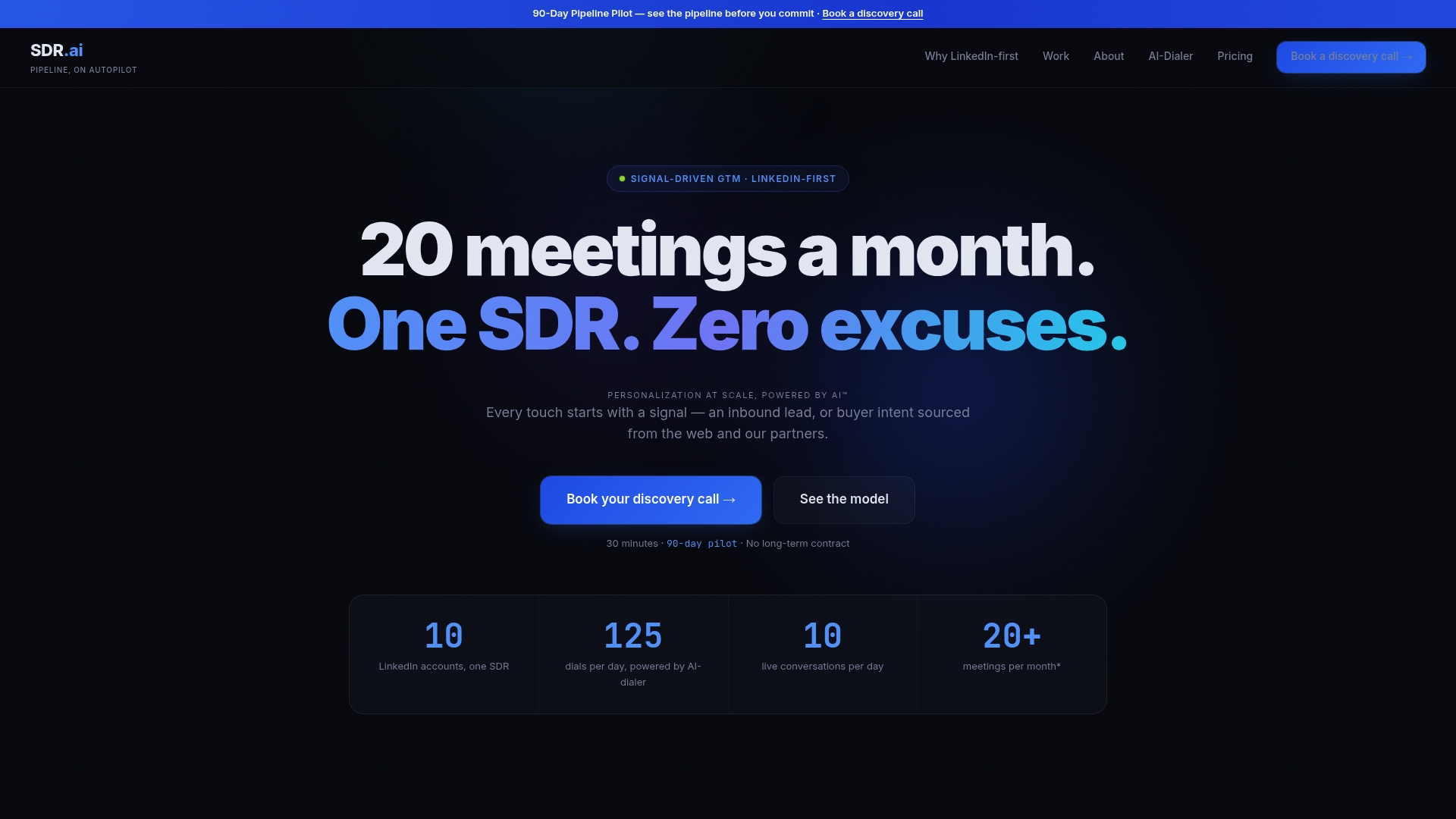
If your team already has reps and needs a faster way to work warm accounts, our AI Dialer is available at $2,400 per year with a one-time $500 onboarding fee. Prefer to build your own engine? The SDR.ai Blueprint lays out the model, playbooks and math.
Common mistakes to avoid
- Buying intent before defining the ICP. Without fit filters, you pay for signals about companies you cannot win.
- Treating every signal as equal. A pricing-page visit and a generic topic surge are different events. Weight them differently.
- Letting signals age. Intent changes over days to weeks. A rule that keeps a two-month-old signal in Tier 1 will cost you replies.
- Ignoring first-party data. Your own site, email and LinkedIn engagement is the highest-confidence intent you have, and it is free.
- Sending the same message to everyone. The signal should show up in the opener. Our guide to AI personalization at scale shows how to do it without hand-writing every note.
- Skipping qualification. A signal gets you a conversation; a framework decides whether it is a real opportunity. See our lead qualification frameworks by deal size.
FAQ
Is intent data better than firmographic data?
Neither is better, because they answer different questions. Firmographics tell you whether a company fits your ICP, and intent tells you whether it may be buying now. Start with firmographics to build the list, then use intent to decide the order of outreach.
What is an example of firmographic data?
An example is a record such as "B2B software company, 120 employees, Series B, headquartered in Austin, Texas." Industry, headcount, revenue, location and ownership structure are the standard fields. They describe the company itself, not its behavior.
What is the difference between firmographic and demographic data?
Demographics describe people through attributes such as age, income and education. Firmographics describe companies through industry, size, revenue and location. In B2B you usually need both: firmographics to pick the account, and role or seniority data to pick the person.
How fresh does intent data need to be?
Fresher than most teams assume. Intent changes over days to weeks, while firmographics change over quarters to years. Set an expiry for each signal type, and drop or downgrade accounts when the signal passes it.
Can a small team use intent data without a big budget?
Yes. Start with first-party signals you already own, such as pricing-page visits and email replies, plus public triggers like hires and funding. Add a paid third-party feed only after you have tested that it returns reachable contacts for your ICP accounts.
Sources
- Firmographic Data (Clay glossary)
- Industry Classification Overview (U.S. Bureau of Labor Statistics)
- Firmographic vs. Technographic vs. Intent Data (SalesIntel)
- Intent Data vs. Firmographic Data: What They Are, When to Use Each (Datalane)
- Firmographic vs. technographic vs. intent data (Vector)
- What Type Of Intent Data Provider Is Best For Your B2B Business (Forrester)
- B2B Marketers: Are You Getting Everything You Can Out Of Intent Data (Forrester)
- CustomerScore case study
- Email Templates That Actually Get Responses