
LinkedIn event outreach works when you treat it as one-to-one selling, not as a broadcast. You warm up a named list of buyers, invite them personally, and follow up on a schedule that matches how people actually register. If your event exists to create pipeline, the goal is not registrations. It is the right accounts in the room and a conversation afterward. That is also the kind of targeted, signal-led LinkedIn outreach we run for B2B companies at SDR.ai, with a human SDR handling every reply.
TL;DR
- Build a list of named prospects first, warm them with useful content, then invite them personally. Broad promotion alone fills seats with the wrong people.
- Concentrate your invitations and follow-ups in the last week before the event: platform data shows nearly half of registrations land then.
- Personal invitations convert far better than posts from a company page. Use founders' and speakers' own profiles.
- Judge success by target accounts that attended and talked to you, not by total registrations.
- Plan for no-shows and book the follow-up conversation before the event ends.
Table of Contents
- What LinkedIn event outreach actually is
- Step 1: Build the list before the event page
- Step 2: Warm up before you ask
- Step 3: Find the right people to invite
- Step 4: Write the invitation
- Step 5: Time your follow-ups to when people register
- Step 6: Add ads only after the outreach works
- How to measure whether it worked
- Why a small team struggles with this
- Getting the outreach done for you
- FAQ
- Sources
What LinkedIn event outreach actually is
LinkedIn event outreach is the set of things you do to get specific people to register for, and show up at, an event you host on LinkedIn or promote there. The event can be a webinar, a panel, a fireside chat or an in-person dinner.
LinkedIn gives organizers free event pages, member invitations, Event Ads and LinkedIn Live. Members can register in the feed with one click using their prefilled profile data. That low friction is the good news. The bad news is that low friction also makes it easy to collect registrants who will never buy.
For a founder or a small sales team, the useful way to think about it is in three layers:
- Reach: the event page, ads and posts that make the event visible.
- Outreach: direct messages and personal invitations to people on your ideal customer profile (ICP), meaning the type of company and role you sell to.
- Follow-up: the conversations before and after that turn attendance into meetings.
Most guides spend their time on layer one. Layers two and three are where a small team gets pipeline.
Step 1: Build the list before the event page
Start with 50 to 100 named prospects, not an audience. A named list lets you personalize, and it lets you tell afterward whether the event worked.
How to build it:
- Start from your ICP. Write down the company size, industry, funding stage and the two or three job titles that buy or influence the purchase. A niche is an advantage here: a tight definition produces a short, high-quality list.
- Add signals. People who recently changed jobs, commented on posts about the problem you solve, or work at companies that just raised money are warmer than a cold title match. These are intent signals, and they are the difference between an invitation that feels relevant and one that feels random. Our guide to LinkedIn prospecting with AI walks through how we approach it for Series A and B startups.
- Use last year's attendees and customers. If you have run events before, past attendee companies are the best seed list. One LinkedIn ads specialist reports that matching on past attendee company lists works at higher rates than contact lists, which is useful if you later add paid promotion.
- Include the speakers' networks. LinkedIn's own events guide suggests adding speakers to the event's about section so their connections are notified, and asking your sales team to share the event with customers using an invitation template.
Where this goes wrong: lists built from a title filter alone. Twenty VPs of Engineering at companies that cannot buy from you is worse than ten who can. Cut the list until each name has a reason to be there that you could say in one sentence.
Step 2: Warm up before you ask
The pattern that keeps showing up in event marketing case studies is "warm before you ask." A LinkedIn case study on Siemens' Hannover Messe 2026 promotion, as reported by an events marketing agency, found that a staged program of awareness content first, then a registration ask only to engaged audiences, delivered 3.2x more leads at a 39% lower cost per lead than the year before. The same write-up describes a four to six week warm-up of expert posts and short video.
You are not Siemens, and you do not need ads to apply the idea. For a startup it looks like this:
- Weeks 4 to 6 before: the founder and speakers post about the problem the event covers: a short video, a carousel, a real number from your own work. Reply to comments within the day.
- Weeks 2 to 3 before: view and engage with your named prospects' posts. Comment with something substantive. Send connection requests with a short, specific note if you are not yet connected.
- Week 1 before: the personal invitations go out (Step 4).
Personal profiles matter more than your company page here. One 2026 guide estimates that personal profiles generate roughly 8x the engagement of company pages, and that LinkedIn's feed now favors native video and carousels over posts that just drop a link. If you want a deeper look at building reach without paid spend, this piece on how to maximize organic reach for your business covers the principles.
Your profile is the landing page for every invitation you send. Before outreach starts, check that your photo, headline and featured section say what you do and who for. A clear, current photo helps: this LinkedIn headshot guide explains what makes one work.
Step 3: Find the right people to invite
The question "how do I find the right attendees" has two good answers, and you should use both.
People who already show interest. Anyone who engaged with your warm-up posts, viewed your profile, or interacted with a speaker's content is a lead worth a personal note. Keep a running sheet of these names with the date and what they did.
People who fit but have not met you yet. These come from your ICP list. Prioritize by signal: a recent role change, a post about the topic, a hiring spree in the function you serve. This is where manual work gets heavy. Researching 100 people well takes hours, and the research is the part that makes an invitation read as personal rather than templated. It is also the part we take off founders' hands in our AI-Powered Outbound service: we handle LinkedIn-first outreach based on the ICP and intent signals, with a human SDR handling every reply.
A useful filter before you send anything: would this person recognize themselves in the event description? If the topic is data security for fintech and the prospect runs HR at a retailer, skip them.
Step 4: Write the invitation
A good invitation is short and specific. One 2026 template guide lists five traits shared by the best-performing event invitations: a subject that names a specific outcome, a relevant first sentence, a one-to-three line summary with date and place, one piece of social proof, and a single call to action. That matches what we would tell a founder.
Here is a version for a webinar, sent as a direct message to a connection:
Hi Dana, I saw your post on moving from founder-led sales to a first sales hire. On Thursday, three Series A founders will share what they changed in their outbound after hiring. 45 minutes, with live Q&A. Want me to hold you a seat?
What makes it work:
- One reference to them. A recent post, a job change, a shared topic. Not their name and company dropped into a template.
- One reason to come. The outcome, not the agenda.
- One ask. A seat, a yes, a link. Not three options.
- No pitch. The event is the offer. The sales conversation happens afterward.
Two cautions. First, do not paste the same message to 100 people with a mail-merge field. LinkedIn readers spot it instantly, and it risks your account standing. Our guides on avoiding spammy outreach and what safe LinkedIn automation looks like explain where the line sits. Second, think about message type: whether a direct message or an InMail suits a given prospect is covered in our comparison of LinkedIn InMail vs message.
For more on making each message feel written for one person, see our approach to LinkedIn outreach personalization: one real signal per message, reviewed by a human.
Step 5: Time your follow-ups to when people register
Most founders start promoting two months out and then go quiet. The data says to do the opposite with your direct outreach.
A 2026 webinar benchmark covering more than seven million registrations found that 49.7% of registrations happened in the final week, only 16.4% three or more weeks out, and 15.3% on the event day itself. Treat that as a pattern for webinars specifically, but it fits what most B2B marketers see: people decide late.
A practical cadence:
| When | Message | Goal |
|---|---|---|
| 7 days before | Personal invitation to the named list | First registrations |
| 3 to 4 days before | Follow-up with one new reason to attend: a speaker, a question they will answer, a customer example | Convert the undecided |
| Day before | Short reminder to registrants with the link and start time | Reduce no-shows |
| Event day | Heads-up to registrants one hour before | Attendance |
| Within 24 hours after | Thank-you with recording and one relevant question | Open a conversation |
| 3 to 5 days after | Specific follow-up to people who attended or engaged | Book a meeting |
The last two rows are where the money is. The event is a reason to talk, not the end of the process. Someone who attended and asked a question has told you what they care about, so your follow-up can refer to it directly.
Plan for no-shows
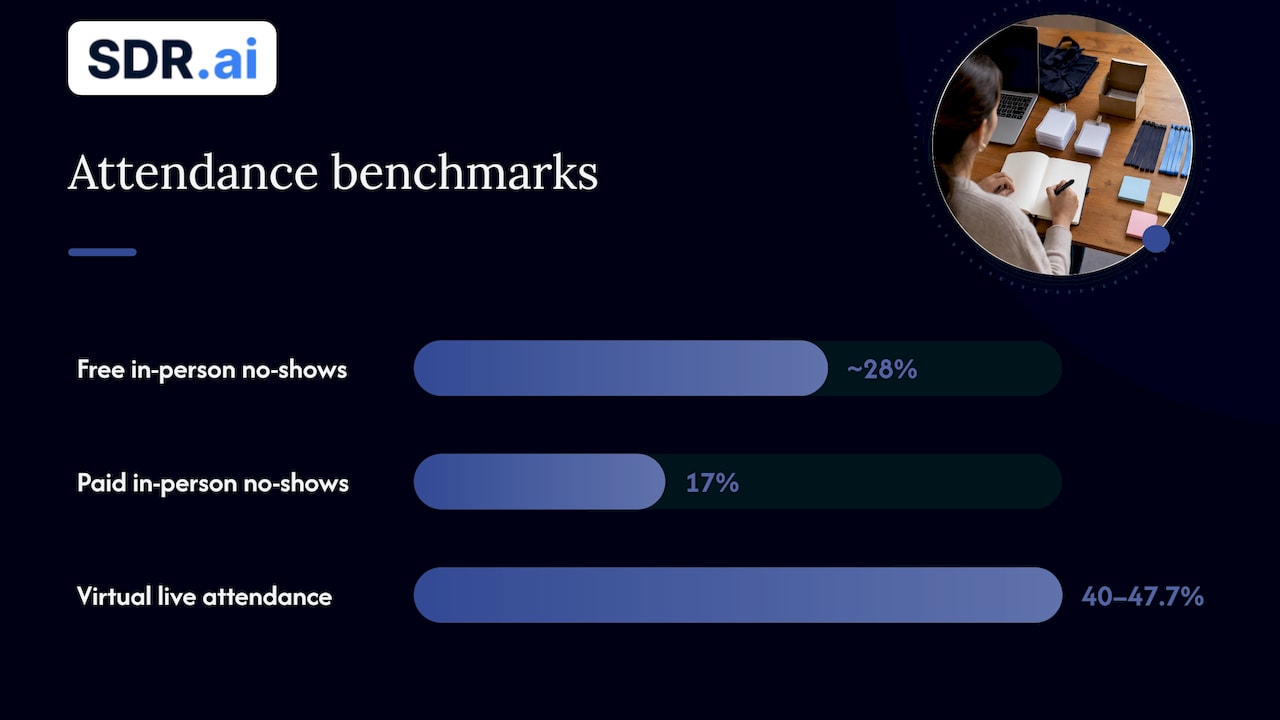
Registrations are not attendance. A 2026 events data report, as cited in one event-marketing plan, found median no-show rates of about 28% for free in-person events and 17% for paid ones, and live attendance for virtual events in the range of 40% to 47.7% of registrants. So if you want 40 people live, aim for noticeably more registrations, and send the recording to everyone who did not make it. A recording is a second chance for a personal follow-up.
Step 6: Add ads only after the outreach works
Paid promotion is a multiplier, not a substitute. LinkedIn's own figures, cited in a 2026 guide, say companies that promote events with Event Ads see about 31x more livestream viewers and 4x more registrations than those that do not. Registration data can flow straight into your CRM through the Lead Generation Objective, which saves manual exports.
If you do run ads:
- Target the same named accounts you are messaging, so a prospect sees the ad and the personal note as one campaign.
- For in-person events, target the event city. The B2Linked analysis recommends recent or permanent location targeting and retargeting people who interacted with the ads after the event.
- Expect modest click rates. A 2026 benchmark report puts the average click-through rate for LinkedIn event ads at 0.55%, which is above single-image ads at 0.42% and video ads at 0.24%.
A reminder on the ask: ads that request registration from a cold audience work worse than ads shown to people who already know you. That is the warm-up logic again.
How to measure whether it worked
Total registrations flatter you. They do not tell you whether you sold anything. Track these instead:
- Qualified attendance: how many people from your named list or ICP actually attended.
- Conversations started: replies, questions in chat, and messages after the event.
- Meetings booked with ICP accounts.
- Opportunities created and pipeline influenced over the following months.
One agency recommends reporting at 30, 90 and 180 days, because event-sourced deals close later than outbound ones. A second source suggests judging success by which target accounts registered, attended, engaged afterward and moved toward pipeline, rather than total registrations, and reaching interested registrants through more than one channel.
Peer-to-peer sharing is also worth tracking. A 2026 benchmark found that 31.72% of social shares by event stakeholders converted into registrations, and 37% for direct personal invitations, with LinkedIn the top channel for peer shares. In practice: ask your speakers and your own team to invite people they actually know, and count those registrations separately.
Why a small team struggles with this
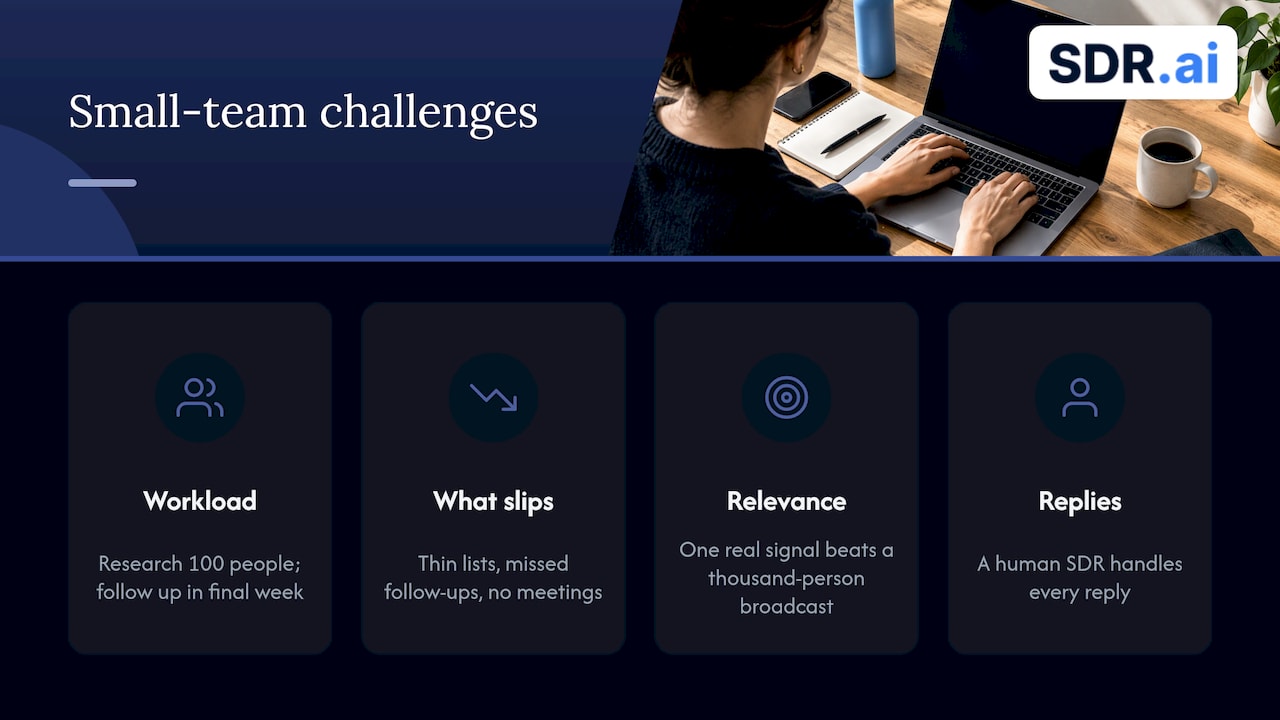
None of the steps is complicated. The trouble is volume and timing. You need research on a hundred people, personal messages that do not sound like templates, a tight follow-up schedule in the final week, and fast replies to everyone who answers. That is a part-time job for several people, landing in the busiest week of an event, when the founder is also preparing to speak.
What tends to happen is that the invitation list gets thin, follow-ups slip, and the post-event meetings never get booked. The event looks fine on a registration report and produces little pipeline.
What we think
We run LinkedIn outreach for B2B companies every day, and the lesson that carries over to events is simple: relevance beats reach. An invitation that references one real signal about one real person will outperform a broadcast to a thousand.
Our model is LinkedIn first. We focus on the ICP and on intent signals, and a human SDR handles every reply, because the reply is where the conversation either starts or dies. Event outreach is the same discipline with a date attached: pick the right people, say something specific, follow up at the right time.
Founders usually do not have time to do that research and follow-up at the pace it needs. That is the gap we are built to close, without asking you to hire and ramp an in-house SDR team.
Chad
Getting the outreach done for you
If you would rather spend your event week preparing to speak than researching prospects and answering replies, our AI-Powered Outbound service is built for that. It costs $2,500 per month plus a one-time $500 setup fee. We run targeted LinkedIn outreach with personalized messaging to your ICP and follow up across channels, and a human SDR handles every reply.
If you would rather build the process yourself, The SDR.ai Blueprint is our playbook for setting up an outbound engine. For teams that also do calls, the AI-Dialer is available at $2,400 per year with a one-time $500 onboarding fee.
FAQ
What is the best way to promote an event on LinkedIn?
Combine personal outreach with the event page. Build a named list of ICP prospects, warm them with posts from founders and speakers, then send personal invitations in the final week. Add Event Ads once the outreach is running, aimed at the same accounts.
How far in advance should I start?
Start content four to six weeks out, but concentrate your direct invitations and follow-ups in the last week. Webinar platform data shows nearly half of registrations arrive then, so a late push is normal rather than a sign of failure.
Does LinkedIn outreach work for events?
Yes, when the invitations are personal. Benchmarks suggest direct, personal invitations convert better than general shares, and LinkedIn is the leading channel for peer invitations. Mass-templated messages are what hurt response and put your account at risk.
How many people should I invite?
Start with 50 to 100 named prospects who fit your ICP and show a signal of interest. A smaller, well-researched list will give you more qualified attendees than a large one, and it is small enough to follow up with one by one.
Sources
- Event Management Use Cases, LinkedIn | Microsoft Learn
- LinkedIn Ads for In-Person Events Promotion, B2Linked
- Promote B2B Events on LinkedIn: Registration & Ads Guide, Converve
- Event lead generation lessons from Siemens on LinkedIn, UBE Marketing
- Peer-to-Peer Event Marketing: 2026 Playbook & Benchmarks, Snöball
- Event Invitation Templates, Attendir
- How to run a webinar on LinkedIn, Livestorm
- LinkedIn Event Ads Guide 2026, ZenABM
- Event Marketing Plan Template + 10-Week Timeline, Christoph Olivier Consulting