
Outbound lead scoring ranks accounts you chose to contact, before they have shown any interest in you. Inbound scoring reacts to what a lead does. Outbound scoring has to predict who is worth a call, who is worth waiting for, and who to skip. The best models score fit first, add intent and timing second, and route accounts into clear tiers. At SDR.ai, a human SDR handles every reply from signal-driven LinkedIn outreach to your ideal customer profile (ICP), so scoring turns into booked meetings and not a spreadsheet nobody acts on.
TL;DR
- Outbound scoring starts with fit (does this company and person match your ICP?), because you cannot score behavior that has not happened yet.
- Keep fit and intent as two separate scores. Fit decides who deserves attention. Intent decides when to reach out.
- Intent signals decay. Re-score weekly and give older signals less weight.
- Set three or four tiers with a specific action for each, not a single "hot" cutoff.
- Test the model against closed deals every quarter. If your top band does not convert clearly better than your middle band, retune it.
Table of Contents
- How outbound scoring differs from inbound scoring
- Why fit comes first in outbound
- Choosing intent and timing signals
- A worked example of an outbound score
- Setting thresholds and routing
- When your data is thin or your market is niche
- Measuring whether the scoring works
- From scores to booked meetings
- Our perspective
- Getting scored accounts into conversations
- FAQ
- Sources
How outbound scoring differs from inbound scoring
Inbound lead scoring assigns points to people who already raised a hand: a form fill, a pricing-page visit, a webinar signup. The lead arrives with behavior attached, so the score mostly measures engagement.
Outbound starts from the other side. You build a list from an ICP, and most of those people have never heard of you. There is little or no behavior to count. The score has to answer three questions:
- Fit: Does this person and company match the buyers who actually close?
- Intent: Is there evidence they are looking, or that something changed that makes now a good time?
- Reachability: Can you actually get a conversation with them?
The research backs this split. A 2026 narrative review of AI-enabled lead temperature treats profile fit, engagement, buying intent, authority and timing as distinct dimensions, and argues that no single dimension is enough. It also describes readiness as a state that can rise or fall over time. Fit and authority are relatively stable. Engagement, intent and timing change.
That is the core design principle for outbound: a stable fit score you build once and refine, and a moving signal score you refresh constantly.
Why fit comes first in outbound
When you have no engagement data, firmographics and role data carry the model. A peer-reviewed study in the Journal of Revenue and Pricing Management by Wu, Andreev and Benyoucef tested a two-stage approach, profiling leads first and scoring second, on roughly 8 million records from 40 inside-sales companies. Even without behavioral features, their cluster-based model lifted average conversion from 6.2% to 8.9%, a 43.5% uplift. The takeaway for a founder with a niche market: a disciplined fit definition is worth real money before a single signal arrives.

Fit also has a practical advantage. Your sales team can create interest in a company that fits. It cannot turn a poor-fit company into a good one. So fit should act as the gate, and intent should act as the timer.
What goes into a fit score
Use the attributes that separate your best customers from everyone else. For a B2B tech company selling to other companies, that usually means:
- Industry or vertical: the segments where you win and retain.
- Company size: headcount or revenue band. Pull your recent closed-won accounts and look at where cycle length and retention are best. The strongest band is often not the largest one.
- Funding stage or growth stage: Series A and B companies buy differently than public ones.
- Role and seniority: the person who owns the problem and can sign or influence the deal.
- Tech stack or business model: anything that makes your product obviously useful or obviously irrelevant.
Two habits keep a fit score honest. First, build it from closed-won data, not from who you wish would buy. Second, treat missing data as unknown (zero points), not as a penalty. Newer companies are often the ones enrichment tools miss, and they are frequently your growth segment.
If you target LinkedIn Sales Navigator, our guide to mapping your ICP to Sales Navigator filters shows how to turn these fit attributes into a searchable list.
Choosing intent and timing signals
Intent signals answer "why now?" Common outbound signals include:
- A leadership change or a new hire in the buying function.
- A funding round or a hiring spike in a relevant team.
- Activity on LinkedIn, such as engaging with content about the problem you solve.
- Research activity around your category or a comparison with alternatives.
- A contact or colleague visiting your site, when you can see it.
Our breakdown of buyer intent signals and how fit, intent and timing combine goes deeper on each type.
Do not trust one signal everywhere
Signals are not universal. A study from Upside looked at 102 buying signals across 19,459 new-business deals at 10 B2B companies. A demo request was a strong predictor at one company and slightly negative at another, and many signals pointed in opposite directions across companies. The same research found that behaviors which predict entering the pipeline often say little about who wins. The lesson is to validate every signal against your own closed-won and closed-lost history, and to avoid copying a points table from a blog post.
Let intent decay
A signal from three weeks ago is not the signal from yesterday. The academic review above stresses recency and calibration: scores need to reflect when something happened. A simple approach is to multiply intent points by a freshness factor:
| Signal age | Weight applied to intent points |
|---|---|
| 0 to 7 days | 100% |
| 8 to 14 days | 75% |
| 15 to 30 days | 50% |
| 31 to 60 days | 25% |
| Over 60 days | Ignore for prioritization |
This table is an illustrative starting point, not a benchmark. Adjust the steps to your sales cycle: a company selling a two-week purchase decision needs faster decay than one with a six-month cycle. Apply decay to intent and engagement only, never to fit.
A worked example of an outbound score
Here is a simple 100-point model for a company selling workflow software to Series A and B tech companies. The numbers are an example you should replace with your own data.
| Dimension | Max points | Example criteria |
|---|---|---|
| Fit | 50 | Target industry (15), company size in best-converting band (15), funding stage (10), buyer title (10) |
| Intent and timing | 30 | Relevant hire or leadership change (10), engagement with category content (10), funding event in last 90 days (10), all decayed by age |
| Reachability | 20 | Verified direct contact or active LinkedIn profile (10), second contact at the account (10) |
Take two accounts:
- Account A: perfect industry, right size, Series B, VP-level buyer (fit 45). A new head of sales joined 10 days ago (10 points, times 0.75 = 7.5). Active on LinkedIn with a second contact (20). Total: about 72.5.
- Account B: right industry, too small, no funding data, manager title (fit 20). Viewed a competitor comparison 5 days ago (10). Only one email contact (10). Total: 40.
Account A gets a personal message today. Account B waits in a lighter cadence. Notice that Account B has a recent signal but still ranks lower, because fit gates attention.
Keep the scores separate
The composite is handy for sorting, but store fit and intent as two fields in your CRM. A 60 built from high fit and no intent needs a different move than a 60 built from low fit and a hot signal. The first deserves patient, personalized outreach. The second probably deserves no one's time.
Setting thresholds and routing
A score is only useful if it triggers a different action. Define tiers and tie each to a response and a time limit.
| Tier | Example score | Action |
|---|---|---|
| 1 | 75+ | Same-day, personalized outreach across LinkedIn and phone, to more than one person in the account |
| 2 | 50 to 74 | Short, signal-based sequence within 48 hours. If reachability is thin, enrich contacts first |
| 3 | 30 to 49 | Light-touch cadence, re-scored weekly |
| Below 30 | n/a | General prospecting pool, standard cadence |
The academic review recommends calibrating thresholds by channel and context, so a LinkedIn message and a phone call can reasonably carry different cutoffs. Calibrate to capacity too. If your team can work 40 accounts a week, set Tier 1 so it yields about that many, not 400. A threshold that sends too much to the top tier is the same as having no threshold.
If you are deciding which accounts get the deepest effort, our guide on how to tier accounts for outbound pairs well with this routing table.
When your data is thin or your market is niche
Most founders do not have thousands of closed deals. That is fine. Start with rules, not machine learning.
- Pull your last 20 closed-won accounts. Twenty is a floor. With fewer, you have a hypothesis, not a model, so treat the scores as a starting guess.
- Find what they share: industry, size, stage, buyer title, and the trigger that preceded the deal.
- Write rules from those patterns. Add points for the shared traits and subtract for clear mismatches.
- Score unknowns at zero. Do not punish missing data.
- Review after each batch of 50 to 100 contacted accounts. Which scores led to replies and meetings? Adjust.
Predictive models generally need volume to work, so a rules-based approach is the right tool for a small, niche market. In a niche, you can also hand-review the top of the list. If your total addressable market is 400 accounts, a person can read every Tier 1 account before outreach goes out.
For a deeper look at account-level focus, see our 8-week pilot for account-based outreach, which works with a small account list of 30 to 50.
Measuring whether the scoring works
A scoring model is a hypothesis. Test it.
A literature review of lead scoring studies found lead conversion rate was the most-used metric across 44 studies, and that predictive models typically beat intuition-based methods by around 5% in conversion. The same review cites Aberdeen Group data showing companies that adopted effective lead scoring averaged a 26% increase in lead conversion, a 50% increase in annual revenue and a 25% decrease in cost per lead. Treat those as direction, not a promise: your own data decides.
Four checks to run every quarter:
- Band comparison: Does your top band convert meaningfully better than your middle band? If leads in the 80s do not convert at a clear multiple of leads in the 40s, the model is not separating anything.
- Tier 1 false positives: If a large share of Tier 1 accounts go nowhere, such as more than one in four or five, your weights need retuning.
- Unscored wins: If low-scoring accounts your reps worked anyway close at the same rate as high scorers, you are scoring the wrong things.
- Pipeline versus wins: Track both. As the Upside research shows, a signal can predict who enters pipeline without predicting who closes, so measure through to closed-won.
Use a baseline. Before launching a new score, record your reply rate, meeting rate and opportunity rate from unscored outreach, then compare. Re-tune weights regularly, and refresh your approach for staying in touch with accounts that are not ready yet with these lead nurturing strategies.
From scores to booked meetings
Scoring decides where effort goes. Outreach decides whether the effort pays. A perfect list of Tier 1 accounts is worth nothing if replies sit unanswered for two days or the first message reads like a template. Our playbook on AI personalization at scale covers writing messages that reflect the signal that put the account in Tier 1, and our outbound versus inbound guide explains how to fund and staff each motion.
Our perspective
Most outbound teams we talk to over-engineer the score and under-invest in what happens next. A 100-point model with fifteen inputs is not better than a clear ICP, two or three intent signals you trust, and a rule for who gets contacted today.
Our approach is built on that idea. We focus only on your ICP and on intent signals, and we start from LinkedIn, where buyers are visible and reachable. A human SDR handles every reply, so a high-scoring account never gets a canned answer. That is what makes the score matter: it decides who hears from us first, and a person follows through.
The other piece is pipeline math. Before anything launches, you should know how many accounts you need in Tier 1, how many replies to expect and how many meetings that implies. A score you cannot connect to meetings is a report, not a system. We build the process so those numbers are visible, and so you can ramp up without hiring and training an in-house SDR team first.
Chad
Getting scored accounts into conversations
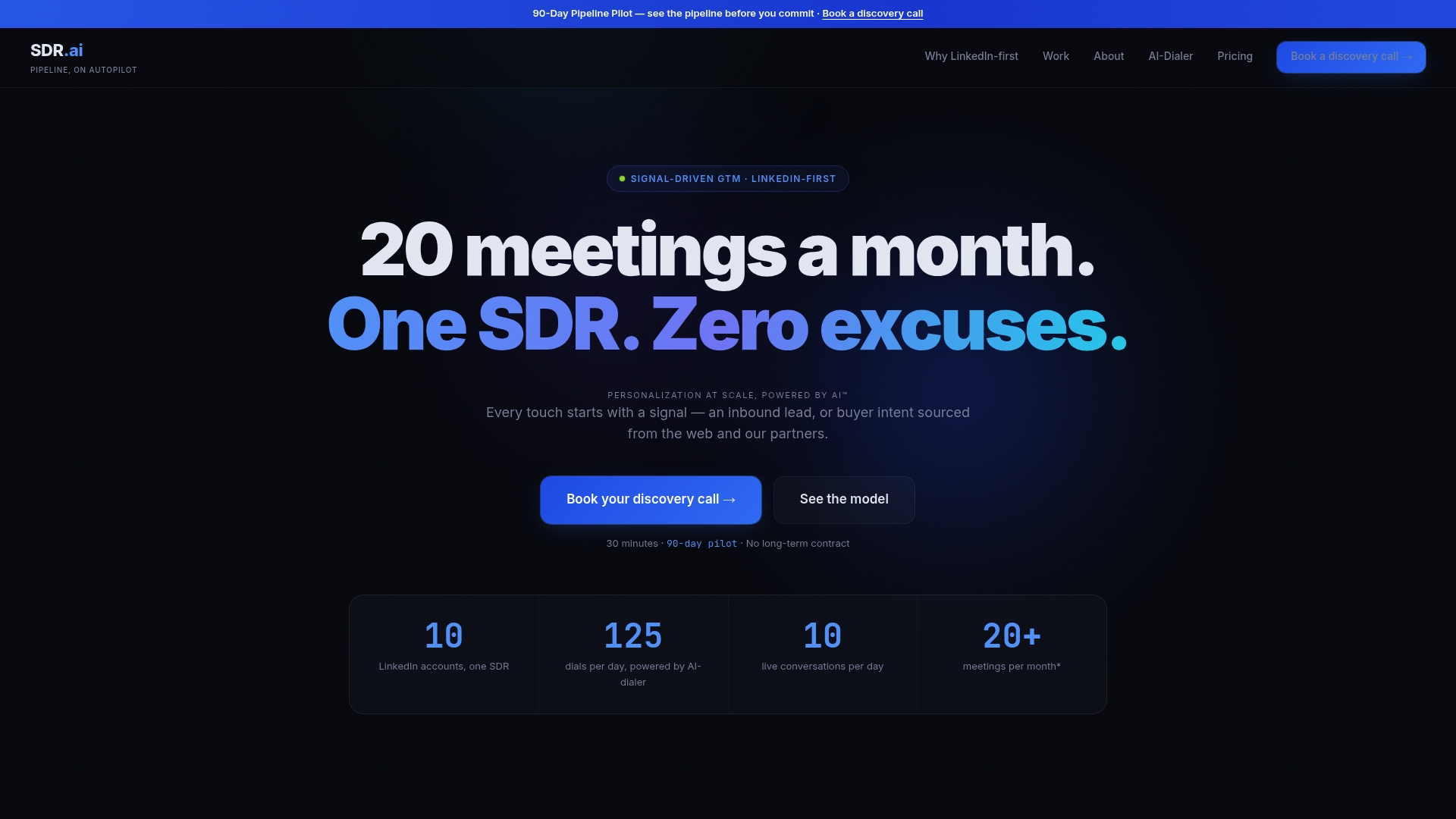
If you would rather not build the scoring, outreach and follow-up machinery yourself, our AI-Powered Outbound service runs it for you: LinkedIn-first targeted outreach to your ICP, personalized messaging, warm calling and multichannel follow-up, with a human SDR handling every reply. It costs $2,500 per month plus a one-time $500 setup fee. You can see how it works on the SDR.ai site.
If your team already does its own outreach and needs faster calling on its Tier 1 list, the AI-Dialer is available at $2,400 per year with a $500 one-time onboarding fee. And if you want to build the engine in-house with a clear plan, The SDR.ai Blueprint lays out the model.
FAQ
What is the difference between fit score and intent score?
A fit score measures how closely a company and contact match your ideal customer profile, using traits like industry, size, stage and role. An intent score measures evidence of timing, such as a new hire, a funding event or research activity. Fit changes slowly, while intent rises and decays, so keeping them separate tells you both who to target and when.
How many data points do I need before I can score leads?
You can start with as few as 20 closed-won accounts to write rules, though at that size treat the result as a hypothesis to refine. Machine-learning models generally need far more clean records, so a small or niche team is better served by a transparent rules-based score reviewed after each batch of outreach.
How often should I update my lead scores?
Refresh intent and engagement points at least weekly, because their value fades quickly. Review the fit rules and the tier thresholds quarterly against closed-won and closed-lost outcomes. The 2026 research on lead temperature describes readiness as a timestamped state that changes, so a static score goes stale.
Should I score outbound leads the same way as inbound leads?
No. Inbound scoring leans on behavior because the lead has already acted. Outbound scoring has to lean on fit, then layer on signals and reachability, since most prospects have not engaged yet. Inbound leads also warrant a fast response time that outbound accounts do not, which is why many teams run separate rules for each.
Sources
- AI-enabled lead temperature: a narrative review (Emerald, 2026)
- Profiling before scoring: a two-stage model (Journal of Revenue and Pricing Management, 2026)
- The state of lead scoring models and their impact on sales (PMC, 2023)
- Buying signals don't travel (Upside research, 2026)