
Inbound pulls buyers to you and compounds over months; outbound pushes your message to chosen accounts and produces pipeline within weeks. The right call almost never picks one over the other. Run outbound when you need meetings fast or your ideal customer profile is narrow, and fund inbound for the durable, lower-cost pipeline it builds once content and search start working.
TL;DR:
- Outbound is most effective for quick meetings when targeting a narrow account list or in early-stage companies needing direct feedback within weeks.
- Inbound produces higher intent leads with lower costs, but typically requires six to twelve months to build a predictable and scalable pipeline.
- Signal-led outbound, triggered by specific events and personalized outreach, outperforms cold outbound in conversion rates and can generate many qualified meetings monthly.
- Combining inbound and outbound, with clear routing based on fit and intent scores, optimizes pipeline predictability and overall revenue growth.
- Setting measured benchmarks, such as response SLAs and separate metrics, ensures both channels remain accountable and aligned to performance goals.
Table of Contents
- Outbound vs Inbound Leads: What Actually Separates Them
- What Outbound Leads Look Like When Done Right
- Inbound vs Outbound: The Numbers Side by Side
- When to Lean Outbound, When to Lean Inbound
- Routing, SLAs, and the Metrics That Keep Both Channels Honest
- Modern Outbound in Action: Signal-Led Outreach at Work
- The Real Lesson Buried in the Inbound vs Outbound Debate
- Where SDR.ai Fits Into Your Outbound Strategy
- Sources
- FAQ
Outbound vs Inbound Leads: What Actually Separates Them
The cleanest way to tell them apart, as Salesforce frames it, is who makes the first move. An inbound lead comes to you. An outbound lead gets contacted by you. Everything else, cost, speed, conversion rate, flows from that single distinction.
Inbound leads are pull-driven. Someone finds your blog post, downloads a guide, signs up for a trial, or gets referred by a happy customer, then raises their hand. The lead already has some context on your product before a rep says a word.
Common inbound channels include:
- Search engine optimization and long-form content that ranks for buyer-intent keywords
- Webinars and gated resources that convert anonymous traffic into named leads
- Customer referrals and word-of-mouth from existing accounts
- Organic social posts and communities where prospects self-select
- Paid search ads that capture demand from people already searching for a solution
Inbound tends to arrive with higher intent because the prospect opted in. It also builds on itself. HubSpot's research on inbound marketing describes a compounding pattern across attract, engage, and delight phases, meaning a blog post published today can still generate leads two years from now without new spend. That compounding effect is also why inbound needs a real conversion path. Lead magnets, demo requests, and free trials that move visitors from top-of-funnel awareness to bottom-of-funnel purchase intent, as outlined in Neil Patel's guide to startup inbound strategy, do the actual converting.
The tradeoff is time. Inbound marketing methods run significantly cheaper per lead than outbound, but that payback typically takes six to twelve months to materialize. If you need meetings on the calendar this quarter, inbound alone will not get you there.
What Outbound Leads Look Like When Done Right
An outbound lead exists because someone on your team decided to reach out. That is the whole definition. No opt-in, no download, no search query, just a rep or an automated sequence initiating contact with a target account.
Outbound channels have expanded well past the cold call:
- Cold email sequences, often three to seven touches over two to three weeks
- Warm and cold calling, increasingly run through parallel dialers that multiply talk time
- LinkedIn outreach combining connection requests, comments, and direct messages
- Account-based marketing plays that coordinate ads, email, and calls against a target list
- Event and conference outreach tied to a specific buying window
The old model, buy a list, blast a generic pitch, was never great and it is worse now that inboxes filter harder than ever. What works in 2026 is signal-led outbound: watching for trigger events like a funding round, a new VP of Sales hire, or a competitor's customer complaining publicly, then reaching out with a message tied to that specific moment. Superleap's breakdown of modern outbound makes the case that targeted, personalized, multi-channel outreach backed by clean data now outperforms generic volume plays by a wide margin.
The numbers back this up. Triggered, signal-based outbound converts multiple times better than cold outbound. That gap is the difference between a rep who dials a purchased list all day and one who reaches out the week a prospect's company announces a Series B. Outbound's advantage has always been speed and control over who gets contacted. Signal targeting just makes that speed convert.

Inbound vs Outbound: The Numbers Side by Side
Here is how the two approaches stack up across the dimensions that actually drive budget decisions.
| Dimension | Inbound | Outbound |
|---|---|---|
| Time to pipeline | six to twelve months to ramp | Days to weeks |
| Cost per lead | significantly lower than outbound | Higher, especially with lists and tools |
| Conversion / close rate | SEO-driven leads close around 14.6% | Cold calling closes at a relatively low rate; signal-led outbound converts multiple times better than cold |
| Deal size | Varies; often larger for enterprise self-serve funnels | Frequently larger for SMB and mid-market targeted deals |
| Predictability / control | Low control over who arrives | High control over exactly which accounts get contacted |
| Scale | Compounds with content volume and domain authority | Scales with headcount, dialer capacity, or list size |
Statistic to note: the gap between a 14.6% close rate on SEO-driven leads and a 1.7% close rate on cold calls is not a rounding error. It is the reason so many sales leaders assumed outbound was dying, right up until signal-led targeting closed most of that gap by aiming at accounts already showing buying signals instead of dialing at random.
Three takeaways follow from this table. First, if you need predictable, targeted pipeline this month, outbound wins on speed and control even though its per-lead cost runs higher. Second, if you can absorb a six to twelve month ramp, inbound's lower marginal cost and higher close rate make it the better long-term engine. Third, neither number tells the full story alone. A company with a narrow ICP of 500 target accounts gets more from tightly controlled outbound than from inbound content aimed at a broad audience that mostly does not fit its buyer profile.
When to Lean Outbound, When to Lean Inbound
Company stage, average contract value, and how narrow your ideal customer profile is should drive the split more than personal preference or whatever channel your last company used.
- Pre-product-market-fit or early-stage companies should run outbound first. You need direct feedback from real prospects, not months of waiting for organic traffic to materialize, and outbound gets you in front of the 50 to 100 accounts that matter most within weeks.
- Companies in the $5 million to $20 million ARR range typically do best with a hybrid model: outbound keeps pipeline predictable while the first real inbound assets, cornerstone content, a proper SEO program, case studies, start compounding in the background.
- Companies past $20 million ARR can usually lean more heavily on inbound for overall volume, while still running dedicated outbound against strategic, high-value accounts that inbound alone would never reach.
Deal size and market breadth change this math further. A narrow ICP, say, only 800 companies worldwide fit your buyer profile, favors outbound because you can name every target account and inbound content would mostly reach people who will never buy. A broad total addressable market with thousands of qualified buyers favors inbound, since search and content can reach volumes no outbound team could dial through.
Pro Tip: Budget inbound like a runway investment, not a monthly expense. Set aside six to twelve months of consistent content and SEO spend before judging results, and run outbound in parallel during that window so you are not waiting on pipeline while inbound assets mature.
Routing, SLAs, and the Metrics That Keep Both Channels Honest
Leads from either channel go cold fast without clear rules for who touches them and when. Set response-time SLAs by source: many teams aim for a five-minute response on inbound demo requests and a same-day first touch on outbound-qualified accounts, since inbound leads convert far worse the longer they wait.
Track these metrics separately by channel so you can compare apples to apples:
- Cost per lead and cost per meeting booked, split by inbound and outbound
- Conversion rate at each funnel stage, not just the final close
- Time-to-meeting from first touch, a strong early signal of pipeline health
- Pipeline velocity, meaning how fast a lead moves from stage to stage
- Customer acquisition cost payback period, especially for inbound given its longer ramp
A simple fit-times-intent matrix helps route leads without guesswork. Score account fit (industry, company size, tech stack) from one to five, and score intent signals (page visits, content downloads, trigger events) from one to five. Anything scoring high on both gets an immediate SQL handoff; high fit with low intent goes into an outbound sequence; high intent with lower fit goes into automated nurture. This is also where hybrid flows earn their keep: an inbound visitor who fits your ICP but never converts on a form is a strong candidate for a triggered outbound follow-up, which is exactly the kind of signal-based approach that outperforms cold outreach. Reading up on lead nurturing tactics is worth the time if your nurture sequences currently amount to a generic drip campaign.
Modern Outbound in Action: Signal-Led Outreach at Work
Signal-led outbound described above is not theoretical. The service runs LinkedIn-first outreach aimed at a defined ideal customer profile, layered with intent signals that flag which accounts are actually in-market, and personalized messaging that a human SDR follows up on directly rather than routing replies to a bot.
Users of this model report booking many qualified meetings a month with a lean team, the kind of output that once required a multi-rep SDR bench.
That volume matters most when it feeds the rest of your funnel instead of sitting in isolation. Meetings booked through signal-led outbound create the inbound nurture list of tomorrow, warm accounts that did not close on the first call but now know your name.
The Real Lesson Buried in the Inbound vs Outbound Debate
Most teams treat this as a philosophical choice when it is really a math problem. Pick your top 500 to 2,000 target accounts, run an outbound pilot against them for 90 days, and simultaneously start one inbound asset, a pillar page or a case study series, with a six to twelve month milestone attached. Measure both against the same cost-per-meeting yardstick and let the numbers, not preference, decide where next quarter's budget goes.
— Chad
Where SDR.ai Fits Into Your Outbound Strategy
If your team keeps stalling out on the "who has time to run outbound properly" problem, that is the exact gap Sdr was built to close. Instead of spending months hiring and ramping an SDR bench, you get LinkedIn-first outreach, intent-based targeting, and a human SDR handling every reply, typically producing more than 20 qualified meetings a month without adding headcount.
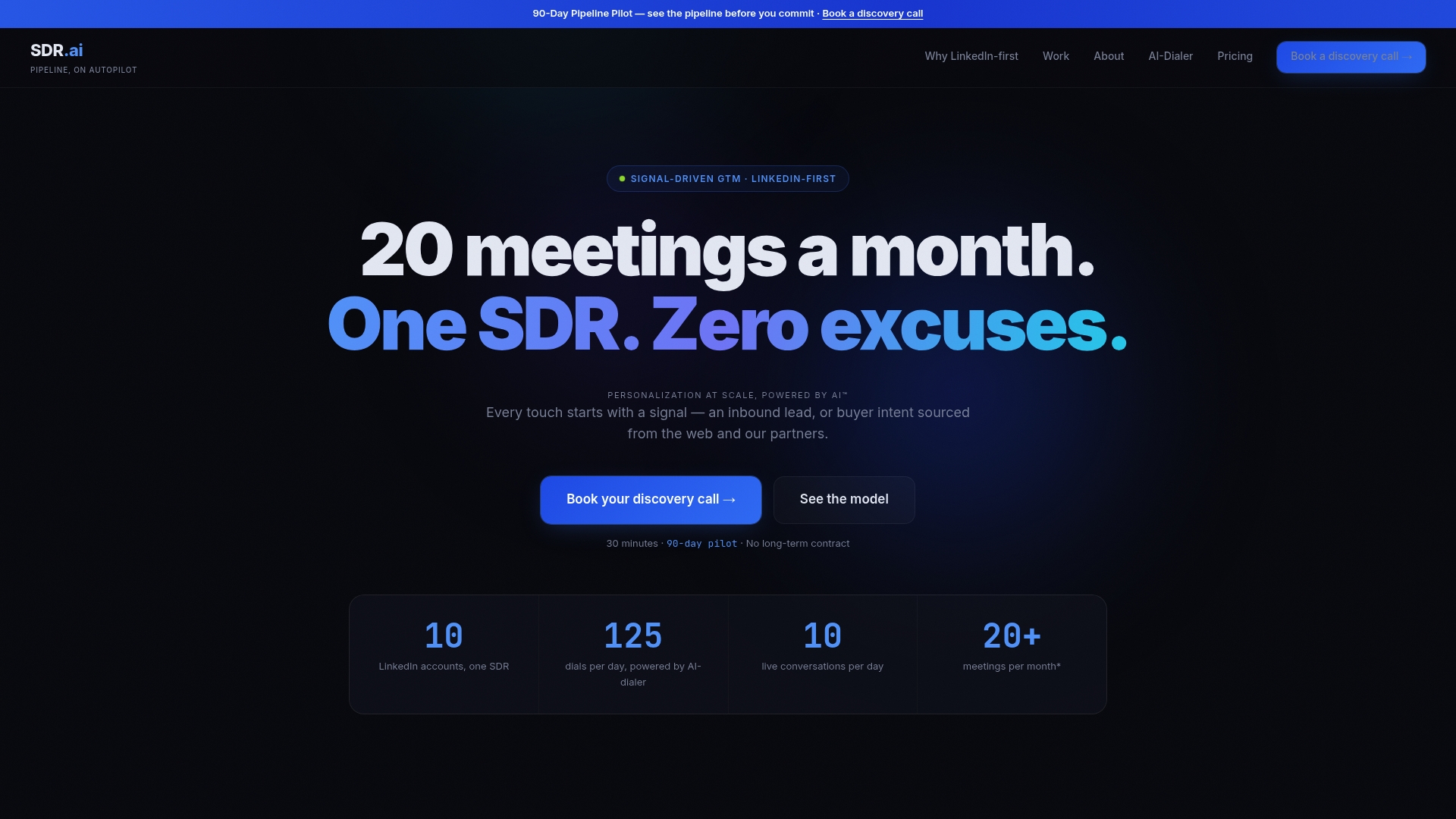
The AI-Powered Outbound service runs $2,500 per month with a $500 one-time setup fee, and it plugs directly into the fit-times-intent routing described earlier so outbound and inbound signals feed the same pipeline instead of competing for attention. Teams that want more dial volume from their own reps rather than a managed service can license the AI-Dialer directly for $2,400 per year plus a $500 onboarding fee. If you want to see the underlying methodology before committing to either, Sdr walks through the data, digital, and dials engine behind the results. Book a demo to see which model fits your ICP and stage.
Sources
- Outbound vs Inbound in 2026: The Data Behind GTM Strategy Choices | Landbase
- Inbound marketing tips to build a lead-generating strategy | HubSpot
- Outbound Marketing: Channels, Strategy, and Examples (2026 Guide) | Superleap
FAQ
What Is an Example of an Inbound Lead?
A visitor who downloads a pricing guide from your website after finding it through a Google search is a classic inbound lead. They arrived on their own, already showing intent, which is why SEO-driven inbound leads close at around 14.6%, well above cold outreach.
What Is an Example of an Outbound Lead?
A prospect who never heard of your company until a rep sent a personalized LinkedIn message referencing their recent funding round is an outbound lead. Sdr's approach uses exactly this kind of signal-led targeting to make outbound outreach feel relevant rather than random.
How Do You Prioritize Between Inbound Leads and Outbound Prospecting?
Score each lead on fit and intent, then route accordingly: high fit and high intent go straight to sales, high fit with low intent goes into an outbound sequence, and low fit leads get deprioritized regardless of source. Company stage matters too. Early-stage teams should weight outbound heavier since they cannot wait months for organic traffic.
What Is an Example of Inbound and Outbound Working Together?
A prospect visits your site through organic search but does not convert, then a signal-led outbound sequence follows up referencing their specific use case days later. This hybrid flow captures leads that pure inbound would lose and gives outbound a warmer starting point than a cold list, which is the model most high-performing GTM teams now run.