
A prospect list tells you who could buy from you. Intent data tells you who may be shopping right now. They answer different questions, so the choice is rarely either/or. The strongest outbound starts with a list built on your ideal customer profile (ICP) and uses intent signals to decide who gets contacted first and what the message says. If you can afford only one, fix your list first, because timing signals on the wrong accounts waste effort.
This guide covers what each one is, what each can miss, what they cost, and a simple way to combine them. It is written for founders and sales leaders at B2B tech companies who need pipeline without building a big SDR team.
TL;DR
- A list is a fit tool: it names the accounts and people that match your ICP and stays useful for months.
- Intent data is a timing tool: it flags accounts researching a problem now, and it fades within weeks.
- Intent on accounts outside your ICP converts worse than a plain ICP list, so build the list first.
- Most published accuracy figures come from sellers, so check any signal against your own pipeline.
- The practical setup is ICP list, then recency-filtered signals, then a human-written first message.
Table of Contents
- What each one actually is
- Side-by-side comparison
- What intent data reveals that a list cannot
- What each one can miss
- What each costs
- Privacy considerations
- When to use a list, intent data, or both
- A simple way to combine them
- Our perspective
- How we can help
- FAQ
- Sources
What each one actually is
A prospect list is a set of companies and contacts selected by firmographics (industry, size, location) and sometimes technographics (the tools they run). It answers "who could buy from us." Because those traits change slowly, a well-built list holds up for months. The contact details inside it age faster: every job change edits a field on someone's record, so a list is a dated snapshot, not a standing fact. The US Bureau of Labor Statistics reported 5.1 million total separations in July 2026, which gives a sense of the churn behind any contact database.
Intent data is behavioral information showing that an account is actively researching a topic, category or problem. It comes from content consumption, search activity, review-site visits and similar behavior, usually aggregated at the account level. It answers "who is in a buying window now." It is a prioritization layer, not a list of names.
A third layer often gets blurred in: contact data, the phone numbers, emails and titles that let you reach someone. Intent providers typically tell you which accounts are in market but not who the decision-maker is or how to reach them. A complete targeting stack has three parts: ICP filtering, intent for prioritization, and contact data for the outreach itself.
Side-by-side comparison
| Question | Prospect list (fit) | Intent data (timing) |
|---|---|---|
| What it answers | Who could buy from us | Who is researching now |
| Shelf life | Months for fit; contact details age with job changes | Days to weeks |
| Level of detail | Named accounts and contacts | Mostly account-level; person-level is rarer |
| Main risk | Contacting everyone with no sense of timing | Chasing hot accounts you would never want as customers |
| Best use | Defining the market and building sequences | Ranking accounts and shaping the first message |
| Cost pattern | Low per contact | Higher per account, often sold annually |
The row to remember is the "main risk" one. Each approach fails in the exact place the other is strong. Our own breakdown of intent data versus firmographics goes deeper on that pairing.
What intent data reveals that a list cannot
A list cannot see behavior. Intent data can show that a company is reading comparison content, visiting review sites, hiring for a relevant role or changing its tech stack. That matters because buyers form opinions early: a 6sense study of more than 4,000 buyers, cited in a 2026 intent data report, found that 94% of buying groups ranked their preferred vendors before first contact with a seller. If you reach out after the shortlist is set, you are competing for second place.
Intent also catches activity that never touches your site. Your own analytics show who engages with you. Category-wide intent can show a prospect researching solutions like yours elsewhere while showing zero visits to your pages.
Signals come in several families:
- First-party: pricing page visits, demo requests, content downloads. Already in your stack.
- Third-party: topic-surge data from publisher networks and research panels.
- Review-site activity: profile, pricing and comparison page views on software review platforms.
- Built signals: hiring pages, funding news, technology changes and leadership moves that your team monitors itself.
For a niche market, the last group is often the richest. A new VP of Sales posting at a high-fit company says more than a generic content view from an unknown one.
What each one can miss
Being straight about limits is how you use these tools well.
Where intent data needs care
- Noise. Students, researchers, job seekers and competitors all generate signals.
- Account matching. Mapping an IP address to a company works better for office networks than for remote workers. One 2026 analysis puts search-intent matching at roughly 60 to 75% accuracy at the SMB tier and 85 to 95% at enterprise.
- Topic accuracy. The same analysis notes the signal is often right that something happened at an account but wrong about the topic.
- Freshness. Signals lose value quickly. One resource recommends recency windows of 7 days for hot outbound prioritization and 14 days for weekly account ranking.
- Coverage. In small markets or brand-new categories there may be too little signal to act on.
- Activation. A score does not say whom to contact or what to say.
Where lists need care
- They give no timing, so reps guess when to call.
- Contact records go stale as people change jobs.
- Sending the same message to the entire list reads as generic.
None of these is a reason to avoid either tool. Each is a reason to pair them and to put a person between the signal and the send.
What each costs
Costs differ sharply, and intent pricing is often hidden behind sales calls.
A 2026 pricing report of major third-party intent providers shows median annual contracts ranging from $25,000 to $95,292, with individual quotes from $7,220 up to $593,267. Those are annual commitments for data alone. You still need contact data, tooling and people to act on the signals.
Prospecting databases are far cheaper per record. For a lean team, that is why the list comes first: it is the lower-cost foundation, and the first-party and built signals you already have cost little.
The sensible way to judge spend is cost per qualified meeting, not cost per record. Cheap contacts with no timing produce low reply rates. Expensive signals with no reachable contact produce nothing. Whichever you buy, measure it against a holdout group on your own pipeline. A 2026 reality check notes that almost every accuracy figure in this space comes from a seller and recommends exactly that test.
Privacy considerations
Intent and list data both involve information about people, and rules vary by place.
- United States: California's exemption for business-to-business personal information expired on December 31, 2022, so business contacts there have the same privacy rights as consumers, including opting out of sale or sharing. Have your counsel confirm how this applies to your data sources.
- EU and UK: Tracking and visitor identification touch both GDPR and cookie rules. If you sell into these markets, get legal advice before buying person-level data or running identification scripts.
Whichever market you sell into, ask any data vendor where its data comes from and how consent is handled.
When to use a list, intent data, or both
A useful rule is to buy for your constraint:
- Reps reach the right people at the wrong moment. Your gap is timing, so add intent.
- Reps know which accounts are moving but cannot reach anyone. Your gap is contact coverage. Fix that first.
- Both are missing. Start with the list and contact coverage. Timing evidence you cannot act on decays while you hunt for a name.
One analysis of multi-quarter outbound programs found that an ICP-only list filtered by a credible intent signal converted at 1.5 to 3 times the ICP-only rate, while the same signal on non-ICP accounts converted at about half the ICP-only rate. Read that as a multiplier: intent amplifies a sharp ICP and distracts on a vague one.
There are also cases where intent data adds little. If your category is brand new, or your total market is under about a hundred accounts, a hand-built list with a researched message often does more than a data feed. In those cases built signals (hiring, funding, leadership changes) do the job of intent.

A simple way to combine them
This is the workflow we recommend for a small team.
- Build the list on fit. Define the ICP by industry, size, role and technology. Keep it narrow.
- Score recency. Treat signals from the last 7 to 14 days as live and let older ones fade.
- Require a cluster. One page view is a guess. Look for more than one signal family pointing the same way, such as a hiring post plus a review-site visit, or activity from several people at one account.
- Write the first line as a hypothesis. Do not announce that you tracked someone. A hiring signal can become a question about the pressure that hiring creates, which is more useful to the reader than a mention of their browsing.
- Use a human to review. A person checks that the signal is still relevant and the contact has a credible role before anything goes out.
- Follow up across channels. A short, structured sequence works better than a single touch. See our examples of sales follow-up cadences.
The step most teams skip is step 4. A raw alert such as "visited pricing twice" is still a row that someone has to research, and that gap is where intent data quietly dies. Our guide on turning buyer intent signals into booked meetings covers how to close it, and LinkedIn outreach personalization shows how to build one message from one signal.
If you are also deciding where outbound fits among your other acquisition channels, this overview of B2B demand generation services helps frame what to buy and how to judge it.
Our perspective
We run outbound for B2B tech companies, and the same pattern shows up in how we work: the debate between intent data and lists is usually the wrong debate.
A list without timing makes a rep guess. Intent without fit floods a rep with in-market companies who will never close. We start with a tight ICP, layer on signals that show a buying window is open, and then a human SDR writes and handles every reply. That last step is what turns a signal into a conversation instead of a creepy or generic message.
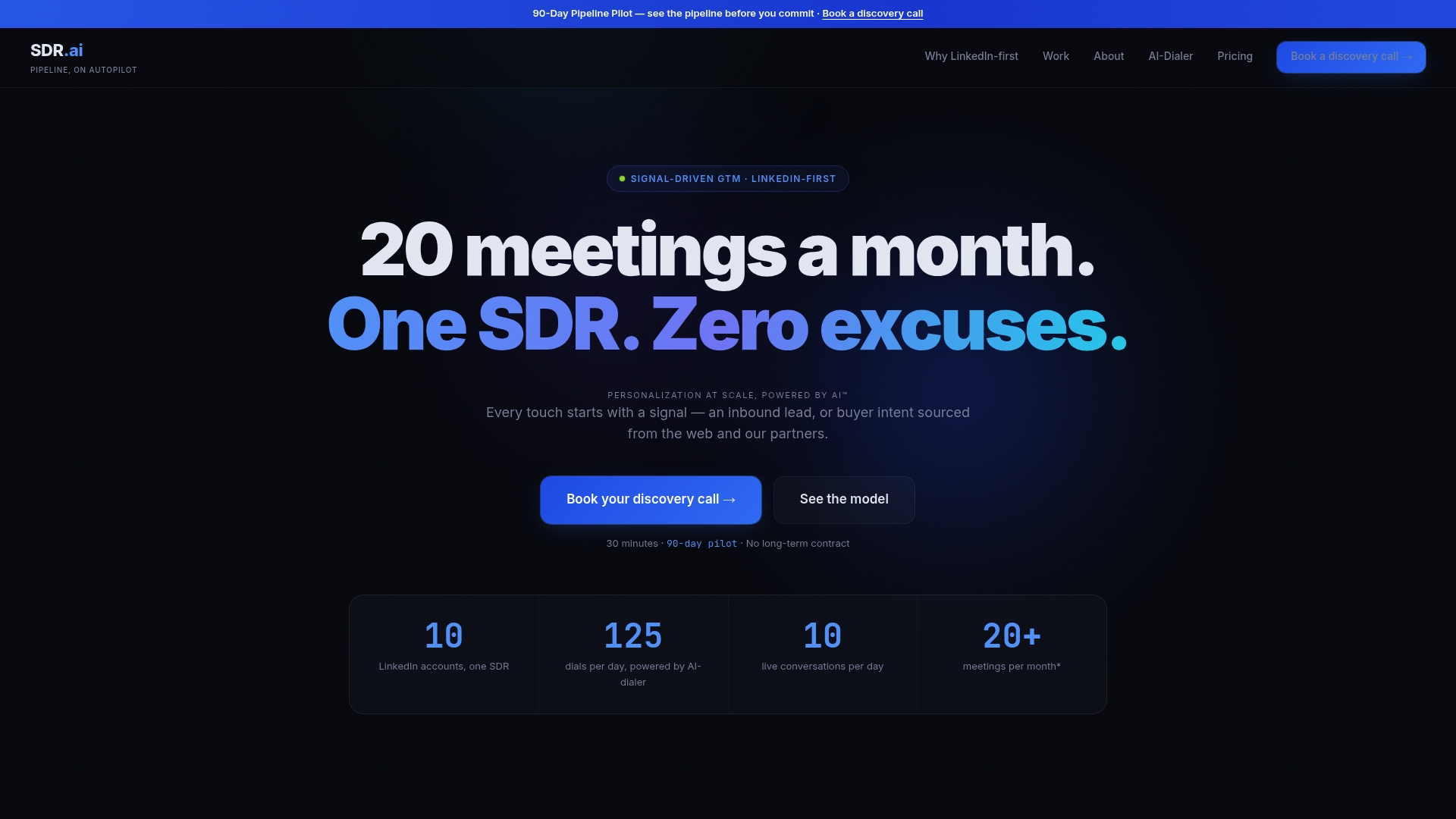
Our approach is LinkedIn-first and signal-driven. We focus only on the ICP and on intent signals, so the team's time goes to accounts that fit and are moving. Clients get the pipeline math laid out, a transparent process and a fast ramp without hiring and training an in-house SDR team. We often see this approach book more than 20 qualified meetings a month with very little manpower on the client side.
If you take one thing from this article: do not buy a data feed and call it a strategy. Define who you want, watch for when they move, and make sure a person acts quickly on what you find.
Chad
How we can help
If you would rather not assemble lists, signals and outreach yourself, our AI-Powered Outbound service does it for you. It costs $2,500 per month plus a one-time $500 setup fee, and it combines LinkedIn-first outreach, intent-based lead identification, warm calling with an AI dialer and multichannel follow-up. A human SDR handles every reply. See the details on the AI-Powered Outbound page.
If your team already has lists and wants to call warm accounts faster, our AI Dialer is $2,400 per year with a one-time $500 onboarding fee. If you want to build the engine in-house, the SDR.ai Blueprint is our playbook for doing it.
FAQ
Is intent data better than a prospect list?
Neither is better, because they answer different questions. A list says who fits your ICP, and intent says who is researching now. Intent applied to a well-defined ICP list tends to convert better than the list alone, while intent on poorly matched accounts does not.
Is intent data the same as contact data?
No. Intent data shows which accounts are in market and usually does not give you a decision-maker's direct email, phone number or title. You still need verified contact data to reach someone, so a working stack uses both.
How fresh does an intent signal need to be?
For hot outbound prioritization, many practitioners use a window of about 7 days, and about 14 days for weekly account ranking. Older signals can still inform planning, but they should not trigger urgent outreach on their own.
Does intent data work for small or niche markets?
It can, but third-party coverage is often thin when the market is tiny or the category is new. In those cases, signals you build yourself, such as hiring, funding and leadership changes, usually carry more weight, combined with a carefully researched list.
How should I test whether intent data is working?
Run a holdout on your own pipeline. Work one group of accounts with signals and another without, and compare replies and meetings over the same period. Judge the result by cost per qualified meeting.
Sources
- Intent Data vs Contact Data: What Each Proves
- B2B Intent Data Reality Check 2026
- Buyer Intent Data: Where the Signal Actually Is
- Intent Signal Decay and Recency Windows
- Intent Data Pricing in 2026