
Call connect rate is the share of your dials that reach a live person: answered calls divided by total dials, with voicemails excluded unless your team defines it otherwise. Cold-call connect rates are usually low, and the biggest swings come from the quality of your numbers, not your script. Start by checking how many of your contacts have a direct line or validated mobile.
TL;DR:
- Track reach as live conversations divided by total dials, exclude voicemails, and measure meetings booked per live conversation separately.
- Check match rate first: contacts with direct lines or validated mobiles are more likely to reach the person than switchboard numbers, regardless of script quality.
- Change one test variable at a time, use a few hundred dials per variant as a sensible floor, and compare results across consistent periods.
- Prioritize prospects who opened an email, visited your site, or engaged on LinkedIn, and judge connects by meeting quality rather than call volume.
- Check consent and do not call requirements before dialing; violations create compliance risk, and carriers may filter numbers with poor caller reputation.
Table of Contents
- 1. How do you calculate call connect rate and set realistic benchmarks?
- 2. What drives differences in connect rates?
- 3. What should you do this week to increase connect rate?
- 4. How do you track connect rate reliably?
- 5. Which mistakes quietly wreck connect rates?
- 6. Why connect rate is only one number on the board
- 7. How can we help you get more meaningful connects?
- FAQ
- Sources
- Where can you check the rules before dialing?
1. How do you calculate call connect rate and set realistic benchmarks?
Two rates matter, and teams often blur them. Dial-to-connect tells you whether you are reaching people. Connect-to-meeting tells you whether those conversations convert.
- Dial-to-connect rate = live conversations ÷ total dials
- Connect-to-meeting rate = meetings booked ÷ live conversations
- Attempts per connect = total dials ÷ live conversations
Say a rep makes some dials over a set period and speaks with a portion of the people reached. The connect rate is live conversations divided by total dials. If some of those conversations end in booked meetings, connect-to-meeting is meetings booked divided by live conversations. Both numbers are healthy or unhealthy only in context.
Published benchmarks for connect rate and cold-call success vary widely, and we are not citing a specific figure here because the numbers depend on how each source sampled its data. A team calling warm, signal-qualified accounts in one region will not look like a team dialing a purchased list across several time zones. Industry, title seniority, geography, and whether the contact was warm or cold all move the number, so treat any single average as a rough reference, not a target.
Your best benchmark is your own baseline. Measure it over a consistent period, then improve it with controlled tests.

2. What drives differences in connect rates?
Some levers sit in your hands. Others are constraints you work around.
- Data quality: A direct line or mobile reaches the person. A switchboard number sends you through a gatekeeper or a phone tree. Match rate, meaning the share of contacts with a working direct number, often explains more of the gap between reps than skill does.
- Timing: Daypart and day of week change who picks up. Test windows rather than trusting folklore.
- Caller reputation: Carriers and apps label and filter suspected spam. Numbers with poor reputation get flagged or blocked, and STIR/SHAKEN call authentication is part of how carriers judge legitimacy.
- Gatekeepers and routing: Receptionists, PBX menus, and extension directories decide whether you get through at all.
- Warm signals: Someone who just opened your email or engaged on LinkedIn is more likely to answer than a stranger on a cold list.
- Regulation: Consent and registry rules shape which numbers you can call, which we cover below.
You control data, timing, and signals. You mostly manage around gatekeepers and carrier filtering.
3. What should you do this week to increase connect rate?
Run these in order. Each step builds on the one before it.
- Audit your numbers. Count how many contacts have a direct line or validated mobile versus a main switchboard. This is your match rate.
- Replace switchboards with direct numbers through enrichment, where lawful. Our post on real-time data enrichment for outbound shows how enrichment raises match rates.
- Test calling windows. Split a list into two or three dayparts, dial each the same way, and compare connect rates. Keep everything else constant.
- Pick your dialing mode deliberately. Power and parallel dialing raise call volume. We cover the tradeoffs in our power dialer benefits post, and this smart dialer guide offers tactical workflow tips for setup.
- Prepare a short live opener. Higher volume only pays off if the opening moments of a connect earn a real conversation.
- Pair every attempt with a follow-up. Leave a brief voicemail, then send a concise email or LinkedIn message that references the call.
- Call on warm signals first. Prioritize prospects who opened an email, visited your site, or engaged on LinkedIn.
- Run small, clean experiments. Change one variable per test. Use a fixed sample (a few hundred dials per variant is a sensible floor), run for a consistent period, and judge by attempts per connect and match rate lift.
Pro Tip: Fix match rate before you test scripts or timing. A better opener cannot help on a number that rings at a front desk.
4. How do you track connect rate reliably?
Bad tracking makes good tests look like noise. Settle your definitions first.
- Define outcomes: Tag every call as live conversation, voicemail, no answer, gatekeeper block, wrong number, or hangup. Only live conversations count as connects.
- Report two rates separately: Dial-to-connect shows reach. Connect-to-meeting shows quality. A rise in the first with a drop in the second means you are talking to the wrong people.
- Build a simple dashboard: Connect rate, attempts per connect, match rate, time-to-contact, and results by experiment variant.
- Keep dialer and CRM aligned: Accurate logging depends on matching calls to records. Our guide to sales dialer integration explains how call matching supports clean connect tracking.
- Read small lifts carefully: A small change on a few dozen calls is probably noise. Wait for enough volume that the difference holds across several days, and rerun a surprising winner before rolling it out.
5. Which mistakes quietly wreck connect rates?
- Polishing scripts before fixing data. A great pitch to a switchboard still goes nowhere.
- Ignoring time zones. A test window that is mid-morning for you may be lunch or end of day for the prospect.
- Mixing up connect rate and conversion. Track both, or you will celebrate more conversations that book fewer meetings.
- Breaking calling rules. The FCC explains that the TCPA restricts autodialed and prerecorded calls, especially to cell phones, and that the National Do-Not-Call Registry applies. Breaking calling rules can create compliance risk, and flagged numbers get filtered.
6. Why connect rate is only one number on the board
Chad here. I'd treat connect rate as a diagnostic, not a goal. Teams that chase it often dial faster and talk worse, then wonder why meetings don't follow. A modest connect rate on well-qualified, signal-warm prospects usually beats a high one on a cold list. When outreach starts on LinkedIn and calls follow real intent, "good" shifts: fewer dials, more relevant pickups, better meetings. Judge the number alongside meeting quality and your pipeline math.
— Chad
7. How can we help you get more meaningful connects?
We built our AI-powered outbound and AI-Dialer around one idea: reach the right person at the right moment, not just more numbers. Our AI-Dialer supports parallel dialing so reps spend their time in conversations. Our managed outbound pairs LinkedIn-first outreach with intent signals, so calls land on prospects who are already warm.
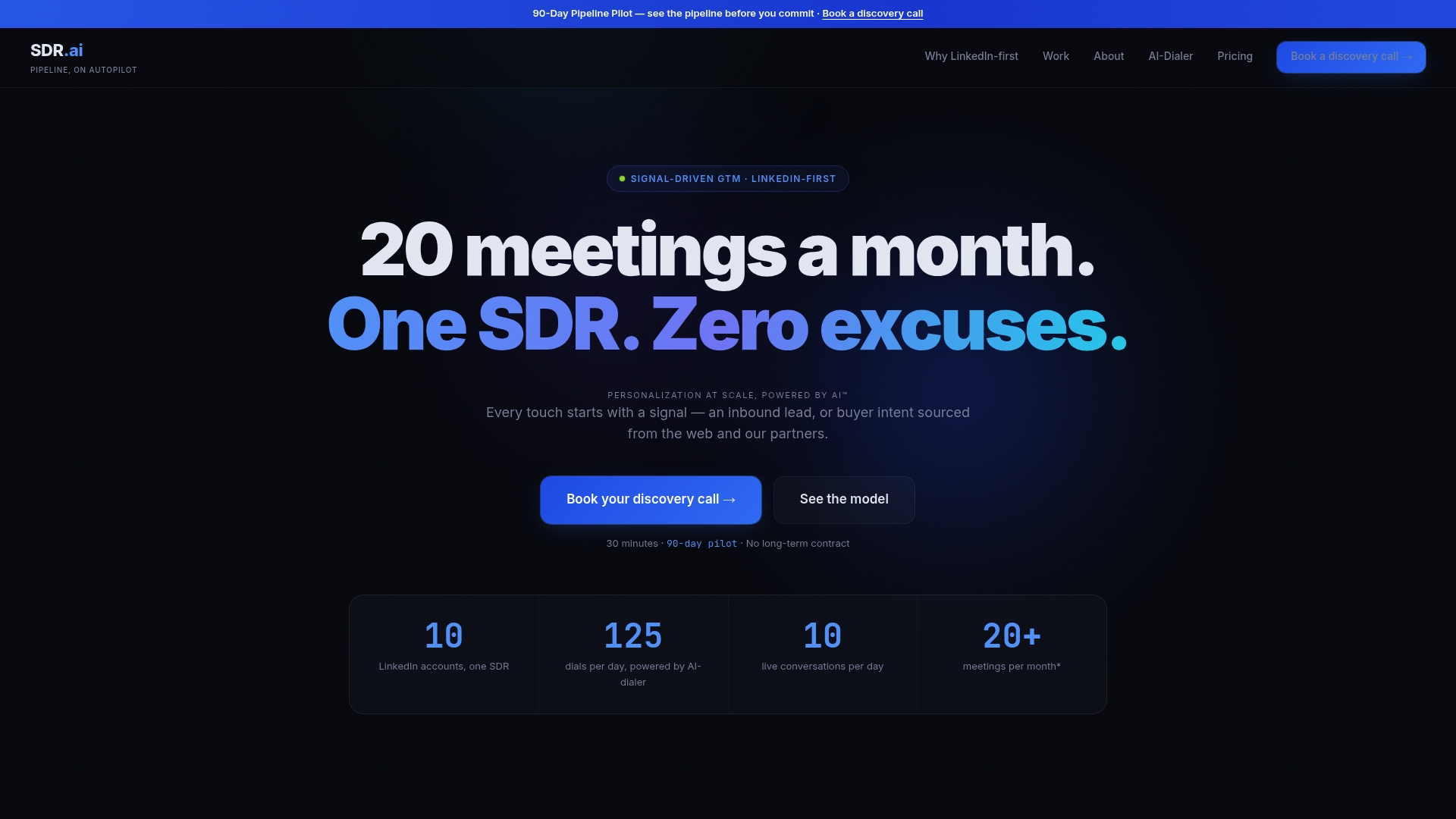
- Our AI-Powered Outbound service is $2,500 per month, with a $500 setup fee, and our human SDRs handle every reply.
- The AI-Dialer is $2,400 per year, with $500 onboarding.
- Our Blueprint shows how to build your own outbound engine.
The next step is simple: Sdr and we'll walk through your current connect numbers with you.
FAQ
What is the typical success rate of cold calls?
It varies widely by industry, list quality, and how a source defines success, so no single figure holds everywhere. Measure your own dial-to-connect and connect-to-meeting rates over a consistent period and use that as your baseline.
Is cold calling effective in sales?
Yes, when it is targeted and lawful. Cold calling works best on well-researched contacts with direct numbers and a warm signal, and it performs poorly on stale, switchboard-heavy lists. The FTC's Telemarketing Sales Rule sets disclosure and conduct requirements for outbound calls.
What is a typical sales conversion rate?
Conversion rates depend on what you count: connect to meeting, meeting to opportunity, or opportunity to close. Track each stage separately, since a healthy call connect rate says little about the stages that follow.
What are the 7 steps of a sales call?
Definitions vary, but a common version runs: prepare, open, qualify, present, handle objections, close or set a next step, and follow up. On a cold call, the opening and the ask for a next step matter most.
Sources
- Complying with the Telemarketing Sales Rule | Federal Trade Commission
- Unlawful Communications: Robocalls, Caller ID Spoofing, Do-Not-Call Registry, and Junk Faxes | Federal Communications Commission
Where can you check the rules before dialing?
Review the FCC guidance on unwanted communications and the FTC Telemarketing Sales Rule for compliance details.