
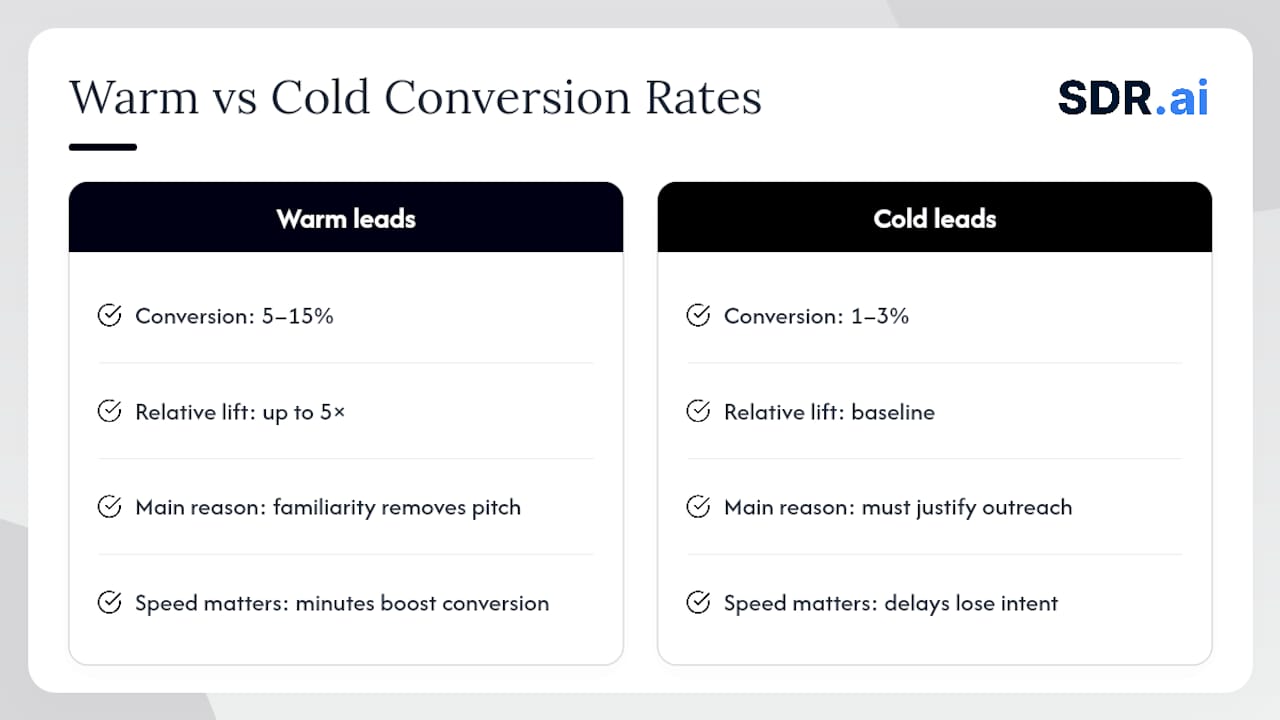
Warm calling is calling a prospect who has already shown interest, whether through a webinar, a pricing page visit, or an inbound reply, and it converts significantly better than cold outreach. Warm leads convert at roughly 5–15%, against 1 to 3% for cold calls, but only when you act fast and personalize the opening around what the prospect already did.
TL;DR:
- Contact speed is critical, with warm leads converting significantly better when called within minutes of a signal, especially for demo requests.
- Prioritize warm leads that have engaged within 48 hours, with signals like pricing page visits, demo requests, or content downloads scoring higher on qualification.
- Use a simple scoring system to rank signals and verify contact details before calling to avoid wasting time on disconnected or incorrect numbers.
- Tailor openers to reference the specific trigger event, creating a natural conversation that skips the need for a broad value pitch upfront.
- Automate signal detection and routing with AI tools to reduce delays, increase call volume, and maximize the speed-to-contact advantage over manual processes.
Table of Contents
- What Is Warm Calling and When Should You Use It?
- Warm Calling vs Cold Calling: Differences That Change Outcomes
- Why Warm Calling Works: The Evidence Behind the Approach
- How to Identify and Qualify Warm Leads
- Prepare for the Call: A 2 to 5 Minute Pre-Call Checklist
- Conversation Framework and Example Openers for Warm Calls
- Follow-Up Cadence and Timing After the Warm Call
- Metrics and KPIs to Track for Warm Calling
- Tools and Workflows That Support Warm Calling
- How SDR.ai Operationalizes Warm Calling
- Common Pitfalls in Warm Calling and How to Fix Them
- Put Warm Calling on Autopilot with SDR.ai
- Sources
- FAQ
What Is Warm Calling and When Should You Use It?
Warm calling means picking up the phone for someone who already left a trace: a demo request, a webinar sign-up, a pricing page visit, a reply to an email, or a referral from an existing customer. That trace changes everything about the conversation, because you're not asking permission to exist. You're following up on something the prospect already did.
Cold, warm, and hot leads sit on a spectrum of prior engagement, not a hard line:
- Cold: no interaction, pure list or account-based prospecting
- Warm: has engaged (site visit, download, webinar, form fill) but hasn't asked for a call
- Hot: has explicitly asked to talk (demo request, inbound reply)
Prioritize warm calling whenever a signal is fresh, under 48 hours old ideally, and tied to a specific action you can reference in your opener.
Warm Calling vs Cold Calling: Differences That Change Outcomes
Warm calling and cold calling aren't just two flavors of the same activity. They demand different prep, different scripts, and different resourcing.
- Conversion and timeline: warm calls close faster because the prospect already has context; cold calls need multiple touches just to earn thirty seconds of attention.
- Conversation structure: a warm call opens with a specific reference ("I saw you downloaded our pricing guide"); a cold call has to earn the right to ask a single question.
- Personalization: warm calling demands you know the trigger event; cold calling relies on firmographic fit and a general value proposition.
- Resourcing: most teams should route warm leads to their best closers first, then use remaining capacity for cold outbound to fill the pipeline behind it.
The practical rule: staff warm calling like it's revenue-critical (because it is), and treat cold calling as the volume engine that feeds the warm pipeline over time.
Why Warm Calling Works: The Evidence Behind the Approach
The conversion gap isn't a rounding error. Warm leads convert at 5 to 15% on average, while cold leads land at 1 to 3%. That's a five-fold difference in some cases, driven almost entirely by one thing: familiarity removes the need to justify why you're calling.
Pro Tip: If your team tracks only one number this quarter, track speed-to-contact on warm leads. It moves conversion more than any script change you'll make.
Speed compounds the advantage. Teams that contact warm leads within minutes of a signal convert far more often than those who wait hours or days, because intent has a shelf life. A prospect who just left your pricing page is thinking about your product right now. Call them tomorrow and you're competing with three other priorities that have already crowded in.
The mechanism is simple: warm calling lets you skip the identity pitch entirely and get straight to value, because the prospect already knows who you are and why you might be calling. That alone can cut two or three minutes off a call that would otherwise stall on "so what do you guys do."
How to Identify and Qualify Warm Leads
Not every website visit deserves a phone call. You need signals that predict buying intent, and a way to rank them.
Behavioral signals worth tracking, in rough order of strength:
- Pricing page visits (especially repeat visits)
- Demo or trial requests
- Webinar attendance, particularly if they stayed to the end
- Content downloads (whitepapers, guides, case studies)
- Email or LinkedIn replies to outbound
- Referrals from existing customers
- Sudden spikes in site activity from a target account
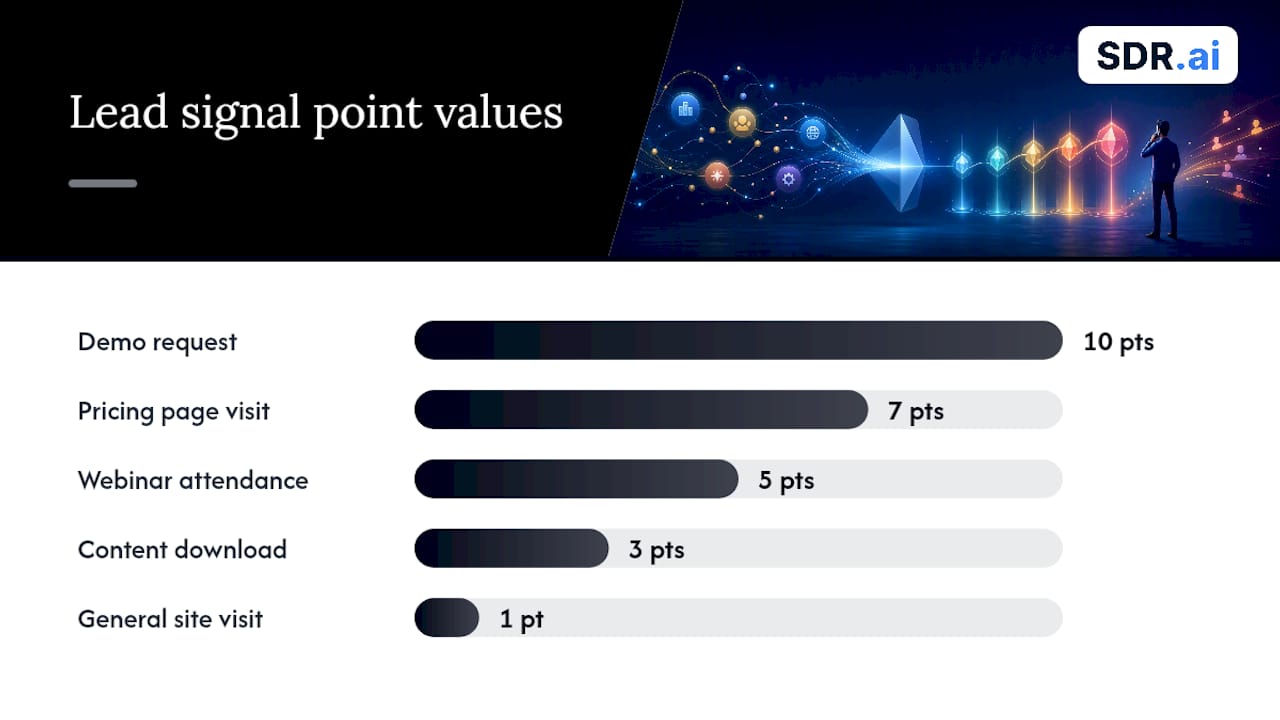
A simple point-based model with five to seven signals usually beats a complicated scoring engine nobody maintains. A workable version: demo request (10 points), pricing visit (7), webinar attendance (5), content download (3), general site visit (1). Call anything above 10 points same day; queue anything between 5 and 10 for next business day.
Before you dial, verify the phone number and email against your CRM record. Wasted calls to disconnected numbers or the wrong contact burn the exact speed advantage you're trying to exploit, and a quick data enrichment check catches most of those errors before they cost you a call.
Prepare for the Call: A 2 to 5 Minute Pre-Call Checklist
A warm lead doesn't stay warm if you spend twenty minutes prepping. Here's a routine that fits between calls.
- Check the CRM: last touch, notes from previous reps, any related contacts at the account.
- Scan LinkedIn: recent posts, job changes, or company news that gives you a natural reference point.
- Confirm the trigger: what exact action brought this lead into your queue, pricing page, webinar, download, and note the timestamp.
- Draft one tailored line: a single sentence connecting your opener to their specific action, not a generic value statement.
- Check for account-level signals: funding news, hiring sprees, or tech stack changes that support urgency.
AI tools can now compress most of this into seconds rather than minutes, scanning LinkedIn activity, firmographic data, and intent signals simultaneously instead of forcing a rep to check five tabs. That shift matters less for the research itself and more for what it frees up: more calls per hour, each one still personalized.
Conversation Framework and Example Openers for Warm Calls
A warm call has a natural four-part shape: reference the trigger, state value in one sentence, ask a discovery question, then propose a next step. Skipping the reference is the single most common mistake reps make. They launch into pitch mode as if the prospect just picked up a cold call.
Openers, adapted to the trigger:
- Webinar attendee: "You stuck around for the Q&A on our pricing webinar last week. What's driving the timing on your end?"
- Content download: "I noticed you grabbed our migration guide yesterday. Are you actively planning a switch, or still exploring?"
- Pricing page visitor: "You checked out our pricing a couple of times this week. Happy to walk through what fits your team size."
- Referral: "[Name] mentioned you two were talking about this. What's the problem you're trying to solve first?"
Pro Tip: Ask one open-ended discovery question and then stop talking. Reps who fill silence with more pitch details lose the thread the prospect was about to give them.
Avoid scripts that read like a monologue. The goal is a conversation with a clear next step, not a pitch with no exit ramp.
Follow-Up Cadence and Timing After the Warm Call
Speed matters even after the first conversation. Prompt follow-up on warm signals keeps momentum that a delay of even a day can erase.
A workable cadence for most B2B sales cycles:
- Same day: send a recap email referencing the specific commitment made on the call.
- Day 2 to 3: a short LinkedIn touch or a relevant resource tied to their stated interest.
- Day 5 to 7: a second call attempt, framed around the next step you agreed on.
- Day 10 to 14: a value-add touch, a case study or comparison relevant to their use case.
- Reset the clock immediately if a new high-intent signal appears, a repeat pricing visit or a demo request supersedes the old cadence entirely.
Demo requests deserve contact within the hour; content downloads can wait up to 24 hours without much conversion loss.
Metrics and KPIs to Track for Warm Calling
Four numbers tell you most of what you need to know: contact-to-meeting rate, meeting-to-opportunity rate, speed-to-contact, and touches-per-conversion.
- Contact-to-meeting: if this sits well under 20%, your qualification criteria or opener needs work.
- Speed-to-contact: anything beyond an hour on hot signals is a red flag worth fixing immediately.
- Touches-per-conversion: rising touch counts on warm leads usually point to weak first-call value delivery, not bad luck.
Run small A/B tests on openers and cadence timing rather than overhauling the whole process at once.
Tools and Workflows That Support Warm Calling
Warm calling breaks down fast without the right plumbing behind it. You need a CRM that routes and assigns leads instantly, an intent or visitor-identification tool to catch signals as they happen, a verification layer so you're not calling dead numbers, and a dialer that logs outcomes automatically.
- CRM and assignment: routes fresh signals to the right rep in seconds, not hours.
- Intent and visitor ID: flags pricing visits and repeat behavior before a form is even filled out.
- Verification: confirms phone and email accuracy, closing the gap that CRM data enrichment is built to solve.
- Sales engagement platform: sequences the follow-up cadence automatically across email and LinkedIn.
- Dialer and analytics: tracks connect rates and call outcomes so you know what's actually working.
Automated assignment and enrichment workflows cut the lag between a signal firing and a rep dialing, which is exactly the window where warm leads cool off.
How SDR.ai Operationalizes Warm Calling
SDR.ai builds its outreach model around LinkedIn-first targeting, using AI to spot intent signals across a company's Ideal Customer Profile before a rep ever picks up the phone. The approach pairs personalized messaging with calls timed to those signals rather than a static list.
That focus is the reason clients using this model report booking over 20 qualified meetings a month with a lean team. The mechanism isn't magic. It's the same signal-to-call speed this article has been describing, applied at scale with AI doing the signal detection a human rep would otherwise do manually, one tab at a time.
Common Pitfalls in Warm Calling and How to Fix Them
The biggest mistake reps make is treating a warm lead like a cold one, opening with a generic pitch instead of referencing the actual trigger. The second is slow follow-up, letting a same-day signal sit for 48 hours. The third is skipping verification and burning calls on dead numbers.
Fix all three with habits, not tools: verify contact data before dialing, spend one minute on research per call, and end every conversation with a specific, dated next step. None of this requires more headcount. It requires discipline applied consistently, which is rarer than it should be.
— Chad
Put Warm Calling on Autopilot with SDR.ai
SDR.ai is built for the exact gap this article just walked through: the lag between a warm signal firing and a rep actually dialing it. Instead of your team manually checking LinkedIn, pricing page visits, and CRM notes before every call, SDR.ai's AI layer surfaces intent signals across your Ideal Customer Profile automatically and routes personalized outreach the moment they appear.
That speed is the whole point. Clients running this model report booking a high volume of qualified meetings with minimal manpower, because the AI handles signal detection and message personalization at a pace no human rep can match manually. If your current warm-calling process depends on reps remembering to check five different tools before every dial, it's costing you conversions you'll never see in a report.
Explore Sdr to see how parallel dialing and automated signal routing can shrink your speed-to-contact, and book a demo to walk through how it would fit your current pipeline.
Sources
- Warm calling definition and context — Investopedia
- Warm Calling: Crafting Winning Sales Conversations — Mailchimp
- Warm leads best practices — Prospeo
- The complete guide to warm leads — Pipedrive
FAQ
What Is Warm Calling and What Does It Mean?
Warm calling means calling a prospect who has already shown interest through an action like a webinar, a pricing page visit, or an inbound reply, rather than someone with no prior contact.
What Is a Warm Call vs a Cold Call?
A warm call follows a known signal of interest and lets the rep open with a specific reference; a cold call has no prior interaction and starts by establishing basic relevance.
Does Cold Calling Still Work in 2026?
Cold calling still has a place as a volume engine for pipeline generation, but it converts far lower than warm calling, typically 1 to 3% versus 5 to 15%, so most teams weight their best reps toward warm leads first.
What Are the Stages of a Cold or Warm Call?
Most frameworks break the call into opening, discovery, value proposition, handling objections, and next steps; on a warm call, the opening shrinks because the reference to a known signal replaces the need to establish relevance from scratch.
How Fast Should You Follow Up on a Warm Lead?
Demo requests and other high-intent signals deserve contact within the hour, while lower-intent actions like content downloads can wait up to 24 hours without a meaningful drop in conversion.