
Trigger events, the specific, time-stamped changes in a company or contact's situation, tell you exactly when a prospect is most open to a conversation. The highest-value ones fall into four buckets: people moves, funding and M&A, product or pricing page activity, and hiring or layoffs. Acting on them raises reply and meeting rates because your outreach lands when it's actually relevant, not just when your sequence says it's time.
TL;DR:
- Monitoring strong signals like funding rounds, new executive hires, and repeated product page visits can significantly boost the chances of engaging prospects at the right moment.
- High-impact triggers such as mergers and acquisitions or leadership changes should prompt outreach within 24 to 48 hours, primarily via LinkedIn, to capitalize on shifting priorities.
- Combining multiple signals, such as a funding announcement plus a new VP appointment, increases the likelihood of a successful engagement, emphasizing the importance of lead scoring.
- Structured detection systems using public feeds, platform analytics, and social alerts help prevent drowning in noise while ensuring timely recognition of high-value triggers.
- Trigger-based outreach is most effective on targeted named accounts with a close fit to the ideal customer profile, rather than broad prospecting across large, unqualified lists.
Table of Contents
- What trigger events are and why signal-based outbound works
- Highest-converting trigger events worth monitoring
- How to detect and track triggers without drowning in noise
- When and how to act: timing, channel, and cadence
- Prioritizing and scoring triggers when SDR bandwidth is limited
- Crafting trigger-based messages that don't sound automated
- Measuring impact and setting guardrails
- A practitioner playbook: wiring alerts into a daily workflow
- Where trigger-based outbound delivers the most lift
- A managed way to act on triggers without building the stack yourself
- Sources
- FAQ
What trigger events are and why signal-based outbound works
A trigger event only earns your attention if it meets three conditions: it's time-bound (it happened recently enough to matter), it's tied to a role that can act on it, and it signals a real decision point rather than background noise. A promotion, a funding round, or a spike in pricing-page visits all qualify because they answer the question every prospect asks silently: why is this rep contacting me now? That "why now" is what separates a relevant message from a generic one, and it's the single biggest lever behind higher reply rates.
But trigger-based outbound has a limit worth naming. Forrester's research found that a majority of B2B buyers start their process with a preferred vendor already in mind, and that preferred vendor wins the deal more than half the time. Preference often forms before intent becomes visible on any signal feed. That means trigger detection works best paired with ongoing brand and demand efforts, not as a standalone strategy for winning deals you're only now discovering.

Highest-converting trigger events worth monitoring
Some signals open a wider window to sell than others. HubSpot's research catalogs a comprehensive list of trigger event types, but a handful consistently produce the strongest response rates.
- Account-level business signals: funding rounds, mergers and acquisitions, and market expansion often come with new budget and a mandate to move fast.
- People-level signals: promotions, new executive hires, a known champion switching companies, or layoffs all shift who holds buying power and why they might reconsider vendors.
- Behavioral and contact signals: repeated visits to pricing or product pages, and demo requests, show active evaluation happening right now.
- Procurement and competitor signals: a published RFP or a critical analyst report can indicate a formal buying process is already underway.
Each of these gives you a specific, defensible reason to reach out, which is the difference between a message that gets read and one that gets deleted.
How to detect and track triggers without drowning in noise
Detection only works if it's systematic. Here's a practical stack for surfacing each signal type before it goes stale.
- Public feeds: SEC filings, earnings call transcripts, and press monitoring catch funding, M&A, and expansion announcements early.
- Platform signals: website analytics and marketing automation tools flag contact-level behavior like page visits, while intent data providers surface account-level research activity, a distinction worth keeping straight since they call for different responses.
- People signals: LinkedIn alerts, job boards, and social monitoring catch promotions, new hires, and departures as they're announced.
- Alert routing: feed all of the above into a single workflow, CRM tasks, a shared Slack channel, or a queue, so reps see one prioritized list instead of five separate dashboards.
HubSpot recommends combining Google Alerts, LinkedIn alerts, and industry newsletters with these formal feeds, since a surprising number of high-value triggers still surface first in trade press or a founder's own LinkedIn post.
When and how to act: timing, channel, and cadence
Not every trigger deserves an immediate call. A funding announcement or executive hire justifies fast outreach because budget and priorities are actively shifting. A single pricing-page visit is worth watching, not calling, until it repeats or pairs with another signal.
- Funding, M&A, or leadership change: reach out within 24 to 48 hours, LinkedIn first, since it's the least intrusive channel for a cold, high-stakes moment.
- Repeated pricing or product page visits: email works well here, since the prospect is already self-educating and a short, low-pressure note fits that mindset.
- Hiring surges tied to a new initiative: phone or LinkedIn, framed around the initiative rather than the hire itself.
- Layoffs: wait and lead with empathy, not a pitch, since timing here is about respect as much as relevance.
A good first-touch line names the trigger directly: "Saw the Series B announcement, congratulations, curious how that changes your plans for [initiative]." Specificity is the whole point.
Prioritizing and scoring triggers when SDR bandwidth is limited
No team can chase every signal, so scoring matters more than volume. A workable formula multiplies three factors: signal weight (how strong a buying indicator the trigger is), buyer fit (how closely the account matches your ICP), and recency (how many days old the signal is). Multiple signals firing on the same account, say a funding round plus a new VP of Sales, should push that account to the top of the queue, since stacked signals are a stronger predictor than any single one alone, making Lead Scoring a powerful way to boost UK sales performance.
Set simple thresholds: high-weight, high-fit, recent signals get same-day outreach; everything else goes into a nurture track for later follow-up. McKinsey's research on next-generation B2B sales points to advanced analytics and propensity models as the mechanism that lets teams focus limited rep time on the accounts most likely to convert, rather than spreading effort evenly across every lead that shows up.
Crafting trigger-based messages that don't sound automated
A trigger only helps if the message built around it feels specific, not templated. A simple formula works across most trigger types: name the observation, add a line of credibility, state one clear piece of value, and end with a low-friction next step.
- Promotion: "Saw you stepped into the VP role, congrats. Teams in that seat often ask us about shortening ramp time for new reps, worth a quick chat?"
- Funding: "Congrats on the raise. Growth rounds usually mean scaling outbound fast, happy to share what's worked for similar-stage teams."
- Product interest: "Noticed you'd been checking out our pricing page. Happy to walk through how it maps to a team your size."
Merge fields and event snippets let you scale this without writing every message from scratch, as long as the underlying observation is genuinely tied to that account.
Pro Tip: Swap your generic opening line for a one-sentence restatement of the trigger itself, it costs nothing to build and consistently outperforms a templated greeting.
Measuring impact and setting guardrails
Track four numbers: reply rate, meeting rate, pipeline conversion, and time-to-meeting, all segmented by trigger type so you can see which signals actually convert versus which ones just generate replies. Run A/B tests comparing trigger-based messaging against your standard sequence, giving each variant enough volume and time to produce a meaningful, not just directional, difference.
Governance matters too: document where each signal comes from, respect opt-outs promptly, and follow applicable privacy rules for the regions you contact. Since Forrester's data shows preference often precedes visible intent, a high reply rate on a triggered account doesn't always mean the trigger caused the win, sometimes you were already the preferred vendor and the signal just gave you a reason to call.
A practitioner playbook: wiring alerts into a daily workflow
A workable first-24-hour play looks like this: an alert fires (say, a funding announcement), it lands in a shared queue, an SDR sends a LinkedIn message within the day, and a follow-up email goes out 48 hours later if there's no reply. For a team fielding a few dozen qualified signals a week, that's roughly 15 to 20 minutes of SDR time per trigger once the workflow is built, most of it spent on personalization rather than research.

Where trigger-based outbound delivers the most lift
Trigger-based outbound works best on named-account lists with tight ICP fit, not broad prospecting. The most common mistake is chasing every weak signal instead of stacking a few strong ones, which just adds noise without adding conversions. Start with one trigger type, test it for a month, then expand.
— Chad
A managed way to act on triggers without building the stack yourself
Most teams underestimate how much work it takes to keep a trigger detection system running well: feeds break, alerts pile up, and personalization slips back into templates under time pressure. A signal-driven, LinkedIn-first approach pairs intent detection with a human SDR handling every reply, so the outreach stays personal even as volume grows.
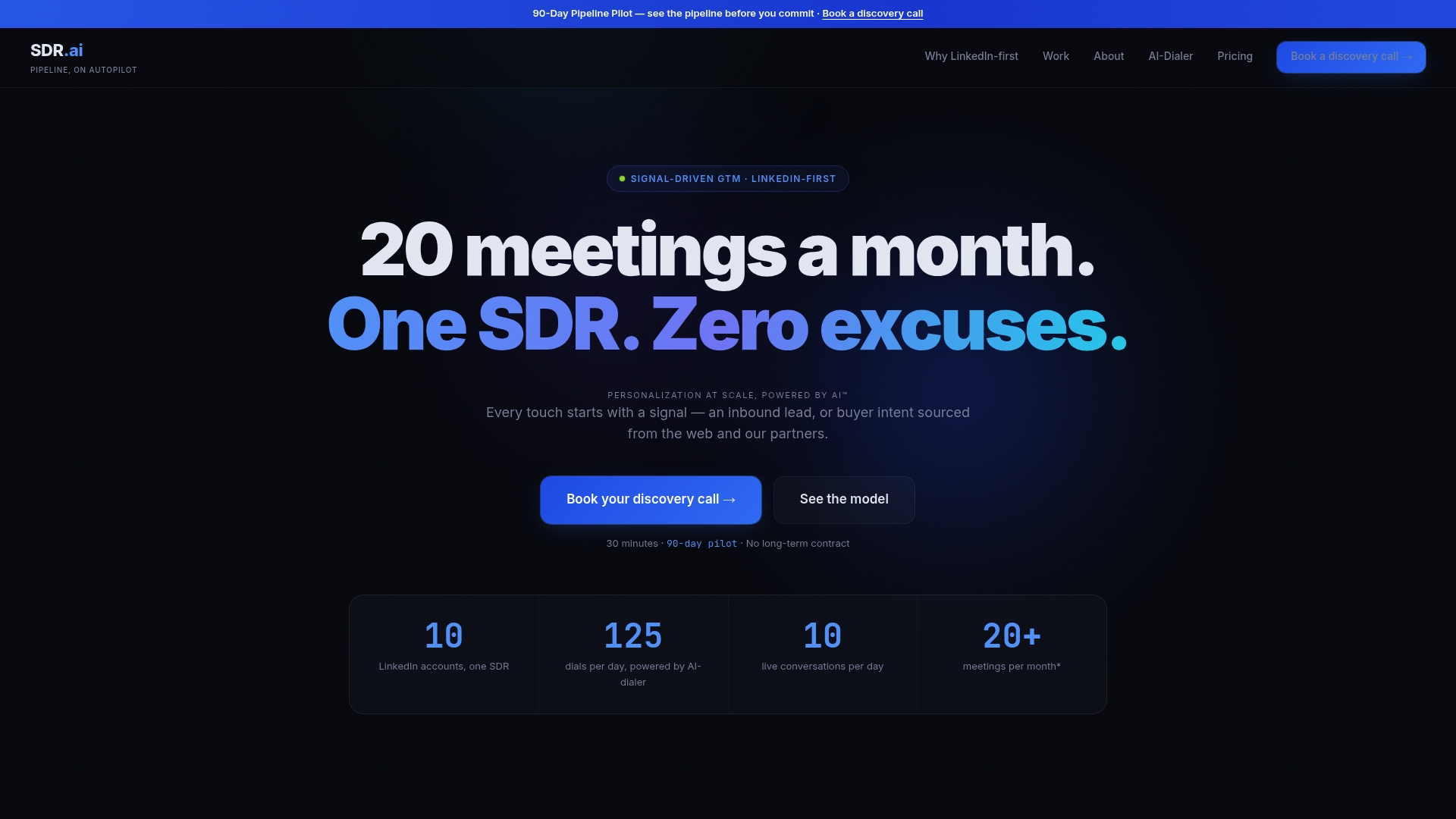
If you'd rather see the method than build it from scratch, the Sdr walks through how the process fits together, or you can book a demo to see it applied to your own ICP.
Sources
- Preference matters more than in-market intent alone in modern B2B buying
- Next-gen B2B sales: How three game changers grabbed the opportunity
- 29 Types of Trigger Events and How to Track Them
FAQ
What is a trigger event in B2B sales?
A trigger event is a specific, time-stamped change at a company or contact, like a funding round, a promotion, or a spike in pricing-page visits, that signals a real reason to reach out now. It works because it answers the buyer's unspoken question of why they're being contacted at this particular moment.
What are the best trigger events for outbound outreach?
The strongest performers tend to be account-level events like funding and M&A, people-level moves like promotions and new hires, and behavioral signals like repeated pricing-page visits. Layoffs and procurement activity, such as a published RFP, can also open a window, though they call for more careful timing.
How quickly should I respond to a trigger event?
High-weight signals like funding announcements or leadership changes deserve outreach within 24 to 48 hours, since budget and priorities are actively shifting. Weaker signals, like a single page visit, are better watched until they repeat or combine with another trigger.
How do I know if a trigger event actually caused a reply or meeting?
Track reply rate, meeting rate, and pipeline conversion by trigger type, then compare against a control sequence with a real A/B test. Since Forrester's research shows preference often forms before visible intent, some wins reflect existing preference rather than the trigger itself, so isolating true signal impact takes deliberate testing, not just watching reply counts.
Can trigger-based outbound be automated?
Parts of it can, alert routing, data collection, and merge-field personalization all scale well with the right tools. Gartner reports that AI saves sellers about 4.8 hours per week, but most sales organizations do not reinvest the time into higher-value activities.