
A sales call framework is a repeatable structure that tells you what each part of a call must achieve, while leaving the exact words to you. A script fixes the words. A framework fixes the purpose of each stage. The best choice depends on the call: a short cold call needs a tight opener and a clear ask, a discovery call needs a question path that bends with the answers, and a follow-up call needs a concrete next step. Below you will find the main frameworks, when each fits, a seven-step flow for any B2B call, and how to keep it from sounding scripted.
TL;DR
- A framework sets the goal of each stage of a call. A script sets the words. Use a framework for discovery and a short, flexible talk track for cold openers.
- Neil Rackham's research describes four stages of a sales call: opening, investigating needs, demonstrating capability and obtaining commitment.
- Match the framework to the call type: a four-part cold call structure, SPIN-style questions for discovery, BANT or MEDDIC for qualification.
- Every call should end with a specific, dated next step, not a vague promise to talk again.
- Practice the structure until you can drop it into natural conversation, then adjust it for each niche.
Table of Contents
- Sales call frameworks vs. scripts vs. talk tracks
- The four stages of a sales call
- A cold call framework in four parts
- Discovery call frameworks
- A seven-step flow for any B2B sales call
- Rules of thumb: 70/30 and 2-2-2
- How to adapt a framework without sounding scripted
- Our perspective: frameworks work best when the right person is on the line
- Put the framework to work with SDR.ai
- FAQ
- Sources
Sales call frameworks vs. scripts vs. talk tracks
The three terms get mixed up, and the difference matters in practice.
A script is prewritten wording for a defined selling situation: the opener, the questions, the value statement, the objection responses and the close. SalesArmor's guide describes a script as word for word, and a talk track as something that fixes the route while leaving the wording to the rep.
A talk track sits in the middle. It is a flexible outline of what you will say and in what order, and it adapts to different prospects. ClickUp's explanation frames the contrast the same way: flexible outline versus word-for-word guide with little room to move.
A framework is one level up. ConnectLoop's guide defines it as a structure that specifies what the rep must accomplish or learn during a call, such as the buyer's situation, pain, budget and decision process, without prescribing exact wording.
Why does this matter for discovery? The next good question depends on what the prospect just said. DrillCall's account makes this point: a fixed script cannot reliably anticipate the answer. A framework lets you track the ground you need to cover and choose the next question from what you hear.
A simple rule of thumb:
| Script | Talk track | Framework | |
|---|---|---|---|
| What it fixes | Words and order | Route and key messages | Goal of each stage |
| Flexibility | Low | Medium | High |
| Best for | First 20 seconds of a cold call, voicemail | Cold calls, demos | Discovery, qualification, negotiation |
| Main risk | Sounding robotic | Drifting off the route | Skipping a stage when the call gets chatty |
The four stages of a sales call
People ask about the "four types of sales calls," and the answer depends on whether you mean the stages inside one call or the kinds of calls across a deal.
Inside a single call, Neil Rackham's SPIN Selling Fieldbook identifies four stages: opening, investigating the buyer's needs, demonstrating capability, and obtaining a commitment to an action that advances the sale. It is a useful skeleton because it is older than any tool you use and still maps onto a call today.

Across a deal, calls tend to fall into types, each with a different job. Zendesk's guide describes discovery or warm calls (assess fit with an interested lead), sales appointments (focus on offer specifics and advancing the sale) and follow-up calls (help close the deal). HubSpot's list goes wider, with ten types including introduction, discovery, demo, negotiation, renewal and follow-up calls.
The practical takeaway: do not run the same call format at every point in the buying cycle. A first call to a stranger and a negotiation call with a champion need different structures.
A cold call framework in four parts
The job of a cold call is small: earn a few more minutes, or a meeting. It is not to pitch your whole product. A compact structure that works for most B2B teams has four parts:
- Opener. Say who you are and why you are calling in one sentence. Make it about them, not you.
- Problem statement. Name one problem you believe a company like theirs has, based on research, not a guess.
- Pain question. Ask whether that problem shows up for them and what it costs.
- Ask. Propose a specific next step with a time, not "let me know if you're interested."
Research is what makes this four-part structure work. Planning for a call means learning about the prospect, preparing open-ended questions and having specific dates and times ready when you ask for the appointment, as Dialpad's planning guidance puts it. When you open with a problem that is true for them, the first 30 seconds stop feeling like an interruption.
Timing and context also change the odds. A call to someone who just requested a demo is a different conversation from a call to a cold list. We cover the speed side of that in our piece on contacting demo requests within an hour.
Handling the first objection
Most cold calls hit "not interested" or "send me an email" in the first minute. Treat it as information, not a verdict. A short, calm response that acknowledges it, restates the one-sentence reason for calling and asks one low-friction question keeps the conversation alive without pushing. If the answer is still no, thank them and move on. A polite exit protects your reputation and your next call.
Discovery call frameworks
Discovery is where deals are won or lost, and where a rigid script hurts most. Three structures are worth knowing.
SPIN
SPIN uses four kinds of question: Situation, Problem, Implication and Need-payoff. Situation questions set context, problem questions surface difficulties, implication questions explore what those problems cost, and need-payoff questions let the buyer say aloud why solving them matters. It is built for the investigating stage that Rackham's fieldbook treats as central to the call.
A SPIN run for an outbound services buyer might sound like this:
- Situation: "How are you generating new meetings today?"
- Problem: "What's hardest about keeping that consistent?"
- Implication: "When the pipeline dips, what happens to your hiring and revenue plan?"
- Need-payoff: "If you had a steady stream of qualified conversations, what would that let you do?"
If you want more depth on how buyers ask and how to answer, this overview of buyer-intent questions pairs well with the investigating stage.
BANT and MEDDIC
These are qualification frameworks. BANT checks Budget, Authority, Need and Timeline. MEDDIC goes deeper into metrics, economic buyer, decision criteria, decision process, pain and champion. Use them as a checklist in your head, not as an interrogation. Asking four budget questions in a row is a quick way to end a call. For choosing among them based on deal size and what to record in your CRM, see our guide to lead qualification frameworks for B2B.
A mutual-fit structure
Some teams prefer a structure that frames the call as a joint check: open and set an agenda, establish context and stakes, explore the situation and problem, qualify, confirm mutual fit, and agree a dated next step. The collaborative tone works well with senior buyers, who dislike feeling processed. It also lets either side say "this is not a fit" early, which saves everyone time.
Questions worth asking in almost any discovery call
- What tools and process do you use today, and what works or does not?
- What are your goals for the next two quarters, and what stands in the way?
- What is the business impact if nothing changes?
- Who else is involved in a decision like this, and how will you evaluate options?
- What is your timeline, and is budget set aside?
These follow the pattern of common discovery checklists: current process, goals and obstacles, impact, decision participants and criteria, timeline and budget. Consequence questions in particular separate a real discovery call from a friendly chat, because they reveal urgency and what is at stake for the buyer.
A seven-step flow for any B2B sales call
If you want one structure to start with, use this. It combines the four stages above with the practical bookends of preparation and follow-up.
- Prepare. Research the account and the person. Write down one hypothesis about their problem and the two or three questions you most want answered.
- Open. Greet, state the purpose in a sentence and ask permission to ask a few questions. Confirm how much time they have.
- Set the agenda. Say what you will cover and what you hope to leave with. This lowers resistance and makes the ending easier.
- Investigate. Ask open questions, listen, and follow the answers. This is the longest part of the call and the part that most affects the outcome.
- Summarize and connect. Repeat their problem in their words, then link one relevant capability to it. Show relevance, not a feature tour.
- Handle objections. Ask what is behind a concern before you answer it. Often it is a missing piece of information, not a refusal.
- Agree the next step. Name a specific action, owner and date: a demo with their finance lead on a named day, not "I'll circle back."
That last step is where many calls leak value. A call that ends without a calendar invite usually stalls. Once the next step is set, the follow-up needs its own rhythm; our follow-up cadence guide lays out an 8 to 12 touch sequence you can test.
Rules of thumb: 70/30 and 2-2-2
Two "rules" show up constantly in searches.
The 70/30 rule says the prospect should do most of the talking, roughly 70 percent, and the rep about 30 percent, on a discovery call. It is a guideline, not a law, but it is a handy check. If you listen back to a recording and you are speaking half the time, your questions are probably too closed.
The 2-2-2 rule is defined differently from team to team, so do not assume a colleague means what you mean. If you adopt it, write down your definition in your team playbook so everyone is measuring the same thing.
The lesson is the same for both: a rule of thumb only helps if your team agrees on what it measures and reviews real calls against it.
How to adapt a framework without sounding scripted
The aim is to learn the structure so well that you stop thinking about it. A useful picture is a GPS: it shows the route, but you still choose how to drive when the road changes. Reps who master the structure can improvise naturally in response to what the prospect says instead of reading a page.
Some ways to do that:
- Memorize goals, not sentences. For each stage, know what you need to learn or achieve. Pick your own words each time.
- Script only the first 15 seconds. Your opener and your ask benefit from rehearsal. Everything between should respond to the person.
- Adapt by buyer stage. Context and exact nature of a call vary by industry, company and product, and the right structure follows where the prospect is in the buying cycle.
- Adapt by niche. In a narrow B2B market, buyers know their problems and their vocabulary. Use their terms, skip the basics and lead with the specific problem your research found. A founder at a 40-person software company and a VP at a regulated enterprise need different openers, even if the framework underneath is the same.
- Review calls weekly. Listen for stages that were skipped, questions that were closed, and moments where the prospect said something you did not follow up on.
Niche targeting also depends on picking the right accounts to call in the first place. If you are building that from scratch, our two-week outbound playbook shows how to set it up, and our guide to appointment setting strategies covers turning conversations into booked meetings.
Our perspective: frameworks work best when the right person is on the line
We see the same pattern in every outbound team we talk to: the framework is rarely the problem. The problem is who gets the call, and when.
A cold call to a random list forces even a great rep into a pitch. A call to someone who has just shown intent, a job change, a funding round, a visit to your pricing page, lets the framework do its work. The opener is relevant, the problem statement is true, and the ask is easy to say yes to. That is why we build our service around the ideal customer profile and intent signals first, and treat the call as the last step, not the first.
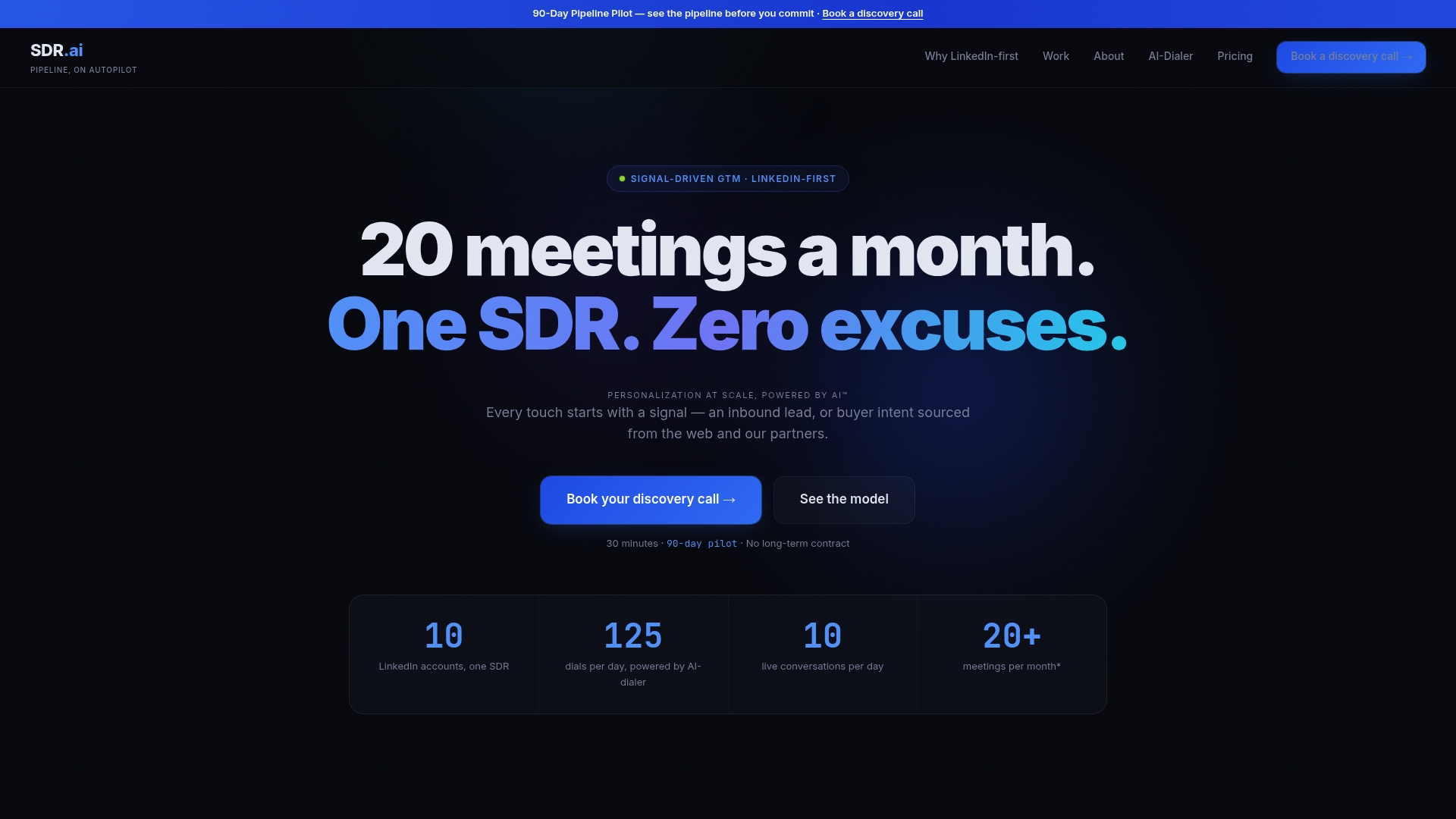
We also believe in keeping a human on the conversation. Our approach is LinkedIn-first outreach, warm calling with an AI dialer, and a human SDR who handles every reply. The AI finds and prioritizes the right people. A person runs the discovery conversation, adapts to the answer and agrees the next step. Structure plus judgment is the combination we design for.
If you are a founder or sales leader without a team of SDRs, you do not need to build every part of this yourself. You need a repeatable process, clear pipeline math and calls that start warm.
Chad
Put the framework to work with SDR.ai
If you would rather not build and staff the whole motion yourself, we run it for you. Our AI-Powered Outbound service combines LinkedIn-first outreach, intent-based targeting, warm calling and multichannel follow-up, with a human SDR handling every reply. It costs $2,500 per month plus a one-time $500 setup fee.
If your team already makes its own calls, our AI-Dialer is available at $2,400 per year, with a one-time $500 onboarding fee. If you want to build the engine in-house, The SDR.ai Blueprint shows the model we use. You can also start at sdr.ai to see which option fits.
FAQ
What are the four types of sales calls?
It depends on the source. Within one call, Rackham's four stages are opening, investigating, demonstrating capability and obtaining commitment. Across a deal, common types include discovery or warm calls, sales appointments, and follow-up calls, and some lists add demo, negotiation and renewal calls. Choose the grouping that matches your sales process.
What are the seven steps of a sales call?
A practical sequence is: prepare, open, set the agenda, investigate, summarize and connect your solution, handle objections, and agree a specific next step. The investigating step deserves the most time, since Rackham's research treats it as the most important part of the call.
What is the 70/30 rule in sales?
It is a guideline that the prospect should speak about 70 percent of the time on a discovery call and the rep about 30 percent. Use it as a self-check when reviewing recordings. If you talk more than that, replace some statements with open questions.
Should I use a script or a framework?
Use both, in different places. Script your opener, your ask and your voicemail, because those benefit from rehearsal. Use a framework for the middle of the call, where the next question depends on what the buyer just told you.
Which framework is best for a cold call?
A short four-part structure of opener, problem statement, pain question and ask suits most cold calls, because the goal is only to earn a next conversation. Save SPIN, BANT or MEDDIC for discovery, once the prospect has agreed to talk.
Sources
- The SPIN Selling Fieldbook: Four Stages of a Sales Call
- 10 Types of Sales Calls: What to Know and How to Use Them
- Convince and convert: How to make sales calls successful
- What Is a Sales Script?
- How to Create Sales Talk Tracks
- Sales Call Script: Templates for Inbound and Discovery Calls
- Sales Script vs Framework: Which to Hold on a Call
- Sales Call Planning: Getting it Right For Your Reps
- Buyer-Intent Questions: What Buyers Ask and How to Answer