
Human-in-the-loop sales AI is a setup where AI does the heavy, repetitive work (research, drafting, sequencing, follow-up timing) and a person approves, edits or takes over at the points where judgment matters: before anything reaches a buyer in a sensitive way, and the moment a buyer replies. The AI supplies speed. The human supplies judgment, accountability and the relationship. This guide shows where to put the human, what to automate, how to design the workflow, and how to tell whether it works.
TL;DR
- Human in the loop means a person holds authority over AI output at defined points. It does not mean a person re-does every step the AI performs.
- Let AI handle research, signal detection, first drafts and scheduling. Keep people on replies, qualification, pricing talk and anything ambiguous.
- The most important handoff is the buyer reply. Automation should stop there and a human should read it.
- Review does not have to stay heavy forever. Start tight, then loosen where the quality data earns it.
- We run this model at SDR.ai: AI-driven targeting, with a human SDR handling every reply.
Table of Contents
- What human in the loop means in a sales process
- Which sales tasks AI can support, and where a person steps in
- Human oversight versus fully automated outreach
- How to design a human-in-the-loop sales AI workflow
- How to measure whether it works
- Our perspective
- What this looks like with SDR.ai
- Common mistakes to avoid
- FAQ
- Sources
What human in the loop means in a sales process
The phrase comes from AI system design: a person reviews or approves what a system does at set points. In sales, one useful definition describes AI agents doing multi-step work on their own, with a human stepping in at defined approval gates, usually to validate judgment calls before something customer-facing happens.
In enterprise B2B selling, the human in the loop has the authority to assess an AI output, ask for changes, or stop a proposed action before it affects a buyer. The word that matters is authority. A person who skims a draft and clicks send on reflex is not in the loop in any useful sense. A person who can change or kill the action, and has the context to do so, is.
Where the human sits matters
Two patterns get confused. In the first, a person sits in the middle of every step: they prompt, read, re-prompt, paste, and send. Output scales with headcount, because each message costs a person's time. In the second, the AI runs the sequence and the human sits at the gates: approving the target list and the message angles, then taking over when a prospect responds. That second pattern is the one described as scaling judgment instead of headcount, and it is the one worth building.
A related idea is worth separating: human on the loop, where a person monitors a running system and can intervene, and human out of the loop, where nothing is reviewed. For outbound to real buyers, we think the first two are defensible and the third is a gamble with your brand. If you are designing tooling for this, agent workflows with human approvals show how approval steps can be built into an automated pipeline without making a person re-check every action.

Which sales tasks AI can support, and where a person steps in
Not every task carries the same risk. A wrong guess about a prospect's job title costs you little. A tone-deaf reply to a founder who just said they are interested can cost you the deal. Sort tasks by what a mistake costs and how reversible it is.
| Sales task | AI role | Human role |
|---|---|---|
| Building the target list from your ICP | Pulls and scores accounts and contacts | Approves the ICP definition and exclusions |
| Detecting intent signals | Monitors hiring, funding, content and engagement signals | Decides which signals deserve outreach |
| Researching a prospect | Summarizes role, company and recent activity | Spot-checks accuracy on new segments |
| Drafting first-touch messages | Writes variants from the research | Approves the angle and tone before launch |
| Scheduling and sequencing | Times touches across channels | Sets cadence limits and quiet periods |
| Handling replies | Flags and routes them | Reads every reply and decides the next move |
| Qualifying interest | Gathers context from the thread | Judges fit, budget, timing and need |
| Pricing, objections, negotiation | Prepares notes | Owns the conversation |
| Logging and CRM updates | Writes activity and fields | Confirms stage changes |
The pattern is consistent. In one practical B2B workflow built around a CRM, the AI researches, drafts and preps, the rep reviews, and the CRM is where the lead stage actually advances. The record of truth stays with people.
The reply is the line you do not automate across
The cleanest rule in human-gated outreach is this: when a buyer replies, automation stops. A well-known pattern halts the sequence on any reply and hands control to a human, who validates the need and context and decides what happens next. The same pattern treats a few events as hard stops:
- Unsubscribe or do-not-contact: suppress all further touches.
- Hard bounce: stop that channel.
- Ambiguous response: stop, and have a person read and classify the thread.
Ambiguity is where AI most often goes wrong. "Not now, maybe next quarter" can mean a polite no, a real timing issue, or a request to be reminded in 90 days. A person reads the tone, the company's situation and the history, and picks the right follow-up. A classifier guesses.
Keep email compliance in the human's hands
If any part of your outreach goes by email, the legal duties do not move to the AI. The FTC's CAN-SPAM guidance says the law covers all commercial email and makes no exception for business-to-business messages. That includes accurate sender information, non-deceptive subject lines, clear identification as an ad, and honoring opt-outs. Put someone accountable in charge of suppression lists and opt-out handling, and ask your legal counsel to confirm your setup for your situation.
Human oversight versus fully automated outreach
Fully automated outreach is attractive on paper: no salaries, no ramp time, unlimited volume. The trouble shows up in what the volume produces.
One vendor-side analysis argues that some AI outbound tools can lift initial email response rates while producing fewer qualified opportunities, leaving a wider but shallower pipeline when no human qualifies what comes back. An opinion piece in the sales tech press goes further, arguing that over-automating a customer-facing moment can create a trust deficit that appears roughly 18 months later, invisible on dashboards until it has already cost the relationship. Treat both as arguments to weigh, not measurements, but the logic is easy to check against your own experience as a buyer. You remember the vendor that sounded like a machine pretending to be a person.
Here is how the two models compare on the points founders ask about:
| Criterion | Fully automated | Human in the loop |
|---|---|---|
| Speed to launch | Fast | Fast, with a short setup for approvals |
| Message volume | Highest | High, set by the ICP and signals |
| Reply handling | Bot or auto-classifier | Person reads every reply |
| Risk of off-tone or wrong-fact messages | Higher, no checkpoint | Lower, with gates before and after |
| Brand exposure | Every error ships | Errors are caught at review |
| What you measure | Replies and opens | Qualified meetings and pipeline |
The goal is not fewer messages. It is more meetings that a seller actually wants to take.
How to design a human-in-the-loop sales AI workflow
A useful design pattern from one AI pilot guide splits human intervention into three moments: before the AI works (people curate the data and set guardrails), after it generates (people edit, approve or reject), and over time (review frequency drops as confidence grows). That maps cleanly onto outbound.

Step 1: Set the guardrails before any message exists
Define your ICP in writing: company size, stage, industry, buyer titles, and the accounts you will never contact (customers, partners, open opportunities). Decide which intent signals count. Write down the claims the AI may and may not make. A person owns this document, and it is the single biggest quality lever in the whole system.
Step 2: Approve the angles, not every message
Have a person approve the message angles, proof points and tone for each segment. Then review a sample of generated messages per batch instead of every one. If the sample shows errors (wrong company facts, stale news, awkward personalization), pause the batch and fix the inputs.
Step 3: Gate the replies
Route every reply to a person. Give them a short classification: interested, not now, not the right person, referral, unsubscribe, unclear. Each class has a defined next action, and unsubscribe always suppresses.
Step 4: Qualify before you hand off
A meeting is not a meeting until someone has confirmed the basics: the problem exists, the person has a say in solving it, and the timing is plausible. The person who handled the reply is best placed to do this before the calendar invite reaches your closer. This is why human SDRs qualifying replies matters in a multi-stage B2B booking flow.
Step 5: Loosen review only where the data says so
Start with heavier review in the first weeks. Track the error rate per task. When a task such as list building or research summaries runs clean for several batches, move it from full review to sampling. Keep reply handling and qualification human at every stage.
How to measure whether it works
Measure outcomes at the bottom of the funnel, not activity at the top. A short scorecard:
- Positive reply rate: replies showing real interest, as judged by a person, divided by prospects contacted.
- Qualified meetings held: meetings that took place and met your qualification bar, not meetings booked.
- Pipeline created per month: the dollar value of opportunities opened from those meetings.
- Cost per qualified meeting: total program cost divided by qualified meetings held.
- Review quality: share of AI drafts changed or rejected at the gate. A falling rate suggests the inputs are improving.
- Opt-out and complaint rate: a rising number means your targeting or tone has slipped.
A published experiment from European B2B agencies reported that AI-assisted outreach beat human-only outreach on several top-of-funnel measures and cost less per meeting, while concluding AI removed repetitive admin work rather than replacing salespeople. It is one company's account of its own test, so use it as a prompt for what to measure in your program, not as a benchmark to promise your board.
Compare cohorts for at least a full sales cycle. Reply rates move in days; pipeline and closed deals take months. If you want the cost side of the staffing decision, our breakdown of outsourced SDR versus in-house costs lays out the math.
Our perspective
We built SDR.ai on a simple belief: AI should find the right people and the right moment, and a human should talk to them.
Most outbound fails in one of two ways. Either a team hires SDRs, waits months for them to ramp, and pays salaries before a single meeting lands. Or it turns on a tool that blasts thousands of messages and floods the inbox with replies nobody qualified. We think both are avoidable.
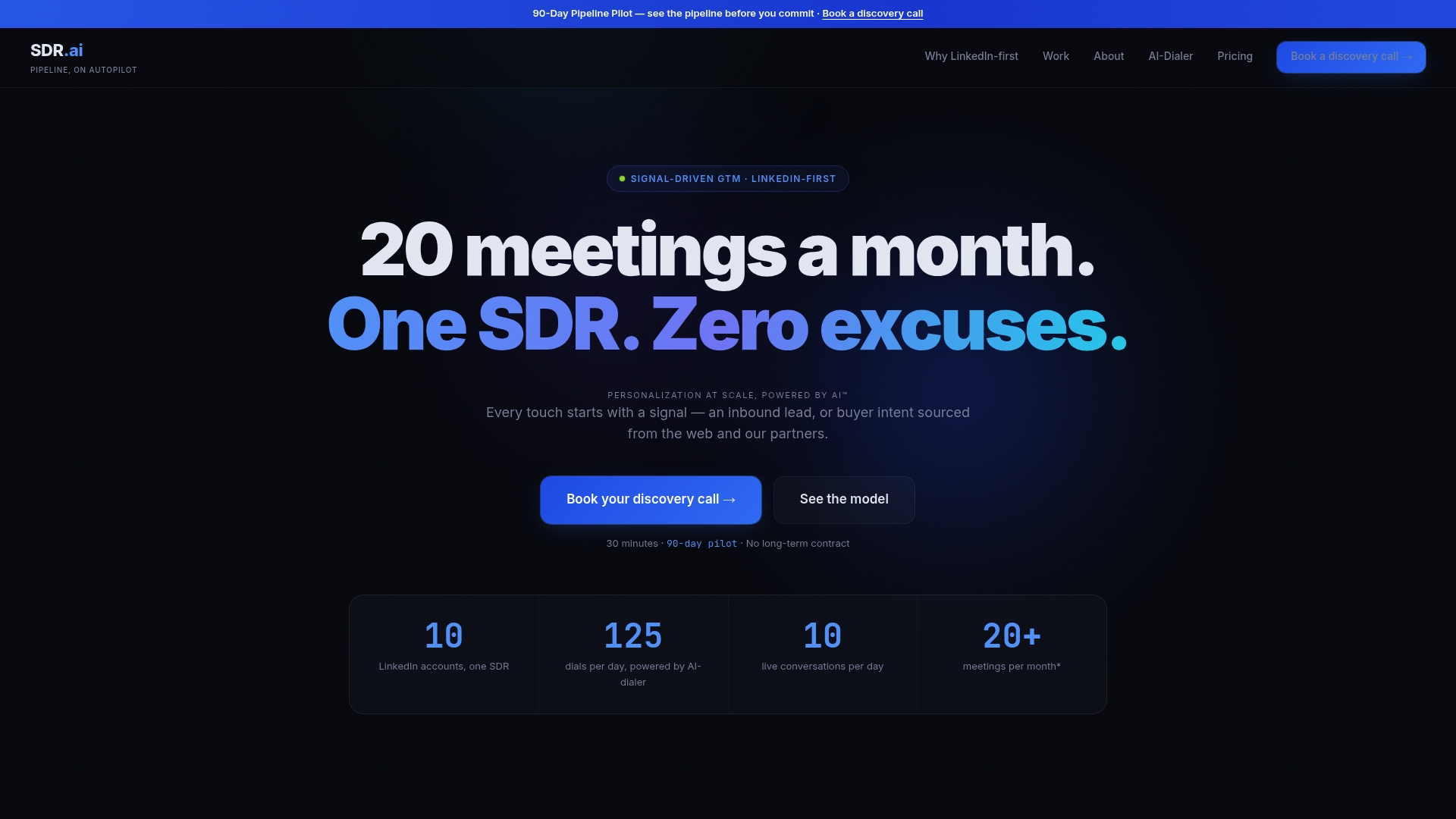
Our model is signal-driven and LinkedIn-first. We focus only on your ICP and on intent signals, so outreach goes to people with a reason to care. AI handles the targeting and the repetitive work. A human SDR handles every reply. That is the line we hold, because the reply is where trust is won or lost.
The result is pipeline math you can read: who we contacted, who responded, who qualified, and what it cost. We aim to book 20 or more qualified meetings a month with minimal manpower on your side, and you do not need to build an SDR team to get there.
Human in the loop is not a compromise between automation and quality. Done well, it is how you get both.
Chad
What this looks like with SDR.ai
If you are a founder or sales leader who wants this model running without hiring and training a team, our AI-Powered Outbound service is built around it: signal-driven targeting, personalized LinkedIn-first outreach, multichannel follow-up, and a human SDR on every reply. It is $2,500 per month with a one-time $500 setup fee.
If your team already has reps and needs a faster way to reach warm prospects, our AI Dialer is $2,400 per year with a one-time $500 onboarding fee. If you would rather build the engine yourself, The SDR.ai Blueprint covers the model and playbooks. To see how it runs against your own ICP, book a demo.
Not sure which route fits? Our honest AI SDR versus SDR agency comparison walks through the tradeoffs, and our plain-English guide to the AI SDR covers the basics.
Common mistakes to avoid
- Reviewing everything, so nothing scales. If a person must touch every message, you rebuilt a manual process with extra steps. Review at gates and by sample.
- Reviewing nothing, so errors ship. One wrong company fact in a message to a founder is enough to end the conversation.
- Letting the sequence continue after a reply. Stop on any response. A follow-up that ignores what the buyer just said is the fastest way to look automated.
- Counting booked meetings instead of qualified ones. Calendar volume that your closers cannot use erodes their trust in the program.
- Skipping the written ICP. Without it, reviewers have no standard to judge against, and the AI has nothing to aim at.
- Forgetting opt-outs. Suppression must be immediate and shared across every channel you use.
For a deeper look at how a managed model handles these points for Series A and B teams, see our piece on managed SDRs in AI outbound.
FAQ
What does human in the loop mean in sales AI?
It means a person has real authority over what the AI does at defined points, such as approving target lists and message angles, and taking over when a buyer replies. The AI does the repetitive work. The human decides what reaches the buyer in sensitive moments and what happens next.
Does human in the loop slow outbound down?
Not when the gates are placed well. Reviewing a sample of drafts and reading replies takes far less time than researching and writing every message by hand. Speed comes from AI doing the research, drafting and sequencing, while people spend time only where judgment changes the outcome.
Which steps should always stay human?
Reply handling, qualification, objections, pricing and anything ambiguous. Unsubscribe and do-not-contact requests should also be honored without exception. Treat a reply as the point where automation stops and a person takes over.
Can the amount of human review go down over time?
Yes. A common pilot approach is to begin with heavy review and reduce it task by task as the error rate falls. Reply handling and qualification should stay with people throughout.
Is human-in-the-loop outreach cheaper than building an SDR team?
For many early-stage teams, yes, because you avoid recruiting, ramp time and salaries before meetings arrive. With SDR.ai, the published price is $2,500 per month plus a $500 setup fee. Our cost comparison shows the full math.
Sources
- Human-in-the-Loop definition, DrJoe.me
- Human in the Loop: How B2B Sales Must Assess AI Output, Seismic
- A B2B sales workflow built with AI and a CRM
- AI Sales Outreach: A Human-Gated B2B Workflow
- CAN-SPAM Act: A Compliance Guide for Business, FTC
- AI Sales Agents Are Lying to Your Prospects
- Sales AI's Next Feature Should Be Restraint
- Designing a Human in the Loop AI Pilot
- AI SDR Experiment: 6-Month Results from European B2B Agencies
- AI sales and BizDev agents with human approvals