
Federal law lets you record a phone call if at least one person on the call consents, and that person can be you. But states can be stricter, and about a dozen require everyone on the line to agree. If your team calls prospects in more than one state, the safe rule is simple: get consent from every party, every time, and capture it on the recording.
This guide is written for founders, sales leaders and ops teams who run outbound calls. It covers the federal baseline, the state split, the interstate problem, penalties, and a working compliance routine. It is general information, not legal advice. Before you roll out a recording policy, have a lawyer licensed in your states review it.
TL;DR
- Federal law requires consent from at least one party to record a call. State law controls when it is stricter.
- Roughly 37 states and D.C. are generally one-party consent. About 11 states, including California, Florida, Illinois, Pennsylvania and Washington, primarily require all-party consent.
- On calls that cross state lines, follow the strictest rule that could apply, which in practice means telling everyone and getting a clear yes.
- Announce recording at the start of the call, then capture the confirmation on the recording itself.
- Penalties include criminal charges and civil damages, so "we record everything by default" is not a policy.
Table of Contents
- What federal law says about recording calls
- One-party consent states
- Two-party (all-party) consent states
- Calls that cross state lines
- What counts as consent
- Penalties for getting it wrong
- A compliance routine for sales teams
- Our perspective on recording in outbound sales
- Running outbound without building the compliance machine yourself
- FAQ
- Sources
What federal law says about recording calls
The starting point is the federal wiretap framework known as Title III. In 1986 Congress passed the Electronic Communications Privacy Act, which expanded Title III to cover electronic communications alongside wire and oral communications. The Supreme Court has described one stated purpose of Title III as protecting the privacy of wire and oral communications.
The practical rule that matters to a sales team: federal law requires consent from at least one party to record a telephone conversation, and states may impose stricter rules. That is why you hear "one-party consent" so often. If you are on the call and you agree to the recording, the federal bar is met.
The federal rule is a floor, not a ceiling. When a state law is stricter, the state law controls. So the federal answer is never the whole answer for a business that calls across the country.
One-party consent states
In a one-party consent state, you can record a call you take part in without telling the other side. One participant, including the person doing the recording, has to agree.
One industry roundup lists 37 states and the District of Columbia as generally one-party consent:
| Region | States generally treated as one-party consent |
|---|---|
| South | Alabama, Arkansas, Georgia, Kentucky, Louisiana, Mississippi, North Carolina, Oklahoma, South Carolina, Tennessee, Texas, Virginia, West Virginia |
| Midwest | Indiana, Iowa, Kansas, Michigan, Minnesota, Missouri, Nebraska, North Dakota, Ohio, South Dakota, Wisconsin |
| West | Alaska, Arizona, Colorado, Hawaii, Idaho, New Mexico, Oregon, Utah, Wyoming |
| Northeast | Maine, New Jersey, New York, Rhode Island |
The same source notes that some of these states carry context-specific nuances or exceptions. State guides from the Reporters Committee for Freedom of the Press confirm the basics for several of them. Alabama requires consent from at least one party to record a private telephone communication, and unlawful recording can carry criminal penalties. Alaska allows recording when at least one party consents. South Dakota allows a party to a call, or someone with one participant's consent, to record it. Kansas generally permits recording a private telephone communication with at least one party's consent.
Why the label can mislead
The Reporters Committee cautions that consent rules vary not only by state but by the type of communication and the circumstances, so a one-party or all-party tag can hide exceptions. A few examples:
- Some states treat electronic and in-person conversations differently. Nevada and Oregon apply different consent requirements to each.
- Michigan shows up on both lists depending on the source. The Reporters Committee counts it among all-party states at least for third-party recordings, while the roundup above lists it as one-party. When sources disagree, treat the state as all-party and move on.
- Narrow exceptions exist, such as certain law enforcement activities or emergency responses. They will rarely apply to a sales call.
Two-party (all-party) consent states
"Two-party consent" is the common phrase, but the legal idea is all-party consent: everyone on the call must agree, whether that is two people or six. The Reporters Committee's overview identifies about 11 states that primarily require all-party consent:
- California
- Delaware
- Florida
- Illinois
- Maryland
- Massachusetts
- Michigan (at least for third-party recordings)
- Montana
- New Hampshire
- Pennsylvania
- Washington
The same overview adds that Connecticut and Nevada require all-party consent for phone calls. New Hampshire is a clear example of how seriously states treat this: recording with only one party's consent is unlawful and may carry criminal penalties.
If your target accounts include California, Florida, Illinois, Pennsylvania or Washington, you are calling into all-party territory every week. These are some of the biggest technology and business markets in the country, so for most B2B outbound teams this is the rule, not the exception.
Calls that cross state lines
Outbound sales is where the one-party versus all-party split bites. Your rep may sit in Texas, a one-party state, while the prospect picks up in California. Which law applies?
Often it is hard to say. The Citizen Media Law Project advises getting consent from all parties for interstate calls because it is difficult to know which state's law controls. The Digital Media Law Project's guide says the same thing: when participants are in more than one state, the safest approach is consent from all parties.
Law firm guidance lines up. Kilpatrick's 2024 chart calls one-party consent the majority rule but recommends following the strictest applicable rule for calls involving multiple states. A 50-state survey makes the same point: when a call extends across state lines, parties may want to comply with the most restrictive law to avoid liability.
For a team calling a national list, that settles the design question. Build one policy that meets the strictest standard and apply it to every call. It is cheaper than maintaining a state-by-state rulebook that reps have to remember mid-dial.

Calls that cross national borders add foreign rules on top of this. The sources above are U.S. law only, so if you call prospects abroad, get local counsel for those countries before recording.
What counts as consent
Consent can be express (the person says "yes, that's fine") or implied (they hear a disclosure and keep talking). One industry guide says businesses can put a recording notice in the greeting, and continuing the call is treated as implied consent. That is a common practice, but it is the weakest form of proof. If a dispute lands in front of a lawyer, "they heard the greeting" is harder to defend than "they said yes on the recording."
For stronger proof, the Digital Media Law Project suggests a sequence: notify the person, obtain consent, then ask for on-record confirmation so the consent is documented with the call itself.
For outbound reps, that sequence is short. Here is a version that fits in the first fifteen seconds:
- Identify yourself and your company.
- Say: "I record calls for quality and training. Is that okay with you?"
- Wait for a clear yes before going on.
- If they say no, stop recording (or end the call, if your policy requires recording) and note it in the CRM.
The FTC has also stressed the quality of consent in other contexts. In an order involving AOL and CompuServe, the agency required express informed consent from subscribers who agreed to continue paid service after asking to cancel, with clear, conspicuous disclosure of material terms. That case is about billing, not recording, but the principle carries over: consent that is buried or assumed is consent you will struggle to prove.
Penalties for getting it wrong
This is not a paperwork risk. Under federal law, violations can carry fines or imprisonment for up to five years, and civil damages may be available under 18 U.S.C. § 2520. State violations can also bring severe penalties, potentially including years in prison, and state civil claims can come from the person you recorded.
There is a narrow statutory defense. Good-faith reliance on a court warrant or order, a grand jury subpoena, or certain statutory authorizations is a complete defense. A sales team will almost never fit it. "We thought the other side was in a one-party state" is not on that list.
Recordings can also be hard to use later. Virginia, for instance, has a rule limiting when recorded phone conversations can be admitted as evidence in civil proceedings, which means an improperly made recording may not help you even when you need it.
A compliance routine for sales teams
Here is a practical setup we would put in front of any outbound team.
1. Default to the strictest rule
Do not branch your script by area code. Area codes are also unreliable, since people keep mobile numbers when they move. Announce and ask on every call.
2. Disclose at the start, in the same words
Put the recording line in the rep's opening and in any voicemail or IVR greeting you control. Short and plain works best. Reps should not improvise it, because inconsistent wording creates inconsistent proof.
3. Capture the yes on the recording
Start the recording before the disclosure so the notice and the answer are both on the file. The recording itself becomes your consent record.
4. Log consent and refusals in the CRM
Make consent a field, not a memory. If you are connecting messaging and CRM data, conversational CRM messaging flows show how conversation data can feed back into sales records, and the same discipline applies to a consent flag on each contact. If your team uses a dialer tied to Salesforce, our dialer-to-Salesforce setup guide walks through mapping fields so call outcomes land where reps expect them. Our call disposition code taxonomy is a good place to add a "declined recording" outcome.
5. Even in one-party states, tell people
Best practice is to notify all callers that a recording may occur, even where the law does not require it, because it builds trust and adds a layer of legal protection. A prospect who finds out later that you recorded them quietly is not a prospect you keep.
6. Control who can hear recordings and how long you keep them
The sources here cover consent, not retention. Set access and retention rules with counsel, and apply them the same way across the team.
7. Train reps on what to do when someone says no
The worst moment is a rep who keeps recording because the dialer is already running. Give reps a one-line stop procedure and make it easy to follow.
Our perspective on recording in outbound sales
Most of the pain we see around call recording comes from treating it as a legal footnote instead of part of how a team sells. We run LinkedIn-first outbound, where a prospect usually has some context about who is calling before the phone rings. A call that opens with a clear, courteous "I record for quality, is that okay?" fits that style. It sounds like a professional, not a cold caller hoping nobody asks.
Our advice to founders is blunt. Pick the strictest standard and make it your default, because the cost of one extra sentence is tiny next to the cost of a wiretap claim or a deal soured by a surprise. Do not rely on a rep's judgment about which state a prospect is in. Build consent into the script, the CRM and the review process, and keep a human accountable for each reply.
The point of recording is learning: coaching reps, spotting objections, improving the pitch. That value is real only when prospects are comfortable on the call.
— Chad
Running outbound without building the compliance machine yourself
If you would rather not design scripts, routines and call workflows from scratch, that is the work we do. Our AI-Powered Outbound service is $2,500 per month plus a $500 one-off setup fee, with LinkedIn-first targeting, personalized messaging, warm calling and a human SDR handling every reply. You can see how it works on the SDR.ai site.
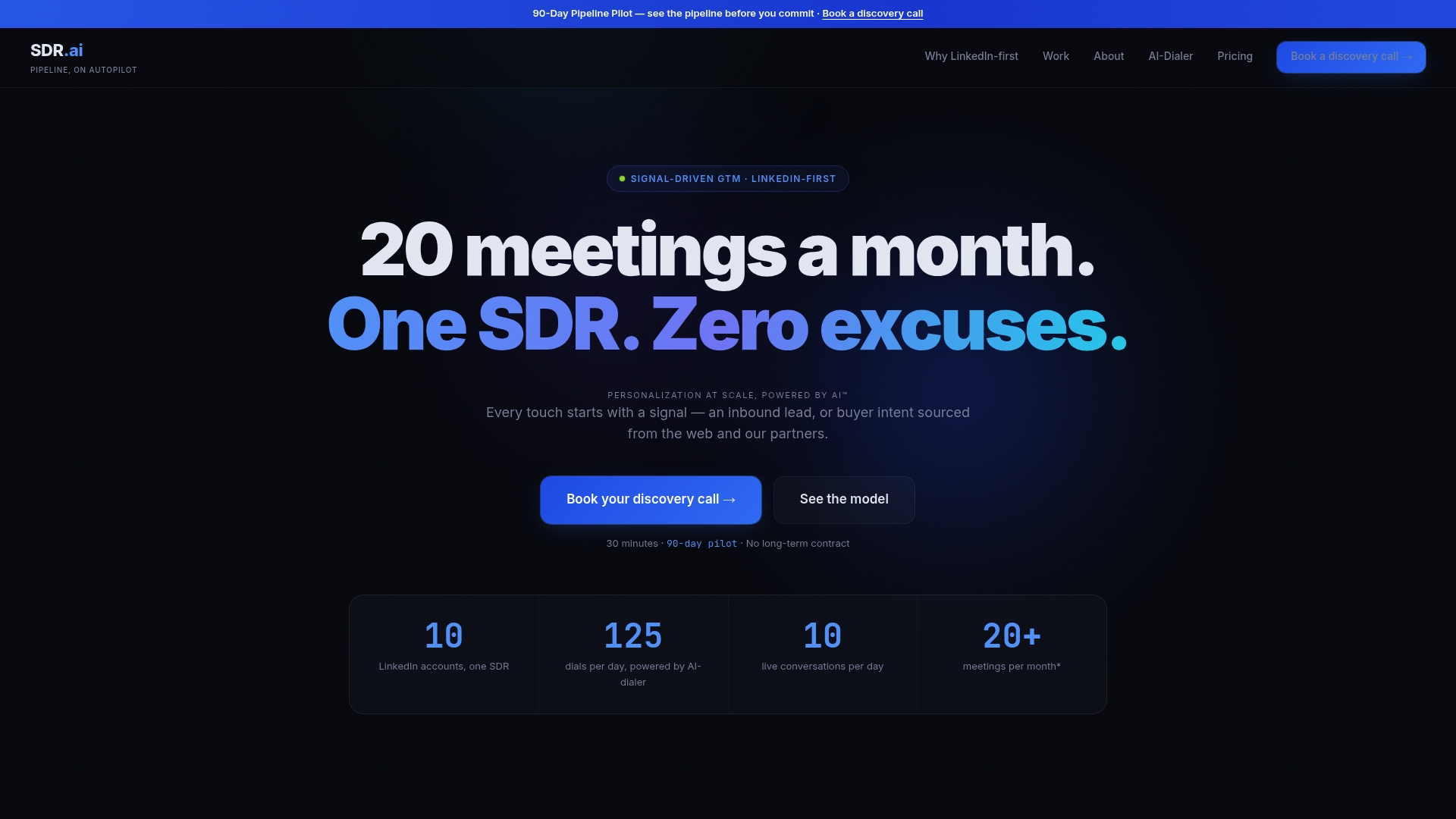
If your team already has reps and just needs a faster way to dial, the SDR.ai AI-Dialer is $2,400 per year with a $500 one-off onboarding fee. Whichever route you choose, bring your recording policy to the first conversation so it is built in from day one. For cadence design once the compliance basics are set, see our follow-up cadence guide.
FAQ
Is it legal to record a phone call without telling the other person?
It depends on the state. Federal law requires only one party's consent, so in one-party states you can record a call you are on. In all-party states such as California, Florida, Illinois, Pennsylvania and Washington, recording without everyone's consent can be a crime. For business calls that may cross state lines, tell everyone.
Which states are two-party consent states?
The Reporters Committee lists about 11 states that primarily require all-party consent: California, Delaware, Florida, Illinois, Maryland, Massachusetts, Michigan (at least for third-party recordings), Montana, New Hampshire, Pennsylvania and Washington. It also notes that Connecticut and Nevada require all-party consent for phone calls. Some states have exceptions by type of conversation, so check the state's own rules before relying on a list.
What if the caller and the prospect are in different states?
Follow the strictest rule that could apply. Legal guides from the Digital Media Law Project and law firms recommend getting consent from all parties because it is hard to tell which state's law governs. In practice, that means your standard script discloses the recording on every call.
Does a recording notice in my greeting count as consent?
Many businesses treat continued participation after a notice as implied consent. It is better to ask for a spoken yes and keep it on the recording, which gives you clear proof if anyone challenges the call later.
Do I need a lawyer to set up call recording?
For a team calling nationally, yes, it is worth an hour or two of review by an attorney who handles privacy or telecommunications law. They can check your script, retention rules and any calls to other countries against current law.
Sources
- Public Law 99-508 (Electronic Communications Privacy Act of 1986)
- Introduction to the Reporter's Recording Guide, Reporters Committee for Freedom of the Press
- Bartnicki v. Vopper, Supreme Court
- Call Recording Laws by State
- Alabama, Reporters Committee
- Alaska, Reporters Committee
- South Dakota, Reporters Committee
- Kansas, Reporters Committee
- New Hampshire, Reporters Committee
- Recording Phone Calls and Conversations, 50 State Survey
- Recording Phone Calls and Conversations, Digital Media Law Project
- Recording phone calls and conversations: Legal guide
- Kilpatrick wiretap laws chart, July 2024
- Practical Tips for Recording Phone Calls, Digital Media Law Project
- FTC petition to reopen proceedings, AOL and CompuServe order
- 18 U.S. Code § 2520, Recovery of civil damages