
A qualified B2B meeting is a scheduled conversation with a person who fits your ideal customer profile (ICP), has a live reason to talk now, and has agreed to a specific purpose. Anything less is a booked meeting. To qualify meetings reliably, write the bar down, check it before the invite goes out, and hand the account executive (AE) a note that preserves what the prospect said.
This guide gives you a working standard: the criteria, the questions that test them, the handoff, the metrics, and the point where AI should stop and a human should read.
TL;DR
- A booked meeting is a calendar event. A qualified meeting has account fit, a relevant attendee, a stated business need and an agreed purpose.
- Turn your criteria into a pass/fail checklist and decide in advance how many items must pass before the meeting counts.
- Qualify before you book, using short discovery questions on role, current process, what is broken and timing.
- Send the AE a handoff note with the prospect's own words, then track show rate, opportunity rate and pipeline per meeting, not meeting count alone.
- Let AI find accounts and signals. Have a human read every reply before a meeting is booked.
Table of Contents
- Booked meeting vs. qualified meeting
- The four criteria that define a qualified meeting
- How to qualify before you schedule
- Why replies need a human reader
- Write a handoff the AE will actually use
- Metrics that show quality, not just volume
- Where AI helps and where it should stop
- Put the standard into practice
- A short example
- Common mistakes to avoid
- FAQ
- Sources
Booked meeting vs. qualified meeting
A booked meeting means someone said yes to a time slot. A qualified meeting means the person on the other end is the right person, at the right kind of company, with a problem your product addresses, and understands why the call is happening.
The difference matters because the two get counted together far too often. A team that reports 30 meetings a month may have 12 that an AE would call real. The other 18 are polite acceptances, junior contacts without influence, or people who agreed just to get a follow-up email off their plate.
The pages that rank for this topic agree on the core idea. They define a qualified meeting as one with a relevant stakeholder at a suitable company and a credible reason to discuss your solution. Where they differ is how strict the bar is, and that is a decision you make for your own sales motion.
The four criteria that define a qualified meeting
Most workable definitions reduce to four checks. Write each one as a yes or no.
| Criterion | Passes when | Fails when |
|---|---|---|
| Account fit | The company matches your ICP on size, industry, tech environment and geography | The company is outside the profile and was booked for volume |
| Relevant attendee | The contact owns the problem, or can pull in whoever does | The contact has no influence and cannot name who does |
| Business need | The prospect has described a problem or goal in their own words | The only signal is that they opened an email or accepted a connection |
| Agreed purpose | The prospect knows what the call covers and has accepted it | The meeting was framed as "a quick chat" with no agenda |
Add a fifth line if your sales cycle needs it: timing. A trigger event, such as a new hire, a funding round, a tool replacement or a missed target, tells you why this conversation is happening now rather than next year.
Set the bar before you start counting
The strictness is a real choice. A high bar (every item must pass) produces fewer meetings and a higher share that become opportunities. A looser bar produces more volume and more wasted AE time. One published handoff checklist uses seven pass/fail points: right title, company fit, stated pain, trigger event, an agreed discovery agenda, the meeting held on the AE's calendar with a video link, and authority to invite others. It sets the acceptance bar at all seven for high-ACV sales and at five of seven for faster mid-market cycles, according to Pulse RevOps.

You do not have to copy that checklist. You do need the habit: a fixed list, a fixed threshold, and the same rule for every SDR.
If you want a deeper look at how thresholds shift with deal size, our guide to lead qualification frameworks by ACV, CRM fields and KPIs covers that in detail.
How to qualify before you schedule
The cheapest place to disqualify a meeting is before it exists. Qualification before booking is a short exchange, not an interrogation. Three to five questions inside a conversation are enough, and they work best when they feel like interest rather than screening.
Check account fit before the first message
Most fit decisions should be made before anyone writes to the prospect. Filter the target list against your ICP: company stage, headcount range, the tools they already use, and the role you sell to. If the account fails here, no amount of good messaging rescues the meeting. Our piece on appointment setting strategies that book qualified meetings goes further on building that list.
Questions that test need, role and timing
One published discovery checklist from Weflow moves through company and role context, the operating environment, the metrics that matter, the current process, the existing solution, what is broken and the core challenge. You can compress that into a pre-meeting set:
- Role and ownership. "What does your team own around outbound today?" This shows whether you are talking to the person who feels the problem.
- Current process. "How are you handling this at the moment?" The answer reveals the existing solution and how well it works.
- What is broken. "What is not working about that?" A prospect who can answer fluently has a live need. One who shrugs does not.
- Metric that matters. "What number are you trying to move this quarter?" This ties your conversation to something they are measured on.
- Timing and people. "Who else would weigh in, and when do you want this solved?" You learn the trigger and the decision path in one question.
You will not always get all five. If you get none, the meeting is not ready to book.
Confirm the purpose in writing
Before the invite goes out, restate the purpose in one sentence the prospect can agree to: what you will cover, who should attend, and what they will leave with. A prospect who confirms that sentence is far likelier to show up prepared than one who accepted a bare time slot. It also gives the AE a clean opening.
Why replies need a human reader
The riskiest moment in outbound is the reply that looks like interest. "Sure, send me something" is not a business need. "We're rebuilding our outbound next quarter, who should I talk to?" is. Telling them apart takes judgment about tone, context and what is not said.
This is the principle behind how we run our own service: automation handles research, targeting and sequencing, and a human SDR reads every reply and decides what becomes a meeting. We explain the staged approach in AI meeting booking across four B2B stages.
Write a handoff the AE will actually use
A meeting that was qualified but passed on poorly gets treated as unqualified. The AE walks in cold, asks questions the prospect already answered, and the prospect's patience drops in the first two minutes.
What the handoff note should contain
John Barrows' sales training firm says a handoff should include at least the prospect's current situation, stated business priorities, the key people in the decision, timeline, how they decide, concerns or objections, and agreed next steps (JB Sales). A template from QUOTA Training adds a qualification summary using BANT or MEDDIC, discovery notes with verbatim quotes, a stakeholder map, a compelling event, and a 1 to 5 SDR confidence score (QUOTA Training).
A workable one-page version:
- Account and contact: name, title, why this person.
- Fit check: which criteria passed, in a line each.
- Their words: two or three direct quotes about the problem.
- Trigger and timing: what changed, and when they want a result.
- People: who else is involved and whether they will attend.
- Objections raised: what they pushed back on.
- Agreed purpose and agenda: the sentence the prospect confirmed.
- Confidence score: 1 to 5, with one line of reasoning.
Verbatim quotes do the most work. They show the AE what the prospect cares about and keep the SDR's interpretation out of the way.
Make the handoff a three-part routine
Pulse RevOps describes a three-part handoff: a warm intro email within 60 minutes of booking, a context document the AE reads before the call, and a discovery agenda sent 24 hours ahead. It notes that many teams do the first part and skip the other two, which is where context gets lost (Pulse RevOps).
For high-value accounts, add a short live conversation. Both JB Sales and QUOTA recommend a brief SDR-to-AE call, about ten minutes in one case and five to ten minutes within 24 hours of qualification in the other. Barrows also suggests opening the meeting by telling the prospect you reviewed what the SDR shared and want to confirm you have it right. That one line signals the company is organized. Our lead handoff process guide has a longer walkthrough.
Metrics that show quality, not just volume
Meeting count is easy to report and easy to inflate. These measures tell you whether the meetings are worth having. Calculate each from your own CRM data over a consistent period, then compare it across SDRs, campaigns and lead sources.
| Metric | How to calculate it | What it tells you |
|---|---|---|
| Show rate | Meetings held ÷ meetings booked | Whether the prospect understood and valued the call |
| Qualified rate | Meetings passing your checklist ÷ meetings held | Whether SDRs apply the standard consistently |
| Opportunity rate | Meetings that become opportunities ÷ meetings held | Whether the meeting led to real sales work |
| Pipeline per meeting | Opportunity value created ÷ meetings held | Whether the right accounts are being reached |
| AE acceptance rate | Meetings AEs accept at handoff ÷ meetings handed off | Whether sales trusts marketing and SDR output |
| Time to first meeting | Days from first touch to a held meeting | How quickly the motion produces results |
The most useful single number is usually opportunity rate by source. If one channel books many meetings that never convert, you have found where the bar is too low. Fix that before you add volume. For a related look at raising output without lowering quality, see how to increase qualified meetings in B2B sales.
Review rejections, do not assume them
When an AE rejects a meeting, record the reason against your checklist: wrong title, no stated pain, no timing, purpose unclear. After a month, patterns appear. If most rejections cite "no stated pain," the fix is in pre-booking questions, not in the list. This feedback loop is the quickest way to tighten qualification without guessing.
Where AI helps and where it should stop
AI is strong at the work that comes before the conversation and weak at the judgment inside it.
Good uses:
- Building and filtering target lists against ICP rules.
- Spotting intent signals, such as hiring patterns, leadership changes or stack changes, that suggest a company is in motion.
- Drafting personalized first messages from account context.
- Logging call notes and pre-filling the handoff template.
- Following up across channels so no warm lead goes quiet.
Keep a human on:
- Reading replies and deciding whether interest is real.
- Judging whether a contact has influence.
- Deciding when a conversation is ready for an AE.
- Anything that touches nuance, objections or a prospect's frustration.
A prospect who is not ready today is not wasted. They belong in a follow-up sequence, and lead nurturing strategies keep them warm until a trigger shows up. Treat that as a separate track from booking: a nurtured lead earns a meeting later, not a calendar slot now.
Our view on qualifying meetings
We build our service around one belief: a meeting is only worth booking if an AE would be glad they took it. That is why we focus on the ICP and intent signals, run outreach LinkedIn-first, and have a human SDR handle every reply.
Automation does the heavy lifting on research and sequencing. People do the part that decides quality: reading what a prospect actually said and deciding whether it clears the bar. We would rather hand over fewer meetings with clear context than a long list nobody trusts.
We also think qualification should be measured, not argued about. When pipeline math is visible, from meetings held to opportunities created, teams stop debating definitions and start improving them. That is the process we aim to make transparent for every client.
Chad
Put the standard into practice
If you want to build this yourself, start with the checklist, the handoff template and the metrics table above. Run it for a month and adjust the bar based on what your AEs accept.
If you would rather not build an SDR team in-house, our AI-Powered Outbound service combines LinkedIn-first outreach, intent-based targeting and a human SDR on every reply. It costs $2,500 per month plus a one-time $500 setup fee. You can see how it works on the SDR.ai site.
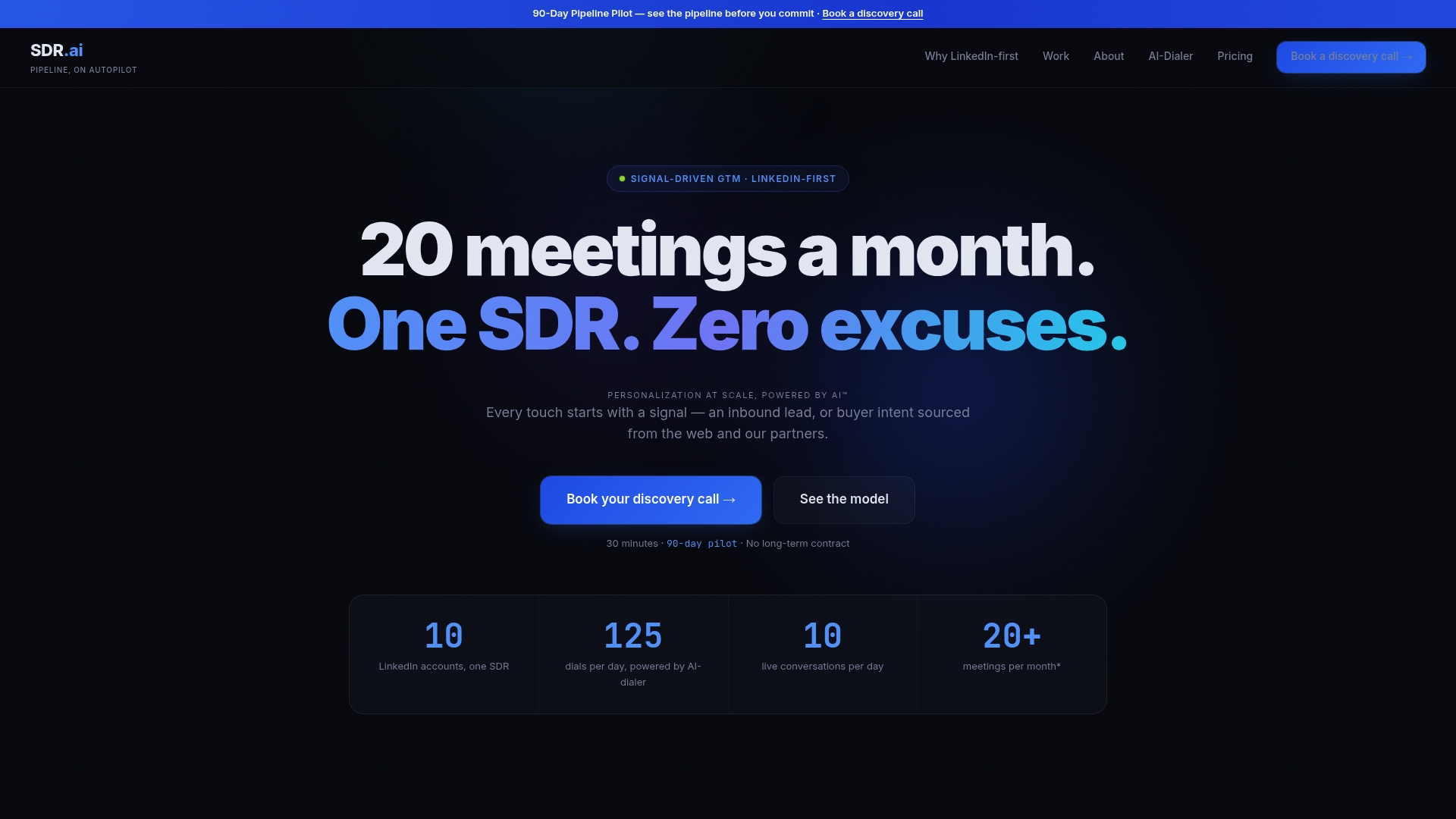
Teams that want the tooling alone can use our AI-Dialer for warm calling at $2,400 per year, with a one-time $500 onboarding fee, on the AI-Dialer page. If you prefer to run outbound in-house, The SDR.ai Blueprint lays out the model and playbooks.
A short example
Consider a Series A software company selling to operations leaders. An SDR gets a LinkedIn reply from a director of operations at a 150-person company.
The reply says the team is replacing a manual process next quarter. The SDR asks how it works today and what is breaking. The director describes a spreadsheet handoff that loses data and mentions the VP of finance will need to approve spend. The SDR proposes a 30-minute call with the VP invited and confirms the agenda: walk through the current process and see whether the product closes the gap.
Against the checklist, this passes on account fit, relevant attendee, stated need, trigger and agreed purpose. The handoff note carries the director's words about the spreadsheet, names the VP, and gives a confidence score of 4. The AE opens by confirming the process described, and the first ten minutes go to the real problem rather than re-asking basics.

Compare that with a reply of "sounds interesting, send times." No role context, no need, no purpose. It might become a meeting, but it does not pass the bar yet. One more question usually decides which way it goes.
Common mistakes to avoid
- Counting acceptances as meetings. Track held and qualified meetings separately.
- Changing the bar to hit a number. If you lower the bar to hit a quota, the damage shows up later as AE distrust and low opportunity rate.
- Skipping the purpose line. An unconfirmed purpose is the usual cause of no-shows and vague first calls.
- Thin handoffs. If the AE has to re-run discovery, the qualification effort was wasted.
- No feedback loop. Without rejection reasons, SDRs repeat the same errors.
For teams deciding who should own this work, see when founders should hire an SDR vs. a BDR.
FAQ
What is a qualified B2B meeting?
It is a scheduled conversation with a relevant person at a company that fits your ICP, who has described a real business need and agreed to a clear purpose. If any of those is missing, treat it as a booked meeting rather than a qualified one.
How many criteria should a meeting pass?
That depends on your deal size and cycle. A longer, higher-value sale justifies requiring every item on your checklist. A faster mid-market motion can accept most of them. Pick a threshold, write it down and apply it the same way to every SDR.
What should go in an SDR-to-AE handoff note?
Include the prospect's situation, priorities, the people involved, timeline, how they decide, objections and next steps. Add direct quotes and the agreed agenda. Many teams also add a short confidence score so the AE knows how much to trust the qualification.
Can AI qualify meetings on its own?
AI is useful for finding accounts, spotting intent signals, drafting outreach and logging notes. A person should still read replies and decide whether a prospect has a real need, because that judgment is what separates a qualified meeting from a booked one.
Sources
- Pulse RevOps: The SDR-to-AE Handoff Reboot
- Weflow: Sales Discovery Questions to Qualify Buyers
- JB Sales: How to Run a Sales Handoff
- QUOTA Training: SDR to AE Handoff