
Short answer: SDRs qualify inbound leads that already raised a hand; BDRs create outbound pipeline from accounts that haven't. Hire an SDR if inbound is piling up unworked. Hire a BDR if you need net-new pipeline in accounts nobody's touched yet. Both roles feed the same next step, an Account Executive, and the titles get swapped more often than they should.
TL;DR:
- An SDR qualifies inbound leads quickly and responds within minutes, while a BDR builds outbound pipeline through targeted research over weeks.
- SDRs focus on speed-to-lead and handle many short, transactional touches, whereas BDRs prioritize account research and personalized outreach across fewer accounts.
- Hiring an SDR is advisable when inbound leads sit unworked, but a BDR is needed when pipeline generation for new accounts is the bottleneck.
- KPIs for SDRs emphasize response time and conversion rates, while BDRs are measured on reply rates, meetings from cold outreach, and pipeline generated.
- AI tools now extend the capacity for both roles by enabling personalized, scalable outreach without increasing headcount, especially in outbound activities.
Table of Contents
- SDR vs BDR: The Core Definitions
- A Day in the Life: SDR vs BDR Responsibilities
- Key Differences Between SDR and BDR Roles
- SDR and BDR KPIs and Compensation Patterns
- Career Paths for SDRs and BDRs
- When to Hire an SDR vs BDR
- Skills, Tools, and How AI Is Changing These Roles
- Why SDR.ai Built Its Approach Around Both Motions
- Publisher Perspective: Pick One Motion and Own It
- Scale Outbound Without Scaling Headcount
- Sources
SDR vs BDR: The Core Definitions
The cleanest way to tell these roles apart has nothing to do with the title on the business card. It comes down to direction of motion. A Sales Development Representative (SDR) works leads that already came in through a form fill, a demo request, or a marketing campaign. Their job is speed and qualification: get to the lead fast, ask the right questions, and decide if it's worth an AE's time. A Business Development Representative (BDR) does the opposite. They start from a target account list and generate the interest themselves, cold, through calls, emails, and LinkedIn.
Ask this one question when a job posting confuses you: "Does this person work leads that came in, or create leads from accounts that didn't ask?" That answer tells you more than the job title ever will.
Here's the definitional split you can use immediately:
- SDR: inbound qualifier, works marketing-generated or website leads, prioritizes response speed
- BDR: outbound prospector, builds and works target account lists, prioritizes research and personalization
- Shared ground: both qualify prospects and hand off booked meetings to AEs, and both sit at the entry level of most sales orgs
Plenty of companies flip this convention entirely, calling their outbound hunters "SDRs" and their inbound responders "BDRs." A few use the terms interchangeably in the same posting. The SDR vs BDR: The complete guide to sales development roles guide makes this point directly: the label is unreliable, so read the actual responsibilities section before you assume anything about the job.
A Day in the Life: SDR vs BDR Responsibilities
The two roles look almost nothing alike once you watch someone actually do the job for a week.
An SDR's day runs on urgency. Leads land in the CRM, and the clock starts. Research on SDR and BDR responsibilities confirms that SDRs typically live inside speed-to-lead metrics, firing off calls and emails within minutes of a form submission, then qualifying against a scoring framework before routing to an AE. Volume is the currency. A busy SDR might work numerous inbound touches a day, most of them short and transactional.
A BDR's day runs on patience. There's no inbound trigger, so they build their own. That means digging through firmographic and intent data, mapping decision makers at target accounts, and writing outreach that references something specific about the company, not a generic template. Comparisons of typical SDR and BDR output show BDRs work fewer accounts per day but layer multiple touches across email, LinkedIn, and phone over a week or two rather than closing the loop in one call.
Here's how that plays out in practice:
- SDR morning: triage overnight leads, respond to the highest-intent ones first, log qualification notes
- SDR midday: run a qualification call, book the meeting, hand off to AE with context
- BDR morning: research three to five target accounts, identify the right contact, check for trigger events like funding or hiring
- BDR afternoon: send personalized sequences, follow up on unanswered touches from earlier in the week, adjust messaging based on replies
Pro Tip: If you're hiring your first SDR or BDR and you're not sure which one you need, watch where your AEs waste time. If they're buried in qualifying inbound demo requests, hire an SDR. If your pipeline is thin because nobody's prospecting new accounts, hire a BDR.
Key Differences Between SDR and BDR Roles
Once you've seen the daily rhythm, the structural differences are easier to spot. These are the ones that actually change how you manage, pay, and equip each role.
- Lead source: SDRs pull from marketing-qualified leads already in the funnel; BDRs generate their own top-of-funnel from cold accounts
- Volume vs. depth: SDRs optimize for speed across many leads; BDRs optimize for research depth across fewer accounts, which changes both ramp time and how quickly burnout sets in
- Reporting lines: SDRs often sit under marketing or a hybrid marketing-sales structure, while BDRs typically report into sales or a growth function
- Tooling emphasis: SDRs lean on lead-routing and speed tools; BDRs lean on prospecting, enrichment, and sequencing platforms
- KPI structure: the two roles get measured on almost entirely different scorecards, which is where a lot of management mistakes happen
The Fullcast breakdown of SDR and BDR roles makes a point worth repeating: SDRs and BDRs need different management approaches and different KPIs, and conflating the two roles degrades performance for both. A manager who asks a BDR to hit SDR-style volume numbers will get rushed, low-quality outreach. A manager who asks an SDR to do BDR-style account research will lose speed on hot leads. Small teams blur these motions out of necessity, but the blur has a cost, usually paid in missed pipeline or burned-out reps.
SDR and BDR KPIs and Compensation Patterns
You can't manage what you measure wrong, and this is where most sales orgs stumble with these two roles.
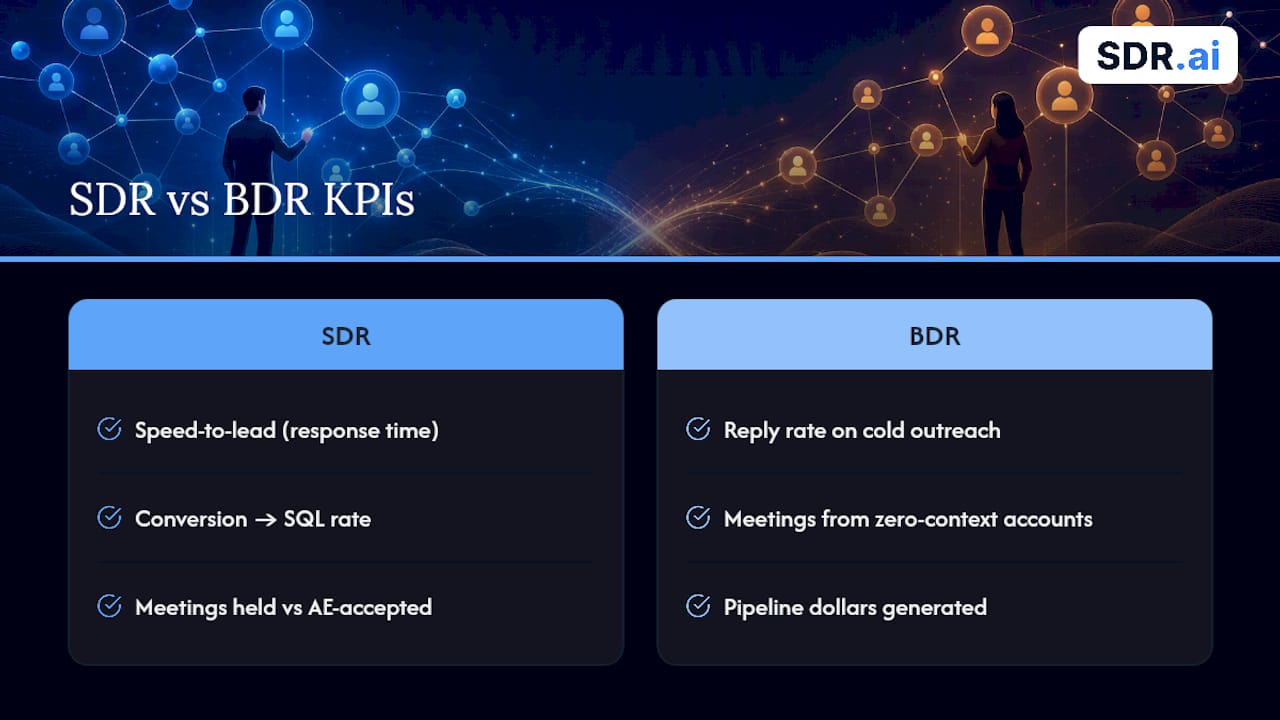
SDRs get measured on speed and conversion. The core numbers are speed-to-lead (how fast they respond to a new inbound lead), conversion rate to Sales Qualified Lead (SQL), and meetings held versus meetings accepted by the AE team. A slow SDR response, even by a few hours, tanks conversion.
BDRs get measured on creation, not response. Reply rate on cold outreach, meetings booked from zero-context accounts, and total pipeline dollars generated are the numbers that matter. Fullcast's analysis of the two roles lays out this split clearly: SDRs are measured on speed-to-lead and conversion, while BDRs are measured on reply rate, meetings from cold, and pipeline dollars generated.
Compensation follows the same logic. BDR pay tends to skew toward a higher variable component relative to base, since the role is closer to pure origination and harder to fake. SDR compensation often leans slightly more toward base, since qualification speed is easier to standardize and reward consistently. Neither structure is universal. What matters is that your incentive design matches the motion. Pay an SDR purely on meeting volume and you'll get a flood of low-quality bookings your AEs will hate. Pay a BDR purely on activity count and you'll get a mountain of untouched, low-effort sequences that never convert.
Career Paths for SDRs and BDRs
Both roles exist as entry points, not destinations, and that's exactly how most people who take these jobs should think about them.
The most common next step for both SDRs and BDRs is Account Executive. From there, the paths diverge: some move into Account Management, focused on retention and expansion within existing customers, while others move into strategic business development or sales enablement roles that lean on the research and messaging muscle built during the BDR years.
Promotion timelines vary by company, but the skills that get someone promoted early are consistent:
- Discovery skill: can this person run a real conversation, not just a script, once they get someone on the phone?
- Negotiation instinct: do they understand the trade-offs a buyer is weighing, even before they own a deal?
- Pipeline ownership: can they track their own numbers and explain what's working, without being asked?
If you're job hunting and coming from either role, frame your SDR or BDR experience around outcomes, not activity. "Booked 15 meetings a month" says less than "improved SQL-to-opportunity conversion by working faster qualification calls." AE hiring managers care about the second sentence.
When to Hire an SDR vs BDR
Most founders and hiring managers get this decision wrong because they hire based on what a competitor did, not what their own funnel actually needs.
Run through this checklist before you post a job:
- Check your inbound volume. If leads are coming in and sitting unworked for more than a day, that's an SDR problem, not a BDR one.
- Check how much time your AEs spend qualifying. If it's eating more than 30% of their week, you need someone dedicated to that step.
- Check whether you need new markets or account segments. If your growth plan depends on accounts that have never heard of you, that's a BDR job, no amount of inbound fixes it.
The Lessie.ai guide to SDR and BDR roles puts the diagnostic simply: hire an SDR first if you have steady inbound that goes unworked, and hire a BDR first if inbound is thin or you need to open new accounts or markets. Startups often start with one generalist doing both, then split the roles once volume in either direction makes the blend unsustainable. A common ratio once you scale is multiple BDRs or SDRs supporting each AE, though that shifts with deal size and sales cycle length.
Pro Tip: Don't split the roles just because a hiring guide says you should. Split them when one motion is starving because the rep is spending all day on the other.
Skills, Tools, and How AI Is Changing These Roles
The core skills haven't changed much even as the tooling around them has.
SDRs need speed, disciplined CRM hygiene, and the judgment to qualify fast without over-qualifying a good lead into a lost one. BDRs need research patience, sharp written messaging, and the resilience to handle a high volume of silence and rejection before a reply lands.
The tech stack looks similar on paper for both roles, but weighted differently:
- CRM systems for tracking every touch and handoff
- Sequencing tools for automated, multi-step outreach
- Enrichment and intent data platforms to find the right accounts and the right moment
- LinkedIn for social prospecting and warm outreach
- Dialers for high-volume or parallel calling
AI has genuinely changed capacity on both sides. Automated list building, personalization at scale, and intent detection now let both SDRs and BDRs cover more ground without more headcount, a shift Sdr. Tools like the Sdr push this further with parallel dialing, letting one rep run through far more conversations in a session than manual dialing ever allowed. What AI hasn't replaced is the relationship-building moment, the actual call where a prospect decides to trust the person on the other end. That part still needs a human paying attention.
Why SDR.ai Built Its Approach Around Both Motions
SDR.ai focuses on the outbound side of this equation, using AI to run targeted LinkedIn outreach built around a company's Ideal Customer Profile rather than generic cold contact lists.
- The core service centers on personalized messaging and calls that engage ICP accounts directly, which is the same discipline a strong BDR practices, just executed at greater scale.
- Clients typically see over 20 qualified meetings booked a month with a lean internal team, addressing the two problems that make in-house BDR hiring slow: long ramp time and inconsistent outreach quality.
- AI-driven intent signals help identify which accounts are already showing buying behavior, so outreach lands as a relevant conversation instead of a cold interruption.
The Sdr documents this data, digital, and dialing framework in detail for teams that want to apply the same logic internally.
Publisher Perspective: Pick One Motion and Own It
Most of the sales teams that struggle aren't struggling because they hired the wrong role. They're struggling because they never picked one motion and committed to it. Small teams especially love to split a single rep between inbound and outbound "for flexibility," and the result is usually a rep who's mediocre at both instead of sharp at one.
Give one person clear ownership of a single direction of motion before you scale headcount. Use AI to extend reach and personalization, not to replace the judgment call at the moment someone actually picks up the phone.
— Chad
Scale Outbound Without Scaling Headcount
Building an outbound engine in-house means months of ramp time, a stack of tools to stitch together, and a BDR team that may or may not hit quota before you find out if the model even works. SDR.ai skips that runway. It runs AI-driven, ICP-targeted LinkedIn outreach and warm calling through an AI Dialer built for parallel conversations, so a lean team can book over 20 qualified meetings a month without the six-month hiring and training cycle a traditional BDR build requires.
The intent signals behind that outreach mean prospects hear from you when they're already showing buying behavior, not on a random Tuesday cold call. If your inbound is healthy but your outbound pipeline is thin, or you're not ready to hire and manage a BDR team yet, Sdr and see what a working outbound engine looks like before you commit to headcount.