
ABM and outbound are not rivals. Account-based marketing (ABM) is a strategy: you pick a short list of accounts and coordinate everything around them. Outbound is a channel: you contact buyers first, by LinkedIn, email or phone. The practical answer for most startups is to run outbound inside a small ABM list, so the accounts that matter most get personal, signal-timed outreach from someone who owns every reply. That is how we run it at SDR.ai: LinkedIn-first outreach to your ideal customer profile (ICP), with a human SDR handling every reply.
TL;DR
- ABM decides who you pursue (a named list of high-value accounts). Outbound decides how you reach them (proactive contact). Most ABM programs use outbound as their meeting engine.
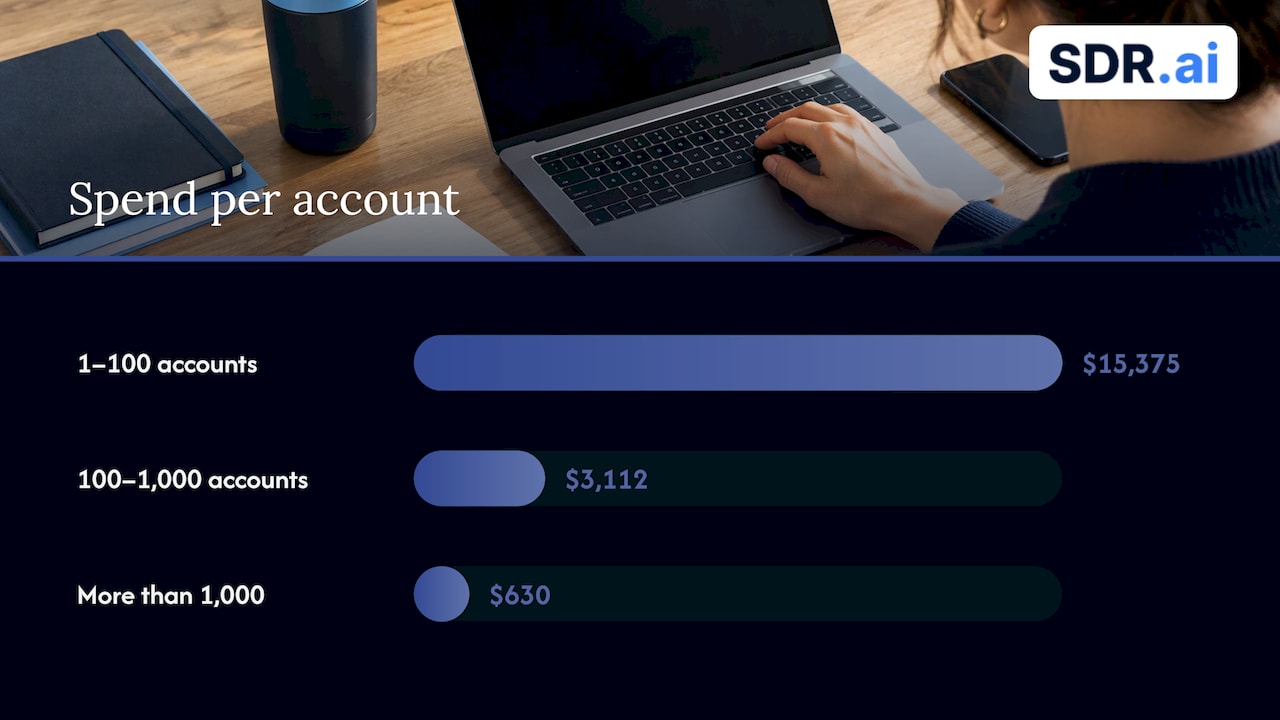
- ABM costs far more per account on short lists: TOPO's benchmark put spend at $15,375 per account for lists of 1 to 100 accounts, against $630 for lists above 1,000.
- Favor ABM when deals are large, the market is finite and several people sign off. Favor broad outbound when deals are smaller and the reachable market is large.
- Measure at the account level, not by clicks, and compare against accounts you did not target.
- A hybrid works best for a lean team: a tight tier-one list plus a wider ICP list, with one owner for follow-up.
Table of Contents
- What each approach actually is
- ABM vs outbound side by side
- What the cost difference looks like
- When ABM wins, when broad outbound wins
- How to combine them without a big team
- Measuring ABM and outbound fairly
- Why a managed outbound team suits an ABM-style list
- How we can help
- FAQ
- Sources
What each approach actually is
Account-based marketing treats a chosen set of accounts as markets of their own. TOPO's 2019 Account Based Benchmark Report, a survey of more than 150 practitioners, defines ABM as a coordinated go-to-market strategy aimed at selected high-value accounts, not a single campaign or a software purchase. The tactics are familiar: SDR outreach, digital advertising, direct mail, marketing email and events. What changes is the unit of work. You plan, run and report by account.
Outbound is the company starting the conversation rather than waiting for a prospect to find it. In practice that means sales development reps (SDRs, the people who book first meetings) reaching out by email, phone and LinkedIn to people who match your ICP. Messaging is repeatable, sequences are short, and volume is the lever.
So the comparison is partly a category mix-up. ABM is a way of choosing and prioritizing targets. Outbound is one of the main ways you act on that choice. TOPO's survey shows how tightly they overlap: 88% of respondents rated SDR email and phone outreach important to ABM, and 87% used it.
Inbound is the third option people compare against. It attracts prospects with search visibility and useful content. IMD's marketing analysis describes it as the slower, trust-compounding approach, with outbound giving faster visibility when you launch or enter a new market. If you are weighing content against direct contact, our guide on funding outbound versus inbound and enforcing a five-minute inbound response covers the operating side.
ABM vs outbound side by side
| ABM | Broad outbound | |
|---|---|---|
| Unit of work | Named account and its buying group | Individual ICP-matched contact |
| List size | Small and curated | Large and filtered by fit and intent |
| Messaging | Tailored per account and per role | Repeatable templates with personalized openers |
| Who is involved | Marketing, sales development and sales | Mostly sales development |
| Cost per account | High | Low |
| Time to first meeting | Often longer, with several touches across contacts | Shorter sequences, faster feedback |
| Best for | Large deals, finite markets, big buying committees | Smaller deals, large reachable markets |
| Success measure | Account engagement, pipeline, win rate | Replies, meetings booked, cost per meeting |
The last row matters most for a founder. Outbound gives you feedback in weeks. ABM, as one marketing explainer notes, usually asks for a longer horizon, often months, before account-level results are clear.
What the cost difference looks like
The cleanest number comes from TOPO's benchmark. Average spend per account was $15,375 for target lists of 1 to 100 accounts, $3,112 for lists of 100 to 1,000, and $630 for lists above 1,000. The logic is simple: the smaller the list, the more research, creative and senior time each account absorbs.
A second data point comes from The Starr Conspiracy's B2B benchmarks, which cover mainly North American B2B technology. For 2024 they report a median cost per marketing-qualified lead (MQL) of $341 for enterprise outbound versus $198 for inbound sales. The same source reports a median $186,000 average deal size and 127-day sales cycle for enterprise outbound in B2B SaaS, against $47,000 and 84 days for inbound sales.
Read these as a trade-off, not a verdict. Outbound to larger accounts costs more per lead and takes longer, but the deals are bigger. That is exactly the situation where a tight account list earns its keep.
A worked example
Say you sell a $60,000-a-year platform to infrastructure teams at mid-size software companies, and about 400 companies in the U.S. fit. That is a finite market with multi-person buying groups. You would tier it:
- Tier one, 30 to 50 accounts. These are your best-fit, highest-value targets. Research each one, reach two or three roles per account, and tailor the message to what is happening at that company.
- Tier two, the other 350. Use ICP filters and intent signals to decide who gets a message now and who waits. Messaging is lighter, with a personalized first line.
- Everyone else. Do not chase them yet. Your reps' time is the scarce resource.
That is ABM thinking and outbound execution in one plan. We lay out a version of the first tier in our 8-week, 30 to 50 account pilot.
When ABM wins, when broad outbound wins
No official body publishes cutoffs, so treat these as working heuristics drawn from how practitioners describe the trade-off.
ABM fits when:
- Contract values are high enough to justify real per-account effort.
- The addressable market is finite, so you can name most of it.
- Several stakeholders (a technical buyer, a budget owner, an executive sponsor) take part in the decision.
- You have a validated ICP, meaning you know which customers closed, stayed and expanded.
- Someone on your team can follow up fast when an account shows interest.
Broad outbound fits when:
- Deals are smaller and cycles are short.
- Your market is large enough that you cannot name it account by account.
- You need feedback on messaging and ICP quickly.
- A single decision-maker can say yes.
If your product is low-priced and self-serve, a heavy ABM program rarely pays back. If you have not yet confirmed who your best customers are, start with outbound to learn that, then narrow into ABM. Choosing a motion by deal value and market size is a call to make before you spend; the same logic applies to picking channels like SaaS SEO automation for growth, which pays off slowly, versus direct outreach that produces conversations within weeks.
How to combine them without a big team
A hybrid is the realistic setup for a startup with a few salespeople. The structure that works:
1. Build the list from your best customers
TOPO's guidance is to pick target accounts using sales input, company data and intent data, then tier the list and match resources to the tiers. Start from closed-won customers. Look at industry, company size, region, tech stack and which customers expanded. Your ICP is what those accounts have in common.
2. Add intent signals to decide timing
A good-fit account that is not in a buying window wastes a touch. Signals such as hiring, funding, leadership changes, or engagement with relevant content tell you which accounts to contact first. This is the core of how we work: signal-driven targeting that focuses only on your ICP and on intent. Our write-up on AI personalization at scale shows how the first-line personalization is built.
3. Reach more than one person per account
In ABM, a tier-one account is a buying group. Contact the likely user, the budget owner and a senior sponsor, each with a message about their own problem. On LinkedIn, acceptance of the connection request is the first gate; our piece on connection acceptance rate benchmarks covers what moves it.
4. Follow up on every reply, fast
This is where most programs leak. Replies come in at odd times, some are "not now," and some are questions that need a real answer. A coordinated program fails when nobody owns the response. Our model puts a human SDR on every reply, so a positive answer becomes a booked meeting rather than a lost thread.
5. Qualify before it reaches a closer
Decide in advance what makes a meeting qualified, by deal size and by the fields in your CRM. Our lead qualification frameworks by ACV give a starting set, and outbound conversion benchmarks by funnel stage show where to expect drop-off.
Measuring ABM and outbound fairly
The two motions need different scoreboards, and mixing them produces confusing numbers.
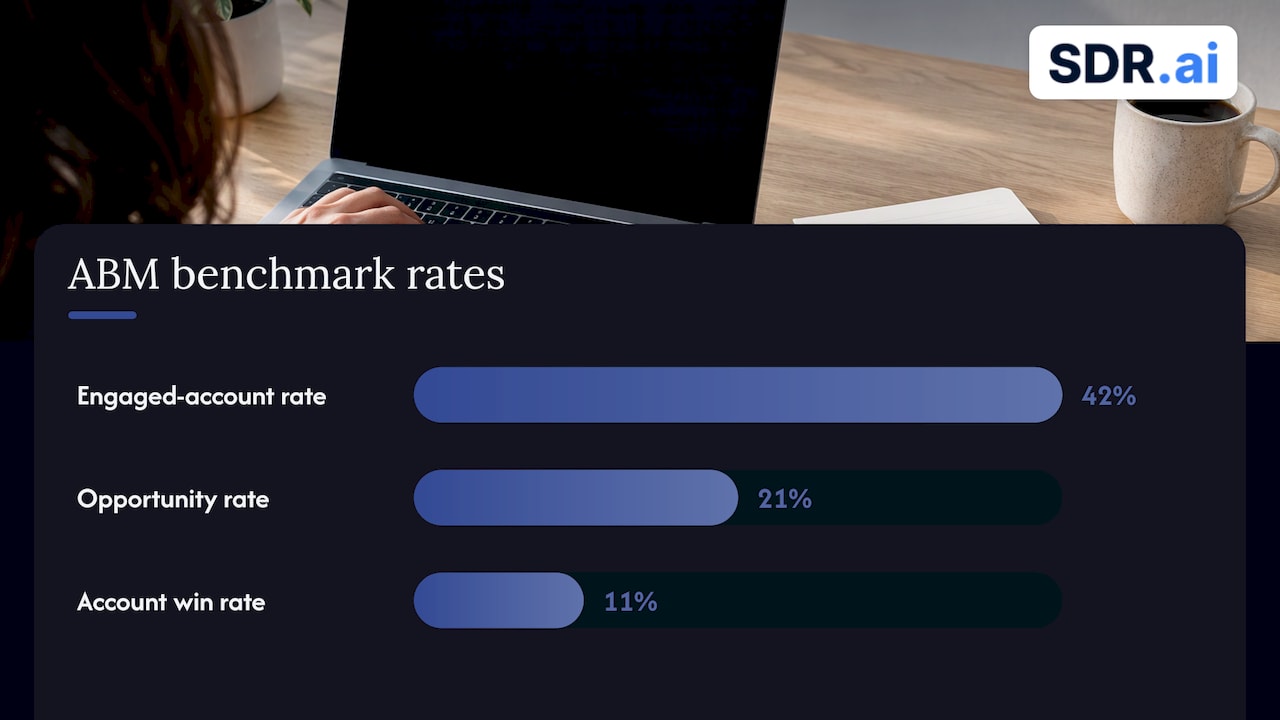
For ABM, track at the account level. TOPO's benchmarks were 42% for engaged-account rate, 21% for opportunity rate and 11% for account win rate, all from its 2019 survey, so use them as rough reference points for a mature program, not targets for your first quarter. Add buying-group coverage, pipeline from target accounts, deal size and sales-cycle length.
For outbound, track the funnel: connection or reply rate, positive replies, meetings booked, meetings held, qualified opportunities and cost per qualified meeting.
One trap applies to both. Target accounts are, by definition, a good fit, so some would have bought anyway. To see your program's real effect, hold back a comparable set of accounts and compare results over the same window. It takes discipline, but it keeps you from crediting outreach for deals that were coming regardless.
Why a managed outbound team suits an ABM-style list
The weakness of ABM at a startup is capacity. Researching accounts, writing tailored messages, watching signals and answering every reply is a full-time job, and hiring and ramping an in-house SDR is slow and costly. Founders end up doing it between other work, and follow-up slips.
A managed service solves the capacity problem while keeping the targeting tight. You give the team your ICP and your best-fit accounts; they run the outreach and handle the replies. You keep the part only you can do: the sales conversations.
Our view on ABM vs outbound
Founders ask us which one to pick, and the question is usually framed wrong. You do not choose between a list and a channel. You choose how narrow your list should be and how personal your outreach can afford to be.
What we have built our service around is the middle: a focused ICP, intent signals to time the contact, LinkedIn as the first place a conversation starts, and a human SDR who reads and answers every reply. That gives you the relevance people want from ABM without a marketing team, a direct mail budget and an events calendar.
The failure we want founders to avoid is a beautiful target list with no one following up. Pipeline math only works when every positive reply gets a fast, informed answer. Our aim is to take that work off your plate so your calendar fills with meetings that fit.
Chad
How we can help
If your list is a few dozen to a few hundred ICP accounts and you do not want to build an SDR team, our AI-Powered Outbound service is $2,500 per month with a one-off $500 setup. It combines LinkedIn-first outreach with personalized messaging, intent-based lead identification, warm calling with an AI dialer and multichannel follow-up, with a human SDR handling every reply. Our clients often book more than 20 qualified meetings a month with minimal manpower.
If you already have reps and want the calling side, our AI-Dialer is $2,400 per year with a $500 one-off onboarding fee. If you would rather run the motion yourself first, The SDR.ai Blueprint lays out the process. You can also book a demo and see it run against your own ICP.
FAQ
Is ABM the same as outbound sales?
No. ABM is a strategy for choosing and coordinating effort around a defined set of high-value accounts. Outbound is a tactic for contacting buyers directly. Outbound outreach by SDRs is one of the most common tactics used inside an ABM program, so they usually work together.
Is ABM more expensive than outbound?
Per account, yes, especially on short lists. TOPO's benchmark reported average spend of $15,375 per account for lists of 1 to 100 and $630 for lists above 1,000. The higher spend buys deeper research and tailoring for accounts that can be worth much more.
Can a small startup run ABM?
Yes, if the list is small and the work is focused. Start with 30 to 50 best-fit accounts, reach several roles in each and follow up quickly. Marketing-heavy tactics like events and direct mail are optional; outbound on LinkedIn, email and phone carries most of the load.
How long before I know whether it works?
Outbound gives signals within weeks: acceptance, reply and meeting rates. ABM account-level results, such as pipeline and win rate, usually take longer because deals with several stakeholders take months. Set a measurement window in advance and compare against accounts you did not target.
Sources
- TOPO 2019 Account Based Benchmark Report
- B2B Marketing Benchmarks, The Starr Conspiracy
- Choosing Between Inbound and Outbound Marketing, IMD
- SaaS SEO automation for growth