
An AI hallucination in sales is a confident statement that sounds right and has no basis in fact: an invented funding round in a cold message, a pricing term nobody approved, a deal marked "confirmed" that never was. The fix is not to avoid AI. It is to point AI at narrow, verifiable inputs and put a person on everything that reaches a prospect. That is how we run outbound at SDR.ai: LinkedIn-first outreach aimed at your ideal customer profile (ICP), with a human SDR handling every reply.
This guide is for founders and sales leaders at B2B startups who want AI to carry more of the outbound load without putting the company's name behind a made-up claim.
TL;DR
- Models fill gaps. When a prospect record is empty, stale or matched to the wrong company, the model produces the most plausible answer instead of saying it does not know.
- The riskiest places are prospect research, personalized openers, deal summaries, quotes and anything that states product or pricing terms.
- Catch fabrications by tracing every specific claim to a source, and by sampling outputs before volume goes up.
- Narrow the task, feed it fresh data, and keep a human on replies and commitments.
- A wrong fact corrected quickly is survivable. A second invented fact is much harder to recover from.
Table of Contents
- What hallucinations look like in a sales process
- Why AI tools make things up about prospects
- What it costs
- How to tell if AI research or outreach contains fabrications
- Prevention: a practical setup
- When a wrong claim has already gone out
- Our perspective
- How SDR.ai fits
- FAQ
- Sources
What hallucinations look like in a sales process
The term sounds technical, but the sales version is simple. PwC describes generative AI as capable of producing plausible outputs with no basis in reality, especially when it works from overly complex or incomplete data. In a sales workflow that data is a CRM record, an enrichment export or a LinkedIn profile.
Here is where it usually shows up:
- Prospect research. Invented executives, phantom funding rounds, fake integrations, stale pricing and wrong founding dates all appear when a model makes specific claims from fields that were never populated or are out of date.
- Personalized outreach. An opener praising a product launch that never happened is worse than a generic opener, because the prospect knows instantly it is false.
- Qualification and deal summaries. An AI note-taker can turn a hedged "maybe" on a call into a firm commitment in the follow-up summary, as one 2026 write-up on sales demos describes.
- Quotes and proposals. One industrial distributor's first-week audit of AI-assisted quoting found seven errors across 34 quotes, including wrong prices and discontinued SKUs, and proofreading caught none of them.
- Product and pricing claims. If an assistant answers a buyer question on your behalf, you own the answer. A Canadian tribunal held in 2024 that Air Canada was responsible for what its website chatbot told a customer.
Notice the pattern. None of these require a malfunctioning tool. They are what happens when generation meets thin data.
Why AI tools make things up about prospects
Three causes account for most of the damage.
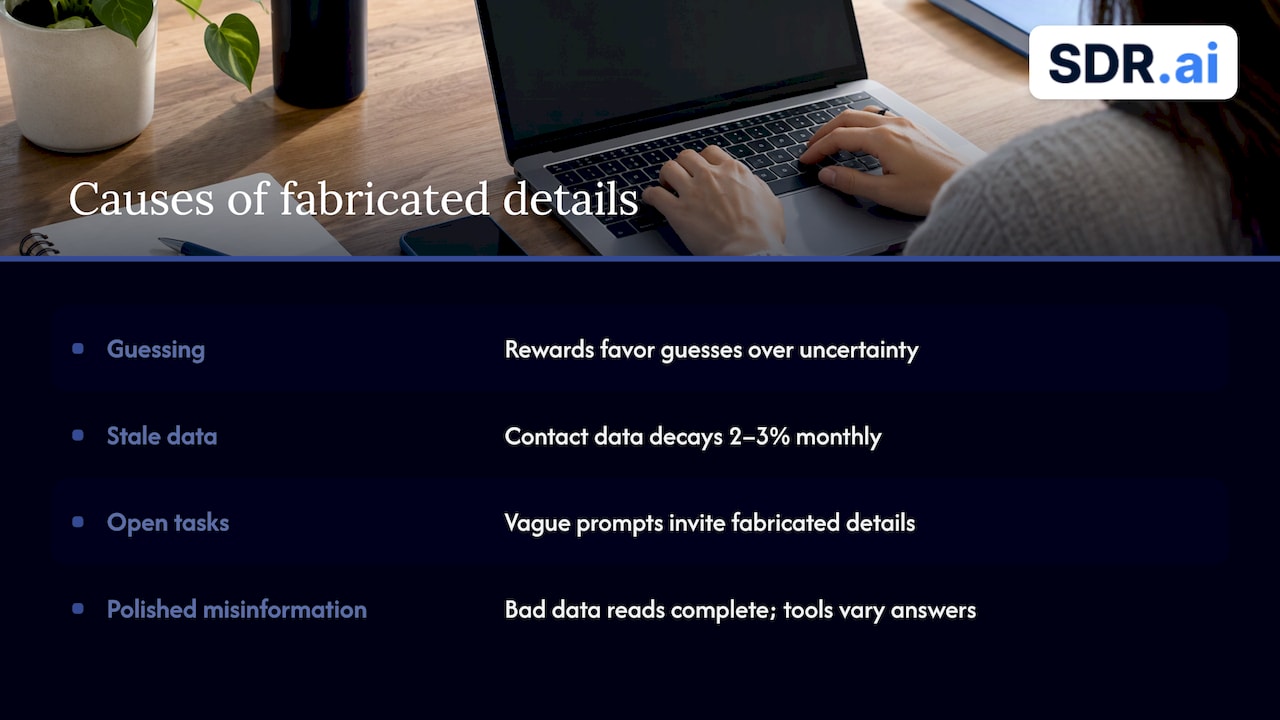
1. The model would rather answer than abstain. A language model has no built-in way to say "I do not know," so it writes the most plausible-sounding thing. A September 2025 paper by Adam Tauman Kalai and co-authors (arXiv:2509.04664) argues that training and evaluation reward guessing over admitting uncertainty. Expect this behavior from every vendor's model.
2. The data underneath is stale. B2B contact and company data commonly decays at roughly 2 to 3% a month. A list that was clean in January has a visible share of wrong titles and dead companies by summer. The model does not know which fields are old.
3. The task is too open. PwC lists vague prompts, poor training data, inadequate enterprise data and unsuitable tasks given to generative AI as drivers. "Research this company and write something personal" is an open task. "Summarize this one public post and reference it in one sentence" is a closed one.
There is a fourth issue that is easy to miss: polish. A messy spreadsheet with an obvious gap is easy to distrust. An AI summary built from the same gap reads as complete. Cognism's 2026 analysis makes the same point, that AI packages bad data more convincingly rather than fixing it. Fragmented tool stacks make it worse, since the same question can return a different wrong answer depending on which tool responded.
What it costs
Hard numbers specific to sales are scarce, and many come from vendors measuring their own category. Treat them as directional.
The most defensible figure is broader. A study commissioned by the British Standards Institution and carried out by Alma Economics estimated that AI failure could cost between 0.1% and 3.6% of market revenue a year depending on failure type, with hallucinations and fabricated outputs at 2.5% in the consulting and litigation legal sectors it examined. That is not a sales study, but it shows the order of magnitude when fabricated output reaches clients.
For a startup, the real cost is more concrete than a percentage:
- A burned prospect in a niche market. If your ICP is a few hundred companies, one false opener sent to a well-connected buyer is not a rounding error.
- Wasted founder time on meetings booked from claims that were never true.
- Liability, when a message or summary states a price, feature or commitment you did not intend.
- Regulatory attention. The FTC's Operation AI Comply targets deceptive claims made with or about AI. Your outreach should never assert something you cannot support.
How to tell if AI research or outreach contains fabrications
This is the question most teams skip. You cannot read every message once volume rises, so you need a method that scales better than proofreading. The audit mentioned above is a warning on that point: errors that slip past a quick read are the norm, not the exception.
Break every message into checkable claims
Read a draft and underline each specific: a name, a title, a number, a date, a product, a funding event, a partnership. Everything underlined needs a source you can open. Anything not underlined (a generic observation about the market) is low risk.
Require a source for every specific
A good research output attaches the origin of each fact: the profile URL, the post, the press page. If a claim has no attached source, treat it as unverified, however natural it sounds. Fabricated claims are usually the ones that cannot point anywhere.
Watch for the telltale shapes
- Round or oddly precise numbers with no origin ("raised $12M last quarter").
- Executives or integrations you cannot find on the company's own site.
- Praise for a launch or hire that you cannot date.
- Details that fit the company name but belong to a similarly named one, which is the wrong-company match.
Sample before you scale
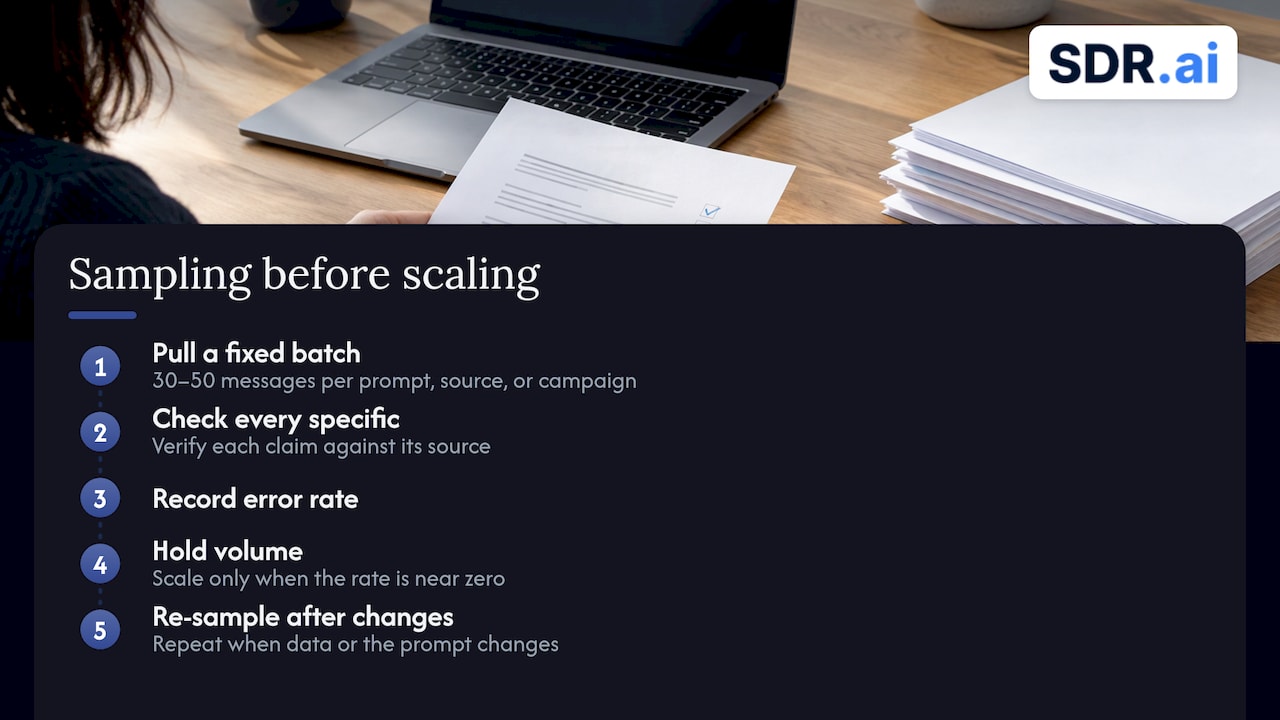
Pull a fixed batch from each new prompt, data source or campaign, such as 30 to 50 messages, and check every specific against its source. Record the error rate. Do not raise volume until the rate is near zero, and re-sample whenever you change the data or the prompt. PwC's guidance on output testing and risk-based review supports this: match the level of review to the harm an error could cause.
Separate vendor claims from measured evidence
The same discipline applies to the tools you buy. Atrium's 2026 report says its review found no independent measurement of AI cold-outreach performance and advises telling vendor-derived claims from measured results. Ask any provider, including us, for your pipeline math in your own numbers.
Prevention: a practical setup
PwC's mitigation list covers reliable, context-specific data, appropriate prompts and guardrails, output testing, employee training and human verification. Translated to an outbound team:
| Task | Hallucination risk | Practical control |
|---|---|---|
| Building target lists from your ICP | Medium: stale or mismatched records | Refresh data on a schedule and confirm company match before research |
| Summarizing a prospect's public activity | Medium to high | Limit the model to supplied text and require a source link per claim |
| Writing a first-touch message | Medium | Keep personalization to one verified reference, not a biography |
| Replying to a prospect | High: commitments, pricing, product claims | A person writes or approves every reply |
| Call and meeting summaries | High: hedges become commitments | Check against the recording before anything goes to the buyer |
| Quotes and proposals | High | Pull prices from the system of record, never from model memory |
Three habits matter more than any tool:
- Narrow the job. The more open the instruction, the more the model invents. Give it a source and a single task.
- Fix the data first. Models do not repair a bad record, they dress it up. Clean fields beat clever prompts.
- Keep a person on the commitments. Anything that states a price, a date, a feature or a promise gets human eyes. We lay out where people belong in more detail in our piece on human-in-the-loop sales AI.
If you also run AI-written content alongside outreach, the same logic applies to wording. Some practical controls for humanizing AI text with instructions lower the risk of incorrect or robotic output. For teams considering a larger build, it helps to understand what AI integration services cover before you scope a project, especially around company and contact data that is missing, stale or matched incorrectly.
To see how personalization can scale without inventing facts, read our AI personalization playbook and the breakdown of the AI sales stack.
When a wrong claim has already gone out
It will happen eventually. Handle it like an incident, not an embarrassment.
- Go to the source record. If a buyer forwards an AI summary with a wrong claim, check the recording or raw transcript first, then compare the claim with your written documentation: docs, trust center, order form.
- Correct it in one sentence. Say the earlier statement was incorrect and give the accurate position with the page that documents it. Per that guidance on sales demos, buyers tend to forgive a corrected fact, but a second invented fact is much harder to recover from.
- Preserve the evidence. An incident runbook for revenue AI agents suggests keeping inputs, retrieved sources, prompts, model settings, outputs, approvals and timestamps.
- Find the affected population. Check destination-system records to confirm what was actually sent, and to whom, before you assume the scope.
- Give people a way to report. PwC recommends channels for employees to flag suspect outputs and a habit of learning from each mistake.
If an error involved a pricing commitment, a contract term or a legal or regulatory claim, bring in your attorney before you reply.
Our perspective
We built SDR.ai around one idea: the model should work on narrow, signal-backed inputs, and a person should own what a prospect actually reads and replies to.
That is why our outreach is LinkedIn-first and limited to your ICP and intent signals. A smaller, better-defined audience gives a model less room to guess. And because a human SDR handles every reply, the moments where a hallucination does the most damage, a promise about price, product or timing, are not left to a model.
The founders we talk to are not short of AI tools. They are short of pipeline they can trust. Our view is that you get speed from automation and accuracy from people, and a managed service lets you have both without hiring and training an in-house SDR team first.
Chad
How SDR.ai fits
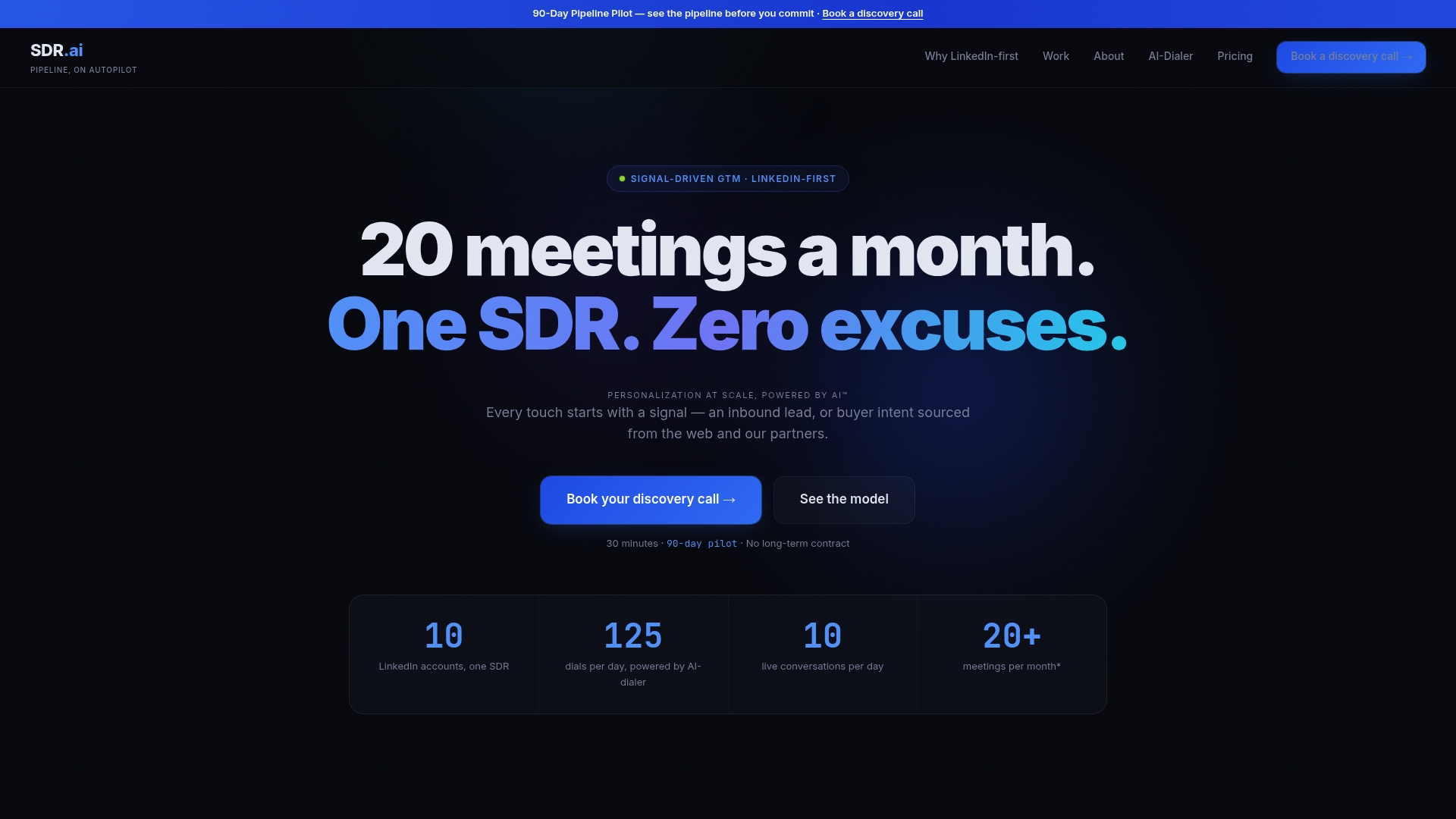
If you want outbound running without building the team and the verification routine yourself, our AI-Powered Outbound service is $2,500 per month plus a $500 one-off setup fee. It combines targeted LinkedIn outreach with personalized messaging, warm calling with an AI dialer and follow-up across channels, with a human SDR handling every reply. You can see the model on the SDR.ai site.
If your team already has reps and needs a calling tool, our AI-Dialer is $2,400 per year with a $500 one-off onboarding fee. Prefer to build in-house? The SDR.ai Blueprint covers the outbound engine.
FAQ
Can you eliminate AI hallucinations in sales?
No tool removes them entirely, because gap-filling is a property of how language models generate text. You can cut the risk sharply by narrowing the task, using fresh data and keeping a human on replies and commitments. The aim is to keep errors from reaching a prospect.
Which sales tasks are safest to automate?
Tasks with closed inputs and low consequences: sorting a list against your ICP criteria, formatting data, drafting a message from a verified source. Anything that states a price, date, feature or promise should be approved by a person. PwC suggests matching review to the risk of the output.
How often should we audit AI outreach?
Audit a sample before launching any new prompt, data source or campaign, and again whenever one of those changes. Track the share of messages with an unsupported claim, and hold volume until it is close to zero. After that, a recurring spot check is enough.
Who is responsible when AI says something wrong to a buyer?
You are. In the 2024 Moffatt case, a tribunal held the airline responsible for its chatbot's statements. For statements about prices or contract terms, talk to your attorney.
Sources
- AI hallucinations and prevention in business, PwC
- Why Your AI Sales Agent Invents Facts About Prospects, Explorium
- AI Hallucinations in Sales Demos, VoiceVocab
- Your AI Just Quoted a Price That Doesn't Exist, Y Meadows
- Moffatt v. Air Canada, Wikipedia
- Why your AI is confidently wrong about your market, Cognism
- The cost of AI failure, BSI
- FTC Announces Crackdown on Deceptive AI Claims and Schemes
- The State of AI in Sales, 2026, Atrium
- When a Revenue AI Agent Takes the Wrong Action, Matt Pru
- Why language models hallucinate, arXiv:2509.04664