
The fastest reliable way to reduce SDR ramp time is a skills-first 30/60/90 program that gates progression on measured behaviors and outcome KPIs, backed by scaled coaching. The two levers that move the needle most are early practice on real prospects and tight, continuous feedback loops. Done well, this approach shortens time to productivity by weeks, not months, though no framework guarantees a fixed number for every team or market.
TL;DR:
- Effective ramp programs focus on behavior and outcome gates, not just tenure, to accurately assess sales readiness and predict future pipeline contribution.
- Micro-practice drills and shadowing should target specific skills like objection handling and full-cycle calls, with transition timings optimized for faster skill retention.
- KPI tracking should prioritize lead response time, call-to-meeting conversion, talk-to-listen ratio, and ramp quota attainment to guide targeted coaching actions.
- Automation tools and peer coaching can extend coaching capacity while maintaining quality, but gates and drills remain essential for true ramp compression.
- Defining a customized, gate-based 30/60/90 plan helps avoid risks associated with premature full outreach, especially in complex buyer environments.
Table of Contents
- Three tactics you can implement this week
- What "ramped" actually means and how to prove it
- A 30/60/90 ramp plan you can copy and adapt
- Practice that actually transfers to live calls
- The KPIs that matter and the coaching moves that follow them
- Scaling coaching without losing quality
- An operational checklist from pre-onboarding to certification
- Speed versus quality: what ramp compression actually costs
- How SDR.ai helps teams shorten the ramp problem entirely
- Sources
- FAQ
Three tactics you can implement this week
You do not need a finished program to start improving ramp today. A few structural changes, made immediately, buy you time to build the fuller plan.
- Run micro-roleplay sessions tied directly to week-one pipeline activity, such as a two-minute cold-call opener drill before every prospecting block.
- Have new hires shadow two live calls a day, then take a supported call themselves with a manager or peer listening and ready to jump in on objections.
- Pre-provision every account (CRM, dialer, email, LinkedIn Sales Navigator) before day one, and set a concrete early milestone: a first booked meeting within 10 business days.
The account setup step matters more than it looks. New reps who spend their first week waiting on IT tickets lose momentum before they ever pick up a phone.
Pro Tip: Book the shadow-to-live-call transition for day 3, not day 10. Reps forget less and adapt faster when the gap between watching and doing is short.
What "ramped" actually means and how to prove it
Most ramp timelines fail because "ramped" is defined by a calendar instead of a capability. A rep who has been onboarding for 60 days is not automatically ready to run full-cycle outreach alone. Define readiness with gates that combine behavior and outcome, not tenure.
Set the gates around the activities and outcomes that predict future pipeline, not the ones that are easiest to measure:
- Behavior gate: the rep can run a structured discovery call without a script, including handling at least three common objections.
- Outcome gate: the rep hits a minimum threshold of qualified meetings booked per week, set relative to your team's average.
- Process gate: CRM logging, follow-up cadence, and lead response time meet the same standard as tenured reps.
The KPI set that proves readiness usually includes lead response time, call-to-meeting conversion, talk-to-listen ratio, and ramp quota attainment. Each one signals something different: talk-to-listen shows whether a rep is actually running discovery instead of pitching, and lead response time shows whether they are prioritizing hot leads over easy ones.
A field experiment on sales onboarding found that decentralized, individualized onboarding produced about 23.5% higher performance than centralized programs, an effect that was especially pronounced for hires coming from other companies. That is the strongest argument for gates over generic cohort calendars: a personalized path built around a rep's actual gaps beats a one-size schedule.
Ramp quota, the reduced target new reps are expected to hit while ramping, should scale with your gates rather than sit at a flat percentage. Tie it to what the business actually needs from pipeline in that period, then adjust the acceptance threshold as you collect data on your own team's ramp curve.
A 30/60/90 ramp plan you can copy and adapt
Salesforce's guidance on sales onboarding recommends a 90-day window broken into product and ICP training, process and CRM fluency, and pitch certification. Here is how to structure that inside gated milestones.
- Days 0 to 30: teach product, ICP, and messaging through sandbox tasks (mock calls, written objection responses, CRM entries on dummy accounts). Gate: pass a scored roleplay covering the top five objections before touching a live prospect list.
- Days 31 to 60: move to supported live execution. The rep runs real calls with a manager or peer monitoring, and every call gets logged against a feedback template covering opener, discovery, and next steps. Early pipeline goal: a set number of qualified meetings booked, reviewed weekly. Gate: independent handling of a full call cycle with no live intervention needed.
- Days 61 to 90: certification and independent execution. The rep runs a full pipeline without shadowing, and performance is measured against ramp quota. Gate: sustained quota attainment over two consecutive weeks, not a single good week.
Weekly coaching rituals matter as much as the gates themselves: a 30-minute one-on-one call review, a written scorecard against the current gate's criteria, and a manager checklist confirming account setup, CRM hygiene, and pipeline activity are on track before the rep advances.
Practice that actually transfers to live calls
Generic repetition does not build skill the way targeted practice does. Research on expertise development distinguishes deliberate practice, useful for novices building foundational skills, from progressive problem solving, which sustains growth once a rep can handle the basics. The practical implication: early drills should isolate one micro-skill at a time, and later training should introduce messier, less-scripted scenarios.
- Deliberate practice drills for weeks 1 to 3: a single objection type per session (price, timing, "send me an email"), scored against a rubric, repeated until fluent.
- Progressive problem solving for weeks 4 onward: unscripted roleplay with a mentor introducing curveballs, mimicking the ambiguity of a real buyer conversation.
- Mentor pairing: assign each new rep a tenured peer for weekly call reviews, rotating pairs every 30 days so reps are exposed to different styles.
This same research emphasizes "purposeful practice" over rote repetition, meaning a drill should target the exact skill a rep is missing, not run through a generic script for the tenth time.
Pro Tip: If a rep keeps stalling on the same objection, do not add more roleplay volume. Cut the drill down to that single objection until they can handle it three times in a row without hesitation.
The KPIs that matter and the coaching moves that follow them
Tracking too many metrics dilutes attention. A small, prioritized KPI set, tied to specific corrective actions, keeps coaching focused during ramp.
- Lead response time: if it exceeds your team's benchmark, run a drill on prioritizing hot leads and set an automated alert for new lead assignment.
- Call-to-meeting conversion: if it lags, review the rep's last five call recordings for a pattern in the opener or qualification questions.
- Talk-to-listen ratio: if a rep talks more than they listen, run a discovery-question drill focused on open-ended follow-ups.
- Ramp quota attainment: if two consecutive weeks fall short, escalate to a manager-led call review before the next gate review.
| KPI | Trigger threshold | Coaching action |
|---|---|---|
| Lead response time | Above team benchmark | Hot-lead prioritization drill |
| Call-to-meeting conversion | Below team average | Recording review, opener rework |
| Talk-to-listen ratio | Rep talks more than prospect | Open-ended discovery drill |
| Ramp quota attainment | Missed two weeks running | Manager-led call review |
A simple weekly dashboard, one row per rep with these four metrics, reviewed in a 15-minute standing meeting, keeps the gates honest. When you change something in the onboarding process, such as adding a new drill or shortening the shadow period, test it on one cohort and compare ramp quota attainment against a control group before rolling it out to everyone.
Scaling coaching without losing quality
Manager time is the real constraint on most ramp programs. Salesforce's enablement research points to manager time scarcity as a top obstacle, and finds that reps spend only a minority of their week actually selling once administrative tasks are factored in, which makes every hour of coaching time more valuable.
- Standardize rubrics so peer mentors can score calls the same way a manager would, removing the manager as the sole feedback source.
- Rotate peer coaching into the weekly cadence so tenured reps share the review load instead of concentrating it on one manager.
- Use conversation intelligence or AI coaching tools to flag talk-to-listen imbalances or missed objection handling automatically, so reps get feedback the day of the call instead of waiting for a manager's calendar to open.
It is worth being honest about what these tools do and do not fix. AI-driven coaching platforms can democratize feedback by flagging patterns automatically, which shortens the feedback loop. They do not shorten ramp on their own if the underlying gates and drills are undefined: visibility into a problem is not the same as a plan to fix it with multi-channel funnels.
Pro Tip: Embed the feedback loop directly in the CRM, a call score field a rep sees the moment they log a call, rather than in a separate coaching tool nobody opens.
An operational checklist from pre-onboarding to certification
A written checklist turns the framework into something you can actually run every time you hire.
Pre-onboarding (owned by sales ops):
- Provision CRM, dialer, and prospecting tool access before start date.
- Assign a peer mentor and schedule the first shadow session for day 3.
- Send ICP and messaging materials for pre-reading.
During the 30/60/90 (owned by the hiring manager):
- Sign off on each gate with a scored rubric, not a subjective impression.
- Log every gate result in a shared tracker so ramp data compounds across cohorts.
- If a rep fails a gate, trigger a defined next step: an extra week on the current stage plus a targeted drill, not an automatic extension of the whole timeline.
Speed versus quality: what ramp compression actually costs
Gating readiness protects pipeline quality, and skipping gates to hit a date usually shows up later as missed quota or early churn. Compressing the timeline can make sense for a small pilot team or a narrow SMB market where the product and objections are simple. It is riskier in complex or enterprise motions, where a rep who is not truly ready will burn real prospects. Start by defining your gates this week, before you touch the calendar.
— Chad
How SDR.ai helps teams shorten the ramp problem entirely
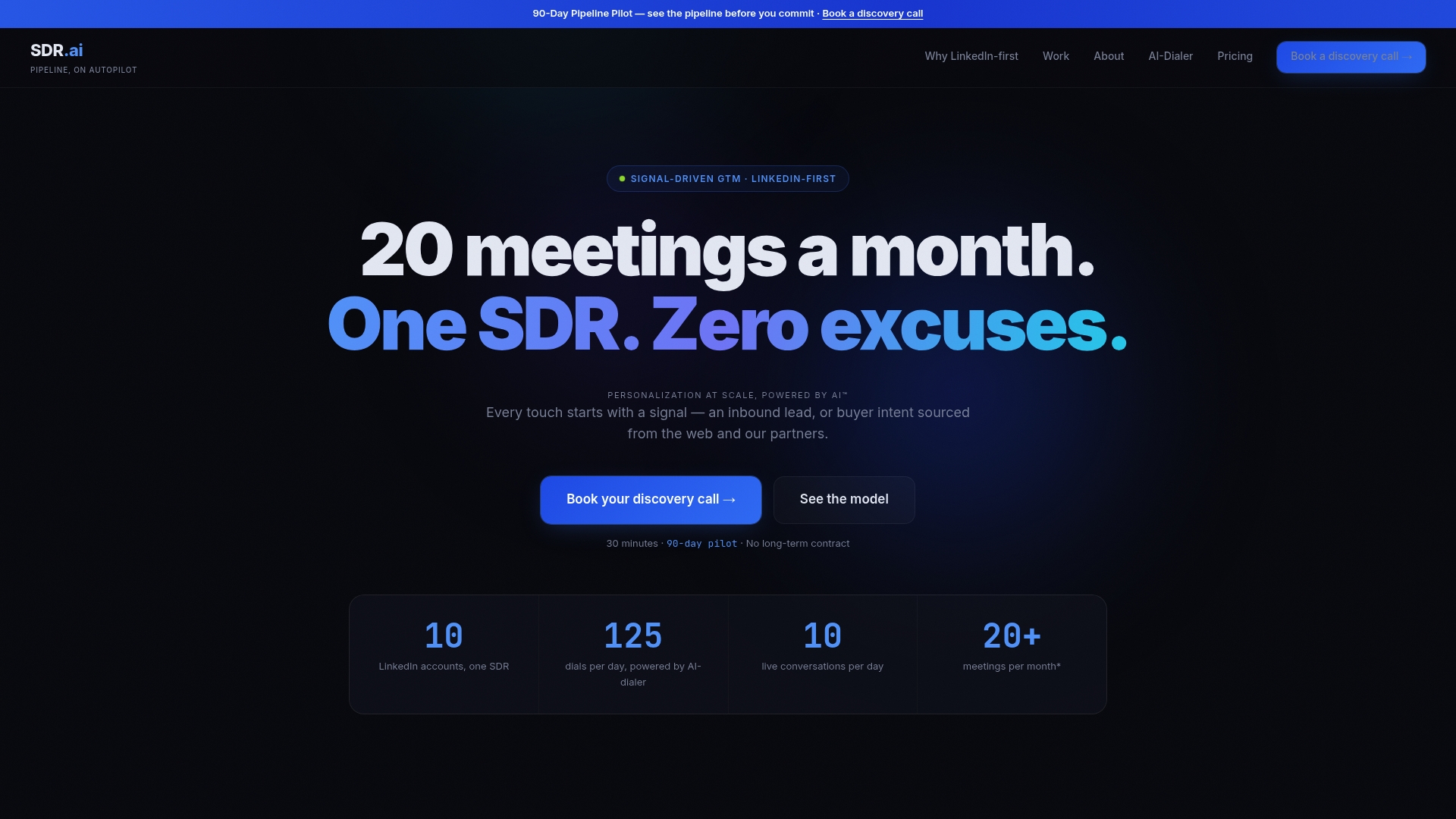
Some teams would rather not build the ramp program at all, and that is a reasonable call when hiring and managing SDRs costs more time than the pipeline is worth. Sdr runs AI-powered outbound on LinkedIn, combining personalized messaging with intent signals and a human SDR who handles every reply, so there is no multi-month ramp to manage in the first place.
- Teams that want outreach running now, without hiring or training, typically start with AI-Powered Outbound plus the one-time setup fee.
- Teams that want to keep an in-house team but need more call volume look at the AI-Dialer, priced at $2,400 per year with a $500 onboarding fee, which supports parallel dialing.
- Teams that want to build their own playbook rather than outsource it can use Sdr, a 30/60/90-style operational guide, with pricing available on request.
If your ramp math does not pencil out, book a demo and see whether a productized alternative gets you to pipeline faster than another hiring cycle.
Sources
The onboarding field experiment, Springer's expertise research, and Salesforce's enablement data back the figures and framework used throughout this guide.
- Onboarding Salespeople: Socialization Approaches (field experiment)
- Expertise development in workplace through deliberate practice and progressive problem solving
- Sales onboarding: What it is, examples & best practices | Salesforce
FAQ
How long should you be an SDR for?
There is no fixed answer: it depends on the individual's goals and the company's promotion path, though many SDRs move to a closing or senior sales role after a year or two of consistent quota attainment. The right length is better measured by demonstrated skill and quota history than by tenure alone.
What percent of SDRs hit the quota?
The article's sources do not report a specific industry-wide quota attainment percentage, so any figure you see elsewhere should be treated cautiously. What matters more operationally is tracking your own team's ramp quota attainment against the gates in your 30/60/90 program.
What is the typical ramp time in sales?
Salesforce recommends a 90-day onboarding window, structured across product and ICP training, process fluency, and pitch certification. Actual ramp time varies by product complexity and market, which is why gating on measured readiness works better than a fixed calendar.
What is a ramp quota?
A ramp quota is a reduced sales target new reps are expected to hit while they are still onboarding, scaled up toward full quota as they progress through gates. It should be tied to your team's actual ramp data rather than set as an arbitrary flat percentage.