
Outsourced SDR teams win when you need pipeline in 30 to 60 days and your ideal customer profile is straightforward enough to hand off. In-house SDRs win when your sale is technically complex, your deal cycle depends on institutional knowledge, or you're building a sales org you plan to promote people out of for the next decade. Everything else comes down to the six-factor scorecard below.
TL;DR:
- Outsourced SDRs offer faster pipeline creation within two to four weeks, while in-house teams typically need 60 to 90 days to generate stable output.
- Full internal costs often underestimate expenses, with factors like benefits, ramp-up, management, and attrition adding roughly 20 to 30% to salary estimates.
- Outsourcing reduces annual costs by approximately 35 to 55%, especially when providers apply established technology and playbooks, but complexity can narrow that advantage.
- Maintaining visibility through call recordings, CRM writeback, and weekly SLA reports is essential regardless of the chosen model to ensure quality and brand consistency.
- For technical, complex sales, keeping SDRs in-house is advisable, whereas simple, straightforward ICPs with high demand variability benefit most from outsourcing or a hybrid approach.
Table of Contents
- Outsourced Sdr Vs In House: The Core Tradeoffs
- Cost and ROI: What to Actually Include in Your Model
- How Fast Each Model Gets You to Pipeline
- Protecting Quality, Brand Voice, and Data Visibility
- A Six-Point Scorecard for Choosing Your Model
- How AI Changes the Outsourcing Math
- An Experienced Revenue Leader's Take on the Real Decision
- How Sdr Approaches the Outsourced Option
- Sources
- FAQ
Outsourced Sdr Vs In House: The Core Tradeoffs
The debate over outsourced sdr vs in house staffing usually gets framed as a cost question, but that's only half of it. Cost, ramp speed, and control all move in different directions depending on which model you pick, and none of them move independently.
In-house sales development representatives give you control you can't buy from a vendor. They learn your product cold, they sit in on customer calls, and they build the kind of tribal knowledge that shows up months later when a prospect asks an odd question nobody scripted for. They also come with a career path: the best SDRs get promoted into closing roles, which keeps your pipeline of future account executives fed. The tradeoff is obvious once you've hired one. You're paying full loaded cost from day one, you're managing a ramp period where output is near zero, and you're exposed to the sales industry's brutal turnover math the moment that rep gets an offer from somewhere else.
Outsourced SDR providers flip that equation. You get predictable monthly capacity, a team that's already trained on outbound mechanics, and none of the recruiting or onboarding lift. Gartner's research on high-growth sales orgs notes that outbound and inbound roles increasingly get separated by specialization, and that specialization is exactly what an outsourced provider already has baked in. What you give up is direct oversight. Your brand voice runs through someone else's script, and if the provider doesn't integrate cleanly with your CRM, you lose visibility into exactly what's being said to your prospects.
A hybrid model splits the difference more often than either camp admits. Companies commonly outsource top-of-funnel outbound to a specialized provider while keeping one in-house SDR or sales development manager to handle inbound leads, high-value accounts, or channel-specific outreach that needs deep product context.
Quick comparison:
- In-house: more control and brand consistency, career-path incentive for reps, but higher fixed cost and 60 to 90 day ramp.
- Outsourced: faster time-to-pipeline, lower upfront risk, but less direct oversight and integration work required.
- Hybrid: outsourced volume plus one internal specialist for complex or inbound leads.
Cost and ROI: What to Actually Include in Your Model
Most build-versus-buy comparisons undercount the true cost of an in-house SDR by looking only at base salary. That's the single biggest reason internal cost models come in wrong.
Here's the full line-item list to build into any in-house cost model:
- Base salary and commission or bonus structure.
- Payroll taxes and benefits, typically adding 20 to 30% on top of salary.
- Recruiting cost, including agency fees or internal recruiter time.
- Sales tools: dialer, sales engagement platform, intent data, CRM seats.
- Management overhead, since a sales development manager typically oversees a team rather than one rep.
- Ramp cost, meaning weeks or months of near-zero output while the rep learns the product.
- Attrition and replacement cost when a rep leaves and you start the ramp cycle over.
Statistic to build into your model: Industry market research on B2B sales outsourcing found that outsourcing can reduce comparable annual costs by roughly 35 to 55% compared to running an equivalent function in-house, in cases where the provider applies established technology and playbooks. That range is a report finding, not a guarantee, and it depends heavily on how complex your sales motion is.
Outsourced pricing usually bundles the rep's time, the tooling, the management layer, and some amount of reporting into one monthly fee. What typically stays your responsibility is CRM access, ICP definition, messaging approval, and any product training the provider needs to get started. Read the statement of work carefully. Some providers charge extra for call recording or CRM writeback, which you'll want for quality control regardless of which model you choose.
For a baseline salary anchor, the Bureau of Labor Statistics publishes occupational wage data for sales managers, useful for estimating what a sales development manager costs before you add benefits and tools. A simple ROI test: take your fully loaded in-house cost per meeting booked (all seven line items above, divided by meetings booked per month) and compare it against an outsourced provider's monthly fee divided by their meetings booked. Run that math conservatively, assuming your new hire needs a full quarter to hit target output, and the comparison usually looks less favorable to in-house than the base salary alone would suggest.
How Fast Each Model Gets You to Pipeline
A new in-house SDR typically needs 60 to 90 days before output stabilizes: two to four weeks learning the product and tools, then another month or two calibrating messaging against real market feedback. Outsourced providers commonly compress that to two to four weeks, since the team arrives with outbound infrastructure and process already running. One industry breakdown of outsourcing programs points out that building an in-house team requires hiring a sales development manager first, then months before that manager's hires become productive, a sequencing problem outsourcing sidesteps entirely.

What you trade for that speed is context. An outsourced team starts without your tribal knowledge, your objection-handling nuance, or the specific way your existing customers describe their problem. That gap closes over the first 30 to 45 days of a well-run engagement, but it doesn't close on day one.
A few structural moves protect pipeline quality while you scale, regardless of which model you pick:
- Run outsourced engagements as a 60 to 90 day pilot with a defined exit clause before committing to a full year.
- Set escalation rules upfront: which leads get routed to an account executive immediately versus nurtured further.
- Require weekly call reviews during the first month, not just monthly reporting.
- Share your best-performing sales calls and win stories with the outsourced team as onboarding material, not just a slide deck.
Pro Tip: Ask any outsourced provider for their average time-to-first-qualified-meeting from three recent client launches, not their marketing page number. The gap between marketing claims and actual client onboarding timelines is where most disappointment starts.
Scalability tends to favor outsourcing when demand is unpredictable. Adding outsourced capacity for a product launch or a new territory takes a contract amendment. Adding in-house capacity takes a hiring cycle you can't compress no matter how urgent the need feels.
Protecting Quality, Brand Voice, and Data Visibility
Whichever model you choose, insist on the same baseline of visibility into what's happening in your pipeline. This is where a lot of outsourcing relationships go wrong, not because the provider is bad, but because the client never set the reporting bar high enough at the start.
Minimum requirements worth writing into any contract or SOW:
- Call recordings for every SDR conversation, reviewable on demand.
- Direct CRM writeback so activity and outcomes live in your system, not a third-party dashboard.
- Weekly SLA reporting on meetings booked, SQLs generated, and show rates, not just dials made.
- Named point of contact who owns escalations, not a rotating support queue.
- Clear data ownership language stating that your prospect and account data stays yours if you end the engagement.
Brand fit deserves its own evaluation during any pilot. Listen to actual call recordings in week two, not just week eight, and check whether the tone matches how your top performers actually talk to prospects. Gartner Peer Community research on SDR pipeline generation notes that LinkedIn messaging drives roughly 17% of net-new leads for a typical org, and channel execution quality varies enormously between providers, so test more than one channel before judging the whole engagement.
Product complexity is the strongest argument for keeping SDRs in-house. If your sale requires understanding a multi-stakeholder technical evaluation or a regulated buying process, an outsourced rep needs months of ramp to reach competence, which erodes the speed advantage that made outsourcing attractive in the first place.
A Six-Point Scorecard for Choosing Your Model
Score your organization on each of these six criteria from 1 to 3, where 1 favors in-house and 3 favors outsourced.
- Urgency: Do you need meetings booked this quarter, or are you building a two-year sales org? Immediate need scores high toward outsourced.
- Budget shape: Can you commit to a fixed monthly operating expense, or do you need to justify a capital hiring investment to a board? Opex flexibility favors outsourced.
- ICP complexity: Is your buyer a single decision-maker with a clear pain point, or a multi-stakeholder technical committee? Simple ICPs favor outsourced.
- Internal bandwidth: Do you have a sales leader who can dedicate real hours to managing and coaching a new SDR? Limited bandwidth favors outsourced.
- Career-path priority: Do you need SDR roles as a farm system for future account executives? Strong yes favors in-house.
- Demand variability: Does your pipeline need change seasonally or by campaign? High variability favors outsourced.
Add up your score. A total of 6 to 9 points suggests in-house fits your situation. A total of 15 to 18 points points clearly toward outsourced. Anything in between, roughly 10 to 14, is hybrid territory: outsource top-of-funnel volume and keep one internal person managing inbound and key accounts.
| Scenario | Likely score | Best fit |
|---|---|---|
| Series A startup, no sales hires yet, needs pipeline in 60 days | 17 | Outsourced |
| Mid-market team scaling from 3 to 10 SDRs with an established ICP | 10 | Hybrid |
| Enterprise seller with a 9-month technical sales cycle | 6 | In-house |
The Series A example scores high toward outsourced because urgency, budget shape, and ICP simplicity all point the same direction. A mid-market team already has some internal muscle and moderate demand variability, which is exactly the profile that benefits from splitting the workload rather than picking one model exclusively.
How AI Changes the Outsourcing Math
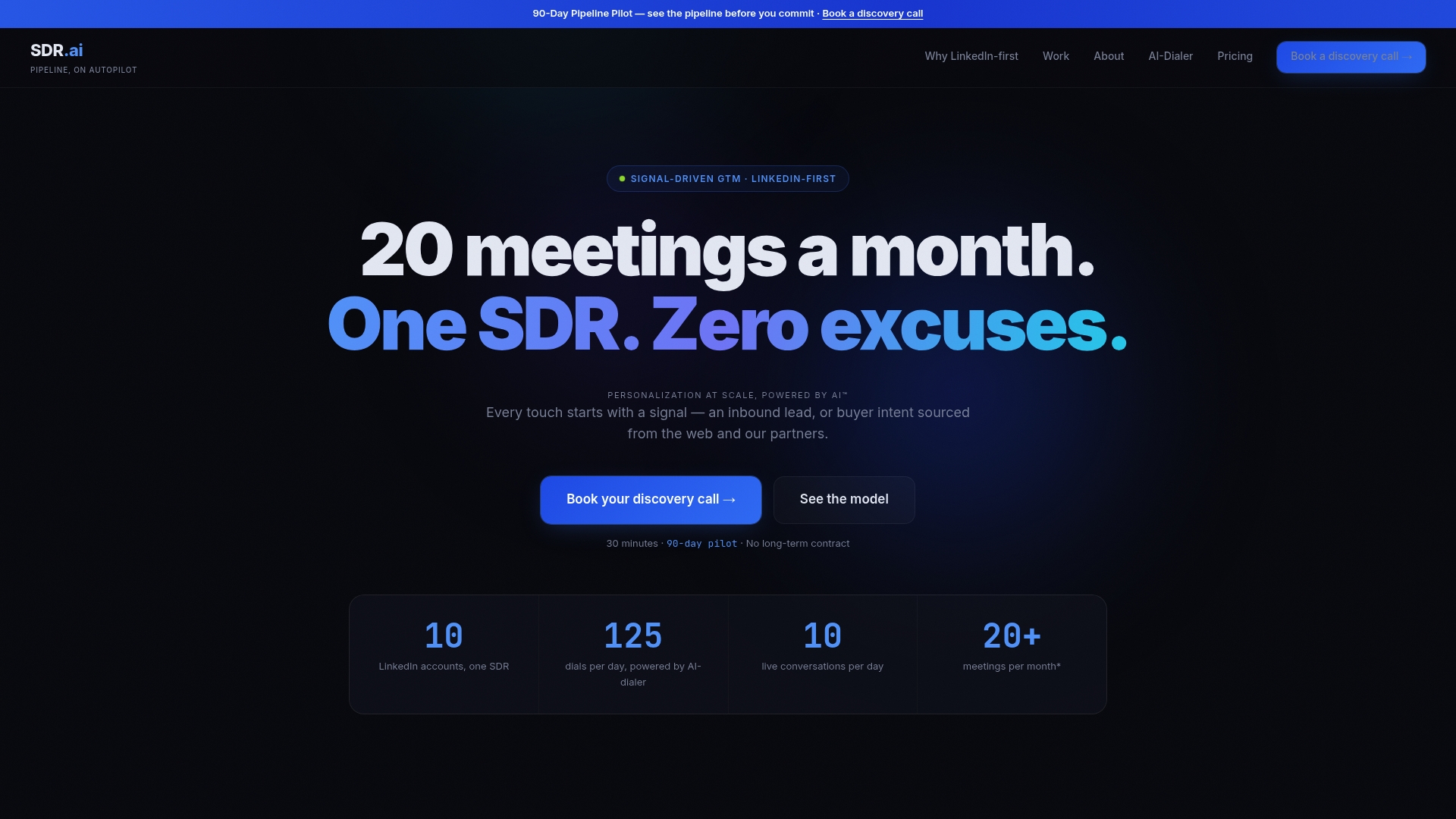
AI-augmented outsourcing has shifted the category away from pure labor arbitrage. Sdr uses AI to run LinkedIn-first outreach against a defined ideal customer profile, combining personalized messaging with call activity so outreach targets buyers already showing intent signals rather than cold lists. Clients typically report booking more than 20 qualified meetings a month with a lean team structure, a meaningfully different ratio than most traditional outsourced or in-house models produce per headcount.
The AI layer helps most with targeting and volume: identifying intent signals across a large prospect list and personalizing outreach at a scale no human team could match alone. Human judgment still matters for the parts AI can't do well: reading tone in a reply, adjusting mid-conversation when a prospect raises an unscripted objection, and deciding when a lead is genuinely sales-ready versus just curious.

An Experienced Revenue Leader's Take on the Real Decision
If you're pre-Series B and need pipeline now, run an outsourced pilot before you hire anyone. If your sale is technical and long-cycle, hire an SDR manager and build the bench you'll need in two years. Either way, write your KPI and SLA terms into the contract before day one, not after the first disappointing month.
— Chad
How Sdr Approaches the Outsourced Option
If the scorecard above pointed you toward outsourced or hybrid, the next question is which provider actually delivers on ramp speed without sacrificing the visibility you need. Sdr's AI-Powered Outbound service runs LinkedIn-first, signal-driven outreach against your defined ICP for $2,500 per month, plus a $500 one-time setup fee, with a human SDR handling every reply so nothing gets lost to a script.
For teams that want to see the methodology before committing to a retainer, Sdr walks through the data, digital, and dialing framework Sdr uses to build outbound engines, with pricing available on request. Teams that already run their own SDR function but want the same AI-driven dialing productivity can license the AI-Dialer directly for $2,400 per year, with a $500 onboarding fee.
Before signing with any provider, run them through the same checklist from the quality control section: ask for CRM writeback, weekly SLA reporting, and a named point of contact, not a support queue. If those boxes check out, book a demo and see what a 60-day pilot looks like against your own pipeline numbers.
Sources
- 11 sales development strategies for high-growth companies | Gartner
- Sales managers: Occupational Outlook Handbook | Bureau of Labor Statistics
- B2B Sales Outsourcing Services Market Research Report 2034 | DataIntelo
FAQ
What Is the Difference Between In-House and Outsourced SDR Teams?
In-house means you hire, train, and manage SDRs as direct employees, giving you full control over messaging and process. Outsourced means you contract a provider that supplies trained reps, tools, and management for a monthly fee, trading some control for faster setup and predictable capacity.
Is Outsourcing Cheaper Than Hiring In-House?
Often, yes, once you count the full cost of an in-house hire: salary, benefits, tools, management overhead, and attrition replacement. Industry market research found outsourcing can cut comparable costs by 35 to 55% in cases where the provider uses established technology and playbooks, though the gap narrows for highly complex, technical sales motions.
Is Inside Sales the Same Thing as an SDR Role?
Not exactly. Inside sales is a broader category covering any sales conducted remotely rather than in person, while an SDR role specifically focuses on prospecting and qualifying leads before handing them to an account executive to close.
Is Sales Outsourcing a Dying Concept?
No, it's expanding rather than fading. Market research points to a growing B2B sales outsourcing sector, and the category is shifting from pure labor arbitrage toward AI-augmented, outcome-focused partnerships that combine intent data and automated targeting with human judgment.
How Much Does an Outsourced SDR Service Cost?
Sdr's AI-Powered Outbound service runs $2,500 per month plus a one-time $500 setup fee, covering LinkedIn-first outreach against your ideal customer profile. Teams that only need the dialing technology can license the AI-Dialer separately for $2,400 per year with a $500 onboarding fee.