
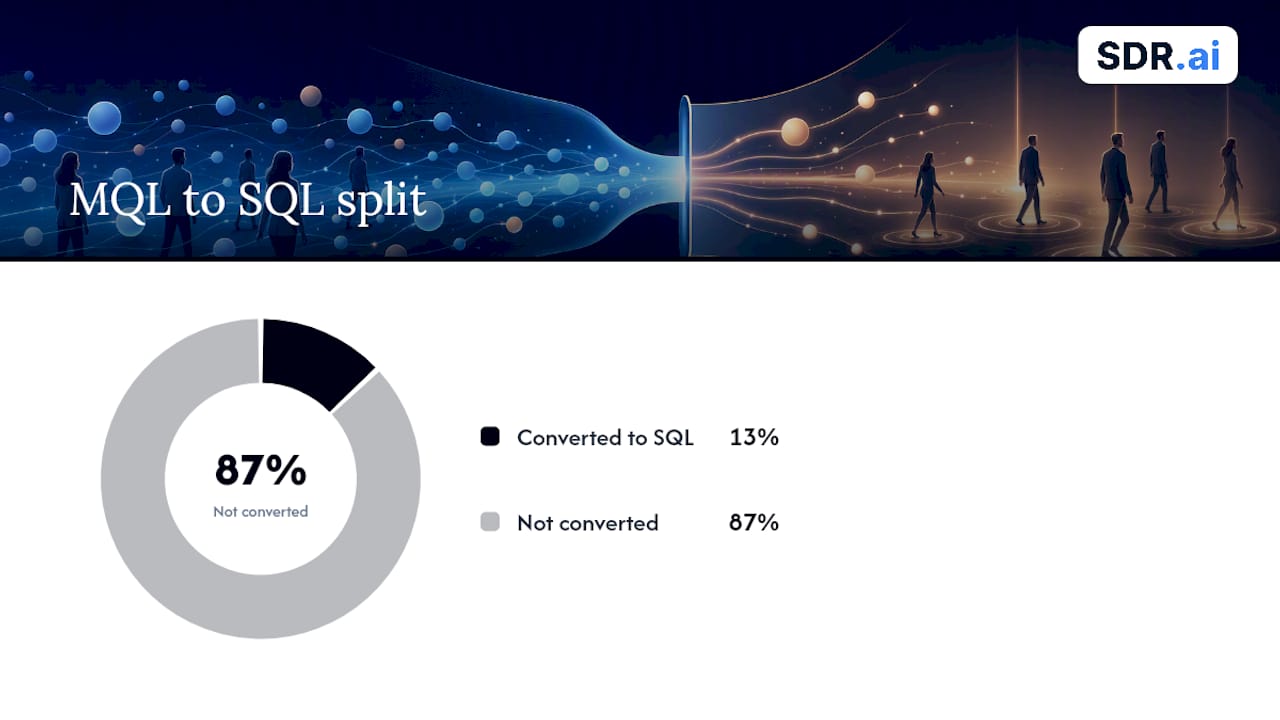
The average MQL to SQL conversion rate lands around 13%, though your real target depends on deal size and sales cycle length. The formula is simple: SQLs ÷ MQLs × 100. The one move that fixes a broken rate faster than anything else is aligning marketing's and sales' definitions and cutting speed-to-first-touch to under an hour for high-intent leads, a strategy supported by CRM & marketing automation best practices.
TL;DR:
- Improving routing speed to under one hour significantly boosts conversion from MQL to SQL, especially for high-intent leads with a short sales cycle.
- Regularly updating and aligning marketing and sales definitions prevents drift that can lower the efficiency of lead qualification and follow-up.
- Tracking sub-metrics like speed-to-first-touch and contact-to-SQL helps diagnose whether conversion issues stem from timing, routing, or lead quality.
- Focusing on fundamental processes such as fast routing and clear qualification criteria delivers more impact than overhauling scoring or incentives prematurely.
- Using AI-driven outreach tools can drastically reduce lead queue times and increase the number of qualified meetings booked with less manpower.
Table of Contents
- What Is MQL to SQL Conversion and How Do You Calculate It?
- What Is a Good MQL to SQL Conversion Rate?
- Why Is Your MQL to SQL Conversion Rate So Low?
- How Do You Improve MQL to SQL Conversion?
- How Do You Report MQL to SQL Conversion Accurately?
- The Six-Step Playbook for Fixing MQL to SQL Conversion This Quarter
- What Does the Research Say About Fixing the Handoff?
- What Should You Prioritize First With Limited Budget?
- How Sdr Fixes the Routing and Speed Problem
- Sources
What Is MQL to SQL Conversion and How Do You Calculate It?
A marketing qualified lead (MQL) is someone marketing believes fits your ideal customer profile based on engagement signals: content downloads, webinar attendance, repeat site visits. A sales qualified lead (SQL) is a lead sales has vetted and accepted as worth active pursuit. The conversion rate measures how much of your marketing output actually becomes usable sales input.
The basic math:
- Count SQLs created in a given period.
- Divide by MQLs created in that same period.
- Multiply by 100.
If marketing sends 400 MQLs in March and sales accepts 52 as SQLs, that is a 13% conversion rate. But single-month math distorts reality when your sales cycle runs longer than a few weeks. A lead that becomes an MQL in January might not clear SQL status until April. Geckoboard recommends a lagged cohort approach: compare SQLs created in month X to MQLs created in month X minus your average conversion lag, often three months for B2B deals with longer evaluation periods.
For teams with short cycles (under 30 days), a 30-day window works fine. Cycles running 60 to 90 days need matching lag windows, or your numbers will bounce around for reasons that have nothing to do with lead quality.
What Is a Good MQL to SQL Conversion Rate?
Context matters more than the number itself. A 13% rate might be strong for one company and mediocre for another, depending on deal size, sales cycle length, and how tightly the MQL definition is scoped.
Typical MQL to SQL conversion rates vary by business model, with B2B SaaS SMBs often seeing moderate conversion, enterprise SaaS somewhat lower rates, professional services varying widely, and e-commerce, with sales-assisted tiers, often achieving higher rates based on purchase intent signals.
Klipfolio and other benchmarking sources cite roughly 13% as a general average across many B2B programs, but that number blends companies with wildly different deal sizes and definitions, so treat it as a reference point, not a target.
Pro Tip: Build your own baseline before chasing an industry number. Pull 12 months of CRM history, segment by lead source, and calculate your rate per channel. Paid search leads and referral leads almost never convert at the same rate, and averaging them hides the channels worth doubling down on.
Why Is Your MQL to SQL Conversion Rate So Low?
Most low conversion problems trace back to five recurring failures, and diagnosing which one applies to you determines what to fix first.
- Misaligned definitions. Marketing and sales silently drift apart on what "qualified" means, often because nobody revisited the criteria after the initial launch meeting.
- Loose thresholds tuned for volume. When marketing gets measured on MQL count instead of MQL quality, the scoring model quietly loosens to hit targets.
- Slow follow-up and routing failures. A lead that sits in a queue for six hours has already lost interest, and industry guidance consistently shows same-hour follow-up converts far better than next-day contact.
- Missing context for SDRs. Reps working a lead with no source data, no intent signals, and no ICP fit information end up guessing, and guessing kills personalization.
- Incentive misalignment. If SDRs get paid on activity (calls dialed, emails sent) rather than SQLs accepted, they will optimize for the metric that pays them, not the one you actually care about.
Pro Tip: Run a 90-day audit pulling every MQL that never became an SQL and tag the reason: bad fit, no response, wrong timing, lost to competitor. Patterns emerge fast, and they usually point to one of the five causes above.
How Do You Improve MQL to SQL Conversion?
Fix these in order. Trying everything at once makes it impossible to know what actually worked.
- Tighten your MQL definition quarterly. Use a framework like BANT (Budget, Authority, Need, Timeline) as a shared vocabulary, document the thresholds in writing, and have both marketing and sales leadership sign off. Definition drift is the single most common cause of slow decay in conversion rates.
- Add a context payload to every handoff. Include lead source, ICP tier, and recent intent signals (pricing page visits, competitor comparisons viewed) so SDRs open conversations with something specific to say.
- Automate routing with a real SLA. High-intent leads get contacted within one hour; everything else gets contacted within 24 hours. Manual routing queues are where good leads go cold.
- Refine scoring and consider account-level qualification. Individual lead scores miss the bigger picture in complex B2B sales where multiple people at one account engage separately.
- Change SDR incentives to reward SQL outcomes, not dial counts or email volume.
- Run small experiments. Change one variable, measure for 30 days, keep what works.
Pro Tip: Before touching scoring models or incentive plans, fix routing speed first. It's the cheapest lever, it requires no new hires, and you'll see movement within two to three weeks.
How Do You Report MQL to SQL Conversion Accurately?
The headline number hides where the actual breakdown happens. Decompose it into three sub-metrics: speed-to-first-touch, contact rate, and contact-to-SQL. A weak headline rate with strong contact-to-SQL usually means a routing problem, not a lead quality problem.
Pick your cohort lag based on median sales cycle length and use that same window every time you compare periods, so you're not accidentally comparing a 30-day snapshot against a 90-day one. CRM platforms like Salesforce, HubSpot, and Pipedrive can automate this reporting once lifecycle stages are configured correctly; otherwise, manual export works fine at smaller volumes.
Your dashboard should track:
- Lead source and campaign
- ICP tier
- Routing SLA compliance
- Enrichment completeness flags
Review tactically every month, and step back for a quarterly strategic review where you export raw CRM data and check for definition drift or channel shifts nobody caught in the monthly view.
The Six-Step Playbook for Fixing MQL to SQL Conversion This Quarter
Work through these in sequence, not in parallel.
- Align definitions (owner: marketing and sales leads jointly; 1 week; metric: signed agreement documented).
- Map routing and SLAs (owner: revops; 2 weeks; metric: average time-to-first-touch).
- Implement the enrichment payload (owner: marketing ops; 2 to 3 weeks; metric: percentage of handoffs with complete context).
- Refine lead scoring (owner: marketing analytics; 3 to 4 weeks; metric: score-to-SQL correlation).
- Train SDRs and adjust incentives (owner: sales management; 2 weeks; metric: SQL acceptance rate).
- Run A/B tests and measure (owner: revops; ongoing; metric: cohort-adjusted conversion rate).
| Step | Timeline | Watch this metric |
|---|---|---|
| Align definitions | 1 week | Signed agreement in place |
| Fix routing & SLAs | 2 weeks | Time-to-first-touch |
| Add enrichment | 2-3 weeks | % handoffs with full context |
| Refine scoring | 3-4 weeks | Score-to-SQL correlation |
| Adjust incentives | 2 weeks | SQL acceptance rate |
| Test and measure | Ongoing | Cohort-adjusted rate |
The most common pitfall: skipping step one and jumping straight to scoring tweaks. Without agreed definitions, you're optimizing a number nobody agrees on.
What Does the Research Say About Fixing the Handoff?
A complete handoff has five stages: trigger, enrichment, routing, acceptance, and first contact. Skip any one of them and the process is broken, no matter how clean your CRM records look on paper.
The data consistently backs three levers: cohort-based measurement to avoid timing distortion, BANT-style qualification criteria to stop definition drift, and fast first contact to preserve lead intent before it decays.
Marketing teams evaluating where to invest limited headcount can review the Sdr to see how enrichment and routing automation address the same five stages at scale.
What Should You Prioritize First With Limited Budget?
Fix alignment and speed before touching scoring models. A perfect lead score means nothing if the lead sits uncontacted for six hours. Get definitions signed off, get routing under an hour, and stabilize that process for a full quarter before layering in automation or AI SDR tools. Once the fundamentals hold, that's when automation earns its keep rather than papering over a broken handoff.
— Chad
How Sdr Fixes the Routing and Speed Problem
Most conversion problems trace back to two things: leads sitting in a queue too long, and SDRs working them without context. Sdr closes both gaps directly. Its AI-driven outreach on LinkedIn identifies intent signals before a rep ever opens the record, then routes and initiates contact with a context payload already attached, source, ICP fit, recent activity, so the first message isn't a guess.
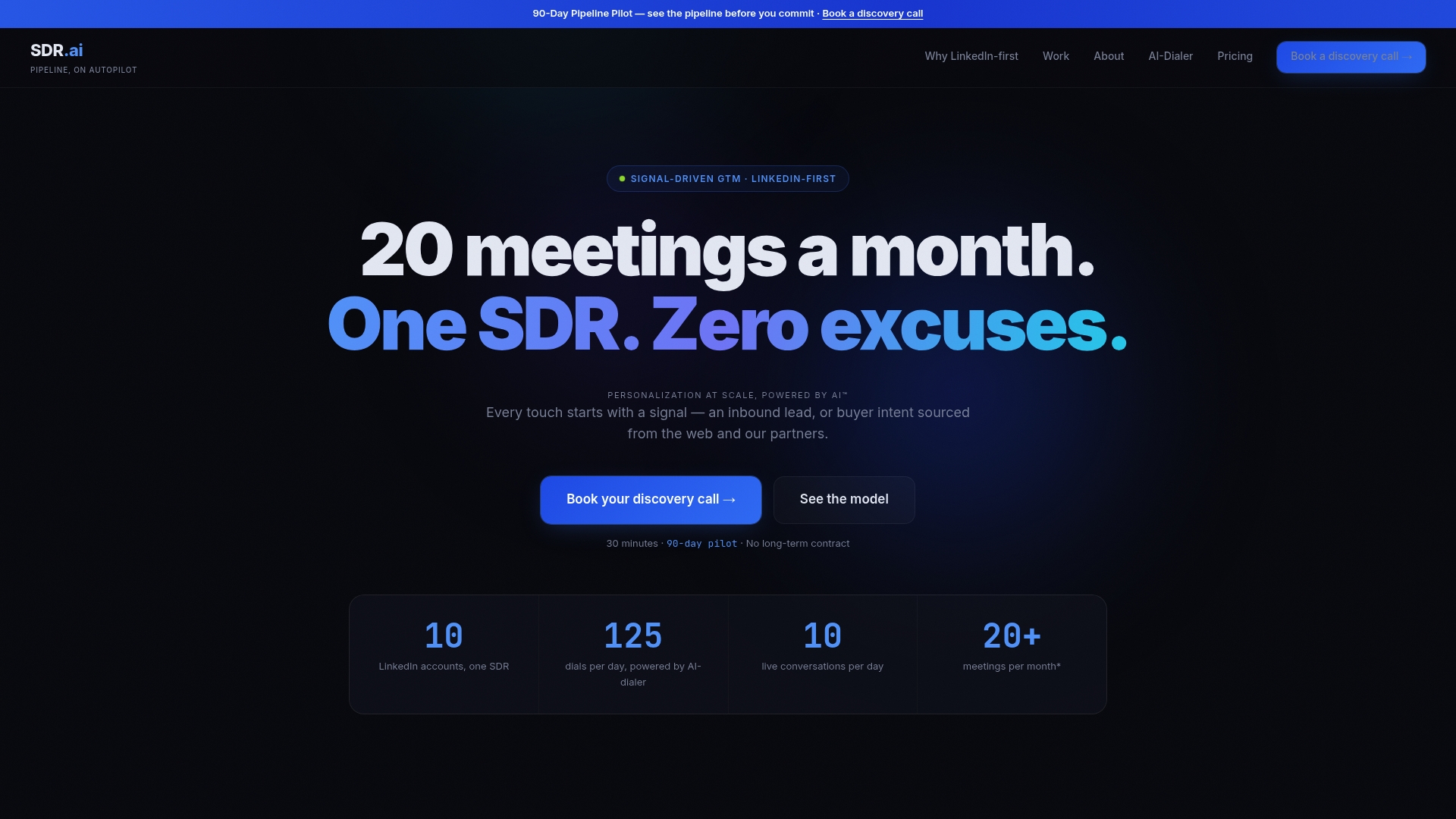
Companies using this approach report booking over 20 qualified meetings a month with a fraction of the manpower a traditional SDR team requires. It fits Series A and B teams that need the contact-to-SQL step to work reliably without hiring and ramping a full outbound bench. If your bottleneck is speed-to-first-touch or SDR bandwidth rather than lead volume, book a demo and see how the routing and enrichment layer maps onto your existing CRM setup.
Sources
- MQL to SQL Conversion Rate | KPI examples (Geckoboard)
- MQL to SQL Conversion Rate - KPI Definition & Formula (Klipfolio)